Wondering about the best things to do in Tromsø? Norway’s Arctic capital sits roughly 350 km north of the Arctic Circle, and it is the country’s premier base for two opposite kinds of magic: chasing the northern lights through the long polar winter, and living through 24-hour daylight under the midnight sun in summer. Around those, you get dog sledding, whale watching, fjord cruises, Sami culture, easy mountain hikes and a food-and-bar scene far livelier than a town of 42,000 has any right to have. Here’s everything I’d tell a friend before they booked.
I’ve come back to Tromsø in three different seasons now, and the thing I always end up explaining is that it isn’t one destination — it’s two, depending on when you land. Come between late September and early April and you’re here for snow, darkness and aurora. Come between late May and mid-July and you’re here for green mountains, blue fjords and a sun that never sets. This guide covers both, with real prices in Norwegian kroner (and rough US dollars), honest takes on what’s worth your money, and the practical details most articles skip. If you’re still deciding where Tromsø fits into a bigger trip, it pairs naturally with the rest of the things to do in Norway.

Tromsø at a Glance
Before we get into specifics, here’s the quick orientation I wish someone had handed me on my first visit.
| Detail | What to know |
|---|---|
| Where | Northern Norway, 69.6°N — over 300 km (190 mi) north of the Arctic Circle, on the island of Tromsøya |
| Population | ~42,000 in the town, ~78,000 in the wider municipality — Norway’s biggest city in the Arctic |
| Getting there | Fly into Tromsø Airport (TOS); ~2 hours nonstop from Oslo. No train reaches Tromsø. |
| Northern lights season | Roughly late September to early April |
| Midnight sun | Roughly 20 May to 22 July |
| Polar night | Roughly 27 November to 15 January (sun never clears the horizon) |
| Currency | Norwegian krone (NOK). Card and phone payments accepted virtually everywhere — you rarely need cash. |
| Language | Norwegian (and Northern Sami); English is spoken fluently almost everywhere |
| How long to stay | 3–4 days for the city and a couple of big excursions; more if you add Senja, Alta or Svalbard |
Why Visit Tromsø? The “Paris of the North”
Tromsø picked up the nickname “Paris of the North” back in the 1800s, when visitors expected a frozen fishing outpost and instead found people in proper fashion, speaking several languages, running a brewery and a busy cultural life. The wealth came from the Arctic — fish, fur and the expedition trade — and the town traded directly with Europe rather than through the south. That outward-looking, slightly cosmopolitan streak is still there. For a place this far north, Tromsø is remarkably switched-on: a real university, a serious coffee culture, good restaurants, and bars that stay loud well past midnight.
What pulls most people here, though, is nature on a dramatic scale. The town sits on a small island between the mainland mountains and the open coast, so you’re never more than a few minutes from a fjord, a peak or a beach. It is one of the most reliable places on earth to see the aurora, one of the easier places to experience genuine Sami culture, and a launchpad for some of the wildest country in Europe — Senja, the Lyngen Alps, the North Cape and even Svalbard. If you only have time for one slice of the Arctic, Tromsø is the most rewarding and the least complicated way in.
Best Time to Visit Tromsø
This is the single most important decision you’ll make, because Tromsø in January and Tromsø in June are almost unrecognisable from each other. There is no “best” time in the abstract — there’s only the best time for what you want to see. And the one thing you can’t do is combine the two headline events: the northern lights need darkness, the midnight sun is the absence of it, so you’ll never catch both on the same trip. For the bigger national picture of seasons and weather, I’d pair this with our guide to the best time to visit Norway.
Winter (October to March): northern lights and snow
This is peak season, and for good reason. From roughly late September the skies are dark enough for aurora, and by December Tromsø is properly wintry — snow on the streets, husky tours running, the harbour steaming in the cold. The trade-off is daylight, or the lack of it. During the polar night (about 27 November to 15 January) the sun never rises above the horizon, though you still get several hours of soft blue twilight around midday, which is genuinely beautiful rather than depressing. December to February is the busiest and most expensive stretch; book flights, hotels and tours well ahead.
Summer (late May to mid-July): the midnight sun
The flip side. From around 20 May to 22 July the sun simply doesn’t set, and the whole rhythm of the place changes — people hike at midnight, the cafés spill outside, and the mountains turn green and walkable. Temperatures are cool (think 12–16°C / 54–61°F), it can be grey and wet, but the light is extraordinary and the crowds are thinner than the aurora months. This is the season for hiking, kayaking, fjord trips and long drives out to Senja. Bring an eye mask — sleeping when it’s bright at 1am takes some getting used to.
Shoulder seasons (April and September–October): the sweet spot
The locals’ quiet secret. Late September into October still gives you aurora-dark nights but with autumn colour, milder weather and lower prices. April keeps the snow and the lights while the days lengthen fast. If you want the northern lights without paying December rates, aim for late September or March–April.
| Winter (Oct–Mar) | Summer (late May–mid-Jul) | |
|---|---|---|
| Headline draw | Northern lights, snow, polar night | Midnight sun, green mountains |
| Daylight | Very little (polar night Nov–Jan) | 24 hours |
| Typical high temp | −3 to −6°C (21–27°F) | 12–16°C (54–61°F) |
| Signature activities | Aurora chase, dog sledding, whale watching, snowmobiling | Hiking, kayaking, fjord cruises, road trips |
| Crowds & prices | Highest Dec–Feb | Busy but cheaper than peak winter |
| Best for | First-timers chasing the lights | Hikers, drivers, light sleepers welcome |
How Many Days Do You Need in Tromsø?
My honest answer is three to four days, or four nights if the northern lights are the point of the trip. Here’s the reasoning. The city itself — the cable car, the Arctic Cathedral, a museum or two, a good dinner — fills a comfortable day. Each big excursion (an aurora chase, a dog-sledding morning, a whale safari, a fjord cruise) eats most of another. And aurora is a numbers game: the more nights you’re under a dark sky, the better your odds, because any single night can be clouded out. Two nights is a gamble; four nights and you’d be unlucky to miss it entirely.
If you’re tighter on time, two full days will still give you the highlights and one aurora attempt — just go in knowing the lights might not cooperate. If you’ve got a week, you can fold in a far-north extension: Senja for scenery, Alta for Sami culture and the ice hotel, or a flight up to Svalbard. I’d resist trying to cram all of it in; the Arctic rewards slowing down, and the weather will make some decisions for you anyway.
Top Things to Do in Tromsø in Winter
Winter is when Tromsø does its party trick, and almost everything below runs from roughly November through March. A word on cost before we start: guided excursions here are not cheap — most sit somewhere between 1,200 and 2,700 NOK (around $110–250) per person (for a country-wide comparison of guided experiences and operators, see our Norway tours and excursions guide) — and they’re the single biggest line on a Tromsø budget. Pick two or three that genuinely excite you rather than trying to do everything.
If you are still weighing Tromsø against the alternatives, we put the three serious contenders head to head on cloud data, cost and flight access — the answer is less obvious than the marketing suggests.
See the Northern Lights
This is the reason most people come, and Tromsø is about as good a base as exists. Sitting at 69.6°N, the city is parked right under the auroral oval — the ring around the magnetic pole where the lights are most active — which means you can see a decent display even on a quiet night for solar activity. The official line from Visit Tromsø is that there’s a good chance of aurora from September until early April, and that matches my experience.
The big question is whether to join a tour or try it yourself. On a clear, active night you can absolutely see the lights from the edge of town — walk away from the streetlights toward the water and look north. But the enemy is rarely the aurora; it’s cloud. That’s the case for a “chase” tour: a guide watches the forecast and drives, sometimes for hours and occasionally all the way to the Finnish or Swedish border, to find a hole in the cloud. A typical small-group chase runs about 1,500–2,500 NOK ($140–235) and usually includes pickup, warm thermal suits, hot drinks around a fire, and the guide taking proper long-exposure photos of you under the lights. Budget bus tours start nearer 1,350 NOK ($125).
Two pieces of honesty that the tour-booking pages won’t tell you. First, no one can guarantee the aurora — it’s weather plus solar activity, and some nights simply don’t deliver, so build in more than one chance and treat a sighting as a gift rather than a given. Second, the lights often look more dramatic in photographs than to the naked eye, especially when activity is low; your camera’s sensor gathers light your eyes can’t. None of that should put you off — when a strong display goes off overhead, nothing prepares you for it — but go in with calibrated expectations. For the science, the KP index, camera settings and a deeper how-to, see our full guide to the northern lights in Norway.
Two things worth knowing before you book anything: you can do a great deal of this yourself, and the tour market is wider than it first appears. We break down the dark-sky spots you can reach on a city bus ticket, and separately compare what the NOK 990 to 2,970 spread in aurora tours actually buys you.
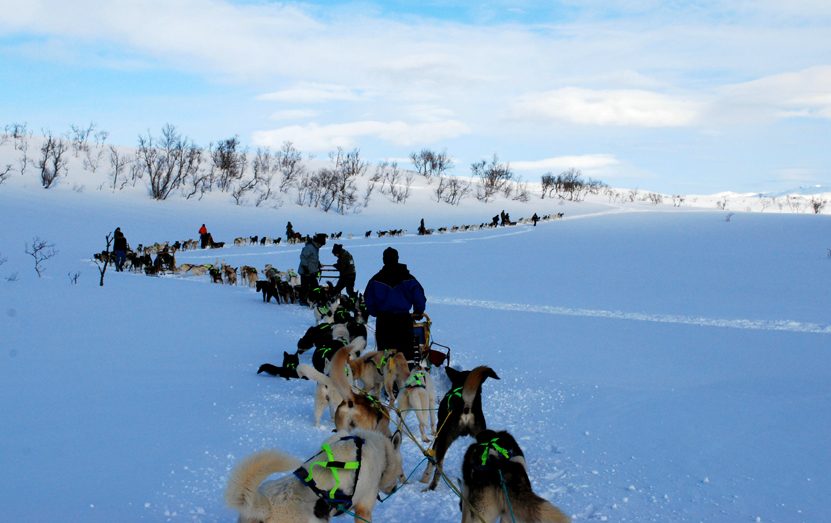
Go Dog Sledding
If you do one snow activity, make it this. Being pulled across a white plateau by a team of huskies, with nothing but the hiss of the runners and the dogs’ breathing, is the kind of thing that justifies the whole trip. Operators offer two versions: you ride as a passenger while a guide drives, or you learn to drive your own team (more expensive, far more fun). A short taster starts around 845 NOK ($79); a proper self-drive half-day with hotel transfer typically runs 1,800–2,700 NOK ($170–250), often paired with a visit to a wilderness camp like Camp Tamok and a hot meal. Cuddling the puppies afterwards is, regrettably, included at no extra charge.
Meet Reindeer and Sami Culture
Reindeer have been herded by the Sami — the Indigenous people of northern Scandinavia — for centuries, and several Sami-owned operators near Tromsø offer reindeer sledding, feeding, a meal in a lavvu (the traditional tent) and storytelling around the fire. Tromsø Arctic Reindeer, which is Sami-run, charges roughly 1,690–2,090 NOK ($158–195) depending on the length of the sled ride. My one piece of advice: choose a Sami-owned operator rather than a generic “Sami experience” bolt-on. The difference between a respectful cultural exchange and a slightly awkward bit of theatre comes down to who’s actually telling the story, and the money staying in the community matters.
Go Whale Watching
From roughly November to late January, humpback whales and orcas follow the herring into the fjords north of Tromsø, and the whale-watching season kicks off. One important caveat that trips a lot of visitors up: the whales have, in recent years, mostly gathered around Skjervøy, a couple of hours north of the city, rather than in Tromsø’s own harbour. So most tours are either a long boat day from Tromsø (6–8 hours) or a bus-plus-boat combination via Skjervøy that can run close to 12 hours. Prices land around 1,800–3,200 NOK ($170–300) depending on the boat. Where the whales are shifts year to year, so check the current situation when you book, and pick a calm day if you’re prone to seasickness — the open water up here does not mess around.
Try Snowmobiling, Snowshoeing and the Ice Domes
Beyond the headline acts, there’s a long tail of winter activities. Snowmobiling at Camp Tamok (about 90 minutes inland, where the weather is colder and clearer than the coast) runs from roughly 2,245 NOK ($210) and gets you out across frozen lakes and forest. Snowshoeing and guided winter hikes are a quieter, cheaper way to reach a viewpoint. One change to know about: the Tromsø Ice Domes, the snow hotel rebuilt inland each winter, is pausing for the 2026/27 season — if sleeping on ice is on your list, look to Alta or Kirkenes instead, and see our full guide to things to do in Norway in winter for every option. King-crab cruises, ice fishing and reindeer-spotting trips round out the menu; most can be booked the day before through Visit Tromsø or directly with operators.
Top Things to Do in Tromsø in Summer
Swap the snowsuit for hiking boots. From late May to mid-July the midnight sun is the headline, but the real gift of summer is access — the mountains are clear, the fjords are calm, and you can be outside at any hour. This is my preferred season for actually exploring, as opposed to chasing.
Experience the Midnight Sun
It sounds gimmicky until you’re standing on a summit at 11pm in full daylight, and then it reframes how you think about a day. The sun is above the horizon non-stop from roughly 20 May to 22 July, and there’s genuinely no darkness in Tromsø from late May to mid-July. Locals make the most of it with midnight hikes, late-evening boat trips and the famous Midnight Sun Marathon each June. The best free version: ride or hike up to Storsteinen near midnight and watch the sun skim along the horizon without dipping below it.
Hike from the Summit to the Sea
Tromsø’s signature summer walk goes up the mountainside behind the Arctic Cathedral via the Sherpa Stairs (Sherpatrappa) — 1,203 stone steps hand-built by Nepalese Sherpas — toward Fløya and the Storsteinen viewpoint at 421 m. It’s a proper calf-burner but doable in about 40 minutes to an hour, with the whole city and fjord opening up beneath you. The stairs are usually snow-free from June to October. If your legs object, the cable car (below) does the same climb in four minutes, and you can always walk down. For gentler options, the area around the city has several easy coastal and forest walks.
Get on the Water: Kayaking, Fjord Cruises and Fishing
Summer is fjord season. Sea-kayaking trips paddle the calm waters around the islands, sometimes timed for the midnight sun. Fjord cruises — increasingly on silent hybrid-electric boats that don’t scare off the wildlife — get you out among sea eagles and porpoises, and a sea-fishing trip is both an activity and, often, dinner. These run roughly 1,000–1,800 NOK ($95–170). The scenery out here is the same drama that makes the rest of Norway’s fjords world-famous, just with far fewer cruise ships than the south.
Relax at Telegrafbukta Beach
Yes, Tromsø has a beach, and yes, people swim — briefly. Telegrafbukta, on the southwest tip of the island, is a grassy park-and-shoreline that fills with locals barbecuing and sunbathing on the long summer evenings. The water is bracing (this is the Arctic), but on a warm June day it’s the most relaxed corner of the city and a lovely free way to spend an evening under the never-setting sun.
Things to Do in Tromsø Year-Round
These don’t care what season it is — they’re good whenever you visit.
Ride the Fjellheisen Cable Car
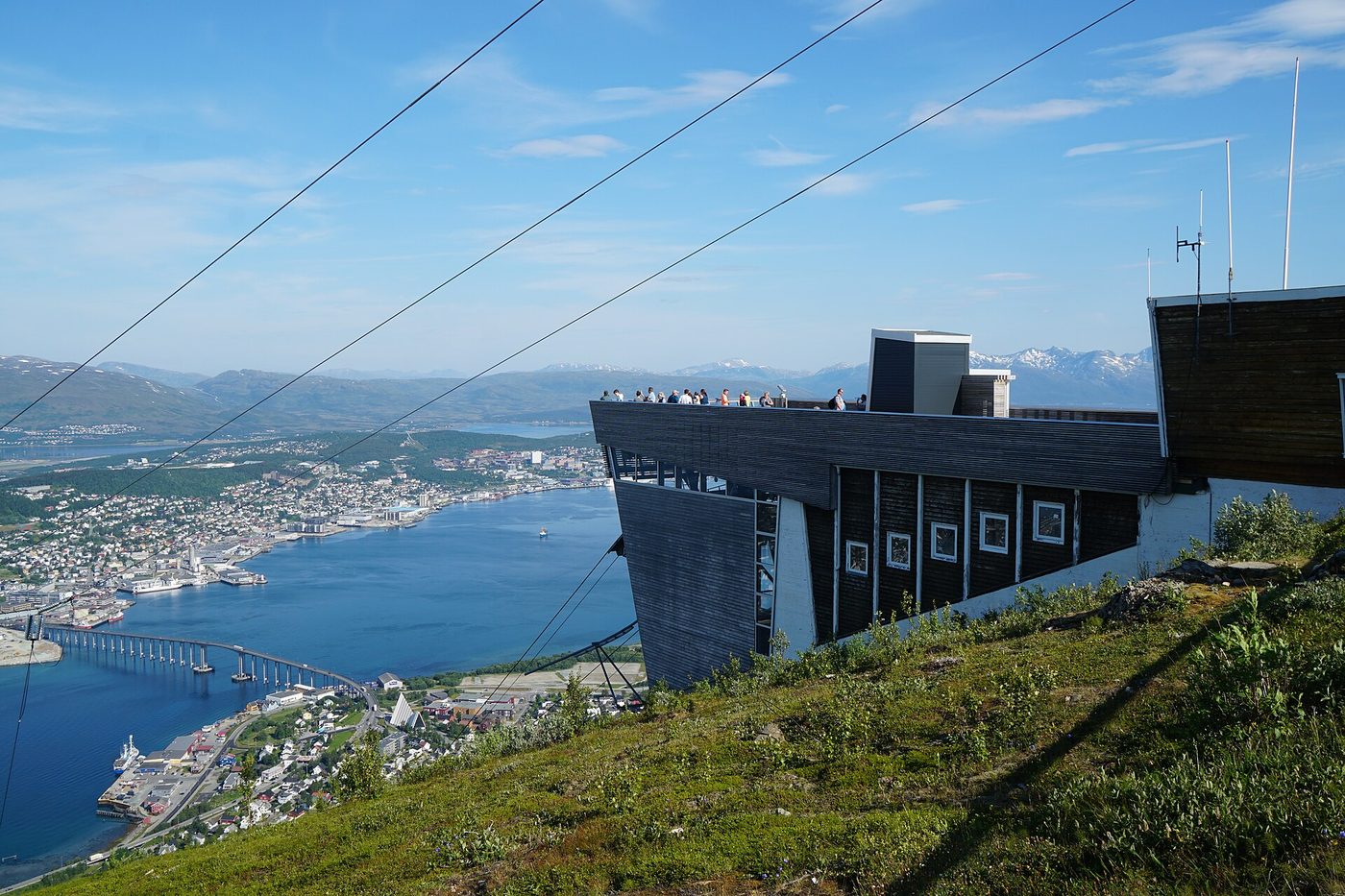
The single best-value thing in Tromsø. The Fjellheisen cable car climbs from Tromsdalen up to Storsteinen at 421 m in about four minutes, and the view from the top — the whole island city laid out below, ringed by fjord and peaks — is the postcard shot in every season. A return ticket is around 495 NOK ($46) as of 2026; there’s a café at the top, and it’s a prime spot for both the midnight sun and the aurora. Go on a clear evening and don’t rush back down. (Prices here have crept up year on year, so check the current rate before you go.)
Visit the Arctic Cathedral
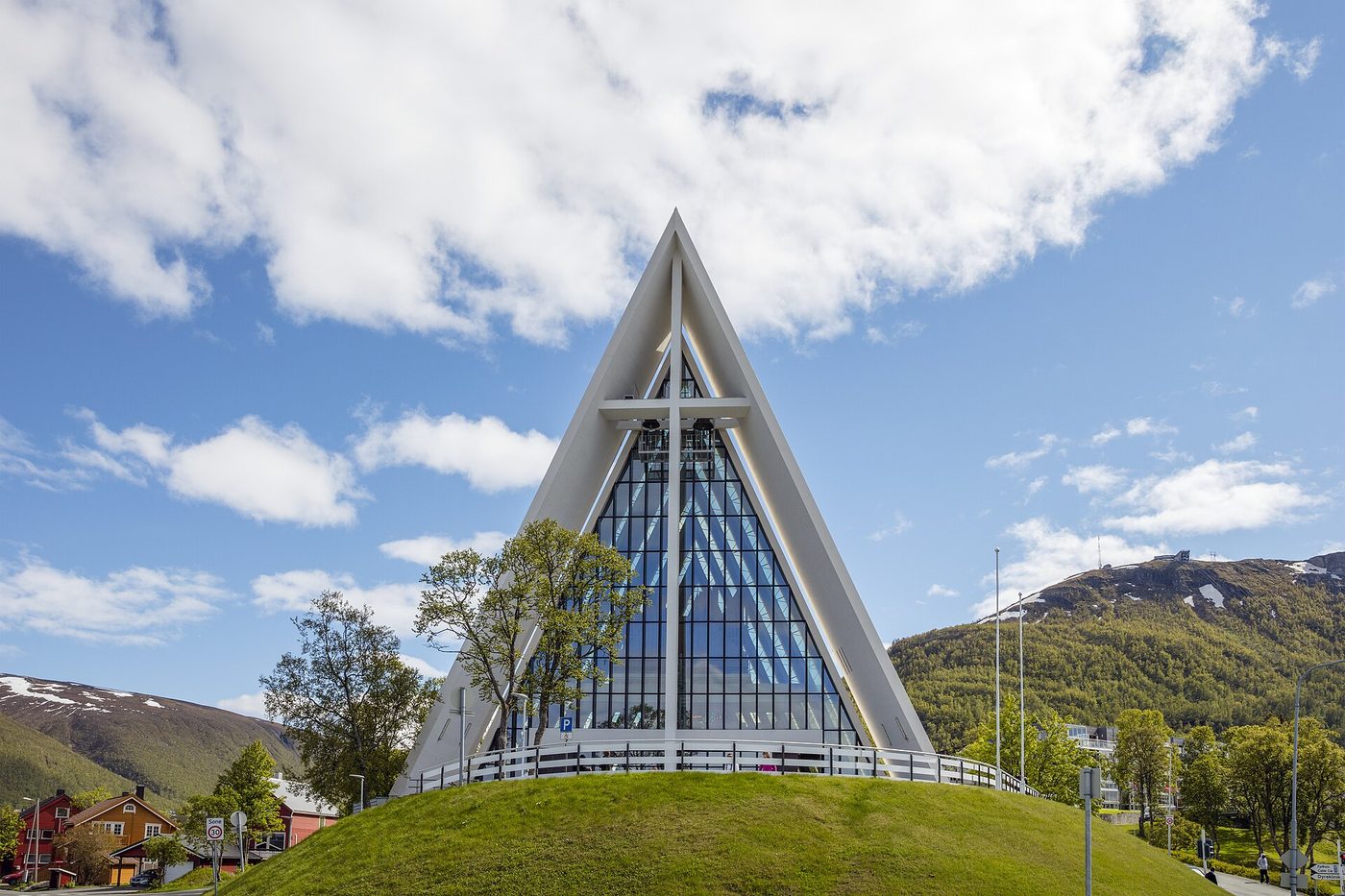
The Arctic Cathedral (Ishavskatedralen) is the white, triangular, glacier-like building you’ll see from the plane — eleven concrete A-frames clad in aluminium, finished in 1965, with an enormous stained-glass window at the eastern end. One small thing to know so you sound clever: despite the name, it isn’t actually a cathedral. It’s the parish church of Tromsdalen. The real cathedral is the wooden Tromsø Cathedral in the centre of town — Norway’s only wooden cathedral and the world’s northernmost Protestant one. Entry to the Arctic Cathedral is a modest 70–80 NOK ($7); better still, catch one of its midnight-sun or aurora concerts.
Soak in a Floating Harbour Sauna
A newer Tromsø ritual that I’m fully on board with: book a session in one of the floating saunas moored in the harbour, roast yourself, then plunge straight into the Arctic sea and yelp. It’s invigorating in the strict, slightly painful sense of the word, and a brilliant thing to do on a cold, dark winter afternoon or a bright summer evening alike. Bring a swimsuit and your dignity.
Dive into Tromsø’s Museums
For a small city, Tromsø punches above its weight on rainy-day options. The Polar Museum, in an atmospheric old customs warehouse on the harbour, tells the gripping, sometimes grim story of Arctic exploration and trapping — Amundsen, Nansen and the men who wintered alone on the ice (around 130–165 NOK / $12–15). Polaria, the world’s northernmost aquarium, has Arctic tanks, a bearded-seal pool with daily feedings, and a panoramic film (around 395 NOK / $37, which has jumped lately, so check). The Arctic University Museum and the Northern Norway Art Museum are both worth an hour if the weather turns.
Wander Downtown and the Harbour
Don’t overlook simply walking the compact centre. Storgata, the main pedestrian street, is lined with painted wooden houses, cafés and shops; the harbour is busy with fishing boats and the daily arrival of the coastal ferry. The Arctic-Alpine Botanic Garden — the world’s northernmost, free and open around the clock — is a lovely, low-key stop in the flowering months from May to October. Tromsø is eminently walkable, and half its charm is just being out in it.
Eating and Drinking in Tromsø
Tromsø eats well, and given the latitude that’s a genuine surprise. The Arctic larder is the star: reindeer (usually served as a rich stew or seared fillet), Arctic char and cod, dried stockfish, king crab, and cloudberries — the tart golden berries that grow on the tundra and turn up on every dessert menu. You’ll pay for it; a main at a casual spot starts around 200 NOK ($19) and a nice three-course dinner can run 900 NOK ($85) and up. It’s worth doing at least once.
For drinking, the institution is Mack Brewery, founded in Tromsø in 1877 and long billed as the world’s northernmost brewery — a title that’s been gently disputed since most production moved inland in 2012 and a brewery in Greenland muscled in, but Mack still brews in town and leans into the branding. The place to drink it is Ølhallen, Mack’s cellar pub from 1928 and the oldest bar in the city, with up to 72 taps. From there, Tromsø’s nightlife genuinely earns the “Paris of the North” tag — for a town this size, the bars are busy, late and friendly, especially on a dark winter weekend.
Best Day Trips from Tromsø
Some of the best of the region is a short drive from the city. These four are all doable as a day out (a rental car helps for the first three).
Kvaløya and Sommarøy
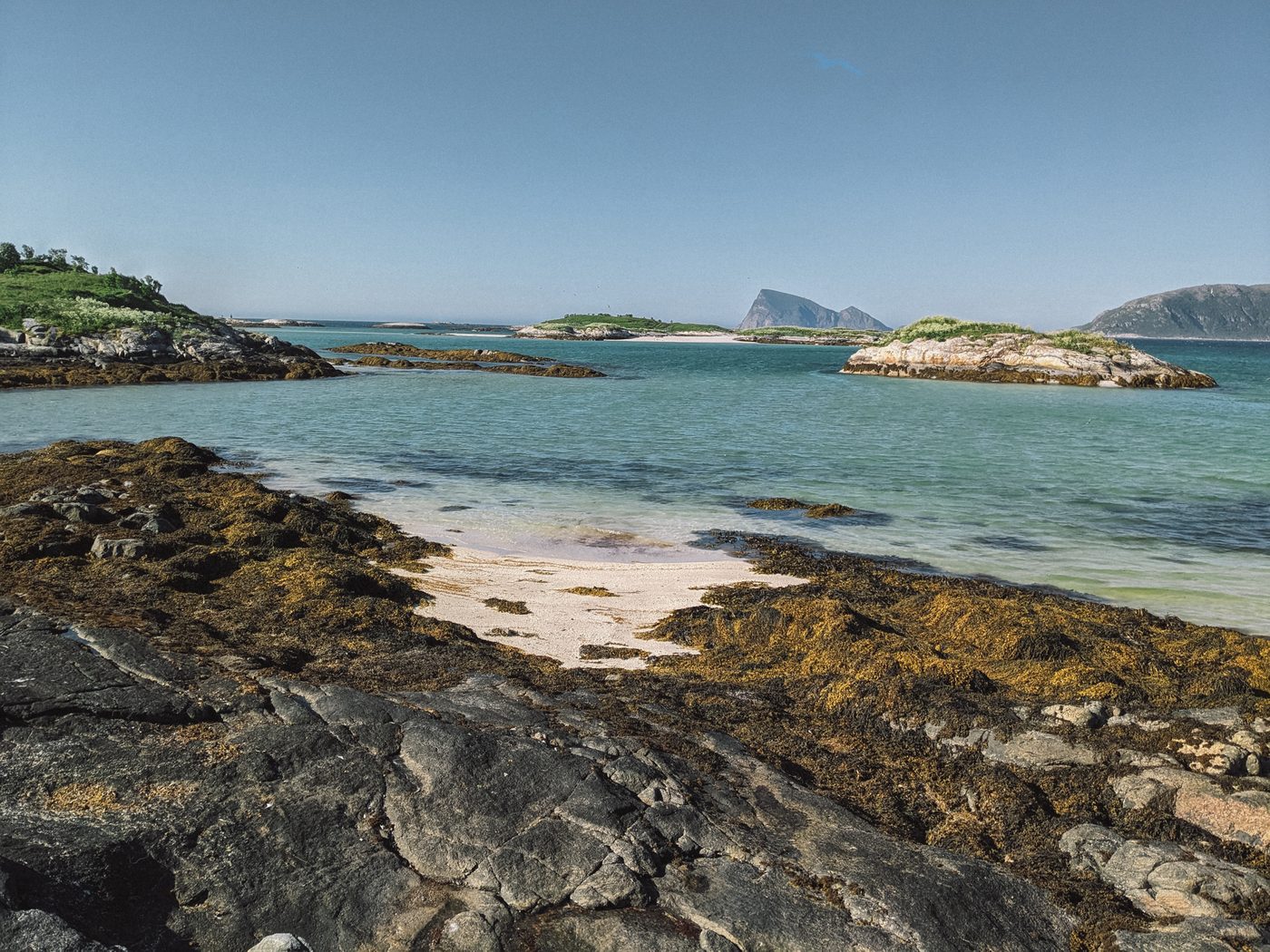
Just across the bridge west of the city, Kvaløya (“Whale Island”) is the easy escape — mountains, fjords and trailheads barely 20 minutes from downtown. Keep going to its western tip and you reach Sommarøy, a fishing village ringed by improbably white-sand beaches and turquoise water that looks tropical until you dip a toe in. On a bright summer evening it’s one of the prettiest spots in northern Norway, and a popular aurora foreground in winter.
The Lyngen Alps
East of Tromsø, across the fjord, the Lyngen Alps rise straight out of the sea in a wall of glaciated peaks. It’s serious mountain country — a magnet for ski-touring in spring and steep hiking in summer — and even if you only drive and gawk, the scenery is the most alpine in the region. Reaching the peninsula involves a ferry, so check timetables and give yourself the day.
Senja
If I could send you on only one day trip, it would be Senja. More on why below — it deserves its own section.
Going Further: Tromsø as Your Arctic Gateway
Here’s where Tromsø earns its “gateway to the Arctic” reputation. It’s the most practical base for some of the most remarkable places in Europe, whether you’ve got a spare day or a spare week. These are the far-north extensions worth building a longer trip around.

Senja: Norway’s Scenic Secret
Norway’s second-largest island, about two to three hours’ drive southwest of Tromsø, Senja is what people picture when they imagine the Lofoten Islands — jagged peaks dropping into fjords, fishing villages, white beaches — but with a fraction of the crowds. The Senja National Tourist Route between Gryllefjord and Botnhamn is the spine of it, with knockout stops: the timber boardwalk at Tungeneset facing the serrated “Devil’s Teeth” peaks, the 44-metre Bergsbotn viewing platform cantilevered over the fjord, and the iconic shark-fin summit of Segla above Fjordgård (a serious hike, often photographed from neighbouring Hesten). You can do it as a very long day trip, but Senja rewards an overnight. In summer you can shortcut the drive with the Brensholmen–Botnhamn ferry.
The North Cape (Nordkapp)
The North Cape is the famous cliff at 71°N, marketed as the northernmost point of Europe you can drive to, topped by the North Cape Hall visitor centre and its globe monument. Two honest caveats. First, it’s a long way from Tromsø — roughly 530 km to the gateway town of Honningsvåg and around an eight-hour drive to the cape itself, so this is a multi-day undertaking or a stop on a coastal voyage, not a day trip. Second, it isn’t actually the northernmost point: the neighbouring Knivskjellodden headland reaches further north (you can hike to it), and the mainland’s true tip is further east still. None of that dents the drama of standing on that cliff above the Arctic Ocean, especially under the midnight sun — just go in knowing what it is.
Svalbard
For the full High Arctic, fly two hours north from Tromsø to Svalbard, where Longyearbyen at 78°N is about as far north as you can travel on a scheduled flight. This is polar-bear country in the literal sense — there are more bears than people, and you’re not allowed to leave the settlement without protection and, sensibly, a guide. Come for glaciers, dog sledding across the ice, snowmobiling, and the strange thrill of the world’s northernmost town. You can walk up to (but not inside) the Global Seed Vault, the “doomsday” vault built into the permafrost. Fair warning: Svalbard is expensive and logistically involved — treat it as a premium add-on, not a casual side trip.
Alta and Finnmark
Inland to the east, about a 35-minute flight or a five-and-a-half-hour drive from Tromsø, Alta bills itself as the “City of the Northern Lights” — the surrounding Finnmark plateau has famously stable, clear inland skies, and the world’s first permanent aurora observatory was built nearby back in the 1920s. Alta also has the UNESCO-listed rock carvings, some up to 7,000 years old; the striking titanium-clad Northern Lights Cathedral; and the Sorrisniva ice hotel, rebuilt from snow each winter. It’s the gateway to Sami heartland towns like Kautokeino and Karasjok, and a great choice if cloud keeps spoiling your aurora luck on the coast.

A Sample Tromsø Itinerary (3–4 Days)
Here’s how I’d sequence a winter trip to balance the city, the big excursions and your aurora chances. Flip the activities for a summer version (hiking and fjord trips in place of sledding and whale watching), and you’ve got a template either way. If you want to slot this into a longer route through the country, our Norway itinerary guide shows how the north connects to the south.
Day 1 — Settle in and look up. Arrive, drop your bags, and walk the centre: Storgata, the harbour, the wooden cathedral. Ride the Fjellheisen cable car at dusk for the lay of the land. If the forecast is clear and active, you don’t even need a tour tonight — head to the water’s edge away from the lights and look north.
Day 2 — Big excursion, then chase. Use the daylight hours for a flagship activity: dog sledding or, in season, a whale safari. Rest in the afternoon, then join an evening northern-lights chase so a guide can drive you to clear skies. This is your best aurora night — protect it.
Day 3 — Culture and a second aurora shot. Slow morning, then the Polar Museum and Polaria, lunch on reindeer or king crab, and the Arctic Cathedral across the bridge. Cap it with a harbour-sauna session, then a second aurora attempt — either another tour or a self-guided spot — to bank your odds.
Day 4 (optional) — Go further. With a fourth day, rent a car for Senja or Kvaløya and Sommarøy, or take a fjord cruise. This is also your weather-insurance day: if clouds wrecked your earlier aurora nights, a flexible fourth evening is often what saves the trip.
What Does a Trip to Tromsø Cost?
No way around it: Tromsø is expensive, even by Norwegian standards, and the guided excursions are what really add up. Here’s a realistic snapshot as of 2026 (US dollars at roughly 10.7 NOK to the dollar — check the current rate, as it moves).
| Item | Typical price (NOK) | Approx. USD |
|---|---|---|
| Northern-lights chase tour | 1,350–2,500 | $125–235 |
| Dog sledding (self-drive, half day) | 1,800–2,700 | $170–250 |
| Whale-watching safari | 1,800–3,200 | $170–300 |
| Fjellheisen cable car (return) | ~495 | ~$46 |
| Museum admission | 130–395 | $12–37 |
| Restaurant main course | 200–350 | $19–33 |
| Pint of beer | 110–135 | $10–13 |
| Hotel, mid-range (per night) | 2,000–3,000 | $185–280 |
| Hostel dorm bed (peak winter) | 1,000–1,100 | $95–105 |
| City bus (single / 24-hr pass) | 48 / 137 | $4.50 / $13 |
| Taxi, airport to centre | 350–400 | $33–37 |
Add it up and a budget traveller can do Tromsø on around 1,700 NOK ($160) a day if they skip the guided tours, while a mid-range trip with a couple of excursions runs closer to 5,000 NOK ($470) a day. The excursions are the variable that matters — each one is a 1,500–2,700 NOK decision.
How to Do Tromsø Cheaper
A few tactics that genuinely move the needle. Visit in the shoulder months (late September, March–April) when hotels drop and the lights are still out. Take the airport bus instead of a taxi. Buy a 24-hour bus pass through the app rather than paying onboard. Lean on your hotel’s included breakfast and stock up at a Kiwi or Rema 1000 supermarket — a packed lunch here saves real money. Choose group tours over private ones, and prioritise one or two excursions you’ll remember rather than booking the whole catalogue. And try to see the northern lights yourself on at least one clear night before you pay for a chase.
Book Early — Everything Together
The one logistical warning I’d underline: in peak winter, Tromsø’s tours and hotels sell out, and the supply of good accommodation is genuinely tight for the demand. Book your flights, your hotel and your headline excursions at the same time, as soon as your dates are firm. Waiting until you arrive to sort out a dog-sledding spot in January is how people end up disappointed.
Know Before You Go: Practical Tromsø Tips
Getting There and Getting Around
You’ll fly in. Tromsø Airport (TOS) is about five km from the centre, with nonstop flights from Oslo in just under two hours, plus direct links to Bergen, Trondheim, Bodø and seasonal European cities. There is no train to Tromsø — the rail network stops far to the south at Bodø and at Narvik (reached via Sweden) — so it’s fly, drive or the coastal ferry. If you’re routing up from the capital, our Oslo travel guide covers the southern end of the journey. The Hurtigruten and Havila coastal voyages also call at Tromsø daily in each direction, which makes a scenic arrival or departure.
Once here, the compact centre is easily walkable, and the airport bus (Flybussen) or a city bus beats the 350–400 NOK taxi. Do you need a car? In the city, no. For Senja, Kvaløya, Sommarøy or Lyngen, a rental gives you freedom — but think twice about driving yourself in deep winter if you’re not used to ice and snow; the excursion transfers exist for a reason.
Where to Stay
Stay in or near the centre if you can — it puts the restaurants, the harbour and the tour pickups on your doorstep, which matters when it’s dark and cold. You’ll find the familiar Scandinavian chains (Scandic, Thon, Radisson, Clarion, and the budget Smarthotel) plus apartments. Harbour-front rooms cost a premium; a short walk inland is cheaper. If you’ve rented a car and want quiet and aurora-friendly darkness, a place out on Kvaløya is a fine trade-off. Whatever you choose, book early for winter — see the warning above.
What to Pack and How to Dress
In winter, layering is non-negotiable: thermal base layers, an insulating mid-layer, and a windproof, waterproof shell, plus a warm hat, proper gloves and insulated waterproof boots. The secret weapon locals swear by is a set of strap-on traction spikes (“brodder”) for the icy pavements — the streets thaw and refreeze into skating rinks. Most aurora and snow tours lend you a thermal oversuit and boots, so you don’t need to buy expedition gear. In summer, bring layers anyway (it’s cool by the sea), a rain jacket, and an eye mask for sleeping through the midnight sun.
Money, Payments and the Rules Nobody Tells You
Norway is effectively cashless — cards and phone payments work everywhere, and you can comfortably visit without touching a krone of cash. A few quirks to file away: shops keep shorter hours and many close on Sundays; alcohol stronger than light beer is sold only at the state Vinmonopolet shops, which also close early and on Sundays, so buy ahead if you want wine or spirits for the weekend; tipping is modest and not expected (round up for good service); and the tap water is excellent, so bring a reusable bottle and skip the pricey bottled stuff.
Travelling Responsibly in the Arctic
Tromsø has leaned into sustainable tourism, and a little care goes a long way up here. Stick to marked trails to protect fragile tundra, give wildlife room (especially on whale and bird trips), and take your litter with you. When it comes to Sami experiences, choose Sami-owned operators and engage respectfully — this is living culture, not a costume. The Arctic is having a moment, and keeping it worth visiting is partly on us.
More in this series
This guide is the hub for our Tromsø coverage. The pieces below go deeper than this page can:
- Tromsø in winter — the month-by-month daylight table, what the cold actually is, 2026/27 prices, and why February beats December.
- Where to stay in Tromsø — areas and hotels priced by season, whether a cabin out of town really improves your aurora odds, and the 2027 visitor levy.
- Whale watching in Tromsø — where the herring moved and the whales went with them, the 2026/27 season dates, and how much light you get.
Frequently Asked Questions
How many days do you need in Tromsø?
Three to four days is the sweet spot — enough for the city sights plus two or three big excursions, with extra nights to improve your northern-lights odds. Two days works if you’re tight, but treat aurora as a maybe. Add days for Senja, Alta or Svalbard.
Is Tromsø worth visiting?
Yes — it’s one of the most rewarding and accessible ways to experience the Arctic, with world-class northern lights in winter, the midnight sun in summer, and a surprisingly good food and bar scene year-round. The main downside is cost, which is manageable with planning.
What is Tromsø famous for?
The northern lights above all — it sits right under the auroral oval — plus the midnight sun, Sami and reindeer culture, dog sledding, whale watching, and its “Paris of the North” nickname for being unexpectedly cosmopolitan for somewhere this far north.
What is the best time of year to visit Tromsø?
For the northern lights, late September to early April. For the midnight sun and hiking, late May to mid-July. You can’t see both on one trip, since the lights need darkness. The shoulder months (late September, March–April) balance aurora odds with milder weather and lower prices.
Can you see the Northern Lights in Tromsø city centre?
Sometimes — on a clear, active night you can see them from the dark edges of town, away from streetlights, looking north. But cloud is the usual spoiler, which is why “chase” tours that drive to find clear skies are popular and often worth it.
Will I definitely see the Northern Lights?
No one can guarantee them — they depend on solar activity and clear skies. The way to improve your odds is to stay several nights (three or four) and go on a chase tour at least once. Over a multi-night winter stay, your chances are good, but never certain.
Is Tromsø expensive?
Yes, even for Norway. Guided excursions (1,500–2,700 NOK each) are the biggest cost, followed by hotels and dining. A budget day without tours runs around 1,700 NOK ($160); a mid-range day with excursions closer to 5,000 NOK ($470).
Do you need to rent a car in Tromsø?
Not for the city — it’s walkable and tours include transfers. A rental helps for day trips to Senja, Kvaløya, Sommarøy or Lyngen, but reconsider self-driving in deep winter if you’re not confident on ice and snow.
How cold does Tromsø get in winter?
Milder than you’d expect for 69°N, thanks to the Gulf Stream — daytime highs around −3 to −6°C (21–27°F), colder at night. It rarely drops below −15°C in the city. Wind and icy pavements are the bigger challenge, so dress in layers and pack traction spikes.
Is there daylight in Tromsø in winter?
During the polar night (roughly 27 November to 15 January) the sun never rises above the horizon, but you still get a few hours of soft blue twilight around midday. It’s atmospheric rather than pitch-black, and the darkness is exactly what makes the aurora visible.
Final Thoughts: Is Tromsø Worth It?
For my money, Tromsø is the most rewarding way to step into the Arctic without it becoming an expedition. You fly in, and within a day you can be standing under the northern lights, mushing a husky team, or watching the midnight sun roll along the horizon — and then be back in town for a plate of reindeer and a local beer that night. It’s wild and civilised at the same time, which is a rare combination. Yes, it’s expensive, and yes, the weather and the aurora will do as they please. But plan for a few days, pick your excursions with care, dress properly, and Tromsø delivers the kind of trip you find yourself talking about for years. Go north.
About This Guide
This guide was written and fact-checked by the Norway Tourism Guide editorial team, drawing on repeat visits to Tromsø across different seasons and on current information from Visit Tromsø, Visit Norway and local operators. Prices are in Norwegian kroner with approximate US-dollar conversions and reflect 2026 rates — always confirm current prices and opening times before you travel, as Arctic tourism is seasonal and costs change. Spotted something out of date? We update our guides regularly.
Last updated: June 2026
Sources and Further Reading
- Visit Tromsø — official destination site (northern lights, midnight sun, attractions, FAQ): visittromso.no
- Visit Norway — Tromsø, Senja, Alta and the North Cape: visitnorway.com
- Fjellheisen cable car — tickets and hours: visittromso.no/cable-car
- Polaria — the world’s northernmost aquarium: polaria.no
- Senja National Tourist Route: nasjonaleturistveger.no
- Visit Svalbard — Longyearbyen and the High Arctic: visitsvalbard.com
An Arctic trip takes a bit more planning than a city break — our Norway travel tips guide covers the essentials, from money to what actually belongs in your bag.
Photo Credits
- Northern lights over Tromsø, one of the best things to do in Tromsø in winter — Photo: Adithya Ananth hashinclude (CC0) via Wikimedia Commons. Source
- Dog sledding with a team of huskies across the snow, a classic Arctic Norway winter excursion — Photo: User: (WT-shared) Osopolar at wts wikivoyage (public domain) via Wikimedia Commons. Source
- White-sand beaches and turquoise water at Sommarøy near Tromsø in the Arctic summer — Photo: Evgenii Salganik / CC BY-SA 4.0 via Wikimedia Commons. Source
- The triangular white Arctic Cathedral (Ishavskatedralen) in Tromsø, Norway — Photo: Godot13 / CC BY-SA 4.0 via Wikimedia Commons. Source
- The Fjellheisen cable-car station and the panoramic view over Tromsø from Storsteinen — Photo: Olivier Bruchez / CC BY-SA 2.0 via Wikimedia Commons. Source
- Dramatic jagged peaks on Senja island near Tromsø in Arctic Norway — Photo: Ximonic (Simo Räsänen) / CC BY-SA 4.0 via Wikimedia Commons. Source
- Colourful buildings and the wooden Tromsø Cathedral in the city centre — Photo: Diego Delso / CC BY-SA 4.0 via Wikimedia Commons. Source