Last updated: June 2026
I’ve stood at the rail of a coastal steamer at 11pm in full daylight, watched a 5,000-passenger megaship squeeze into a fjord narrower than its own length looks from deck, and puttered down the Nærøyfjord on an electric boat so quiet I could hear a waterfall half a mile away. Here’s the thing nobody tells you before you book: those are three completely different holidays, and they’re all sold under the same two words.
A Norway fjord cruise comes in three forms: a 7–14 night big-ship cruise from the UK or Europe (from around £700/$900pp), the 12-day Hurtigruten or Havila coastal voyage from Bergen to Kirkenes (from around $1,900–$2,700pp), or land-based day cruises on the fjords themselves (from around NOK 600/$55). Which one suits you depends on time, budget, and how close to the water you want to be.
I’ve written this guide to walk you through all three honestly — including the stuff the brochures gloss over: the 2026 zero-emission rules that quietly reshuffled itineraries, what a “fjords cruise” from Southampton actually shows you, why Havila exists and when it beats Hurtigruten, and what the whole thing really costs once you add excursions and drinks.

Norway Fjord Cruise Options at a Glance
Start here. This table is the decision I help friends make over one coffee, compressed:
| Cruise type | Duration | Typical 2026 price (pp) | What you see | Best for |
|---|---|---|---|---|
| Big-ship fjords cruise (P&O, MSC, Princess, Cunard, NCL…) | 7–14 nights, usually round trip from Southampton | From ~£700–900 inside cabin; balconies ~£1,200+ | 3–5 fjord ports (Stavanger, Olden, Ålesund, Haugesund, sometimes Geiranger or Flåm) | First-timers, families, no-fly travelers, resort comforts |
| Coastal voyage (Hurtigruten / Havila) | 12 days round trip Bergen–Kirkenes (or 6–7 days one way) | From ~$1,900–$2,700; winter sailings cheapest | 34 ports, the entire coastline, Arctic Norway, Lofoten, North Cape region; aurora in winter | Scenery obsessives, photographers, second visits, winter aurora hunters |
| Day fjord cruises (Nærøyfjord, Geiranger, Lysefjord) | 1.5–3.5 hours each | NOK 600–960 (~$55–90) per cruise | One spectacular fjord, up close, on (mostly) electric boats | Independent travelers building their own Norway itinerary |
Three Very Different Things Are Sold as a “Norway Fjord Cruise”
Before you compare prices, make sure you’re comparing the right product. I’ve met people on big ships who thought they’d booked the coastal voyage, and coastal-voyage passengers who expected a casino and a kids’ club. Both were disappointed for no good reason.
Option 1: The big-ship cruise — a floating resort that visits fjords
This is the classic “Norwegian Fjords” itinerary: a 7-night round trip from Southampton (or Hamburg, Kiel, Copenhagen) on ships like P&O’s Iona, MSC Virtuosa, or Sky Princess. You spend two sea days crossing the North Sea, then call at three to five ports — typically Stavanger, Olden, Ålesund, Haugesund, sometimes Hellesylt or Flåm.
The appeal is obvious: it’s cheap per night (I’ve seen inside cabins on MSC spring sailings from around £513, and P&O from about £726 as of 2026), there’s no flight, and the ship itself is the holiday — pools, shows, a dozen restaurants. The fjord sail-ins are spectacular, and you’ll do them in daylight because it barely gets dark in summer.
The catch: you see a thin slice of fjord Norway on a fixed clock. Port calls run roughly 8am–5pm, the famous fjords are shared with several thousand shipmates, and — this matters since 2026 — some itineraries that used to sail Geirangerfjord now don’t. More on that below.
Option 2: The coastal voyage — Hurtigruten and Havila’s Bergen–Kirkenes route
This is not a cruise in the resort sense. It’s Norway’s working coastal route — running since 1893 — carrying travelers, locals, and cargo to 34 ports between Bergen and Kirkenes, far above the Arctic Circle. The full round trip takes 12 days and covers about 2,500 nautical miles.
You’re sailing the actual coastline the whole time, not crossing open sea to reach it. You’ll see the Lofoten Islands, the Arctic cathedral towns, fishing villages no big ship can enter, and — from late September to late March — some of the best northern-lights viewing on Earth. Both operators are so confident they offer an aurora promise: no lights on a qualifying winter voyage, free 6/7-day voyage on them.
The trade-offs are real. Many port stops are 15–45 minutes (the ship is delivering cargo, not waiting for you), entertainment is lectures and landscape rather than production shows, and excursions cost extra. It’s also pricier than a big-ship deal: as of 2026 the 12-day round trip starts around $1,900–$2,700 depending on season.
Option 3: Day cruises — the fjords up close, on your own schedule
The third option is the one most cruise articles ignore: skip the multi-night ship entirely, base yourself on land, and do the fjords by day boat. The Flåm–Gudvangen cruise through the UNESCO-listed Nærøyfjord runs on silent all-electric vessels for around NOK 550–625 one way (about $55). Geiranger’s new hybrid-electric sightseeing catamaran runs 2-hour cruises from NOK 610. Stavanger’s Lysefjord cruise under Pulpit Rock costs NOK 890.
Pair those with the great fjords themselves, scenic trains, and a rental car, and you’ve built a fjord trip with more freedom than any ship allows. That’s a different article — our Norway itinerary and road trip guide covers it — but I’ll give you the day-cruise essentials further down, because even big-ship passengers end up booking these from port.
The Fjords You’ll Actually Sail
“The fjords” is a big claim — Norway has over a thousand. These are the ones that matter for cruising, and what each is like from the water. For the full deep-dive on geology, hikes, and villages, see our complete guide to the Norwegian fjords.
Geirangerfjord — the postcard
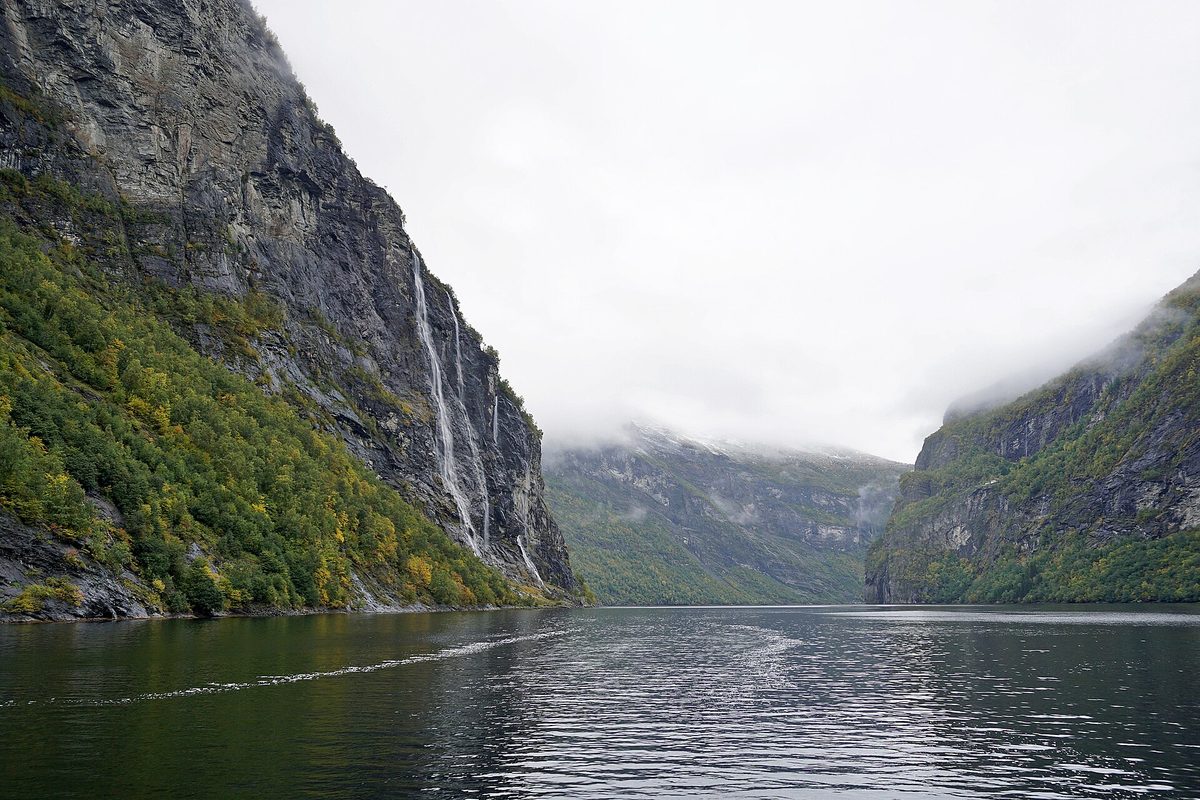
Fifteen kilometers of near-vertical rock, the Seven Sisters waterfall dropping 250 meters down one wall, abandoned farms clinging to ledges. Geirangerfjord is UNESCO-listed and earns it. The sail-in is the single best hour of most big-ship itineraries — set an alarm, because ships often enter between 5:30 and 7am. Hurtigruten’s coastal ships detour in from June to August; Havila sails it from April. Check your specific itinerary, though — the emission rules are changing who gets to come in here (next section).
Nærøyfjord — the narrow one
The other half of the UNESCO listing, and my personal favorite. At its tightest the Nærøyfjord is about 250 meters wide, with walls rising over a kilometer. Big ships can’t meaningfully enter; you do it on the electric day boats between Flåm and Gudvangen. If your cruise calls at Flåm, this is the excursion to take — and you can book it independently for less than the ship charges. Our guide to the best Norway tours and excursions compares every bookable fjord experience — RIB safaris, glacier walks, kayak trips — with current prices.
Sognefjord — the king
Norway’s longest and deepest fjord — 204 km long, 1,300 m deep. Cruise ships transit its outer reaches en route to Flåm or Skjolden, and the scale is hard to process: the walls keep going underwater more than a kilometer down. The Nærøyfjord and Aurlandsfjord are both its arms.
Hjørundfjord — the connoisseur’s choice
South of Ålesund, flanked by the jagged Sunnmøre Alps, and blissfully under-visited. The coastal ships swap Geiranger for Hjørundfjord in autumn (Hurtigruten in spring and autumn, Havila September–October), and honestly? Plenty of crew members prefer it. Fall colors against 1,500-meter peaks, almost no other traffic.
Lysefjord — the dramatic day trip
Best seen from Stavanger: a 3–3.5 hour cruise (around NOK 890 as of 2026) that sails directly beneath Preikestolen, the Pulpit Rock, looming 604 meters overhead. Big ships pass the entrance; the day boat gets you underneath it.
Trollfjord — the party trick
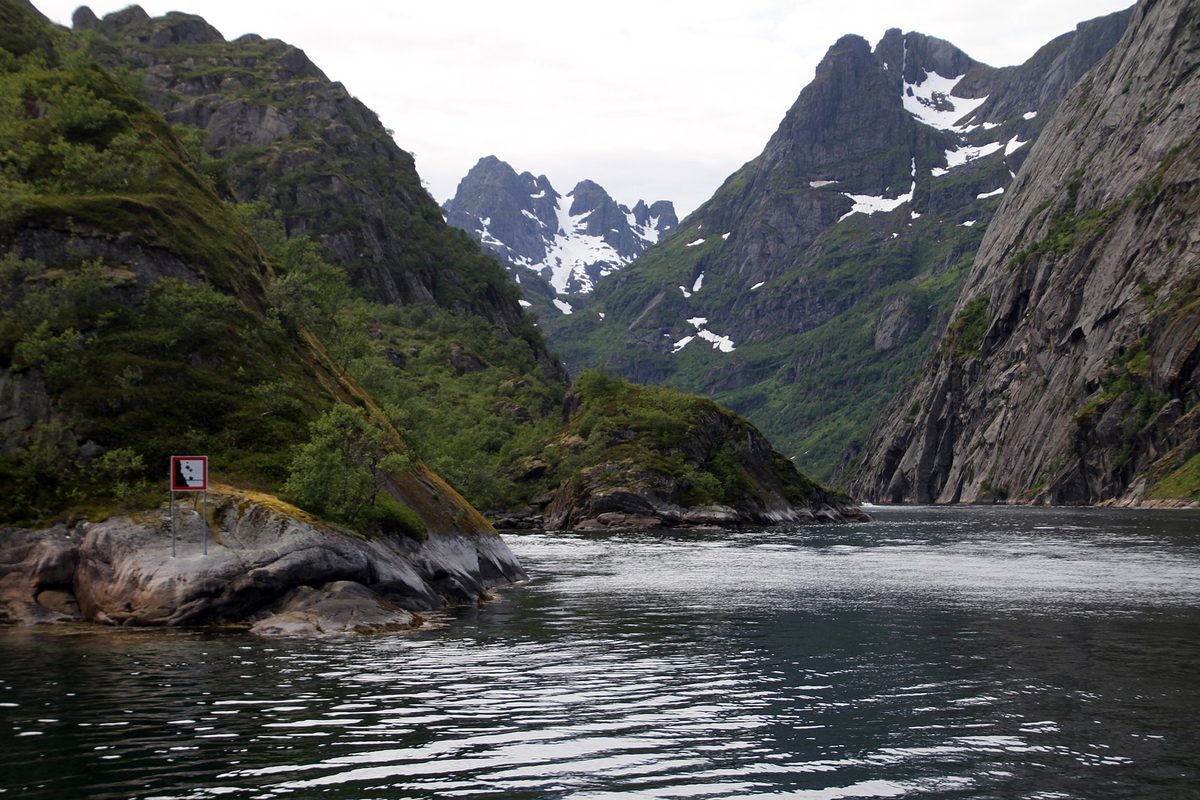
Only the coastal voyage gives you this one. The Trollfjord, between the Lofoten and Vesterålen islands, is 2 km long with an entrance roughly 100 meters wide — the ship slides in, pirouettes on the spot, and slides back out while everyone films from the bow. Weather permitting, and usually not from November to March (avalanche risk along the walls is real). It’s a highlight of the southbound leg, right in the territory covered by our Lofoten Islands guide.
Two of these fjords now have guides of their own: a full breakdown of Geirangerfjord, which untangles the car ferry from the sightseeing cruise, and a shortlisting guide to picking between the big five if you have not settled on one yet.
The 2026 Zero-Emission Rules: Why Your Cruise Might Skip Geiranger
This is the section I’d want to read before booking anything, because it’s current, confusing, and the cruise lines aren’t volunteering it.
Since January 1, 2026, passenger ships under 10,000 gross tons must run emission-free — no direct CO2 or methane — inside Norway’s World Heritage fjords: the Geirangerfjord and Nærøyfjord, plus their approach fjords. Battery-electric qualifies; LNG does not. From January 1, 2032, the same rule hits ships of 10,000 GT and above — which means essentially every conventional cruise ship afloat.
What that means in practice, as of 2026:
- Big ships can still sail Geirangerfjord — the large-ship deadline was pushed to 2032, and the 2026 season has 80+ scheduled calls from lines like MSC, AIDA, Celebrity, and Costa. But lines are already reshuffling: some itineraries now substitute Hellesylt, Olden, or Ålesund. If Geiranger is the reason you’re booking, check the itinerary port list, not the brochure photo.
- The small boats are already electric. The Nærøyfjord day fleet (Future of the Fjords and its siblings) is battery-powered, and Geiranger launched a new hybrid-electric sightseeing catamaran for 2026 to meet the rules.
- Havila has a genuine edge here: its ships carry battery packs of about 6.1 MWh — among the largest ever installed on a passenger ship — and sail the Geirangerfjord on battery power alone, silently and emission-free, for up to four hours. Hurtigruten’s coastal ships, being over 10,000 GT, are exempt until 2032.
- Looking ahead: expect more big-ship itineraries to quietly drop Geiranger as 2032 approaches, unless lines deploy zero-emission-capable tonnage. Book it sooner rather than later if it’s on your list.
One more 2026 change worth knowing: Norway’s parliament approved a 3% tourist tax that municipalities can levy on overnight stays and cruise day-visitors from summer 2026. It’s opt-in and rolling out hotspot by hotspot — expect a few extra kroner on bills in places like Tromsø and the Lofotens. Not a dealbreaker, just don’t be surprised.
Hurtigruten vs Havila: The Coastal Voyage, Properly Explained
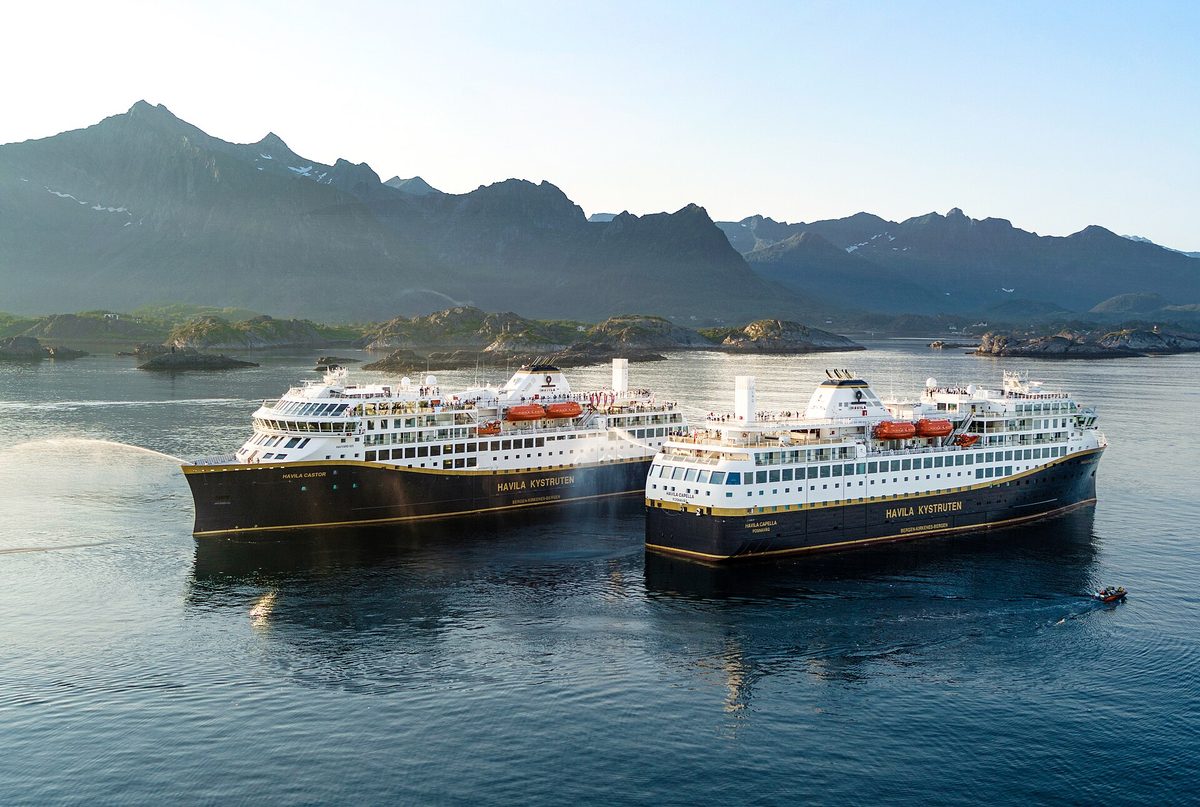
For over a century the Bergen–Kirkenes route was Hurtigruten’s alone. Since 2021, Havila Voyages has run four ships on the same route under the same government contract — same 34 ports, same fjord detours, same daily rhythm. So the real question isn’t “which route” (identical) but “which ship culture.”
What’s the same
Both sail year-round, Bergen to Kirkenes and back in 12 days, calling at 34 ports — some for hours (Trondheim, Bodø, Tromsø), many for 15–45 minutes while cargo and locals come and go. Both detour into the Geirangerfjord in summer (Havila from April) and the Hjørundfjord in autumn, and attempt the Trollfjord southbound when weather allows. Both include full board and Wi-Fi, sell excursions separately, and back winter sailings with a northern-lights promise: if the aurora doesn’t show on a qualifying voyage (Hurtigruten: 11+ days departing Sept 20–Mar 31; Havila: 12-day round trips Oct–Mar), you get a free 6/7-day voyage to try again.
Where they differ
| Hurtigruten (Coastal Express) | Havila Voyages | |
|---|---|---|
| Ships | 7 ships, built 1990s–2000s, refurbished; characterful, varied | 4 identical ships (2021–23), ~640 guests, modern Nordic interiors |
| Environment | Conventional propulsion (exempt from fjord rules until 2032) | LNG-battery hybrid; sails Geirangerfjord 100% emission-free on batteries |
| Food | Buffet-style mains in Torget, fine dining in Kysten (extra/Platinum) | No buffets at all — à la carte in Havrand, menus rotate with the coastline |
| Heritage | The original, since 1893; expedition teams, 10–15 lectures per voyage | The newcomer; quieter ships, bigger standard cabins |
| 2026 price, 12-day round trip | From ~$2,690 (lowest ~$1,883 in December) | Broadly similar; winter sailings from ~$1,500–2,000; frequent solo deals |
| Premium option | Signature line: all-inclusive ships (Trollfjord, Midnatsol from summer 2026), Svalbard & North Cape lines from ~$4,100–5,100 | None — one product, four fare/cabin levels |
My honest read: pick Havila if you care about the newest hardware, quieter sailing, table-service food, and the only emission-free Geirangerfjord transit on the route. Pick Hurtigruten if you want the heritage, a bigger excursion program, more departure flexibility (seven ships vs four), or the premium Signature option. Nobody I’ve met regretted either; the coastline does most of the work.
What a coastal voyage day actually feels like
People imagine cruising; the reality is closer to a moving mountain lodge. You wake to a fjord, eat breakfast watching fishing boats, dock somewhere like Bodø for two hours, walk into town, come back, read, watch the coast scroll past, attend a lecture about Sami culture, eat dinner, and realize at 11pm the sun is still up — or, in winter, that the sky has gone green. The Arctic Circle crossing comes with a ceremony involving ice water down your collar. It’s gloriously unglamorous.
Port time is the thing to manage. The long calls — Trondheim (~3 hours), Tromsø, Kirkenes — are where the headline excursions happen: dog sledding out of Tromsø (about 3.5 hours, Nov–Mar), the North Cape trip from Honningsvåg (~3 hours), a snowmobile or king-crab safari in Kirkenes. Budget NOK 1,000–4,000 ($100–400) per excursion as of 2026, and book the popular ones before you board.
Big-Ship Norwegian Fjords Cruises: Lines, Prices, and Honest Trade-offs
If you’re sailing from the UK, the maths is compelling. As of 2026, 7-night fjords cruises from Southampton start around £513–726 per person inside (MSC Virtuosa and P&O Iona spring departures), roughly £848 on Sky Princess, with Cunard’s Queen Anne and a clutch of others above that. From the US, you’ll typically fly into London or Copenhagen, or take NCL’s longer Norway-plus-Iceland routings (10–11 nights, from around $1,589).
A quick field guide to who’s who, as of 2026:
- P&O (Iona): the volume play — a 5,200-passenger ship doing fjords on repeat all summer. Excellent value, busy ports. The Olden call puts you near the Loen Skylift, which I’d take over almost any ship excursion.
- MSC (Virtuosa): frequently the cheapest big-ship fjord fare going; style is glossy European, announcements multilingual.
- Princess and Cunard: the classic mid-premium choices; Cunard adds white-glove theatre to the whole thing and overnights in some ports.
- Royal Caribbean, NCL, Disney: fewer dedicated fjord loops, often folded into bigger North Sea/Iceland routings; Disney Dream ran fjords from Southampton in August 2026.
- Fred. Olsen and Viking: smaller ships that fit further up the fjords and feel closer to the landscape; you pay for the intimacy.
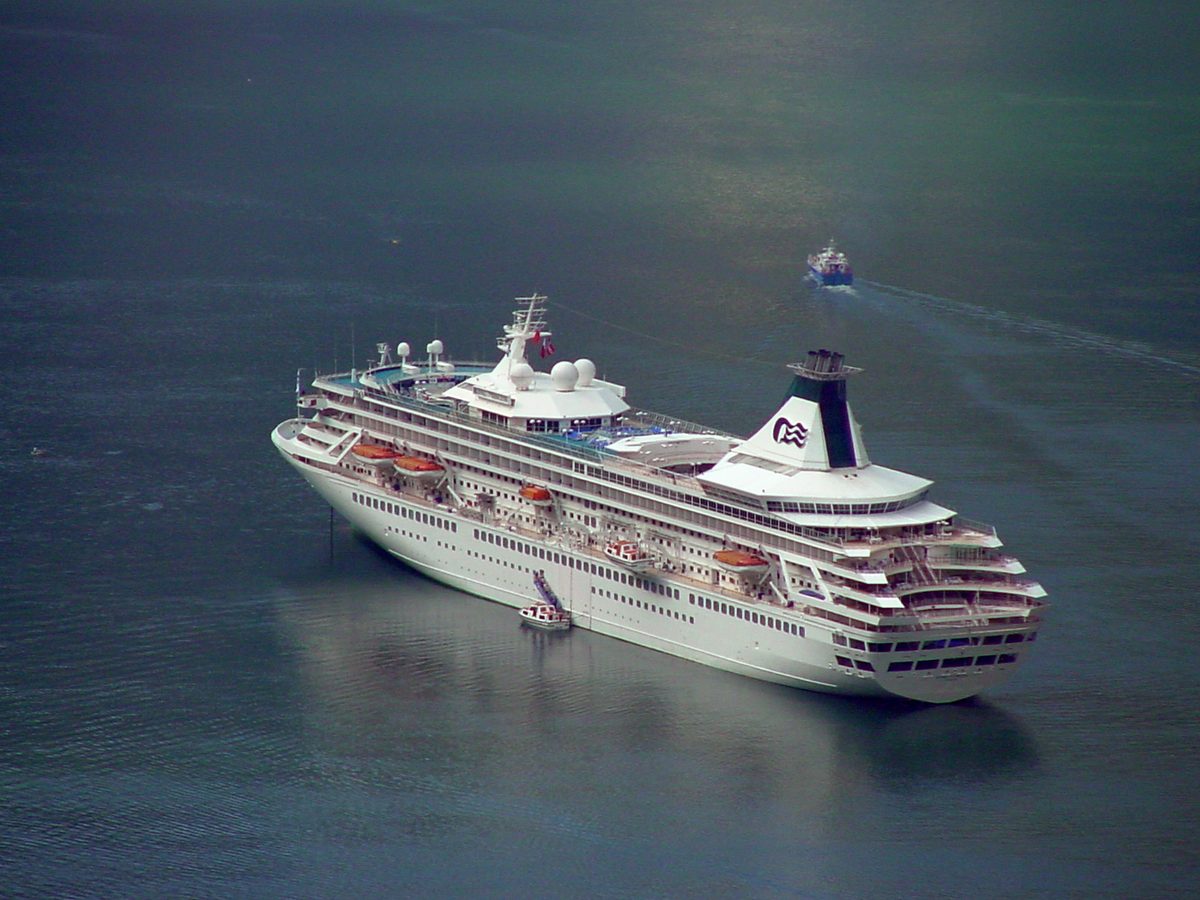
What the brochures undersell: two of your seven nights are open-sea crossings (pack seasickness tablets; the North Sea has opinions), port days run on the ship’s clock not yours, and the headline fjord may be a tender port — at Geiranger, a floating SeaWalk pier takes one ship at a time and everyone else anchors and tenders. None of this makes it a bad holiday. It makes it a ship holiday with fjord views — and for a first look at western Norway with kids or non-hikers in tow, it’s hard to beat the price.
Day Fjord Cruises: The Short, Spectacular Ones
Even if you never set foot on a multi-night ship, you can cruise Norway’s best fjords for the price of a nice dinner. These are the three I send people to first — all bookable independently, all running on quiet electric or hybrid boats as of 2026.
Bergen is the trickiest starting point of the lot, because four operators sail from four separate quays inside about 400 metres and none of them reaches a World Heritage fjord. We map every boat to its departure pier, with 2026 fares and an honest note on what water you are actually on.
Flåm–Gudvangen through the Nærøyfjord
The best two hours on Norwegian water. The route runs down the Aurlandsfjord and through the UNESCO Nærøyfjord on all-electric, carbon-fiber vessels — Future of the Fjords and Legacy of the Fjords — that glide so quietly you hear goats on the shore farms. Around NOK 550–625 one way, NOK 950–960 round trip as of 2026, up to four daily departures in high season, year-round service. Combine it with the Flåm Railway and you’ve recreated the core of the famous Norway in a Nutshell route on your own terms.

Geirangerfjord sightseeing cruise
From Geiranger village, a 1.5–2 hour cruise past the Seven Sisters, the Suitor, and the abandoned cliff farms — from NOK 610 adult as of 2026, kids half price. New for 2026 is the hybrid-electric catamaran MS Geirangerfjord III, built specifically to meet the World Heritage emission rules. If you’re fit, ask about the Skageflå farm drop-off: they put you ashore at the base of the cliff path and you hike back to the village (a stiff, wonderful 4–5 hours).
Lysefjord from Stavanger
Rødne’s electric catamaran leaves from Stavanger’s old harbor: 3–3.5 hours, NOK 890 adult, sailing right under the Preikestolen overhang with a pause at Hengjanefossen waterfall. On a cruise port day it fits comfortably; independent travelers can do the cruise-plus-Pulpit-Rock-hike combo (about NOK 1,415, 8–9 hours) instead.
For the short trips specifically — every hub in Norway, fares in kroner and season dates — we have a dedicated guide to fjord day boats and sightseeing cruises.
Svalbard and Expedition Cruises: The Serious Arctic
One step beyond the coastal voyage sits expedition cruising — smaller ships, zodiac landings, naturalists instead of lectures-from-a-distance. The flagship trip is circumnavigating Svalbard, the polar archipelago a 90-minute flight north of Tromsø: think polar bears on pack ice, walrus haul-outs, bird cliffs with a hundred thousand residents, and sailing above 80°N if the ice allows.
The season is short — roughly May to September — and the prices are a different sport: as of 2026, HX (the former Hurtigruten Expeditions) sells 11-day Svalbard circumnavigations from around $8,100 per person, with Lindblad–National Geographic, Quark, and Ponant in the same bracket from roughly £6,400. A cheaper taste: Hurtigruten’s Signature “Svalbard Line” sails Bergen–Longyearbyen along the whole coast, 15 days from about $5,073, June through September.
Is it worth it? If wildlife is the point of your trip, yes, and nothing else on this page substitutes. If you mainly want fjords and coastline, the classic coastal voyage delivers 80% of the scenery for a third of the money. We cover the far north in more depth in our Tromsø & Arctic Norway guide.
Best Time for a Norway Fjord Cruise, Month by Month
There’s no single best month — there’s a best month for what you want. The honest version, refined by getting rained on in most of them (Bergen records rain on roughly 200 days a year; pack accordingly). For the full seasonal picture beyond cruising, see our month-by-month seasons guide.
| Month | Big ships? | Coastal voyage highlights | Weather reality | Crowds & prices |
|---|---|---|---|---|
| Jan–Feb | No | Aurora prime time, polar night blues, promise applies | Cold, rough open-sea stretches possible | Cheapest fares of the year |
| Mar | No | Aurora season ends late March; lengthening days | Wintry north, brightening south | Low prices, few tourists |
| Apr | First sailings | Havila starts Geirangerfjord detours; snow-capped drama | Changeable; waterfalls waking up | Quiet, good value |
| May | Yes | Peak waterfalls, blossom in the fjords, midnight sun begins up north (~May 14 at North Cape) | Often the driest, clearest window | Moderate; my pick for value-vs-conditions |
| Jun–Jul | Peak | Hurtigruten resumes Geiranger detour; 24-hour daylight above the Arctic Circle | Mild (10–20°C); rain showers normal | Maximum crowds and prices; Geiranger can see ~8,000 visitors in a day |
| Aug | Peak | Warmest sea, long days (midnight sun ends late July) | Warm but wetter late month | Busy until school terms resume |
| Sep–Oct | Last sailings Sep/Oct | Hjørundfjord detour, autumn colors, first auroras (~Sep 20) | Storm risk rises; moody light | Prices fall, ports calm down |
| Nov–Dec | No | Aurora, polar night from ~Nov 21, Christmas sailings | Dark, dramatic, occasionally rough | Very cheap (Hurtigruten from ~$1,883 in Dec) |
Two seasonal truths worth repeating. First: you cannot see the northern lights on a summer cruise — the sky never gets dark enough above the Arctic Circle between May and late July. If aurora is the goal, book the coastal voyage between late September and late March, and read our northern lights in Norway guide first. Second: summer’s midnight sun is the consolation prize that turns out to be a headline act — standing on deck at midnight in golden light is something photos keep failing to convey.
What a Norway Fjord Cruise Really Costs in 2026
Cruise pricing is designed to be compared on the headline fare. Don’t. Here’s the all-in arithmetic I’d actually budget, per person, as of 2026 — assume a couple sharing.
| Cost line | Budget big-ship week (MSC/P&O inside) | Premium big-ship week (balcony, Princess/Cunard) | 12-day coastal voyage (Hurtigruten/Havila) |
|---|---|---|---|
| Fare | £550–750 / ~$700–950 | £1,300–1,800 / ~$1,650–2,300 | $1,900–3,500 (season/cabin dependent) |
| Flights/travel to port | £0 (Southampton) or US flights ~$600–1,000 | Same | Flights to Bergen: ~£100–250 from UK; from North America connect via Oslo/Copenhagen/Amsterdam (no nonstop to Bergen as of 2026), ~$700–1,200 |
| Pre-cruise hotel night | Optional | Optional | Effectively required (no online check-in; the ship won’t wait) — ~NOK 1,200–1,800 |
| Excursions (2–3) | $150–400 (less if DIY in port) | $250–600 | $300–800 (NOK 1,000–4,000 each) |
| Drinks | Packages ~£30–40/day, or pay-as-you-go | Often bundled in promos | NOK ~100/drink, wine from NOK 400/bottle; Hurtigruten Platinum fare or Havila packages bundle dinner drinks |
| Gratuities | ~$12–20/day on US lines; included on P&O | Same logic | Not expected — service is included, Norwegian style |
| Realistic total pp | ~$1,000–1,600 | ~$2,200–3,300 | ~$3,000–5,000 |
Three ways to spend less, learned the slightly hard way. Book coastal voyages for November–February if you’re aurora-hunting anyway — the same cabin can cost half its June price. Watch the solo deals: as of 2026 Havila runs 40% off selected cabins for solo travelers and Hurtigruten has its own solo offers, which is rare generosity in cruising. And in port, check whether the thing the ship sells (Flåm Railway tickets, Loen Skylift, Lysefjord cruise) is bookable directly — it usually is, often for meaningfully less, as long as you respect the all-aboard time.
Port Days: Making the Hours Count
A fjord cruise lives or dies on what you do with your six to ten hours ashore. Here’s my short version for the ports you’re most likely to hit — with rough 2026 prices so you can sanity-check the ship’s excursion sheet.
Bergen
The gateway to the fjords and the start of the coastal route. Walk the UNESCO-listed Bryggen wharf, ride the Fløibanen funicular up Mount Fløyen (around NOK 200–220 return in summer), and graze the fish market. All of it sits within 10–15 minutes of the cruise quays. With a full day, the Mostraumen fjord cruise leaves from the city center. Our full Bergen guide has the complete plan.
Flåm
Two world-class things, both DIY-able: the Flåm Railway up to Myrdal (one of the steepest standard-gauge lines anywhere; around NOK 440–570 one way depending on season) and the electric Nærøyfjord cruise. Doing both in one port day is possible but tight; pick the boat if you’ve already ridden mountain trains, the train if you’ll cruise fjords elsewhere.
Geiranger
Tender port, usually. Skip the souvenir strip and get height: the bus to the Eagle Road bends or Flydalsjuvet viewpoint reframes the whole fjord, and the Dalsnibba Skywalk at 1,500 m looks down on ships like bath toys. The 8-hour Trollstigen round trip is the big-ticket excursion (Hurtigruten runs it June–August) and worth it on a clear day — on a foggy one, save your money.
Ålesund
Norway’s prettiest town center — rebuilt in Art Nouveau style after the 1904 fire. Climb the 418 steps up Mount Aksla for the postcard view over the islands; the aquarium (Atlanterhavsparken) is a solid wet-weather fallback with kids.
Stavanger
The Lysefjord cruise (NOK 890, 3–3.5 hours) fits a standard call with room to wander Gamle Stavanger’s white wooden lanes afterward. The full Preikestolen hike needs 8–9 hours door to door — only attempt it on a long port day, and check the all-aboard time twice.
Olden / Loen
The Loen Skylift hauls you from fjord level to 1,011 m in five minutes (summer 2026: about NOK 650 return adult); shuttle buses loop from the pier. Up top: the Hoven restaurant and an easy ridge walk with Jostedalsbreen glacier views. The Briksdal glacier arm excursion is the classic alternative.
Tromsø
The Arctic capital and the coastal voyage’s most generous stop. Fjellheisen cable car (~NOK 495 return), the Arctic Cathedral (the coastal ships time midnight concerts to their calls), and in winter, dog sledding on the islands outside town. Everything you need is in our Tromsø guide.
Honningsvåg & the North Cape
Mainland Europe’s famous full stop. The North Cape plateau is about 45 minutes from the dock; the visitor center charges NOK 350 adult as of 2026. In June and July you can stand at the railing at midnight with the sun still well above the horizon. Birders: the Gjesværstappan safari (puffins, gannets, sea eagles) is the sleeper hit of the whole route.
Cabins, Ship Sides, and Booking Tips
The questions everyone asks in the forums, answered without the folklore.
Is a balcony worth it on a fjord cruise?
More than on almost any other cruise, yes — if you’ll use it. Fjord scenery unfolds for hours, not minutes, and having your own rail beats jockeying for deck space during a 6am Geiranger sail-in. That said, the top deck is open to everyone and the best photos come from the bow. If the balcony premium is steep, an inside cabin plus early alarms does the job — and insides have a secret weapon in summer: actual darkness for sleeping through the midnight sun.
Which side of the ship should you book?
The old rule — starboard sailing north, port sailing south — holds for the coastal voyage, where land stays on one side for days. On big-ship loops it matters far less: fjords are sailed in and out, so both sides get the show, just in different order. I wouldn’t pay a premium for it; I would set alarms for the sail-ins instead. Ships often enter Geirangerfjord between 5:30 and 7am, and that hour beats anything on the excursion list.
Coastal voyage cabin reality check
Hurtigruten’s older ships have cabins from snug to suite, with character varying by ship (the hot tubs live on Nordnorge, Nordkapp, Polarlys, and Richard With; the little Vesterålen is the charming runt of the fleet). Havila’s standard cabins run larger on average, and all four ships are identical, so there’s less booking roulette. On both, you’re paying for a window on Norway, not square footage — the public lounges with their wall of glass are where you’ll live.
When to book
For summer big-ship sailings, either book very early (best cabin choice, early-booking perks) or watch for spring flash fares on MSC and P&O if you’re flexible. Coastal voyages reward early booking — as of 2026 Hurtigruten runs up to 30% off and £200 early-booking credits on 2026–27 departures — and winter departures are the persistent bargain. Expedition Svalbard trips sell out the furthest ahead; a year-plus is normal for the famous operators.
Getting to your ship
For coastal voyages, fly into Bergen (direct from London, Manchester, Edinburgh, Aberdeen as of 2026; North Americans connect via Oslo or a European hub) and come a day early — there’s no online check-in and the ship genuinely will not wait. Better yet, arrive via the Oslo–Bergen railway, one of the world’s great train rides, and start the trip before the trip. More route-planning help in our guides to Oslo and things to do in Norway.
Frequently Asked Questions
How many days do you need for a Norway fjord cruise?
Seven nights is the standard big-ship loop from Southampton and shows you three to five ports. The full coastal voyage is 12 days round trip; the northbound half (Bergen–Kirkenes, 7 days) is the scenic priority if you must choose. Day-cruising from a land base, three to four days covers Nærøyfjord and Geirangerfjord comfortably.
How much does a Norwegian fjords cruise cost?
As of 2026: big-ship weeks from roughly £513–900/$700–1,150 per person inside cabin; balconies from around £1,200/$1,500. The 12-day coastal voyage runs about $1,900–3,500 depending on season and cabin. All-in with excursions, drinks, and travel, sensible budgets land at $1,000–1,600 (budget week), $2,200–3,300 (premium week), or $3,000–5,000 (coastal voyage).
When is the best month for a Norwegian fjords cruise?
May and early June for waterfalls, clear weather, and saner crowds; late June–July for midnight sun; September for autumn color and the Hjørundfjord detour; October–March (coastal voyage only) for northern lights. August is fine but busier and wetter late in the month.
Can you see the northern lights on a Norwegian fjords cruise?
Not in summer — the sky stays bright. From late September through late March, the coastal voyage is one of the best aurora platforms anywhere, spending nights at sea above the Arctic Circle away from light pollution, and both Hurtigruten and Havila back qualifying winter voyages with a free-voyage aurora promise.
Is Hurtigruten a cruise or a ferry?
Both, and that’s the charm. It’s Norway’s working coastal service — locals ride it between towns, cargo comes aboard at midnight — that happens to traverse some of Earth’s best coastline. Expect excellent scenery, good food, short stops, and zero waterslides.
Hurtigruten or Havila — which is better?
Same route, same ports. Havila has newer, quieter hybrid ships, larger standard cabins, no-buffet dining, and sails Geirangerfjord emission-free; Hurtigruten has the 130-year heritage, seven ships’ worth of departures, a deeper excursion program, and the premium Signature line. Price them both for your dates and let the cabin and food style decide.
Can large cruise ships still sail into Geirangerfjord?
Yes, through 2031. The zero-emission requirement in the World Heritage fjords applies to ships under 10,000 GT from January 1, 2026, and to all ships from January 1, 2032. Some lines have already rerouted to Hellesylt, Olden, or Ålesund, so check your itinerary’s actual port list if Geiranger matters to you.
Which side of the ship is best for the Norwegian fjords?
On the coastal voyage: starboard northbound, port southbound, keeping you coast-side. On round-trip big-ship cruises it barely matters — you sail fjords both directions. Spend the money on a deck-friendly jacket instead.
What should I pack for a Norway fjord cruise?
Layers, always: a waterproof shell, warm mid-layer, hat and gloves even in July (deck wind is real), sunglasses and sunscreen (midnight sun is still sun), binoculars, seasickness tablets for the North Sea legs, and swimwear — the hot-tub-in-the-Arctic photo is obligatory.
Is a Norway fjord cruise worth it?
If you want maximum fjord per unit of effort, yes — no other format shows you this much vertical landscape while you sleep your way between viewpoints. The honest caveats: summer ports are crowded, ship time limits depth, and independent travel shows you more per day at the cost of logistics. Plenty of people do a cruise first, fall hard for Norway, and come back overland — our itinerary guide is for exactly that second trip.
Sources & Further Reading
- Hurtigruten — The Coastal Express round voyage (official)
- Havila Voyages — Bergen–Kirkenes round voyage (official)
- Norway’s Best — Nærøyfjord electric fjord cruise (official operator)
- Geiranger Fjordservice — Geirangerfjord sightseeing (official operator)
- Rødne — Lysefjord cruise from Stavanger (official operator)
- Norwegian Maritime Authority — zero-emission requirements in the World Heritage fjords
- UNESCO — West Norwegian Fjords: Geirangerfjord and Nærøyfjord
- Visit Norway — the Bergen Railway
- Loen Skylift — prices and opening hours (official)
- North Cape Hall — visitor center prices (official)
About This Guide
The NorwayTourism.org team has cruised this coast in most of its moods — coastal voyage in aurora season, big ship in July, and more Nærøyfjord day boats than strictly necessary. We don’t sell cruises; we update prices and rules (like the 2026 emission requirements) as they change, and we’d rather tell you a foggy Trollstigen excursion isn’t worth it than collect a commission on it. Found something out of date? Tell us and we’ll fix it.
Before you sail, skim our Norway travel tips guide — the sections on money, opening hours and Sunday closures will save you a few surprises in port.
Photo Credits
- Hurtigruten’s MS Polarlys in the Geirangerfjord — Photo: Ethan79 (Public domain) via Wikimedia Commons. Source
- The Seven Sisters waterfall, Geirangerfjord — Photo: Mariordo (Mario Roberto Durán Ortiz) / CC BY-SA 4.0 via Wikimedia Commons. Source
- The Trollfjord, between Lofoten and Vesterålen — Photo: Gerd Eichmann / CC BY-SA 4.0 via Wikimedia Commons. Source
- Havila Capella and Havila Castor meeting off northern Norway — Photo: LasseAV / CC BY-SA 4.0 via Wikimedia Commons. Source
- A cruise ship at anchor in the Geirangerfjord — Photo: TravelingOtter / CC BY 2.0 via Wikimedia Commons. Source
- Future of the Fjords, the all-electric Nærøyfjord-route vessel — Photo: SAERTEX / CC BY-SA 4.0 via Wikimedia Commons. Source