Last updated: June 2026
I’ll be honest with you: for years, travelers treated Stavanger as the city you pass through on the way to a rock. Two rocks, actually. And then somewhere between the third cinnamon bun on Øvre Holmegate and a fish soup at the harbour, it clicks — this place is quietly one of Norway’s best city breaks, with a 42-kilometre fjord of pale granite hanging off its doorstep.
The best things to do in Stavanger include hiking Preikestolen (Pulpit Rock), cruising the Lysefjord, wandering Gamle Stavanger’s 173 white wooden houses, the colourful Fargegaten street, and the surprisingly excellent Norwegian Petroleum Museum — with Kjeragbolten, Flørli’s 4,444 steps and the Jæren surf beaches within day-trip range.
This guide is the hub for our whole Stavanger and Lysefjord series. It covers the city itself, the three big Lysefjord adventures, every cruise option compared with real prices, day trips, food, itineraries, and what it all costs in 2026 — in NOK and US dollars, because I find it maddening when guides won’t tell you what anything costs. Throughout, NOK prices convert at roughly 9.5 kroner to the dollar.
Stavanger at a Glance
| Essentials | The short version |
|---|---|
| Where | Southwest Norway, Rogaland county; Norway’s third/fourth-largest urban area (~150,000 in the municipality, ~240,000 with Sandnes) |
| Famous for | Preikestolen (Pulpit Rock), the Lysefjord, Kjeragbolten, oil-capital history, sardine canning, one of Europe’s largest collections of wooden houses (~8,000) |
| How many days | 2 full days minimum (one for the city, one for Preikestolen); 3–4 to add Kjerag or a cruise without rushing |
| Getting in | Direct flights from London, Amsterdam, Copenhagen, Oslo, Bergen; ~8h train from Oslo; ~5h bus from Bergen (no train); overnight ferry from Denmark |
| Daily budget | Roughly NOK 1,200–1,600 (~$125–170) midrange per person with a hotel double split, one activity and modest meals; less with hostels and supermarkets |
| Best months | May–September. June for long days and the Gladmat food festival; late June–September for Kjerag |
| Weather reality | One of Norway’s rainiest cities — well over 1,200 mm a year. Pack a shell, plan museums as rain insurance |
| City transport | Walkable centre; Kolumbus bus single NOK 45 (~$5) in the app; e-bikes free for an hour with any valid bus ticket |
Why Visit Stavanger? (And How It’s Different From Bergen)
Stavanger got rich twice. The first time was sardines: by the 1920s, around 70 canneries operated here and roughly half the town worked in them. The second time was the 1969 Ekofisk oil discovery, which turned a fading cannery town into Norway’s energy capital — Equinor’s headquarters sit just south at Forus, and the money shows in the restaurants. This is a city of about 150,000 with a three-Michelin-star restaurant, a one-star sushi counter, and a food festival that draws a quarter of a million people every June.
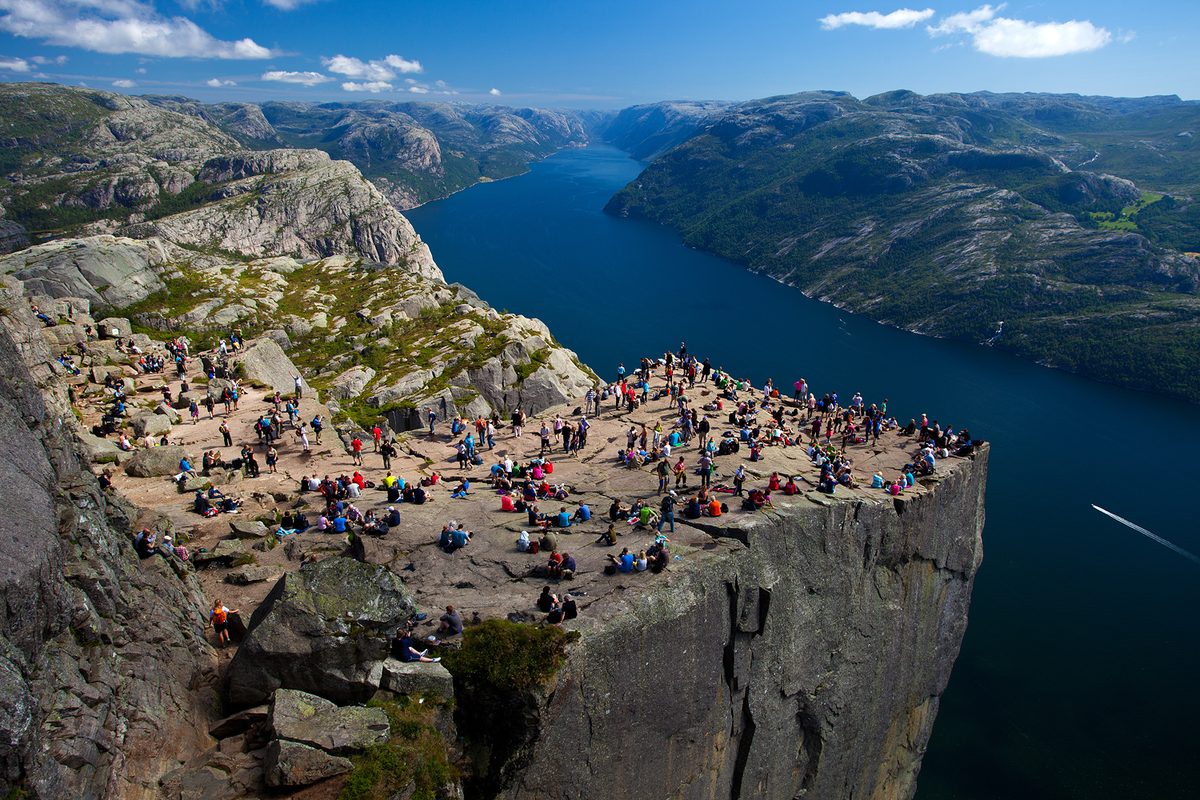
People constantly ask me whether to choose Stavanger or Bergen. Here’s my honest take: Bergen is the prettier city; Stavanger has the better single adventures. Bryggen beats any one street in Stavanger, but nothing in Bergen’s immediate day-trip range matches standing on Preikestolen’s flat 25-by-25-metre ledge, 604 metres above the Lysefjord. Stavanger is also flatter, sunnier in early summer (May and June are statistically its driest months), and far less overrun between cruise calls. If you’re doing a longer route through Norway’s fjord country, do both — they’re complementary, not duplicates.
One more thing in Stavanger’s favour: scale. The centre is fifteen minutes on foot from end to end. You can walk off a plane, be at your harbour-front hotel within forty minutes, and be eating fish soup ten minutes after that.
The Big Three: Lysefjord, Preikestolen and Kjerag
Everything iconic near Stavanger hangs off one fjord. The Lysefjord — “light fjord”, named for its pale granite walls — runs 42 km inland, up to 422 m deep, with cliffs rising close to a kilometre straight out of the water. Three experiences anchor it: the Preikestolen hike, the Kjerag hike to the famous wedged boulder, and seeing the fjord itself by boat. Here’s how they fit together, and how to choose.
Preikestolen (Pulpit Rock): The Essential Hike
Preikestolen is the reason most people come, and it earns the hype. The trail is 8 km round trip with about 500 m of total ascent — figure 4–5 hours with photo stops. It’s a real mountain hike with stone-stepped steep sections, but it’s the most manageable of Norway’s three famous hikes, and I’ve seen everyone from trail runners to grandparents with poles on it. The payoff is that impossibly flat granite shelf hanging over the fjord. There are no railings. You decide how close to the edge you belong.
Getting there from Stavanger is easy in 2026. By car it’s 30–40 minutes via the Ryfast tunnel system — the world’s longest and deepest undersea road tunnel — with tolls of roughly NOK 230–280 (~$24–29) round trip for a petrol car, plus NOK 275 (~$29) day parking at Preikestolen BaseCamp. No car? Shuttle buses (Go Fjords’ Preikestolen Express and Pulpit Rock Tours) run up to nine times daily in high season from the city bus terminal, about an hour each way, from around NOK 498 (~$52) round trip — book online, they don’t sell seats on board. The trail itself is free.
Two crowd-control tips that matter more than anything else I can tell you: start before 8 am or after 3 pm in July and August (the trail sees 300,000+ hikers a year, and the late-morning wave off the cruise ships is real), and keep a flexible day in your itinerary so you can hike in the best weather window. From October to April the trail is often icy and a guided hike is the sensible play — Outdoorlife Norway’s sunrise winter hike runs about NOK 1,390 (~$146). Our full guide to Pulpit Rock from Stavanger — every transport option, timed itineraries, winter logistics — is coming soon in this series.
Kjerag and Kjeragbolten: The Adventurous One
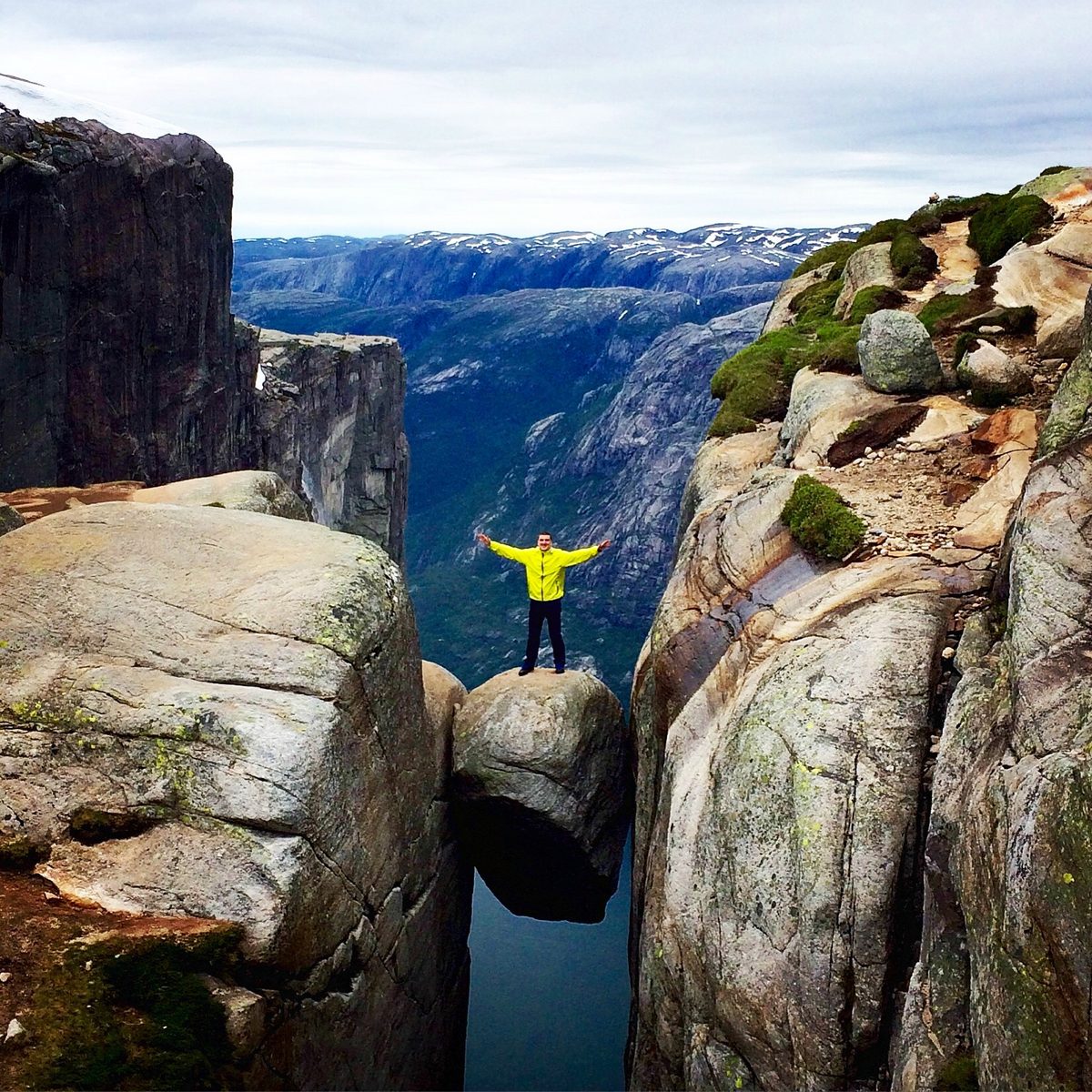
Kjerag is the hike for people who found Preikestolen too tame. It’s roughly 10–11 km round trip from the Øygardstøl trailhead with 570+ m of cumulative ascent over three successive ridges — chains bolted into the steeper granite slabs — taking most people 5–6 hours. The trophy is Kjeragbolten, a five-cubic-metre boulder wedged in a crevice about 984 m above the fjord. You can step onto it. There is no barrier, no harness, no one checking your shoes. Plenty of people hike to it and decide photographing someone else on the boulder is achievement enough; I think that’s a perfectly good decision.
The catch is the season. The trailhead sits at 640 m up the Lysevegen — a 27-hairpin road from Lysebotn that’s snowed shut from roughly November to mid-or-late May. Realistically, Kjerag is a June-to-September hike. From Stavanger it’s about a 2.5-hour drive via Sirdal, with trailhead parking around NOK 250–300 (~$26–32; check kjerag.info for the current rate). Carless, the Kjerag Express bus runs from Stavanger in July and August (weekends into September) — around 2.5 hours up, with about six hours at the mountain. The Eagle’s Nest café at the trailhead has the single best road-view terrace in Rogaland. Our dedicated Kjerag from Stavanger guide is coming soon in this series.
Flørli 4444: The World’s Longest Wooden Staircase
Flørli is the one page-one guides keep missing, and it might be my favourite half-day in the region. It’s a roadless former power-station hamlet halfway up the Lysefjord, reachable only by the fjord ferry. From the dock, 4,444 wooden steps climb 740 m straight up alongside the 1917–21 penstock pipes — the longest wooden staircase in the world. Up the stairs, down the old navvies’ path (Rallarstien), about 5 km and 3.5 hours all told, with a café in the old turbine hall (open weekends from May, daily in the main season). Quads will complain. Worth it.
Seeing the Lysefjord by Boat: Every Option Compared
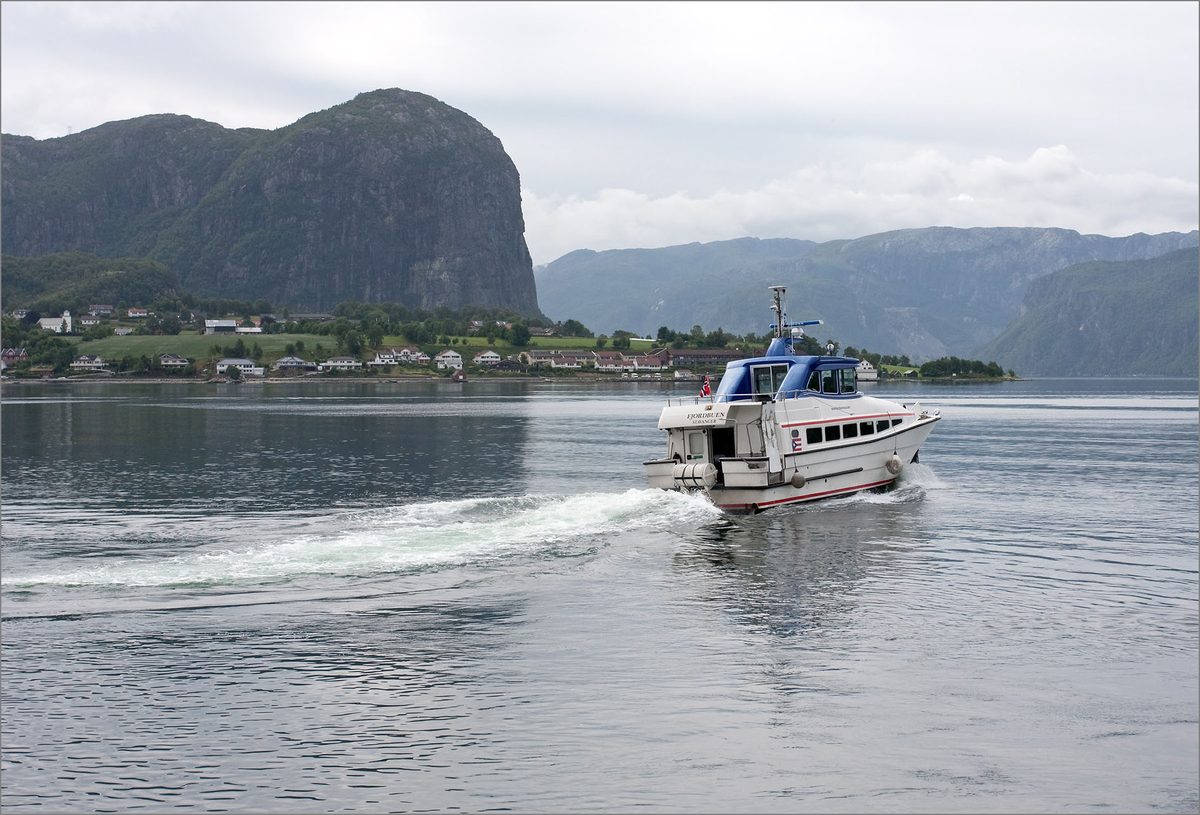
You don’t have to hike anything to get the Lysefjord. From a boat deck you crane up at Preikestolen instead of down from it, pass the Hengjanefossen waterfall and the Vagabonds’ Cave, and usually meet the semi-resident goats at Bratteli. Here’s the 2026 menu from Stavanger, honestly compared:
| Option | Duration | 2026 price (adult) | Best for |
|---|---|---|---|
| Rødne fjord cruise (year-round) | 3–3.5 hrs | NOK 890 (~$94) | The classic; biggest boats, runs even in January |
| Go Fjords electric cruise (MS Rygerelektra) | ~3 hrs | ~NOK 850–950 (~$89–100) | Silent sailing, modern catamaran; check current fares |
| Brim Explorer “Silent Lysefjord” | 3.5 hrs | NOK 750 (~$79) | Hybrid-electric, quietest decks, often the best price |
| RIB safari | ~2 hrs | ~NOK 1,000+ (~$105+) | Speed and spray; skip in heavy rain |
| Public Kolumbus ferry (Lauvvik–Flørli–Lysebotn) | up to ~2 hrs one way | roughly NOK 100–250 (~$11–26) by stretch | Budget option and the Flørli connection; a transport ferry, not a tour |
My take: if you want commentary, comfort and a guaranteed sailing, take Rødne or Brim. If you want the fjord as locals use it — and the only way to Flørli — take the public ferry and pack your own coffee. Note for late 2026: a brand-new combi catamaran, MS Rygerlys, is slated to take over the public Lysefjord route from around August, carrying passengers and a handful of cars — check kolumbus.no for current schedules. For the deeper comparison (including combining boats with hikes), our Lysefjord cruise guide is coming soon in this series, and our Norway fjord cruise guide covers how the Lysefjord stacks up against Geiranger and Nærøyfjord sailings.
Can You Do Pulpit Rock and a Lysefjord Cruise in One Day?
Yes — it’s a long, brilliant day, and the combo ticket logic works in either order. The standard play is the morning fjord cruise (you’ll look up at the ledge you’re about to stand on), back to Stavanger around lunch, then the afternoon shuttle to the trailhead and hike in the long evening light — in June and July it’s bright until nearly 11 pm, so a 4 pm trailhead start is comfortable, not crazy. Rødne and Go Fjords both sell cruise-plus-hike combinations. I’d only attempt the double in May–August; in shoulder season, give each its own day and let the weather pick which.
All three of those hikes, plus the three separate boat services people confuse with each other, are covered in detail in our dedicated Lysefjord guide — including the seasonal cut-off times that decide whether Kjerag is even walkable on the day you turn up.
The Best Things to Do in Stavanger City Centre
The city itself deserves a full day, and it’s all walkable. Here’s what’s worth your time, starting with the two streets everyone photographs.
Gamle Stavanger: 173 White Wooden Houses
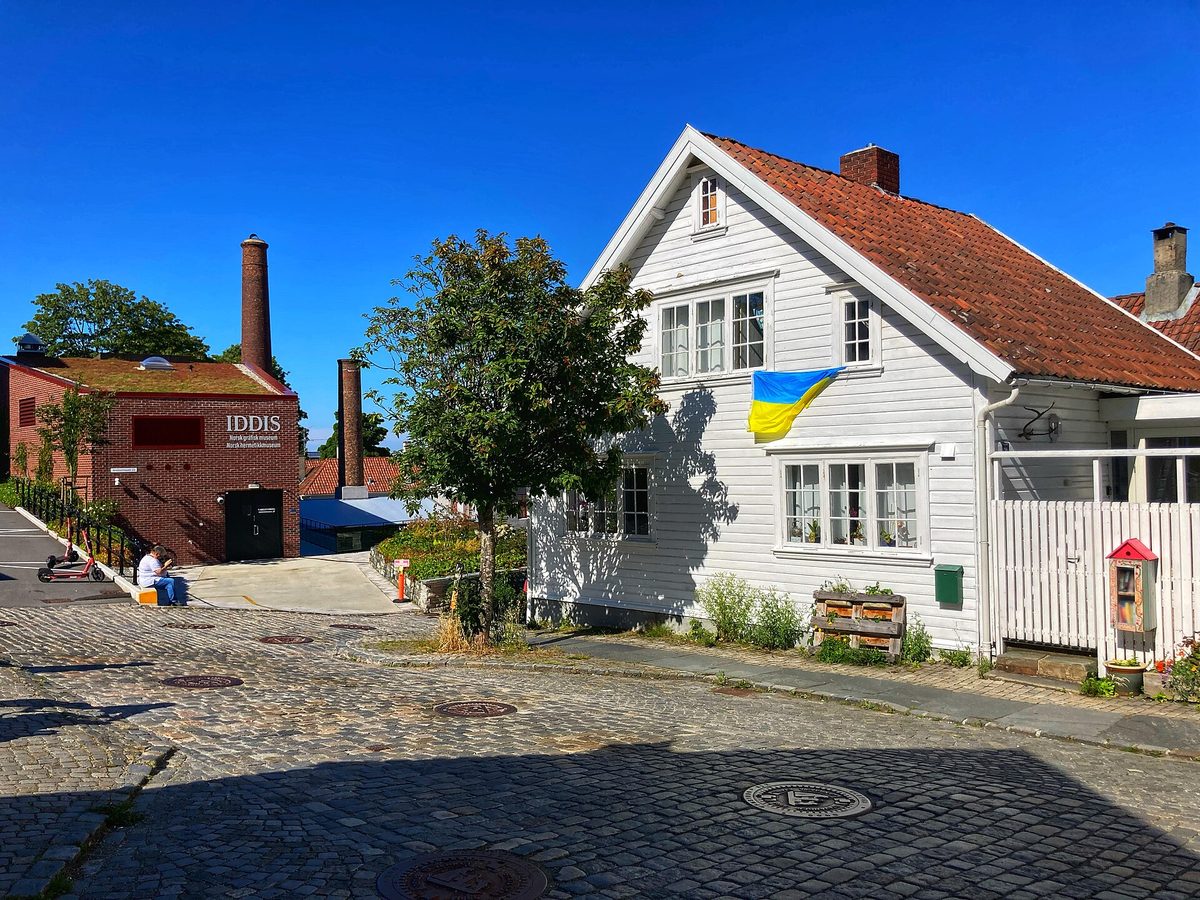
On the west side of Vågen harbour, Gamle Stavanger is northern Europe’s best-preserved wooden house settlement — 173 white-painted timber houses from the late 1700s and 1800s, climbing the hillside in cobbled lanes with hollyhocks against the walls and ship’s-lantern porch lights. These were sailors’ and cannery workers’ homes; today they’re lived in, lovingly kept, and free to wander at any hour. Go before 9 am or in the evening — on busy cruise days the lanes fill by mid-morning — and resist the urge to peer through windows; people genuinely live here. A protected heritage area rather than a museum, it pairs perfectly with the Canning Museum sitting right in its middle (more below). Our street-by-street Gamle Stavanger guide is coming soon in this series.
Fargegaten (Øvre Holmegate): The Colour Street
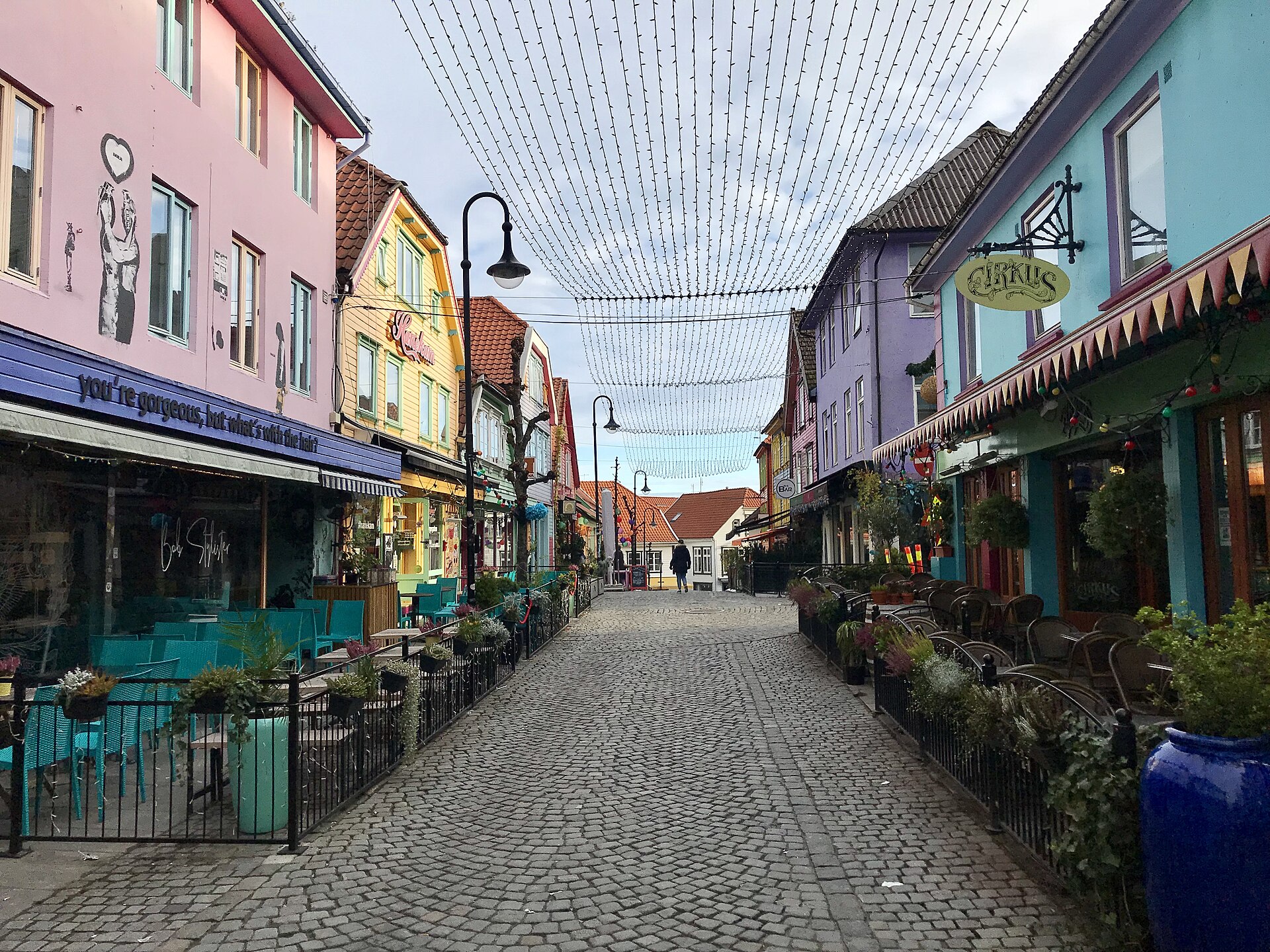
In 2005, a local hairdresser named Tom Kjørsvik convinced an entire street to repaint itself in a colour scheme devised by artist Craig Flannagan — pink against teal, lime against indigo, all of it deliberate. Twenty years on, Fargegaten (“the colour street”) is pedestrianised, lined with indie cafés, vintage shops and bars, and is the most photographed street in southwest Norway. It’s also a working café strip, not just a backdrop: Bøker og Børst, the book-bar at its heart, is exactly the kind of place a rainy afternoon was invented for. Come at golden hour when the paint glows and the day-trippers have gone.
Stavanger Cathedral: Norway’s Oldest, Freshly Restored
Stavanger Domkirke, completed around 1125, is Norway’s oldest cathedral in continuous use — and after a decade-long, ~NOK 350 million restoration, it reopened in late 2024 for the city’s 900th anniversary year. The Anglo-Norman nave (the founding bishop came from Winchester) and the riotously carved baroque pulpit are the highlights. It sits right between the harbour and the Breiavatnet lake, so you’ll pass it constantly; step in. Tourist admission is modest (around NOK 50/~$5 as of 2026 — hours vary with services, so check locally).
Street Art and the Nuart Legacy
Stavanger is, improbably, one of Europe’s street-art capitals. The Nuart Festival has run here since 2001, and two decades of invited artists have left murals across the city — from Ella & Pitr’s sleeping giants to stencil works tucked down alleys off Pedersgata. Grab the self-guided trail map (3–6 km depending on appetite) or join the guided Nuart walk (about 90 minutes). It’s the best free gallery in Norway, and it reframes the whole city as you walk between the “proper” sights.
Vågen Harbour and Sverd i Fjell
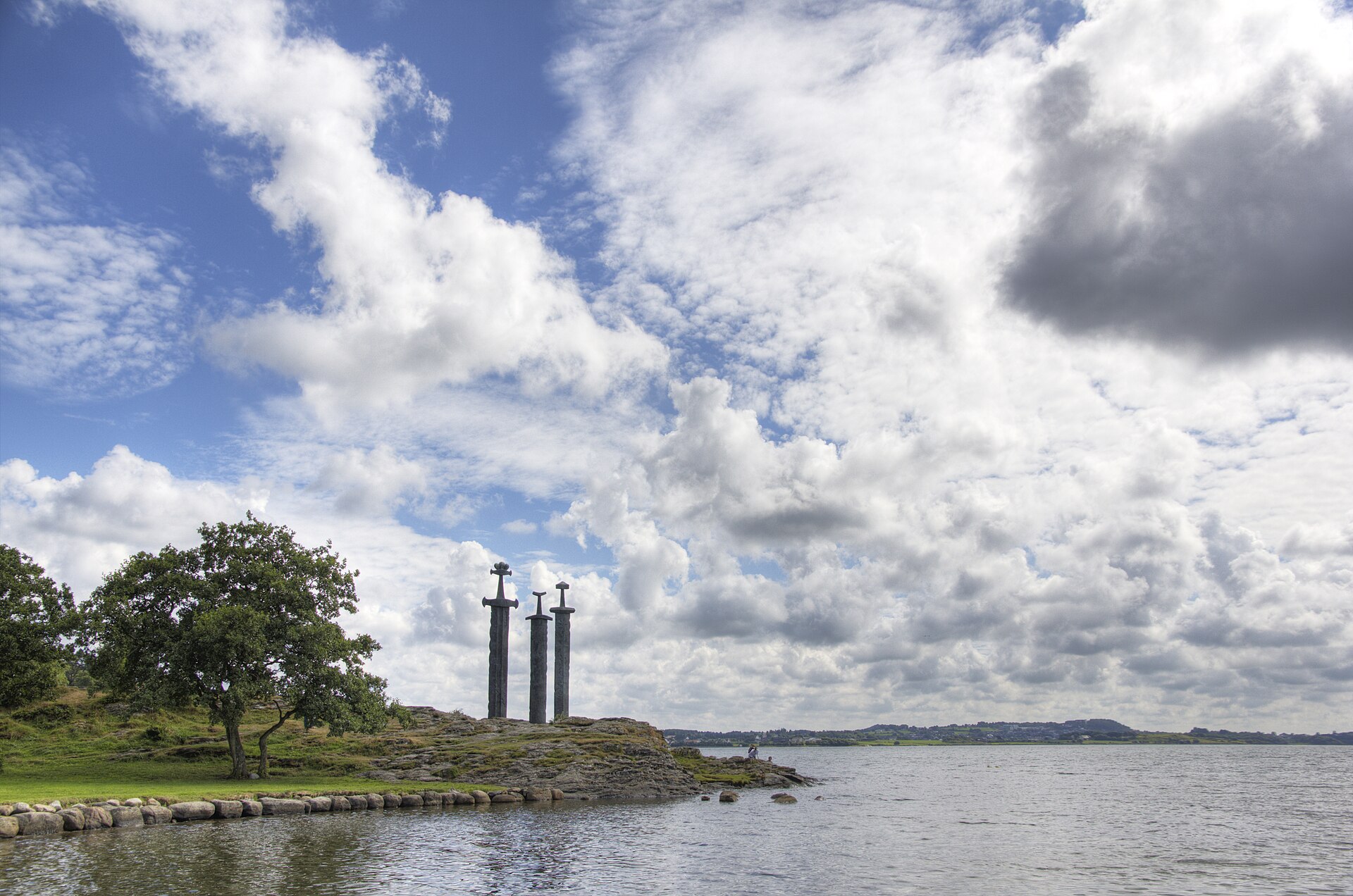
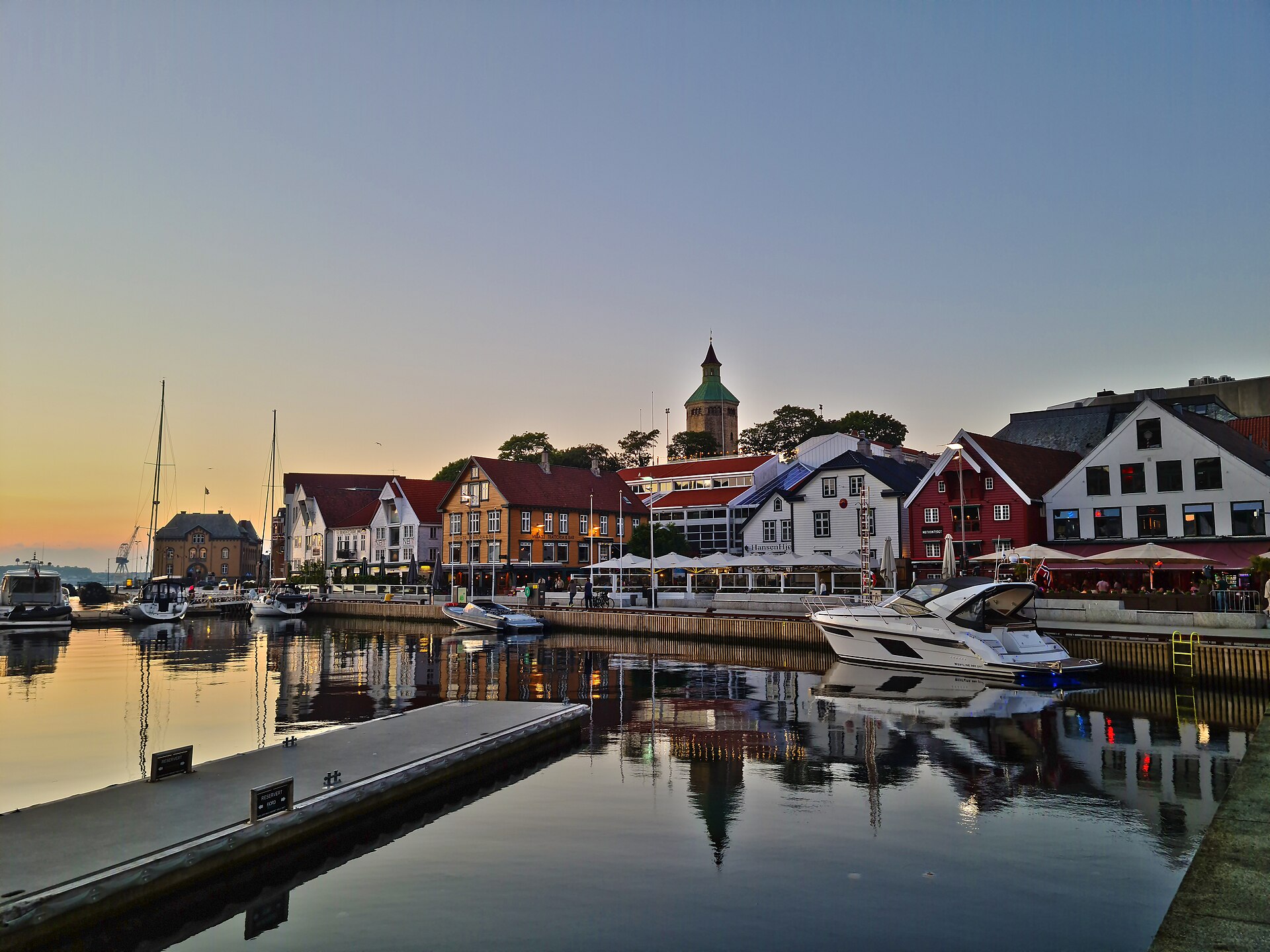
Vågen — the inner harbour — is Stavanger’s living room: Skagenkaien’s wharf houses on one side, Gamle Stavanger rising on the other, fish market at the head. Ten minutes south of the centre by bus or bike, on the shore of Hafrsfjord, stand the Sverd i fjell: three bronze swords, ten metres tall, planted in the rock since 1983 to mark the Battle of Hafrsfjord in 872, where Harald Fairhair won the fight that traditionally counts as the unification of Norway. Free, always open, and best at sunset when the swords silhouette against the water. If you want the saga itself, the Viking House VR experience in the centre retells the battle in 20 immersive minutes (NOK 145/~$15, family NOK 550/~$58) — surprisingly good, especially with kids or in rain.
Stavanger’s Museums, Ranked Honestly
Stavanger’s museum scene splits into one big standalone and the MUST family (one NOK 170/~$18 adult ticket covers every open MUST museum the same day; under-18s free — one of the best museum deals in Norway). Ranked by how likely you are to thank me:
| Museum | 2026 price (adult) | Time needed | Verdict |
|---|---|---|---|
| Norwegian Petroleum Museum | NOK 180 (~$19); family NOK 420 | 2–3 hrs | The must-do. Genuinely world-class on how oil built modern Norway |
| Norwegian Canning Museum (IDDIS) | NOK 170 MUST ticket | 1–1.5 hrs | The charmer — a preserved sardine cannery in Gamle Stavanger; sprats smoked live on demo days in summer |
| Museum of Archaeology | NOK 170 MUST ticket | 1 hr | Viking-age Rogaland; pairs with the Iron Age Farm at Ullandhaug |
| Stavanger Maritime Museum | NOK 170 MUST ticket | 1 hr | Solid, steps from the cruise quay; good wet-day filler |
The Petroleum Museum deserves a word more. It would be easy for an oil museum funded by an oil town to be propaganda; instead it’s frank about risk (the Alexander Kielland disaster gets proper treatment), great on engineering, and the offshore-platform play areas are catnip for children. Summer hours are long (daily 10–19, June through August). The building itself — granite, steel and concrete mimicking a platform jutting into the harbour — is one of Stavanger’s architectural landmarks.
Beyond the Centre: Day Trips and Half-Days
Stavanger’s hinterland is absurdly generous. Beyond the Lysefjord trio, here’s what fills the extra days — our full day trips from Stavanger guide is coming soon in this series.
Sola Beach and the Jæren Coast
Norway does not advertise its beaches, which is how 25 km of dune-backed white sand along the Jæren coast stays this quiet. Solastranden, 2.3 km long beside the airport, is the easy one — you can be barefoot in the sand 20 minutes after leaving the city. Further south, Bore and Orre are the surf beaches: cold-water breaks good enough to have hosted European championships, with board and wetsuit rental and lessons at Boretunet. Surfing is off-limits on certain bird-protection stretches from October to March, but the core breaks run year-round for the neoprene-committed. Even if you never touch the water, the drive down the Norwegian Scenic Route Jæren — big skies, stone walls, lighthouses — is the region’s best low-effort afternoon.
Flor & Fjære: The Palm Island
Twenty minutes by boat from the city, on the island of Sør-Hidle, one family has spent decades building a lush private garden where palm trees somehow thrive at 59° north. Flor & Fjære runs as a package — boat from Bekhuskaien, guided garden tour, and a genuinely good lunch or dinner, about five hours all in — from May to September, Monday to Saturday. It’s not cheap (roughly NOK 1,500–1,900/~$160–200 per person with the meal; check current prices at florogfjare.no) and it books out, but it’s the most cheerfully surreal thing you can do in Rogaland.
Utstein Monastery, Månafossen and the Rest
Utstein Kloster, ~30 minutes north through the Rennfast tunnels on Mosterøy island, is Norway’s only fully preserved medieval monastery — 12th-century stone quiet, summer concerts, open mid-May to end of August (adult around NOK 150). South-east, an hour’s drive into Frafjord, Månafossen drops 92 m in a single ribbon — a steep 30–45 minute chained scramble to the viewpoint, free, and far less visited than anything on the Lysefjord. Combine it with Gloppedalsura, northern Europe’s largest boulder scree, and waffles at Byrkjedalstunet’s candle-factory café. Train people: the Jærbanen local line runs to Egersund (~1 hr), a white wooden harbour town at the gateway to the UNESCO-listed Magma Geopark.
Stavanger for Cruise Passengers: One Perfect Port Day
Stavanger is one of Norway’s easiest cruise ports because ships dock in the city — at Vågen’s quays (Strandkaien/Skagenkaien) or Bjergsted just north, all of it walk-off. No tender, no shuttle, no excuses. With a standard 8–10 hour call you have two honest options: stay on foot (Gamle Stavanger, Canning Museum, Fargegaten, cathedral, Petroleum Museum — all within 15 minutes’ walk of your gangway, and frankly a perfect day), or book the 3-hour Rødne Lysefjord cruise, which leaves from Strandkaien a few steps from most berths. The Preikestolen hike is doable on a long call but tight — the organised ship excursion is the safer play than DIY if your aboard time is early evening. One local secret: if you’re not on a ship, check the cruise calendar and do Gamle Stavanger on a no-ship day; the difference is night and day. Our complete Stavanger cruise port guide is coming soon in this series.
Where to Eat and Drink in Stavanger
For a city of 150,000, Stavanger punches stupidly far above its weight — oil money built an audience for ambitious cooking, and the 2025 Michelin Guide confirmed it: RE-NAA holds three stars (the first three-star outside Oslo), with Sabi Omakase and K2 holding one each (status as of the 2025 guide; the 2026 ceremony may shuffle things). You don’t need a tasting-menu budget to eat well here, though. Where I’d actually point you:
| Hungry for | Go to | Expect to pay |
|---|---|---|
| Fish soup & the daily catch | Fisketorget, on Vågen | Daily fish dish ~NOK 305 (~$32) |
| Norway’s most exciting food street | Pedersgata — a dozen kitchens from bao to tacos to natural wine | Mains NOK 200–350 |
| Cinnamon buns | Kanelsnurren, by the harbour | ~NOK 50–60 |
| Coffee, books, beer in one room | Bøker og Børst, Fargegaten | Beer NOK 110–130 (~$12–14) |
| Brunch/deli | Ostehuset (two locations) | Lunch NOK 180–250 |
| Local craft beer at the source | Lervig taproom | Pints NOK 110–130 |
| The blowout | RE-NAA (book months ahead) | Several thousand NOK |
Time your visit for late June and you collide — delightfully — with Gladmat (24–27 June 2026), the Nordics’ largest food festival: 250,000 visitors, free entry, the whole harbour turned into one long tasting counter. Book your hotel early that week. And a warning in the other direction: ONS, the giant energy conference, runs 24–27 August 2026 and hotel prices double or triple; unless you’re in oil, avoid those dates entirely.
Suggested Itineraries: 1, 2 or 3 Days
One day (city only)
Morning coffee on Fargegaten, Gamle Stavanger and the Canning Museum before the lanes fill, fish soup at Fisketorget, Petroleum Museum after lunch, then the bus to Sverd i fjell for golden hour and dinner on Pedersgata. That’s the city’s greatest hits, honestly done.
Two days (the classic)
Day one as above. Day two is Preikestolen: early shuttle or drive, on the trail by 8–9 am, summit crowd-free, back in Stavanger by mid-afternoon for a sauna float or a slow dinner. If the forecast says day one is the sunny one, flip them — the city works in rain; the ledge is better dry.
Three days (add the fjord — or the boulder)
Day three, choose your character: the Lysefjord cruise plus a lazy harbour afternoon (most people), the Flørli 4444 steps via the public ferry (my pick), or — June to September, sure-footed hikers only — the Kjerag Express for Kjeragbolten. With four or five days you can add Jæren’s beaches and Månafossen, or push on toward Bergen by coastal bus. For slotting Stavanger into a bigger route, see our Norway itinerary guide — the southwest pairs naturally with a fjord-country loop.
When to Visit Stavanger
May through September is prime, and the shape of the season matters more here than in most Norwegian cities because the headline activities have different windows:
| Months | What works | What doesn’t |
|---|---|---|
| May–early June | Statistically the driest stretch; Preikestolen open and quieter; everything green | Kjerag road usually still closed until mid/late May; sea cold |
| Late June–August | Everything open incl. Kjerag; ~18.5 hrs of daylight at midsummer; Gladmat (June); beach days possible | Peak crowds on Preikestolen mid-morning; ONS hotel spike late Aug 2026 |
| September | Nuart festival; autumn light; Kjerag until the snow; fewer ships | Rain climbing toward the autumn peak |
| October–April | Museums, food, storm-watching on Jæren; guided winter Preikestolen hikes; Rødne cruises run year-round | Short days (~6 hrs at solstice); icy trails; Kjerag shut |
Don’t let the rain statistics scare you off — yes, Stavanger is one of Norway’s rainiest cities, but it’s mild (Gulf Stream), the rain comes in bands rather than all-day siege, and the city is unusually well-stocked with indoor backup. For how Stavanger’s seasons compare across the country, our guide to Norway’s seasons breaks it down month by month — and no, you won’t see the midnight sun here (Stavanger is too far south; for that, look to Tromsø or Lofoten). Northern lights are rare this far south too — possible on strong solar nights, but plan aurora hopes around northern Norway instead.
Getting to Stavanger and Getting Around
Stavanger Airport Sola (SVG) sits 14 km southwest of the city with direct flights from London Gatwick, Amsterdam, Copenhagen and the Norwegian trunk routes (Oslo, Bergen, Trondheim), plus seasonal European additions — as of 2026, Norwegian flies Gatwick roughly eleven times weekly and KLM runs Amsterdam multiple times daily. The Flybussen does airport-to-centre in 25–30 minutes (~NOK 151/$16 booked online); the local Kolumbus bus is cheaper and slower.
Overland, the numbers surprise people. From Oslo, Go-Ahead Nordic’s Sørtoget train takes around 8–8.5 hours along the southern coast (advance Lowfare-style tickets from roughly NOK 250–400, and there’s a night train with reclining options). From Bergen there is no train — the Kystbussen coach does it in roughly 4.5–5.5 hours including a ferry crossing, typically NOK 500–700 depending on demand. There’s even a proper overnight ferry: Fjord Line from Hirtshals in Denmark, arriving at Risavika terminal at 7 am. Full national logistics — trains, tolls, ferries, the lot — live in our getting around Norway guide.
In town, your feet cover almost everything. For the rest: Kolumbus single tickets are NOK 45 (~$5) in the app (buying from the driver costs NOK 20 extra; buses are cashless), a 24-hour pass is NOK 120, and — the deal nobody notices — the city’s electric Bysykkelen bikes are free for an hour at a time with any valid Kolumbus ticket. Drivers should know Norwegian city parking is expensive and the AutoPASS toll tag halves your Ryfast crossings; honestly, for a Stavanger-plus-Lysefjord trip, you only need a car for the Kjerag/Månafossen/Jæren days.
Where to Stay in Stavanger
Stay central — this is a city where “five minutes from Vågen” genuinely means everything is five minutes away. Around the harbour, Hotel Victoria (a 1900 harbourfront classic, usually NOK 1,400–2,000/~$145–210) and the big reliable pair of the Radisson Blu Atlantic (overlooking Breiavatnet lake) and Clarion Hotel Stavanger cover the midrange at roughly NOK 1,200–2,500. The splurge is the Eilert Smith Hotel — twelve rooms in a 1937 functionalist warehouse with RE-NAA downstairs, from around NOK 4,500 (~$470). For something completely different, the 1914 Sola Strand Hotel puts you on the beach with a sea-view spa for about NOK 1,800–2,400. Budget travelers should look at the chains’ smaller properties and book early for June; everyone should avoid ONS week (24–27 Aug 2026) unless someone else is paying. Our full where to stay in Stavanger neighbourhood guide is coming soon in this series; for the national picture — rorbuer, mountain lodges, ice hotels and all — see where to stay in Norway.
What Stavanger Costs in 2026: The Master Table
Every price I could verify as of June 2026, in one place. Hedge accordingly — operators adjust season to season, so treat these as “close, check current” rather than gospel.
| Item | NOK | ~USD |
|---|---|---|
| Kolumbus bus single (app) | 45 | $5 |
| Flybussen airport bus (online single) | 151 | $16 |
| Norwegian Petroleum Museum (adult) | 180 | $19 |
| MUST museums day ticket (adult; under-18 free) | 170 | $18 |
| Viking House VR (adult) | 145 | $15 |
| Stavanger Cathedral (tourist visit) | ~50 | $5 |
| Preikestolen shuttle bus (round trip, from) | ~498 | $52 |
| Preikestolen BaseCamp parking (day) | 275 | $29 |
| Ryfast tunnel tolls (car, round trip) | ~230–280 | $24–29 |
| Kjerag/Øygardstøl parking | ~250–300 | $26–32 |
| Rødne Lysefjord cruise (adult) | 890 | $94 |
| Brim Explorer Lysefjord cruise (adult) | 750 | $79 |
| Public Lysefjord ferry (passenger, by stretch) | ~100–250 | $11–26 |
| Guided winter Preikestolen hike | ~1,390 | $146 |
| Flor & Fjære (boat + tour + meal) | ~1,500–1,900 | $160–200 |
| Daily fish dish at Fisketorget | ~305 | $32 |
| Pint of craft beer | 110–130 | $12–14 |
| Midrange hotel double (central) | 1,200–2,500 | $125–265 |
Rule of thumb: a midrange couple doing the city plus Preikestolen plus one cruise spends around NOK 2,800–3,500 (~$295–370) per person across two-three days before flights. Cheaper than Geiranger-circuit fjord touring, mostly because everything is so close together. For national budgeting context, see our Norway highlights guide and the cost tables in our Norway tours guide.
Stavanger FAQ
Is Stavanger, Norway worth visiting?
Emphatically yes — provided you use it as both city break and basecamp. The city alone (old town, food scene, museums) makes a satisfying day or two; what makes it unmissable is the Lysefjord on its doorstep: Preikestolen, Kjeragbolten and Flørli are three of Norway’s signature experiences, all day-trippable from one comfortable harbour town.
How many days do you need in Stavanger?
Two full days minimum: one for the city, one for Preikestolen. Three lets you add the Lysefjord by boat without rushing; four to five covers Kjerag (in season) or the Jæren beaches. Cruise passengers can do the walkable city highlights well in a single port day.
What is Stavanger best known for?
Three things: Preikestolen (Pulpit Rock) above the Lysefjord; its role as Norway’s oil capital since the 1969 Ekofisk discovery; and before that, sardines — by the 1920s around 70 canneries operated here. Add Gamle Stavanger’s white wooden houses and a Michelin-decorated food scene and you have the modern mix.
How hard is the Pulpit Rock hike, and how long does it take?
Moderate: 8 km round trip, about 500 m of total ascent, 4–5 hours with stops. The trail is well-built (stone steps on the steep bits) and fine for anyone reasonably fit in proper footwear. It is not technical in summer; from October to April ice makes a guided hike the smart choice.
Can you see Pulpit Rock without hiking?
Yes — every Lysefjord cruise passes directly beneath it, and from the deck the 604 m cliff is arguably more dramatic than the view from the top. If your knees, time or weather rule out the trail, the boat is a legitimate alternative, not a consolation prize.
How do you get from Stavanger to Preikestolen?
Drive 30–40 minutes via the Ryfast undersea tunnel to Preikestolen BaseCamp (tolls ~NOK 230–280 round trip, parking NOK 275), or take a seasonal shuttle bus from Stavanger’s bus terminal — about an hour each way, from roughly NOK 498 round trip, up to nine departures daily in high season. Book buses online in advance.
When can you hike Kjeragbolten?
Roughly June to September. The trailhead sits at 640 m up the Lysevegen hairpin road, which is snowed shut from about November to mid/late May, and the route’s granite slabs are dangerous when icy. In high summer the Kjerag Express bus runs from Stavanger; check current schedules.
Is the Lysefjord cruise worth the money?
At NOK 750–890 for 3–3.5 hours, I think so — it’s the only way to grasp the fjord’s scale from water level, and the route packs in Preikestolen from below, the Hengjanefossen waterfall, Vagabonds’ Cave and the Bratteli goats. Budget alternative: the public Kolumbus ferry does the fjord for a fraction of the price, minus the commentary.
Is Stavanger expensive to visit?
It’s Norway, so it isn’t cheap, but it’s no worse than Oslo or Bergen and the headline sights are cheap or free: Gamle Stavanger, Fargegaten, street art and Sverd i fjell cost nothing, the trail up Preikestolen is free, and the MUST museum ticket (NOK 170, under-18s free) is excellent value. Budget NOK 1,200–1,600 per person per day midrange.
Is Stavanger walkable from the cruise port?
Completely. Ships dock at Vågen or Bjergsted, effectively inside the city — Gamle Stavanger, the Canning Museum, Fargegaten, the cathedral and the Petroleum Museum are all within about 15 minutes’ walk of the gangway. No shuttle needed.
Stavanger or Bergen — which should I visit?
Bergen for the prettier city and rail connections (Bryggen, Fløibanen, the Bergen Line); Stavanger for the bigger single adventures (Preikestolen, Kjerag, Lysefjord) and a less crowded, flatter, often drier city. With 4+ days, do both — the Kystbussen coach links them in about five hours.
Can you see the northern lights in Stavanger?
Rarely — at 59° north it takes a strong solar storm, a dark sky and luck. If aurora is the point of your trip, head north to the Tromsø–Lofoten belt instead, where the lights are overhead dozens of nights each winter.
How to Use This Guide (and What’s Next)
This page is the hub for everything we publish on Stavanger and the Lysefjord. Deep-dives coming soon in this series: Pulpit Rock from Stavanger, the Lysefjord cruise compared in detail, Gamle Stavanger street by street, Kjerag from Stavanger, day trips, where to stay, and a complete cruise-port guide. For the wider country, start with our guides to things to do in Norway, hiking in Norway (where Preikestolen and Kjerag sit alongside Trolltunga and Besseggen), and Norway in winter if you’re tempted by the quiet season. City-hopping? Our Oslo guide covers the other end of the Sørtoget line.
About This Guide
The NorwayTourism.org team has hiked Preikestolen in June sunshine and October fog, ridden the public ferry to Flørli with thighs full of regret, and eaten an irresponsible number of cinnamon buns on Fargegaten. We write from on-the-ground experience and current official sources, we list prices in NOK and dollars because vagueness helps nobody, and we update our guides as things change. No operator paid to appear here.
Sources & Further Reading
- Visit Norway — the Stavanger region
- Fjord Norway — Stavanger & Ryfylke
- Preikestolen BaseCamp — parking, trail and transport
- Kjerag.info — trail status and parking
- Rødne Fjord Cruise — Lysefjord sailings
- Flørli 4444 — stairs, café and ferry access
- Kolumbus — local buses, tickets and the Lysefjord ferry
- Norwegian Petroleum Museum — hours and tickets
- MUST / Museum Stavanger — joint tickets
- Gladmat food festival
- Ferde — Ryfast toll rates
Photo Credits
- Preikestolen (Pulpit Rock), 604 m above the Lysefjord — Photo: Svein-Magne Tunli – tunliweb.no / CC BY-SA 3.0 via Wikimedia Commons. Source
- A sightseeing boat on the Lysefjord — Photo: Sergey Ashmarin / CC BY-SA 3.0 via Wikimedia Commons. Source
- Kjeragbolten, wedged 984 m above the fjord — Photo: Scoundrelgeo / CC BY-SA 4.0 via Wikimedia Commons. Source
- Gamle Stavanger and the IDDIS canning museum — Photo: Artem Vynohradov / CC BY-SA 4.0 via Wikimedia Commons. Source
- Fargegaten (Øvre Holmegate), the colour street — Photo: Vogler / CC BY-SA 4.0 via Wikimedia Commons. Source
- Sverd i fjell at Hafrsfjord — Photo: TomasEE / CC BY 3.0 via Wikimedia Commons. Source
- Vågen harbour and Skagenkaien at dusk — Photo: Geir Hval (www.MacWhale.eu) / CC BY-SA 4.0 via Wikimedia Commons. Source