Every guide to a Norway road trip tells you the roads are beautiful. Almost none tell you what a day of driving costs. I went looking for a car-hire day rate, a young-driver surcharge, a current petrol price and a straight answer on winter tyres across the five best-ranked English guides, and found none of the four. That is the gap this piece fills.
So: mechanics only, no day-by-day route. For the actual driving plan, the loops and the overnight stops, see my suggested Norway driving routes and the one-week driving loop. What follows is the money and the rulebook: hire rates, fuel after the 1 September duty change, how tolls get billed by a rental firm, how car ferries are priced, what the police will fine you, and when the mountain passes open.
I have driven most of these roads and paid the bills afterwards, which is the part that teaches you something. A Norway self drive is not cheap, but it is predictable once you know which costs are fixed, which scale with the length of your vehicle, and which you can halve with ten minutes of admin before you land.
What a Norway road trip costs: the at-a-glance numbers
All figures checked September 2026, at 9.35 NOK to the dollar.
| Item | Typical price (NOK) | USD | Note |
|---|---|---|---|
| Small car hire, per day | 540 | $58 | Aggregator averages run $39-63/day; August is dearest |
| SUV hire, per day | 1,290 | $138 | Rarely worth it in summer |
| Bergen pick-up, average day rate | 835 | $89 | Entry rates from 160 NOK/day if you book far ahead |
| Young-driver surcharge, per day | 100-300 | $11-32 | Ages 19-24, sometimes to 26; often capped at 7-10 days |
| Petrol, per litre (1 Sep 2026) | 26.84 | $2.87 | National average across 1,100+ stations |
| EV charging, per kWh | 3-6 | $0.32-0.64 | 25,000+ public points nationwide |
| Rental toll admin fee, per tolled day | 30-80 | $3-9 | On top of the tolls themselves |
| Car ferry, short crossing (Zone 10), car under 6 m | 104 | $11 | Includes driver and all passengers via AutoPASS |
| Car ferry, long crossing (Zone 50), car under 6 m | 345 | $37 | Vehicles 6-8 m pay 734 NOK on the same route |
| Speeding fine, 10 km/h over in a 50 zone | 3,350 | $358 | Rates from 15 February 2026 |
Hiring the car: the numbers nobody publishes
Day rates, and why the spread is so wide
Across the booking aggregators, Norway comes out between $39 and $63 a day depending on which you ask and how far ahead you book. Segment it: a small car averages about $58 a day (roughly NOK 540), an SUV about $138 (around NOK 1,290). Bergen averages around 835 kr a day (about $89), with genuine entry rates from 160 kr a day (about $17) if you book months out and accept a tiny manual hatchback.
That last number is worth chasing. The gap between 160 kr and 835 kr on the same forecourt is almost entirely booking lead time and fleet pressure. August is the most expensive month of the year to hire a car in Norway, and it is not close. My guide to the best months for a Norway visit covers the weather trade-off, but on price alone the shoulder seasons win outright.
Verdict: book the smallest car you can live with, book early, avoid August.
Young-driver surcharge and minimum age
This is the most reliably omitted fact in Norwegian road trip content, and it catches people at the desk. The minimum rental age is generally 19. The surcharge then applies roughly from 19 to 24, and some firms extend it to 26.
The amounts vary more than you would expect. Enterprise quotes NOK 100 a day (about $11), other firms come in at NOK 125-160 ($13-17), and the realistic market range is NOK 100-300 a day ($11-32). The saving grace is that most firms cap the surcharge at seven or ten days. On a two-week trip at NOK 200 a day, uncapped you pay 2,800 kr; capped at seven days you pay 1,400 kr (about $150). Ask which cap applies, because it is rarely on the summary page.
Verdict: under 25, the surcharge cap matters more than the headline day rate. Compare totals, not dailies.
Gearbox, size and whether you need four-wheel drive
Automatics cost more and are scarcer in the cheap tiers. If you can drive a manual, do. On size: the fjord roads are narrow, passing places are short, and a wide SUV turns every oncoming bus into an event. There is also a hard financial reason to stay under six metres, which I come to in the ferry section.
Four-wheel drive in summer is a solution looking for a problem. Every road a tourist wants is sealed, and the passes do not open until conditions allow. In deep winter the calculation changes, but so does the whole trip; that is covered in my notes on driving Norway in the cold months.
Verdict: small, manual, two-wheel drive. Save the difference for ferries.
Fuel: the 1 September 2026 price change everyone else missed
What petrol actually costs now
On 1 September 2026 the national average price of petrol in Norway was NOK 26.84 per litre, from data across more than 1,100 stations. That is roughly $2.87 a litre, about $10.85 per US gallon.
It jumped that morning for a reason. A temporary fuel duty cut ran from 1 May to 1 September 2026; at midnight on 1 September the duty was reapplied, adding NOK 4.71 a litre. On the standard 85 percent petrol, 15 percent bioethanol blend sold at Norwegian pumps, the duty component went from 3.23 to 6.76 NOK per litre. Any price quoted by someone who filled up in July is now wrong by about five kroner a litre.
Why you will see three different fuel prices online, and which to believe
The sources genuinely conflict here, and pretending otherwise would be dishonest. A 2026 Norwegian cost-of-living guide still quotes 22.4 kr/l. A driving guide dated April 2026 says “roughly 20-25 NOK/litre” for 95 octane. Blogs quoting 19 NOK are years stale.
None of those authors were careless. They wrote during the duty cut, or before it. The honest current answer is mid-to-high 20s per litre, and I budget 27 kr/l. If you see a figure under 25 on a page without a September 2026 date, assume it predates the duty restoration.
Practically: a small hatchback doing 6 litres per 100 km costs about 161 kr ($17) per 100 km. A 1,500 km loop is roughly 2,400 kr ($257) in petrol alone, usually the second-largest line in a Norway self drive budget after the car. My wider Norway budget breakdown puts that in context.
Electric, and whether it changes the maths
Norway has over 25,000 public charging points, and charging typically runs 3-6 NOK per kWh (roughly $0.32-0.64). An EV also gets 50 percent off car ferries with a tag, and electric tolls are capped at 70 percent of the fossil rate, in practice nearer 50.
Stack those three discounts and an EV that costs more per day can still land cheaper over a week. The counterweight is planning overhead: charging stops are longer, and on remote stretches you drive to the charger rather than the view.
Tolls, AutoPASS, and the fee your rental firm adds
How Norwegian tolls actually work
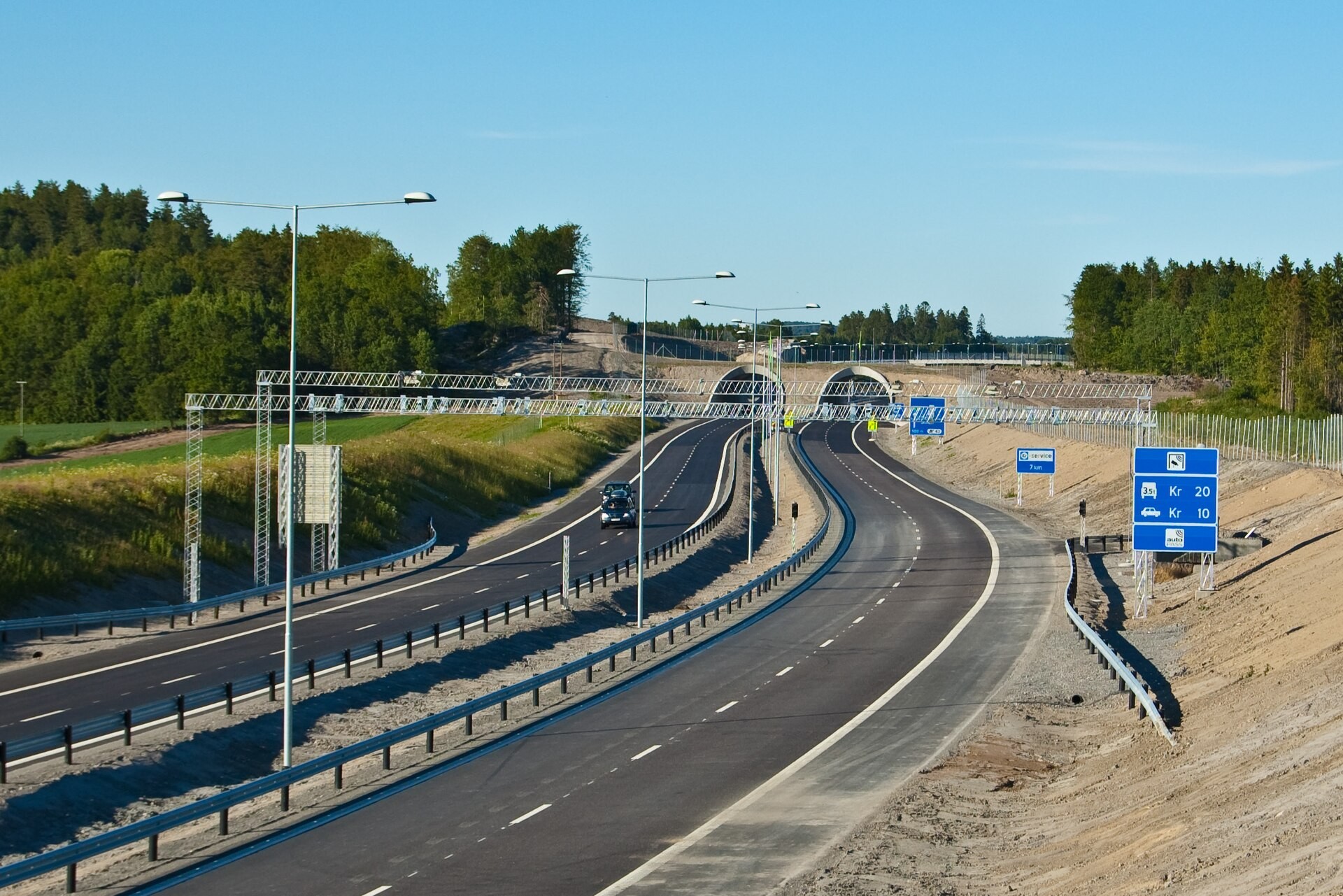
There are no toll booths. Gantries read your plate or tag and bill you afterwards. Tolls are priced by weight class, which matters because ferries are priced by length and people conflate the two systems constantly.
A physical AutoPASS tag earns 20 percent off tolls. A rush-hour surcharge of 25-30 percent applies in the urban rings, but not at weekends, on public holidays, or at all during July. Within a ring you are charged once per hour however many gantries you pass, which is why circling central Oslo for parking does not bankrupt you. Oslo has three separate rings, so one drive across the city can touch more than one. Electric vehicles are capped at 70 percent of the fossil rate and in practice pay closer to half.
One quirk worth flagging for anyone in a large camper: a motorhome over 3,500 kg registered as category M1 is charged at the light-vehicle rate only if it carries a valid tag and agreement. Without one it drops into the heavier rate group and the bill roughly doubles.
The rental toll admin fee
Here is the charge that surprises people three weeks after they get home. You do not arrange AutoPASS yourself; the rental car is already registered. What you pay is the company’s handling fee for processing those tolls, on top of the tolls themselves.
Most firms add NOK 30-80 per day on days when tolls are incurred (about $3-9). Avis charges NOK 40 a day capped at five days; Hertz builds the AutoPASS device into the quoted rate; Sixt sells an optional AutoPASS service at NOK 236.80. The Sixt and Avis figures are single-source, so treat them as indicative and check your own terms.
Look for the capped structures. Uncapped at 80 kr a day over a ten-day trip through toll rings, that is 800 kr ($86) in admin fees for a service that costs the company almost nothing. Capped at five days you pay 200 kr.
Verdict: ask one question at the counter: “is the toll admin fee capped, and at how many days?” It is worth more than any insurance upsell.
The toll-free north
Reportedly, northern Norway — Lofoten, Tromsø and Senja — has no toll roads at all. I have seen this stated once and not corroborated elsewhere, so treat it as reported rather than confirmed, though it matches my experience of driving the Lofoten archipelago, where ferries and fuel are what bite.
Car ferries: priced by length, and that is the whole trick
The length bands
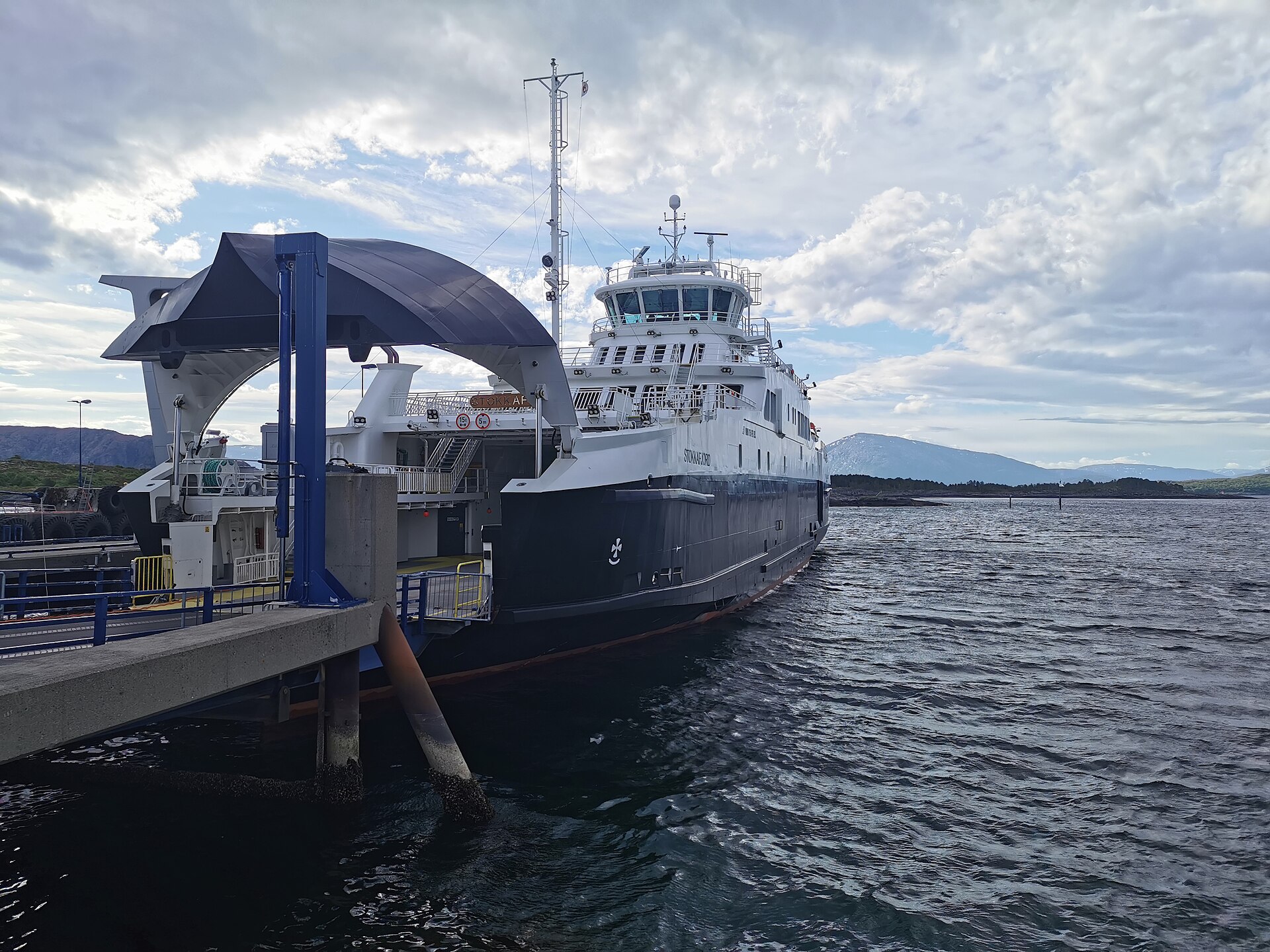
Norwegian car ferries are priced by how many metres of deck you occupy, not by weight. The official AutoPASS ferry tariff in force from 1 January 2026 uses nine bands: AP1 under 6 m, AP2 for 6.01-8 m, AP3 for 8.01-10 m, up to AP9 for anything over 22 m. The jump between bands is brutal:
| Zone | Under 6 m (AP1) | 6-8 m (AP2) | 8-10 m (AP3) |
|---|---|---|---|
| Zone 10 (short hop) | NOK 104 / $11 | NOK 231 / $25 | NOK 318 / $34 |
| Zone 22 (medium) | NOK 176 / $19 | NOK 382 / $41 | NOK 507 / $54 |
| Zone 50 (long) | NOK 345 / $37 | NOK 734 / $79 | NOK 961 / $103 |
Crossing from AP1 into AP2 multiplies your fare by 2.22; into AP3, by 3.06. Over eight or ten crossings that is the difference between roughly 1,200 kr and 3,700 kr.
Now the part that costs real money: a roof box or towbar can push a long estate over six metres, and the measurement is the vehicle as presented, not as sold. It is often cheaper to take a smaller car and pack lighter than to pay AP2 rates all week.
AutoPASS ferry prepayment: the 50 percent lever
Ferries and tolls use separate accounts even though both wear the AutoPASS name. For ferries a tag alone gets you only 10 percent off; prepayment as a private customer gets 50 percent (business customers 40). The 2026 prepayment deposit for vehicles in the 0-8 m range is NOK 2,200 (about $235), drawn down as you travel.
The fare paid via AutoPASS also includes the driver and all passengers, so a family of five crosses on one charge, and electric vehicles get 50 percent off with a tag. Halving eight or ten crossings pays back the admin in two days. If you are only crossing two or three fjords, skip it and pay the standard rate.
Do you need to book?
For the ordinary shuttle ferries — the ones that run every half hour across a fjord and form part of the road network — no. You drive on, a crew member reads your tag, and you drive off. There is no reservation system for most of them and queueing is the norm in July.
The exceptions are long-distance and tourist-branded sailings, some of which take bookings and fill up. My rule: if the ferry has a route number and appears on the map as part of the road, turn up. If it has a name and a marketing page, check. The same logic runs through my overview of how to move around Norway.
The rules, and what breaking them costs
Speed limits
Fifty in urban areas, eighty on rural roads, and 90-110 on motorways, with 110 km/h the national maximum. Anything over 3,500 kg is capped at 80 km/h regardless of the posted limit, which applies to a lot of hire campervans.
Norwegians keep to these limits with a discipline that surprises visitors from countries where the limit is a suggestion. Follow the traffic.
Fines, and they are not small
Under the rates effective from 15 February 2026, doing 10 km/h over in a 50 zone costs NOK 3,350. That is about $358 for the kind of drift that would earn a shrug elsewhere in Europe. There is no discretionary warning culture to rely on.
Penalty points stack on top: two points from 11 km/h over, three points from 16 km/h over. Eight points inside three years costs you your licence for six months. Licence confiscation is considered from roughly 26 km/h over in a 50 zone, and yes, that happens to tourists.
The blood-alcohol limit is 0.02 percent, functionally zero. One beer with dinner is a genuine risk, not a technicality. If you are staying somewhere with a bar, plan on the car staying put; my notes on choosing accommodation in Norway apply.
Winter tyres: what the rule actually says
Every competitor guide I read describes this as a flat calendar mandate: “winter tyres are compulsory from 1 November”. That is not what the law says. It is a tread and traction rule. For vehicles under 3,500 kg, the requirement during the winter period from 1 November to the first Sunday after Easter is a minimum of 3 mm tread on winter tyres. The obligation is tyres adequate for the conditions, evidenced by that tread depth, not a blanket ban on a particular tyre from a particular date.
Studs and chains are separately permitted from 1 November to the first Monday after Easter in southern Norway, and from 16 October in Nordland, Troms and Finnmark. You will also see a 16 October to 30 April window quoted with a 5 mm requirement for those counties. Read the fine print: that applies to vehicles over 3,500 kg. Plenty of pages repeat it as a flat car rule.
In practice a rental collected in November comes on legal winter tyres and you need do nothing. The rule matters if you bring your own vehicle, hire from a small operator, or drive a heavier camper.
The studded tyre fee nobody mentions
Oslo, Bergen, Trondheim, Stavanger and Kristiansand all levy a daily studded-tyre charge, the piggdekkavgift, on vehicles running studs inside the city. If your winter rental has studs and you park in one of those five for several days, that is a live cost. Ask the desk whether the car is studded and who pays the fee.
Mountain passes: when the good roads actually open
Trollstigen, and the stale information problem
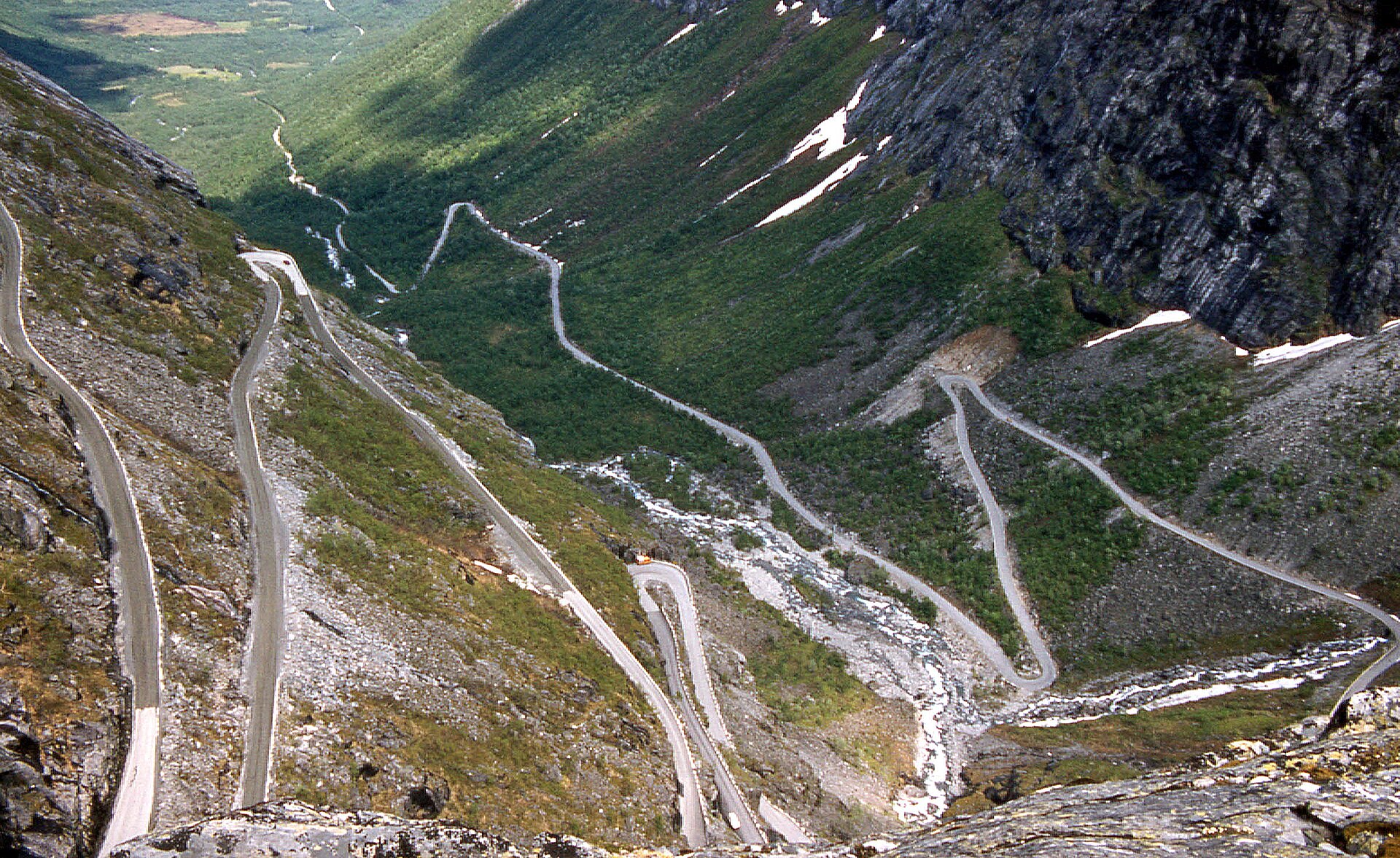
Trollstigen reopened at 12:00 on Monday 27 April 2026. That is its earliest opening on record; a normal year starts in mid-May. Our week-by-week guide to spring in Norway has the rest of the opening calendar, and it is worth checking before you fix a route.
The road has had a difficult few years: shut for most of 2024 after rockfalls, reopened 11 July 2025 once protection works were done. Here is the useful part. The official nasjonaleturistveger.no page still carries stale 2024 “closed for the year” text, and a long tail of blogs have copied it verbatim. If you read that Trollstigen is closed, check the date on the claim before rebuilding your route. As of this writing it is open.
Sognefjellet
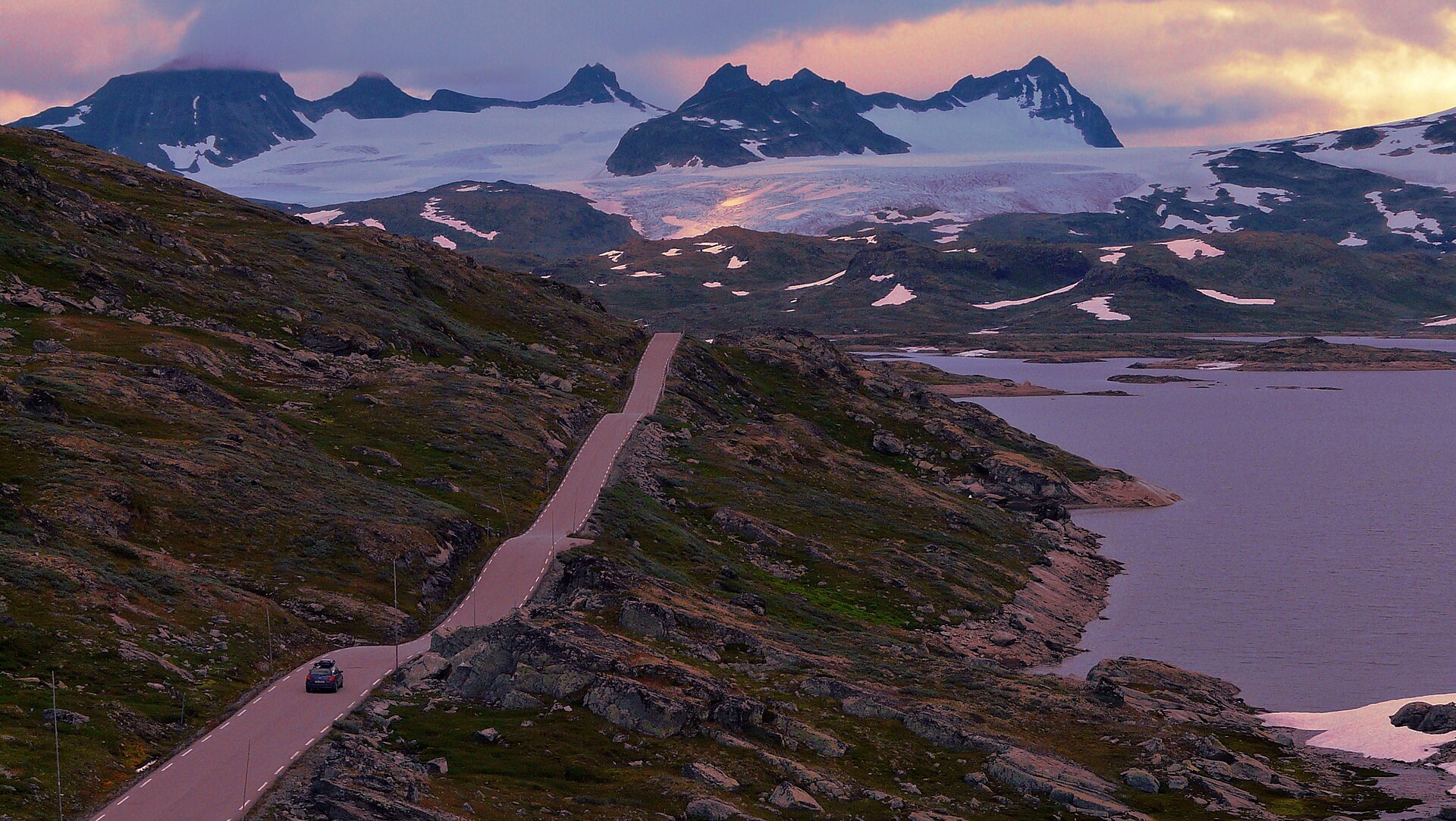
Fv55 over Sognefjellet opened on 2 April 2026, with 20:00-08:00 night closures until conditions allowed. At 1,434 m it is Norway’s highest mountain pass, and the plateau crossing is the most alien-looking hour of tarmac in the country.
The general pattern for high passes: April to May opening, October to November closing, with night closures at the margins. Do not treat an opening date as a promise. A late snowfall re-closes a pass for days, and the road authority publishes those closures in Norwegian first.
Planning around them
Travelling in June, July or August, every pass you care about is open and this is a non-issue. In late April, May, October or November, build one alternative per high pass into your route and check it the morning you drive. The lower fjord-side roads stay open year-round and reach most of the best fjord viewpoints anyway. If you would rather not plan around passes at all, the south-coast road trip is the one to look at.
What people get wrong, and what they over-worry about
Over-worried: the driving itself. Norwegian roads are well surfaced, well signed and lightly trafficked outside the two big cities. Tunnels are long but lit and ventilated. If you can drive a country lane at home, you can drive here.
Over-worried: needing a big car. I have watched a couple collect a seven-seater for the boot space, then pay AP2 ferry rates all week and struggle on every passing place. Small is better here.
Over-worried: tolls. People imagine a running meter. Tolls on a typical two-week fjord trip come to a couple of hundred kroner plus the rental admin fee, and the admin fee is often the larger number. That tells you where the real problem is.
Underestimated: driving time. A 250 km leg on a Norwegian map is not a 250 km leg anywhere else. Ferries add 20 to 60 minutes each with waiting, and between single-lane tunnels, roadworks and the temptation to stop, 55-60 km/h is a realistic average on fjord roads, not 80. Plan 200-250 km as a full driving day; plan 400 and you spend it behind the wheel.
Underestimated: food and lodging. The car is not the expensive part; a roadside meal and a night’s bed out-cost your fuel most days. My practical Norway advice covers the supermarket-and-thermos approach that keeps this sane.
Underestimated: the ferry length band. Six metres. Check the vehicle length on the rental listing, and remember what a roof box does.
A worked total: one week, two adults, small petrol car
A fjord-and-mountain loop out of Bergen: seven days, 1,300 km, six ferry crossings mixing short and medium zones, car in the AP1 band. Prices checked September 2026.
| Line item | Working | NOK | USD |
|---|---|---|---|
| Car hire, small manual | 7 days at 540 | 3,780 | $404 |
| Petrol | 1,300 km at 6 l/100 km, 26.84/l | 2,094 | $224 |
| Ferries | 4 short (104) + 2 medium (176) | 768 | $82 |
| Tolls | Typical loop, tag rate | 350 | $37 |
| Toll admin fee | 4 tolled days at 40 | 160 | $17 |
| Parking, misc | Cities and trailheads | 500 | $53 |
| Vehicle total | 7,652 | $818 |
Call it NOK 7,650 (about $820) for the wheels, or roughly 1,090 kr ($117) a day for two. A young-driver surcharge capped at seven days adds 700-1,400 kr. Book in August rather than September and the hire line alone can rise by half. Accommodation, food and activities sit on top and will comfortably exceed all of this: the car is the plannable cost, and everything else is where the money goes.
Frequently asked questions
Do you need AutoPASS for a rental car?
No. Hire cars in Norway are already registered in the toll system, so you drive through the gantries and the charges find their way to your rental agreement. What you should check is how the company passes those charges on, because that is where the mark-up lives.
How do rental tolls get billed, and what is added on top?
Tolls are passed through at cost, then a handling fee is added: most firms charge NOK 30-80 per day (about $3-9) on days you incur tolls. Avis charges NOK 40 a day capped at five days, Hertz includes the AutoPASS device in the quoted rate, and Sixt sells an optional AutoPASS service at NOK 236.80. The Avis and Sixt figures are single-source, so verify against your contract.
What does petrol cost per litre in Norway now?
NOK 26.84 a litre as the national average on 1 September 2026, roughly $2.87. It rose that day because a temporary duty cut that ran from 1 May expired and NOK 4.71 a litre of duty came back. Any figure you see under 25 kr almost certainly predates that change.
Are winter tyres compulsory in Norway, and from when?
It is a tread rule, not a calendar ban. For vehicles under 3,500 kg, winter tyres need at least 3 mm of tread during the winter period, 1 November to the first Sunday after Easter. Studs and chains are permitted from 1 November in the south, 16 October in Nordland, Troms and Finnmark. A rental collected then is already correctly shod.
Do you need to book car ferries in advance?
Not for the ordinary shuttle ferries that form part of the road network: you queue, board and pay by tag. Long-distance and tourist-branded sailings are different and some take reservations, so check those individually. In July, expect to wait a sailing at popular crossings.
How much is a car ferry in Norway?
Under the AutoPASS ferry tariff from 1 January 2026, a car under 6 m pays NOK 104 on a short Zone 10 crossing, NOK 176 in Zone 22 and NOK 345 in Zone 50, covering driver and all passengers. Vehicles of 6-8 m pay about 2.2 times those rates and 8-10 m about 3.1 times.
What are the speed limits, and how big are the fines?
Fifty in towns, eighty on rural roads, 90-110 on motorways with 110 the national maximum, and 80 for anything over 3,500 kg. Since 15 February 2026, 10 km/h over in a 50 zone costs NOK 3,350 (about $358). Penalty points start at two for 11 km/h over, three for 16 km/h over; eight points in three years costs your licence for six months.
When do Trollstigen and the other mountain passes open?
Trollstigen reopened on 27 April 2026, its earliest ever; mid-May is more typical. Sognefjellet (Fv55) opened 2 April 2026 with night closures until conditions improved. Be careful what you read: the official national tourist routes page still shows stale 2024 closure text that many blogs have copied, so verify the date on any “closed” claim. Pass dates are one of the traps in my rundown of when not to go.
Photo credits
- Trollstigen reopened on 27 April 2026, its earliest opening on record. — Photo: W. Bulach / CC BY-SA 4.0 via Wikimedia Commons.
- Ferries are priced by vehicle length, in nine official bands. — Photo: Wolfgang Hägele / CC BY-SA 4.0 via Wikimedia Commons.
- Sognefjellet, Norway’s highest pass at 1,434 m, opened on 2 April 2026. — Photo: Ximonic, Simo Räsänen / CC BY-SA 3.0 via Wikimedia Commons.
- There are no toll booths in Norway. Cameras read your plate and the bill finds you later. — Photo: Peter Fiskerstrand / Public domain via Wikimedia Commons.
All prices checked September 2026, converted at 9.35 NOK to 1 USD. Fuel duty changed on 1 September 2026 and pump prices move weekly, so treat the petrol figure as a planning average. Ferry tariffs are those in force from 1 January 2026; fine rates those effective 15 February 2026.