Almost every lofoten itinerary you will read online starts on a morning in Svolvær with coffee and good light. Mine starts in a departure lounge in Oslo, because that is where the real trip starts, and the day you spend getting north is a day the other guides quietly delete from the schedule.
That deletion matters. Sell someone four days and they book four nights. They then discover that day one ends somewhere around dinner, that the Bodø car ferry runs twice a day between October and mid-May, and that the “5 days in Lofoten” they paid for is really three and a bit.
So this plan is built the other way round. I have costed the ferry, timed the flights, and put the travel day where it belongs, at the front, with its own budget. Then a tight four-day core that works even if you arrive late, and a six-day version for people who would rather hike than drive.
I have also answered the question that dominates the search results this year and that nobody has got right: no, there is no visitor levy being collected in the Lofoten archipelago as of September 2026. Details further down, along with the Reine parking rules that changed in May 2025 and now come with a 900 NOK fine.
The itinerary at a glance
Two versions. The four-day core is the minimum I would fly this far for. The six-day adds the hiking and the outer villages, and is the one I would book again.
| Day | Base | Focus | Driving |
|---|---|---|---|
| 1 | Svolvær | Travel day: Oslo to Lofoten, arrive late afternoon at best | 0-30 km |
| 2 | Svolvær | Henningsvær, Festvågtind, east Lofoten | 60-70 km |
| 3 | Reine or Hamnøy | Drive west on the E10, Nusfjord, Leknes, Flakstad beaches | 120 km |
| 4 | Reine or Hamnøy | Reine, Å, Moskenes; fly or sail out on day 5 | 40 km |
| 5 (six-day) | Reine or Hamnøy | Reinebringen or Ryten, whichever the weather allows | 30-60 km |
| 6 (six-day) | Leknes or Svolvær | Haukland and Uttakleiv, slow drive back east | 80-100 km |
The arithmetic nobody shows you
Here is the honest version of arriving. There is one direct flight from Oslo into the islands, Widerøe to Svolvær, and it takes 2h25m. Add the standard airport hour in Oslo and the drive or transfer at the other end and you have burned the productive part of a day even on the good option. If Lofoten is one leg of a longer trip, the ten-day case for flying north puts a price on that lost day.
Most people do not get the good option. They route through Bodø, which means an Oslo to Bodø leg, a connection wait, and then either a 25-minute Widerøe hop to Svolvær or a ferry. The Bodø to Moskenes car ferry takes about 3h15m to 3h30m. In high season, 18 May to 6 September, there are several sailings a day. From 1 October to 17 May there are usually two. Miss the afternoon sailing in February and your day is gone.
Budget it like this: leave Oslo on a morning flight, expect to be checked into a room in Svolvær between 15:00 and 18:00. That is a realistic day one. Anything you plan before then is a bonus, and any guide that gives you a full sightseeing day on arrival is writing fiction.
My rule of thumb: whatever number of days you have in your head, subtract one for arrival and half a day for departure. A four-night booking is two and a half real days. That is why the core plan below is four days on the ground, meaning five nights, and why I think six is the number that actually works.
One base or two?
I have done Lofoten from a single base and I would not repeat it. The archipelago looks compact on a map and is not: a Svolvær to Reine and back loop is about 350 km of driving in total, on a road that runs through tunnels, over bridges and behind slow campervans for most of July. Doing that as two day-returns from Svolvær means roughly four hours in the car on each of them.
Two bases is the answer, split east and west, exactly as the plan below does it. Two nights in or near Svolvær, then three or four in Reine, Hamnøy or Sørvågen. You move once, with your luggage, on a day you were driving anyway. If you are travelling in winter, add the caveat that the E10 is kept open but the side roads to the beaches are not always cleared early, and a two-sailing-a-day ferry timetable punishes any delay.
The four-day core
Day 1 — Arrival, Svolvær (0-30 km, half a day gone, ferry 605 NOK if driving)
Land at Svolvær (SVJ) or Leknes (LKN), or roll off the Moskenes ferry. If you have driven up and taken the car across, that crossing cost 605 NOK (about $65) for a car under six metres, or 424 NOK ($45) if it is electric. Passengers travel free. More on the discount that halves this in the getting-there section. Whether driving up from the south is worth it at all is argued out in the two-week driving itinerary.
Do not schedule anything demanding. Svolvær is a working town of a few thousand people with a harbour, a couple of decent restaurants and the Magic Ice bar that you can safely skip. Walk the harbour, eat, sleep. If you land in late May through mid-July you will have full daylight at midnight and no sense of time at all, which is its own kind of problem on a travel day.
If you arrive between early December and early January, note that Svolvær sits in polar night from 7 December to 6 January. The sun does not clear the horizon. It is not pitch dark, you get several hours of blue twilight, but plan for headlamps and shortened driving days. I have written more about how the dark season actually feels elsewhere.
Day 2 — Henningsvær and Festvågtind (60-70 km, full day, free)
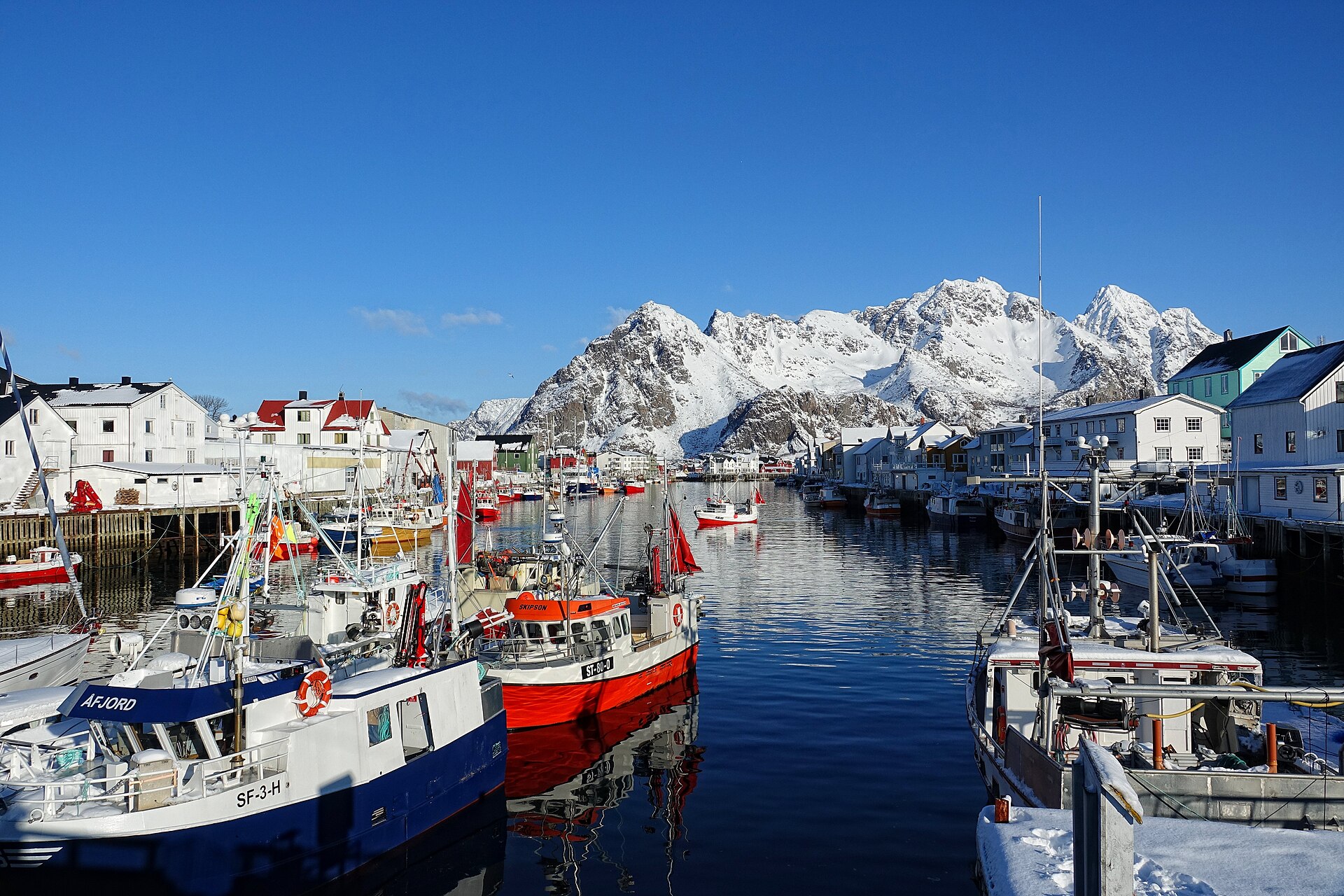
Svolvær to Henningsvær is 24 km and about 26 minutes on the E10 and the spur road. Go early. Henningsvær is a fishing village spread over several small islands, connected by bridges, with the much-photographed football pitch that you cannot actually photograph well from the ground. Drone or nothing, and drone rules are tight, so mostly nothing. The village is still worth the morning for the harbour, the drying racks and a good bakery.
Afternoon: Festvågtind, 541 m, 1.9 km one way, 1 to 1.5 hours up. This is the sensible first hike in Lofoten. Medium difficulty, a proper path, and a view down over Henningsvær that is genuinely better than the one from Reinebringen because you can see the village layout. The trailhead is by the Festvåg ferry quay.
If you have any interest in the aurora and you are here between late September and late March, this is the night to start watching. The archipelago sits at a good latitude for it, and I have covered the practical side of chasing the lights from these islands in detail, including which beaches face north.
Day 3 — West on the E10 to Reine (120 km, 3h driving with stops)
Change base today. Svolvær to Reine is about 1h53m of pure driving, but you should give it the whole day.
Stops in order: Vestvågøy and Leknes (about 70 km and just over an hour from Svolvær), then Nusfjord, then the Flakstad beaches. Nusfjord is a restored fishing village that now charges a 100 NOK ($10.70) entry fee, waived if you are staying at the resort. I have paid it and I have skipped it. It is a well-preserved place and the fee is honest about what it is, but if your time is short, the working harbour at Henningsvær tells you more about how these islands actually earn a living.
Leknes to Reine is 36 km and about 40 minutes. Arrive with light left if you can, because Hamnøy and Reine at low sun are the reason the archipelago is on so many Norway lists.
Day 4 — Reine, Å and Moskenes (40 km, full day, parking 150-300 NOK)
Reine to Å is 11 km and about 20 minutes. Å is the village at the end of the road, with a stockfish museum and a bakery in an old building, and it is small enough to see properly in two hours.
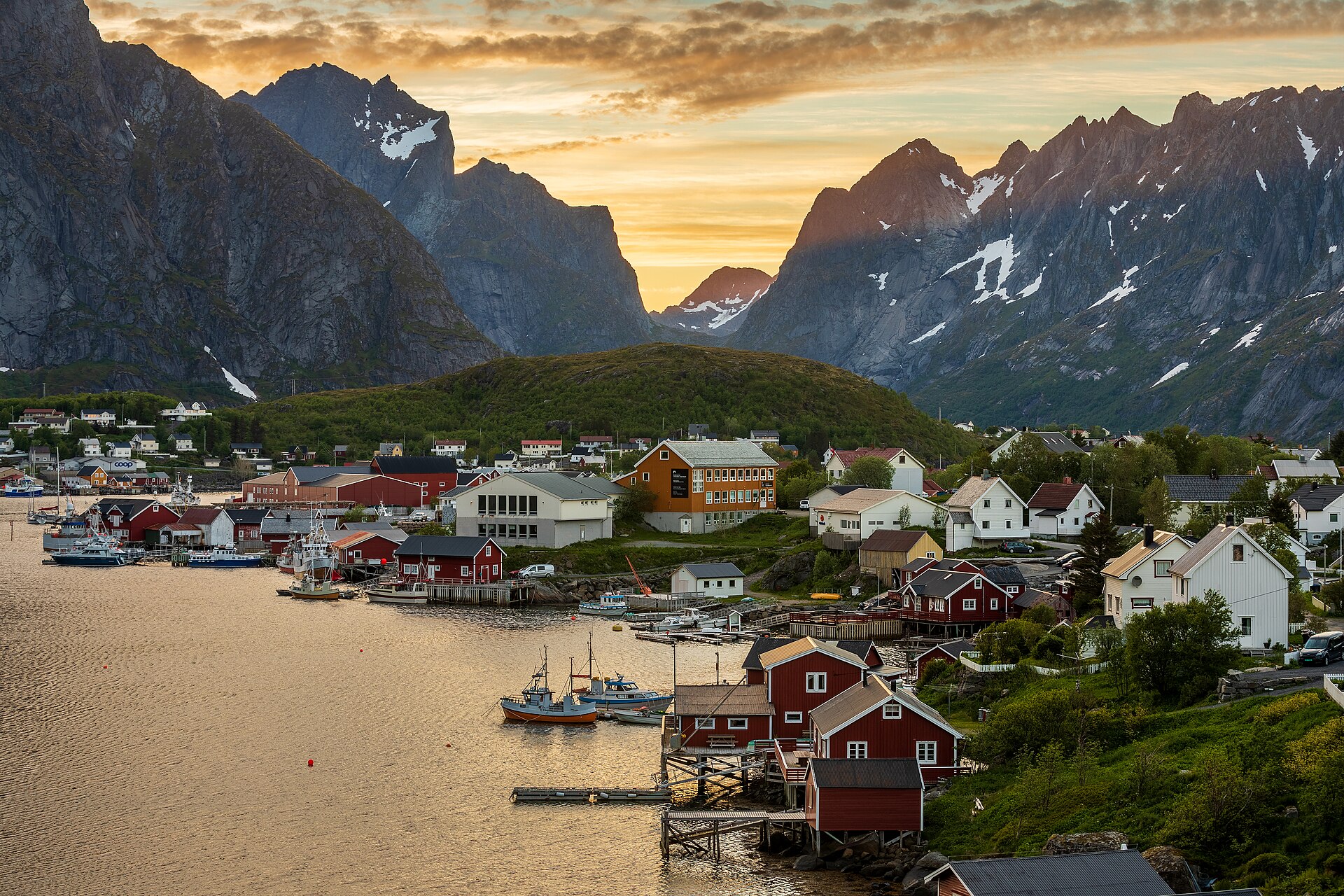
The important thing about today is parking, and it is the single most expensive mistake people make here. Since May 2025 the whole of Reine is a no-parking zone except for four marked P areas. The fine for parking outside them is 900 NOK, roughly $96. Full breakdown in the contrarian section below, because it deserves more than a footnote.
If the weather is good and you have the legs, this is the day to attempt Reinebringen. If the weather is marginal, do not. The staircase in wet conditions is a different proposition entirely and I say so below.
Departure logistics for day 5: if you are flying from Leknes, that is 36 km back east, allow an hour. If you are taking the Moskenes ferry, you are eight minutes from the quay, which is the one genuine advantage of basing yourself out here.
The six-day version
Two extra days, both spent in the west, and they change the trip from a drive-past into something you actually experienced. If you are stitching this into a longer route, my broader Norway routing guide covers how Lofoten connects to the rest of the country without wasting a week on transfers.
Day 5 — Reinebringen or Ryten (30-60 km, 3-5 hours on foot)
Pick based on weather and on how you feel about crowds.
Reinebringen: 5 km return, 400 to 448 m of gain depending on which sign you believe, about 2.5 hours, and roughly 1,974 Sherpa-built stone steps. Sources disagree on the exact step count and on the summit height; nobody has published a definitive figure and the trail has been rebuilt in stages, so treat both numbers as approximate.
Ryten: 543 m, about 3.5 km each way, 3 to 5 hours return, moderate. Trailhead parking is around 100 NOK ($10.70). This is the better hike. It is longer, quieter, the summit looks down on Kvalvika beach, and you are walking on ground rather than climbing a staircase in a queue.
If you only have the energy for one summit on this trip, and you have already done Festvågtind on day 2, take Ryten. I know that is not the popular answer. See below for why.
Day 6 — Haukland, Uttakleiv and the drive back (80-100 km)
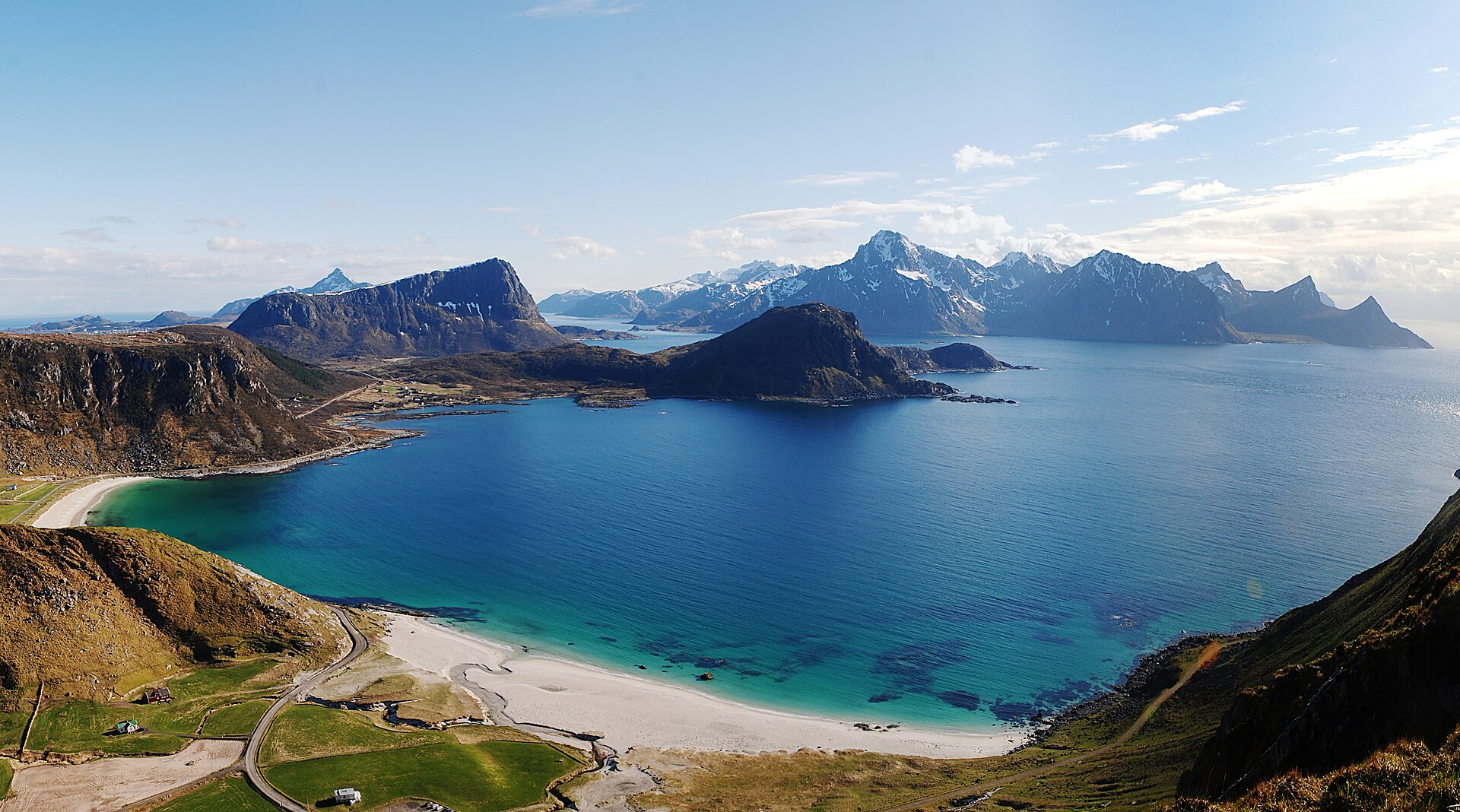
Work back east with a long stop at the Haukland and Uttakleiv beaches near Leknes. White sand, turquoise water, air temperature that makes the colour feel like a practical joke. There is a short coastal path linking the two beaches over a headland, about 40 minutes each way, and it is one of the best low-effort walks in the archipelago.
Then finish in Leknes or push on to Svolvær depending on where you fly out. If you have a late flight, the drive back east on a clear evening in June with the sun still up at 23:00 is the memory that sticks. My notes on planning around the midnight sun go into the dates properly.
Getting there: the ferry and flight numbers in full
This is the section the competition skips, and it is where the conflation happens. There are two boats from Bodø and they are not the same trip.
The Bodø to Moskenes car ferry
This is the one you want if you are bringing a vehicle. Crossing time is about 3h15m to 3h30m. Published sources give 3h, 3h15m and 3h30m; the discrepancy is mostly about whether the figure includes manoeuvring, so plan on three and a half hours.
| Fare type | Standard | With AutoPASS agreement | USD (standard) |
|---|---|---|---|
| Car under 6 m | 605 NOK | 302.50 NOK | about $65 |
| Electric car under 6 m | 424 NOK | 212 NOK | about $45 |
| Motorcycle | 177 NOK | not applicable | about $19 |
| Passengers and foot passengers | Free | Free | Free |
That AutoPASS line is the single most useful number in this article. A prepaid AutoPASS ferry agreement halves the car fare, 605 NOK down to 302.50 NOK, electric 424 down to 212. Set it up before you travel, not at the quay. I have never seen a competing itinerary mention it, and on a return crossing it saves you 605 NOK ($65) for the sake of a form.
Frequency is the real constraint. High season, 18 May to 6 September, gives you multiple daily departures. Low season, 1 October to 17 May, is usually two a day. The route moved 123,291 vehicles and 326,762 passengers in 2024, roughly 338 vehicles a day averaged out, which tells you two things: the boats are big, and in July they are still full. Book the vehicle deck ahead in summer.
The Bodø to Svolvær express boat (foot passengers only)
Route 23-755. Full run 3h 25m with nine stops, between one and three weekday departures each way, timetable valid 1 September 2026 to 31 January 2027. This is a passenger catamaran. No cars. Several guides describe “the ferry to Lofoten” and blur these two services together, which is how people end up standing on a quay in Bodø next to a hire car they cannot load.
Flying
| Route | Time | Notes |
|---|---|---|
| Oslo to Svolvær (SVJ) | 2h 25m | Widerøe, the only direct service from Oslo |
| Bodø to Svolvær | about 25 min | Widerøe Dash 8, roughly 27 flights a week as of May 2026 |
| Evenes (Harstad/Narvik) to Svolvær | about 2.5 h drive | Bigger airport, cheaper fares, adds a drive |
| Tromsø to Svolvær | just over 6 h drive | Only sensible if combining the two |
The two Lofoten airports are Leknes (LKN) in the middle of the archipelago and Svolvær (SVJ) in the east. Leknes is better placed if your base is Reine. Evenes is the value play: fares into it are usually well below the small-airport prices, and the 2.5-hour drive to Svolvær is scenic. If you are already going to be up north, the drive down from Tromsø is over six hours and I would not do it as a day transfer.
Can you do this without a car?
Yes, but the itinerary changes shape. Buses run the E10 between Svolvær, Leknes, Reine and Å, and foot passengers cross the ferry free, which is a genuinely good deal. What you lose is the beaches and trailheads that sit off the main road, and you lose the ability to move at dawn or dusk when the light is worth having. Base yourself in one place, use buses for the villages, and accept that Uttakleiv and Kvalvika are probably out. My general notes on moving around the country without your own vehicle apply here more than most places.
What to skip, and the things people get wrong
The Reine parking situation
Since May 2025 the entire village of Reine is a no-parking zone outside four marked P areas. This was a direct response to a village of a few hundred people absorbing a share of roughly one million annual visitors against about 25,000 residents archipelago-wide. Roadside pull-offs that guidebooks published two years ago are now enforcement targets.
| Parking area | Cost | Notes |
|---|---|---|
| Steffenakken | Free | About 20 cars, full by mid-morning in summer |
| Reine Kulturhus | 50 NOK/h, 150 NOK for 3-5 h, 300 NOK/24 h | The realistic Reinebringen option |
| Reine Harbour (municipal) | 43.75 NOK/h | Central, turns over quickly |
| Fellesdrift | 250 NOK/day | Flat rate, useful for a long hike |
| Anywhere else in Reine | 900 NOK fine | Enforced |
150 NOK ($16) for a three-to-five-hour stay at the Kulturhus is the price of doing Reinebringen legally. Pay it. The 900 NOK fine is about $96 and the wardens know exactly which laybys tourists use.
Reinebringen is not the easy win
The Sherpa staircase gets described as a stairway, which makes people think of a handrail and a gentle grade. It is roughly 1,974 uneven stone steps rising 400 metres or more in 2.5 km of return distance, with no shade, exposed sections near the top, and a queue. Around 41,000 people hiked it in the year to June 2024, up about 50% on the previous year. In wet weather the stone is slick and the descent is the dangerous half.
It is a fine hike. It is not the best hike in Lofoten, and it is certainly not the beginner-friendly one it is sold as. If you have a single good-weather window, I would spend it on Ryten. If you want the Reine view without the steps, the roadside view from the Hamnøy bridge is the shot you have actually seen on Instagram, and it costs nothing. There is more on grading Norwegian trails properly in my guide to walking in Norway.
Other things I would cut
The Magic Ice bar in Svolvær. The Lofotr Viking Museum is genuinely good but eats three hours and it is a hard sell on a four-day trip. Nusfjord at 100 NOK is a judgement call rather than a skip. And do not try to add Senja or Vesterålen to a first Lofoten visit; the driving swallows the trip.
Budget reality
Rorbu cabins in Reine and Hamnøy sit broadly in a 1,300 to 4,000 NOK per night band in season, roughly $140 to $430. That range is aggregated from booking-site listings rather than published rates, so treat it as indicative only. Everything else follows the national pattern, which I have broken down properly in my cost-of-travel guide, and the choice between a rorbu, a campsite and a guesthouse is covered in the accommodation guide.

Frequently asked questions
How many days in Lofoten do you actually need?
Four full days on the ground, which means five nights, is the minimum that justifies the journey. Six days on the ground is the number I would book, because it gives you two weather buffer days for hiking. Anything under four and you are spending a higher proportion of your trip in transit than in Lofoten.
How do you get to Lofoten from Bodø?
Three ways. The car ferry to Moskenes, about 3h15m to 3h30m, which is the only option that takes a vehicle. The express passenger boat to Svolvær, 3h 25m for the full run with nine stops, foot passengers only. Or the Widerøe flight to Svolvær, about 25 minutes, with roughly 27 services a week as of May 2026.
How long is the Lofoten ferry and how much does it cost?
About three and a half hours from Bodø to Moskenes. A car under six metres is 605 NOK (about $65), an electric car 424 NOK ($45), a motorcycle 177 NOK ($19), and all passengers and foot passengers travel free. A prepaid AutoPASS agreement halves the vehicle fares to 302.50 and 212 NOK respectively.
Is there a tourist tax or visitor levy in Lofoten?
No. As of September 2026 no visitor levy is being collected anywhere in Lofoten. Norway’s Visitor Contribution Act took effect on 1 July 2026, but it is opt-in per municipality and capped at 3% of the cost of overnight stays. Vågan, Vestvågøy, Flakstad and Moskenes are approved pilot municipalities targeting the first half of 2027, and campsites, tents, private campervans and boats are exempt from the scheme when it does arrive. If a booking site tells you otherwise this year, it is wrong.
Can you visit Lofoten without a car?
Yes. Buses connect Svolvær, Leknes, Reine and Å along the E10, foot passengers ride the Bodø ferry free, and both airports have onward transport. You will miss the off-road beaches and the flexible timing that makes photography here work, so pick one base rather than trying to move around. It is the cheaper trip by a wide margin.
How hard is Reinebringen and how many steps are there?
Roughly 1,974 Sherpa-built stone steps over 400 to 448 metres of ascent, 5 km return, about 2.5 hours. Published step counts and summit heights vary between sources. It is a steep, sustained, unshaded climb with an awkward descent, not a stroll, and it should not be attempted in rain or ice.
When is the midnight sun in Lofoten?
The upper limb of the sun stays above the horizon from 25 May to 18 July, and the full disc from 28 May to 14 July. At the other end of the year, Svolvær sits in polar night from 7 December to 6 January.
What is the best month to visit Lofoten?
Late May and early June for long light, open roads and fewer people than July. Late September for autumn colour and the first aurora nights. February if the northern lights are the entire point and you accept two ferry sailings a day. July is the busiest and the most expensive. My wider notes on seasonal timing across Norway and a few practical ground rules will fill in the gaps.
Photo credits
- Reine is the postcard, and since May 2025 it is also a no-parking zone. — Photo: Ximonic (Simo Räsänen) / CC BY-SA 4.0 via Wikimedia Commons.
- Henningsvaer is 24 km and 26 minutes from Svolvaer. — Photo: Bjørn Christian Tørrissen / CC BY-SA 4.0 via Wikimedia Commons.
- Haukland is the beach that makes people misjudge how far north they are. — Photo: Michele Agostini / CC BY-SA 2.0 via Wikimedia Commons.
- Polar night in Svolvaer runs from 7 December to 6 January. — Photo: Christoph Strässler / CC BY-SA 2.0 via Wikimedia Commons.
Fares, parking rates, fees and timetables checked September 2026. Currency conversions use 9.35 NOK to 1 USD. Ferry frequencies and the express boat timetable are seasonal, and the visitor levy position reflects the situation as of 2 September 2026.