Norway is one of the easiest countries in Europe to travel with children and one of the most expensive to get wrong. Those two facts sit right next to each other, and the difference between them is almost entirely about knowing the age and height cutoffs before you book.
I read the four articles currently ranking for Norway with kids. They’re warm, well-meaning and useful on atmosphere. Between them they contain almost no Norwegian kroner, not one height limit, and nothing about the car seat law — which is stricter here than in the UK or US and catches out most families hiring a car.
So this guide is the practical layer: what children actually pay, where they go free, which famous hikes a seven-year-old can genuinely finish, and what a week costs for two adults and two kids. For the wider picture, the main things-to-do guide covers the country as a whole.
Why Norway works with children
Norwegian culture is built around friluftsliv — open-air living — and children are simply included in it. Nurseries take toddlers outside in all weather. There’s a national saying that there’s no bad weather, only bad clothing, and people mean it. The practical consequences for a visiting family are real:
- Changing facilities and high chairs are normal, not a favour.
- Breastfeeding anywhere is completely unremarkable.
- Playgrounds are everywhere, well-built and free.
- Tap water is excellent, so you’re not buying bottled water for a week.
- It’s safe, calm, and drivers actually stop at crossings.
The two genuinely hard parts: distance — Norway is long, roads are slow and full of ferries, and “just two hours away” is often five — and cost, particularly eating out, which is where families haemorrhage money fastest.
The single biggest money lever: under-18s go free
This is the fact that changes a family budget in Norway, and none of the competing articles frame it properly. Norway’s major museums admit children free — not reduced, free.
| Place | Adult 2026 | Children |
|---|---|---|
| MUNCH, Oslo | NOK 280 day / 200 evening | Free 0–17; NOK 100 under 25 |
| Nasjonalmuseet, Oslo | Around NOK 200 | Free under 18 |
| Vigeland Sculpture Park | Free | Free, open 24/7 |
| Opera House roof | Free | Free |
| Holmenkollen Ski Museum | NOK 185 | NOK 110 (6–15), free under 6; family 2+2 NOK 500 |
| Lofotr Viking Museum | NOK 265 | NOK 170 (6–15), free under 6; family NOK 750 |
| Fløibanen funicular, Bergen | NOK 200 return online | NOK 100 (4–15), free under 4; family 2+2 NOK 500 summer, 365 winter |
Two Oslo notes. The Oslo Pass child price is exactly half the adult — NOK 290 for 24 hours against NOK 580 — but given children are already free at the big museums, it’s usually only worth buying for the adults. And MUNCH is free on Wednesday evenings between 18:00 and 21:00 outside July and August, which is a genuinely good rainy-day move.
One thing to plan around: the old Viking Ship Museum on Bygdøy is closed and reopens as the Museum of the Viking Age in 2027. Every child who has been promised a Viking ship in Oslo this year will be disappointed. The Fram polar-exploration museum next door is open, excellent, and you can walk around inside the actual ship — which lands better with under-tens anyway.
Car seats: the rule that catches families out
Norway’s child restraint law is stricter than most visitors expect, and rental companies enforce it.
- Children under 135 cm must use an approved child restraint. Not “should” — must.
- Children between 135 and 150 cm should use one if it’s available.
- Children under 15 months must travel rear-facing, and rear-facing is recommended well beyond that — to age four and up. Norway is the country that pioneered extended rear-facing, and Norwegian parents take it seriously.
- Children under 140 cm must not sit in a front seat with an active airbag.
Hire seats cost roughly NOK 100–150 a day and are frequently sold out in summer, so reserve them with the car rather than on arrival. If you’re bringing your own, check it’s E-marked.
Getting around with children
Trains are the answer. On the SJ Nord routes — Oslo–Trondheim and Trondheim–Bodø — children under 6 travel free with an adult on a Standard ticket (still reserve them a seat), and 6–17s get 50% off Standard Refundable fares. Better still, those routes run family carriages with a playroom and changing table, which turns a six-hour journey from an endurance event into the best part of the day.
On Vy’s routes, including the Oslo–Bergen line, under-6s travel free and school-age children travel at a substantial discount; check the exact bracket when booking as the fare rules shift. The airport express, Flytoget, generally carries under-16s free with a paying adult — worth confirming at the machine, but it’s a meaningful saving on arrival.
Ferries are free more often than you’d think. Around 60 low-traffic and island routes carry vehicles and passengers at no charge at all. Where a crossing is paid, the AutoPASS vehicle fare normally covers the driver and all passengers, so children don’t add to the fare.
Buses and city transport are cheap for children and free for the very young. In Oslo, a child fare is roughly half an adult’s, and prams travel free — you board through the middle doors and don’t pay for the pusher.
The transport guide has the full fare picture, including why you should use the Entur app rather than Google Maps.
A seven-day route that actually works with children
The commonest family mistake in Norway is planning an adult itinerary and adding children to it. Norwegian travel days are long, and a route that looks efficient on a map becomes a car full of misery. This is the shape that works: two proper bases, one spectacular journey between them, nothing rushed.
| Day | Where | With kids |
|---|---|---|
| 1 | Oslo | Arrive, Opera House roof, harbour ice cream, early night |
| 2 | Oslo | Bygdøy: Fram museum and the open-air folk museum; ferry back |
| 3 | Oslo → Flåm | Bergen Line to Myrdal, then the Flåm Railway down |
| 4 | Flåm | Electric fjord boat on the Nærøyfjord; cycle or swim in the afternoon |
| 5 | Flåm → Bergen | Boat or bus to Bergen; fish market; settle in |
| 6 | Bergen | Fløibanen, troll forest and playground; aquarium if it rains |
| 7 | Bergen | Bryggen’s alleys, Bergenhus grounds, fly home |
Note what isn’t in there: no long drives, no 6am starts, and a maximum of one moving day in three. If you want to add Lofoten, fly rather than drive — Bergen to Bodø or Evenes takes under two hours and saves you two days in a car. The itinerary guide has longer routes.
Feeding children in Norway without going broke
Food is where family budgets die here. A café lunch for four runs NOK 700–900; a restaurant dinner NOK 1,500–2,000. Do that daily for a week and you’ve spent more on eating than on beds.
What Norwegian families actually do:
- Matpakke. The packed lunch is a genuine national institution — bread, brown cheese, a sliced pepper, wrapped in paper. Norwegian children eat this every school day of their lives. Make it in the morning, eat it on a rock with a view, and you’ve saved NOK 800 and had a better lunch.
- Book accommodation with a kitchen. A hytte, cabin or apartment costs little more than a hotel room for four and removes most of your food spend. Campsite cabins are the cheap end and are usually spotless.
- Shop at the discounters. Kiwi, Rema 1000 and Coop Extra, not the convenience shops at stations.
- Eat the hotel breakfast. Norwegian hotel breakfasts are enormous and usually included. A big one at 8am removes the need for a paid lunch entirely — and nobody minds if a roll leaves in a napkin.
- Hot dogs are the national fallback. Every petrol station sells pølse with a lompe wrap for around NOK 45. Not glamorous; universally accepted by children.
- Drink the tap water. It’s among the best in the world. Buying bottled water in Norway is money set on fire.
Where it’s worth paying: the Bergen fish market’s indoor hall, a proper waffle with brown cheese and sour cream at a mountain lodge, and one dinner somewhere with a fjord view. Three good meals beat seven mediocre ones.
Ages and stages: what actually lands
Toddlers and under-fives. Norway is easy at this age but the distances aren’t. Stay put — Oslo plus a fjord base is plenty. Playgrounds, ferries and animals do more than any attraction; the Oslofjord island ferries are a hit precisely because they’re just boats. Prams go free on public transport and most trails near towns are pram-friendly. Skip the long hikes entirely.
Five to nine. The sweet spot. Old enough for the Flåm Railway, a fjord boat, a short hike and a theme park; young enough that trolls still work as a narrative. This is the age where Norway’s folklore does a lot of heavy lifting — troll signs on roads, the troll forest at Fløyen, Hunderfossen’s giant. Lean into it shamelessly.
Ten to thirteen. Now you can do the real stuff: Preikestolen, Reinebringen, kayaking, a proper via ferrata, dog sledding as a passenger. Also the age where a rorbu cabin over the water in Lofoten becomes the memory rather than any single activity.
Teenagers. Norway is unusually good for teens, because the activities are genuinely impressive rather than childish: Trolltunga, surfing at Unstad in Lofoten, ziplines, RIB safaris, ski touring. Give them one thing that sounds slightly dangerous and the rest of the trip runs itself.
What to pack that you wouldn’t think of
- Full waterproofs for every child, including trousers. Not a rain jacket — trousers too. This is non-negotiable in western Norway.
- Wool base layers, even in July. Norwegian children wear wool year-round, and it’s the reason they’re outside in weather that would send other families indoors.
- An eye mask or blackout blind for the midnight sun. Worth repeating because it’s the thing that ruins most Arctic family trips.
- Insect repellent if you’re going inland in July or August.
- A refillable bottle each. Free water everywhere, and it’s better than anything you’d buy.
- Snacks for travel days. Station and ferry food is expensive and thin.
What you don’t need: umbrellas (useless in coastal wind), formal clothes (nowhere expects them), or large amounts of cash — Norway is close to fully cashless and card works everywhere, including on buses and at unstaffed car parks. More in the planning essentials guide.
Which famous hikes can children actually do?
This is the question parents ask and nobody answers honestly. Norway’s icon hikes are marketed with photographs, not gradients. Here’s the real picture.
| Hike | Distance | Time | Realistic age | Verdict |
|---|---|---|---|---|
| Reinebringen, Lofoten | ~2 km, 1,978 steps | 2–3 hrs | 8+ | Steep but short; stairs the whole way |
| Preikestolen | 8 km return | 4–5 hrs | 6–7+ | Doable with fit kids; no barrier at the edge |
| Fløyen to Vidden, Bergen | 13–15 km | 4–6 hrs | 10+ | Exposed plateau; take the funicular down |
| Besseggen, Jotunheimen | 14 km | 6–8 hrs | 12+ | Scrambling and drops; not for nervous kids |
| Kjeragbolten | 11 km | 6–7 hrs | 12+ | Chain sections; the boulder itself is a hard no |
| Trolltunga | 28 km | 10–12 hrs | 14+ | A serious mountain day. Don’t. |
Two safety points worth stating plainly. Preikestolen has no fence. None. It is a flat cliff top 604 metres above a fjord with a vertical edge and nothing to stop a running child. Plenty of families do it and it’s fine, but you hold hands near the edge and you don’t do it with a toddler on your shoulders.
And Norwegian trails are graded for Norwegians. A route described locally as “easy family walk” may involve a scramble that a British or American guidebook would grade moderate. The hiking guide covers conditions and gear.
The better answer for younger children is usually the low-effort spectaculars: the boardwalk at Vøringsfossen, walking behind Steinsdalsfossen, the Fløibanen up and a gentle troll-themed forest trail down, or any Lofoten beach.
Theme parks, animal parks and rainy days
Norway’s family attractions are genuinely good and priced with height gates that determine what you pay. Check these before you promise anything.
Kristiansand Dyreparken is the big one — zoo, water park and a Norwegian children’s-book village rolled together, and it draws over a million visitors a year. Entry is free until the day before a child’s third birthday. Day tickets start around NOK 269 for children and NOK 299 for adults but run on dynamic pricing that climbs past NOK 600 in school holidays, so book early and online — that alone saves about NOK 50 a ticket. Extra days are heavily discounted, from about NOK 150.
Hunderfossen, near Lillehammer, is the fairytale park with the giant troll. Entry is free under 90 cm; the Children’s Farm is free under 2. It pairs well with the Lillehammer Olympic sites and the Maihaugen open-air museum.
TusenFryd, half an hour from Oslo, is the rollercoaster park. Under 95 cm goes free; 95–120 cm is a reduced ticket from around NOK 469; over 120 cm from around NOK 529 booked online, which is NOK 60–80 cheaper than at the gate.
Atlanterhavsparken in Ålesund is a superb aquarium built into the coastline, with divers feeding fish in a huge open tank. Children 3–15 pay around NOK 135; under-3s free.
The Norwegian Museum of Cultural History at Bygdøy in Oslo is an open-air village of relocated historic buildings including a stave church, with costumed staff and animals. It’s the best rainy-and-dry hybrid in the country.
Where to base yourself with kids
Oslo (2–3 days). The easiest arrival, and unusually good for children: Bygdøy’s museums, the fortress, the islands in the Oslofjord for swimming, Nordmarka forest twenty minutes up the metro, and TusenFryd nearby. See the Oslo guide.
Bergen (2 days). Compact, walkable, and the Fløibanen has a troll forest and playground at the top that buys parents an hour. The aquarium is central. It rains — plan for it rather than fighting it. The Bergen guide has the wet-weather list.
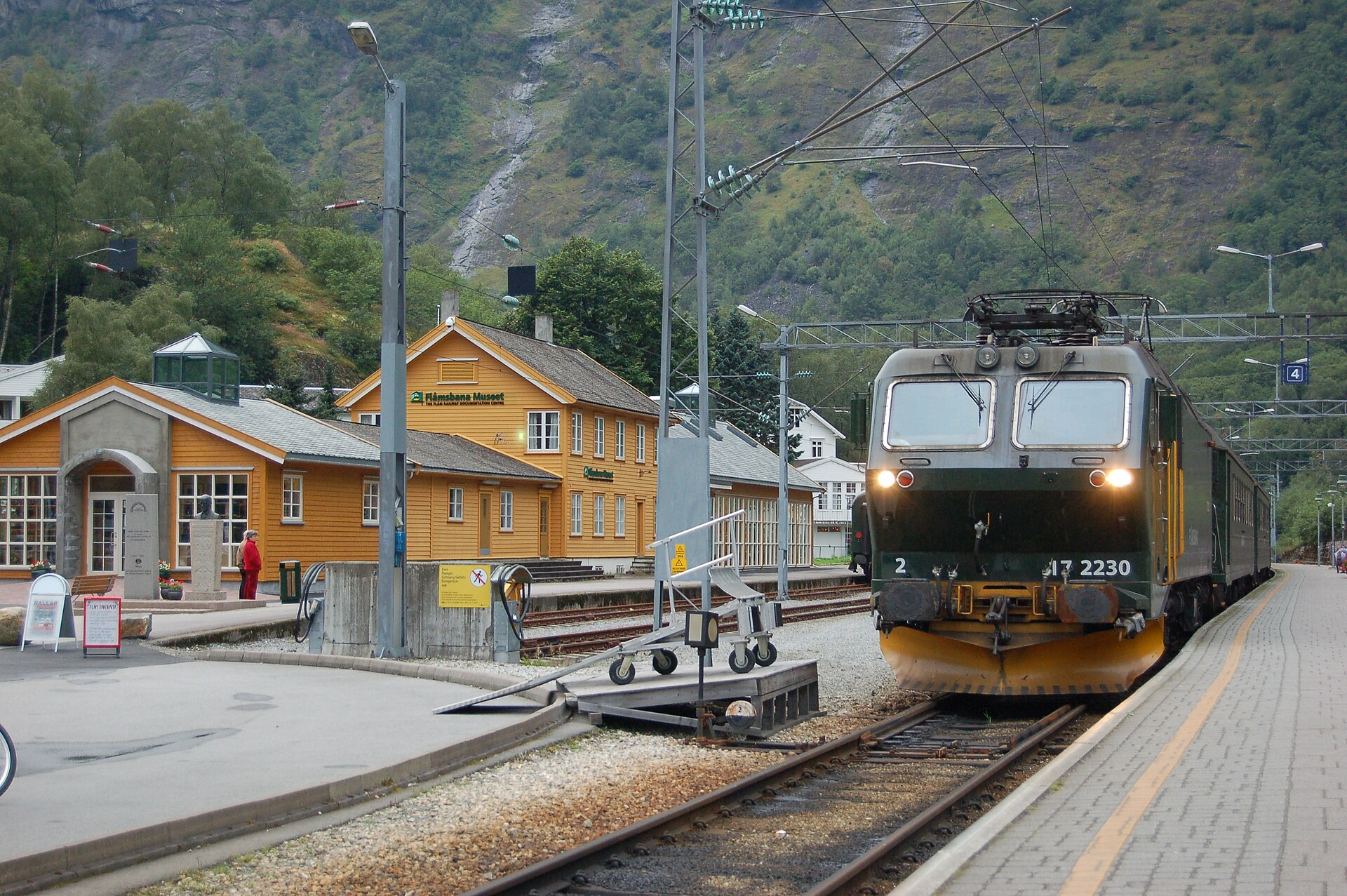
Flåm and the Nærøyfjord (1–2 days). The Flåm Railway is the single best-value hour with children in Norway: waterfalls, tunnels, a dramatic stop, and it’s over before anyone gets bored. The fjord boats are now electric and quiet, which helps with younger children.
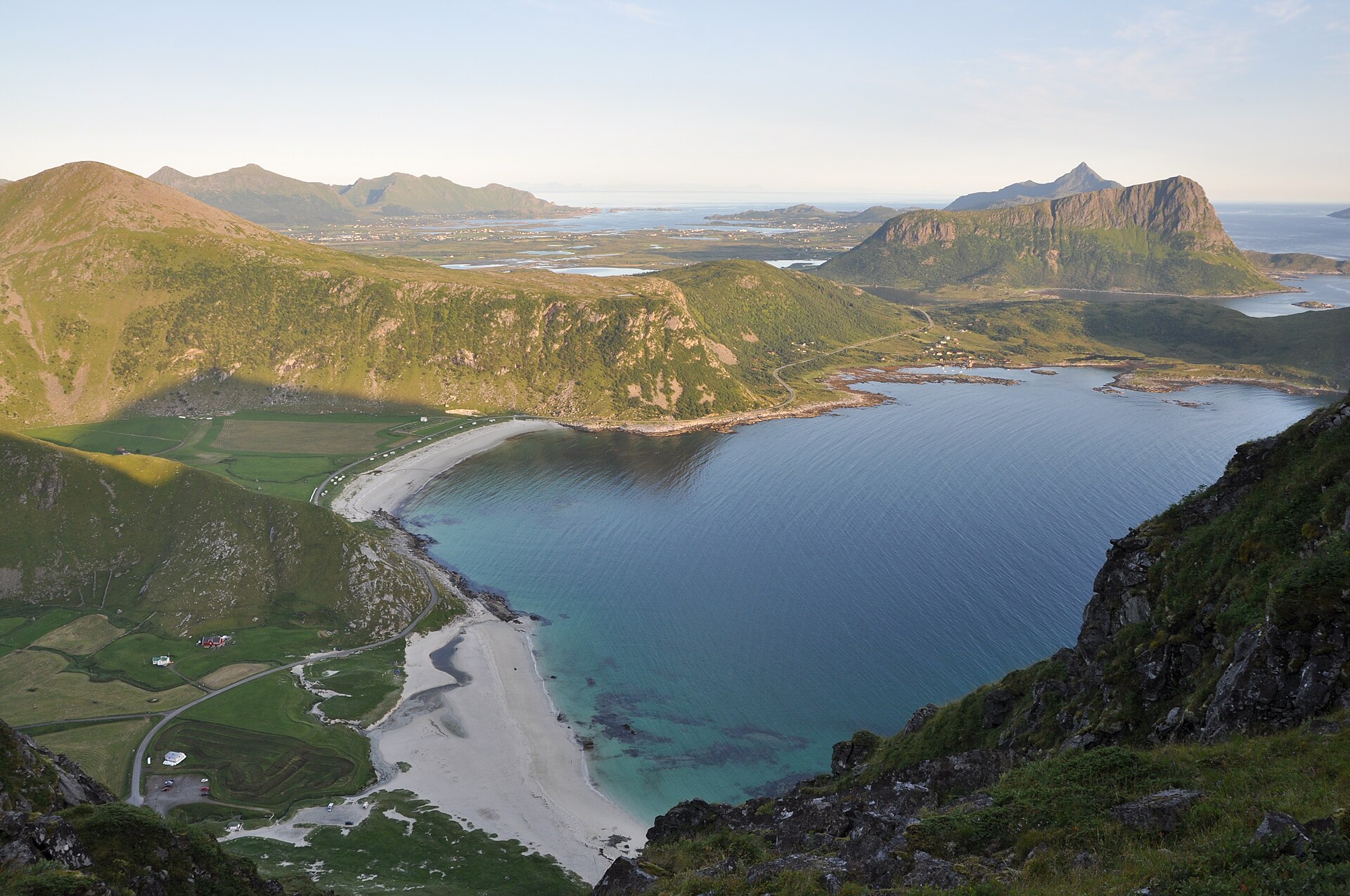
Lofoten (4–5 days). White-sand beaches, rorbu cabins where children get their own bunk over the water, short hikes, and the midnight sun to blame for bedtimes going completely wrong. Needs a car. The Lofoten guide covers logistics.
Tromsø (3 days, winter). Dog sledding, reindeer, the cable car, and aurora — though be realistic, chases run late and are cold. Several operators run shorter, earlier family versions. The Tromsø guide lists them.
Winter with kids
Every competing article is a summer article, which is a shame, because Norway in winter is arguably better with children — it’s the season the country is designed around.
Sledging is a national activity with free municipal hills. Cross-country tracks in Oslo’s Nordmarka are floodlit until late and free to use. Dog sledding as a passenger works from about age four; driving your own team is teens and adults. Reindeer sledding with a Sámi herder is slow, gentle and better suited to small children than an aurora chase.
The honest caveats: daylight is short (Tromsø gets none at all from late November to mid-January), aurora tours run from 18:00 to past midnight in serious cold, and small children will not enjoy a five-hour chase. Pick the daytime activities and accept you might not see the lights. The winter guide has what runs when.
What a week costs for a family of four
Nobody publishes this, so here it is: two adults and two children aged 6 and 10, seven nights in summer, Oslo–Bergen–Flåm, at roughly 9.5 NOK to the dollar.
| Item | Budget version | Comfortable version |
|---|---|---|
| Accommodation, 7 nights | Cabins/campsite: NOK 7,000 | Family hotel rooms: NOK 16,000 |
| Food | Self-catering + 2 meals out: NOK 5,500 | Half eating out: NOK 12,000 |
| Transport | Trains booked early: NOK 3,500 | Hire car + fuel + ferries: NOK 8,000 |
| Attractions | Mostly free + Flåm Railway: NOK 2,000 | Add Dyreparken/aquarium: NOK 5,000 |
| Total | ~NOK 18,000 (~$1,900) | ~NOK 41,000 (~$4,300) |
The gap between those columns is mostly food and beds, not attractions — because attractions are where children are cheapest. Self-catering in a hytte or apartment is the single biggest saving available to a family here. The costs guide and the accommodation guide go deeper.
Practical things Norwegian parents know
- Bring a blackout blind or eye masks. In June above the Arctic Circle it does not get dark, and children’s bedtimes collapse entirely. This is the most common complaint I hear from families.
- Supermarkets stock everything. Nappies (bleier), formula (morsmelkerstatning), baby food and calpol-equivalents are all in Kiwi, Rema 1000 and Coop Extra. Don’t overpack.
- Rain gear, not umbrellas. Full waterproofs and wellies for every child. Norwegian kids wear regntøy as a default, and the weather changes hourly.
- Book July early or avoid it. The Norwegian fellesferie — the common holiday — falls in weeks 28 to 30, which in 2026 was 6 to 24 July. Cities empty out, the coast and cabins fill, and prices peak.
- Mosquitoes are real inland. The Finnmarksvidda plateau and areas around bogs and lakes are bad in July and August. The windy coast is largely fine.
- Sunday closing. Most shops shut. Plan food on Saturday.
Frequently asked questions
Is Norway good for families with young children?
Unusually so. Facilities are excellent, it’s safe, and outdoor life includes children by default. The constraints are distance and the cost of eating out, both of which are manageable with trains and self-catering.
Do children travel free on trains in Norway?
Under-6s travel free with an adult on standard tickets — you should still reserve them a seat. School-age children get large discounts, typically around half the adult fare. The Oslo–Trondheim and Trondheim–Bodø services have family carriages with a playroom.
Can kids hike Preikestolen?
Fit six- and seven-year-olds manage it regularly. It’s 8 km return, four to five hours, and about 350 to 500 metres of climb. The serious point is that the cliff top has no fence — hold hands, and don’t attempt it with a toddler.
Do I need a car seat in Norway?
Yes. Children under 135 cm must be in an approved restraint, under-15-months must be rear-facing, and under-140 cm can’t sit in front of a live airbag. Reserve hire seats with the car; they sell out in summer.
What is the best time to visit Norway with children?
Late June or mid-August — long days and open attractions, either side of the July crush. February and March if you want snow, sledging and huskies with enough daylight to use them.
How many days do you need in Norway with kids?
Seven to ten, and fewer places than you’d plan for adults. Two bases plus a scenic journey between them beats four bases. Norwegian travel days are long.
Is Norway too expensive for a family holiday?
It’s expensive but the children’s economics are unusually favourable: free museums under 18, free or half-price transport, free nature everywhere. A self-catering week runs around NOK 18,000 for a family of four. Eating out is what breaks budgets here.
Are Norwegian beaches safe for children?
Yes, and free under the right to roam. The water is cold — the Oslofjord reaches 20–22°C in July and August, while Lofoten peaks around 11–15°C, which is wetsuit territory for anything longer than a shriek and a run out.
Photo credits
All photographs are used under their respective Creative Commons or public-domain licences.
- Haukland, Lofoten. Caribbean — Photo: Paal Svendsen / CC BY-SA 3.0 via Wikimedia Commons.
- The Flåm Railway at Flåm. The best — Photo: Alasdair McLellan / Public domain via Wikimedia Commons.
Prices, age brackets and height limits were checked in July 2026 and are given in Norwegian kroner at roughly 9.5 NOK to 1 USD. Attraction pricing in Norway is increasingly dynamic — confirm on the operator’s own site before booking.