The one number that decides your budget, and nobody publishes it
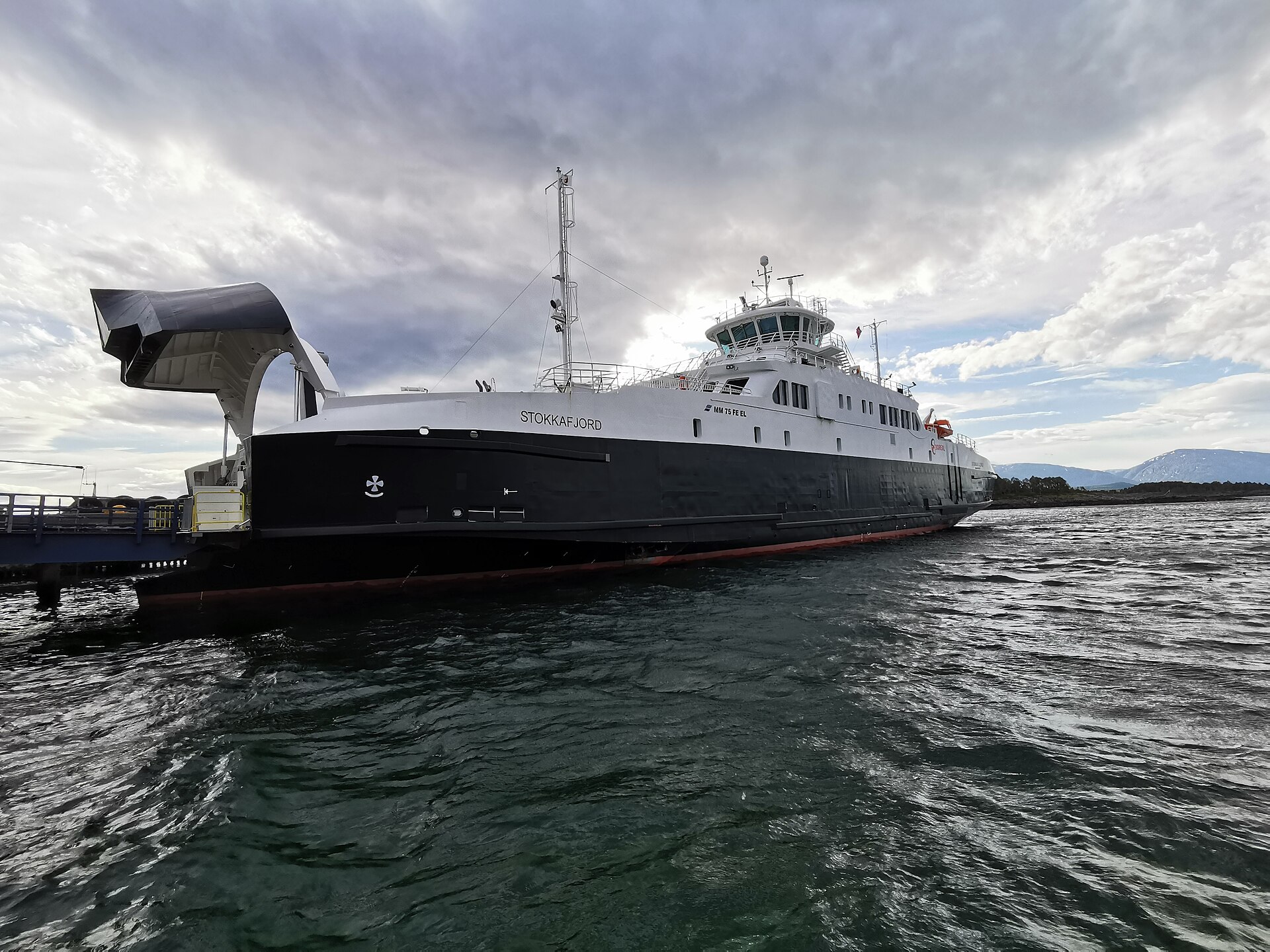
Every guide to a norway campervan road trip tells you ferries are expensive. Not one of the five biggest pages on this topic tells you how they are expensive, which is the part that actually changes what you spend. Norwegian car ferries do not charge by weight, by axle count, or by some vague sense of how big your vehicle looks. They charge by length, in nine official bands, under a single national tariff. Cross the line from under six metres to 6.01 metres and your fare roughly doubles. On every crossing. For the whole trip.
I have read the five top-ranking campervan Norway articles side by side. Two give no prices at all. The two best are honest, receipt-based accounts from people who genuinely drove it, and they still contradict each other outright on tolls. None names the tariff structure.
So this is not a driving guide or an itinerary. It is the money and the law: what a motorhome trip in Norway actually costs in 2026, where you may legally sleep, and the trips where I would tell you to hire a car and book cabins instead. If it’s routes you’re after, our Norway itinerary hub lays them out from five days to two weeks.
The ferry length bands: the centrepiece
The AutoPASS ferry tariff that came into force on 1 January 2026 sorts vehicles into nine length bands plus a motorcycle rate. Prices below include 12% VAT. The band is decided by the total measured length of what you drive onto the deck, not by what the registration document says the chassis is.
| Band | Vehicle length | Typical vehicle |
|---|---|---|
| Motorcycle | n/a | Motorcycle with driver |
| AP1 | Under 6.00 m | Car, small panel-van conversion |
| AP2 | 6.01-8.00 m | Most coachbuilt motorhomes, long-wheelbase vans |
| AP3 | 8.01-10.00 m | Large A-class, van plus trailer |
| AP4 | 10.01-12.50 m | Big rigs, car plus caravan |
| AP5-AP8 | 12.51-22.00 m | Commercial vehicles |
| AP9 | Over 22.00 m | Articulated freight |
Every crossing is assigned a price zone, and the zone number tells you how far you are travelling: short hops across a fjord arm sit low, long open-water runs sit high. Here is what three representative zones cost, and this is the table I wish someone had shown me before I booked my first van.
| Zone | AP1 car (under 6 m) | AP2 van (6-8 m) | AP3 van (8-10 m) | AP2 vs car | AP3 vs car |
|---|---|---|---|---|---|
| Zone 10 (short hop) | NOK 104 ($11) | NOK 231 ($25) | NOK 318 ($34) | 2.22x | 3.06x |
| Zone 22 (medium) | NOK 176 ($19) | NOK 382 ($41) | NOK 507 ($54) | 2.17x | 2.88x |
| Zone 50 (long) | NOK 345 ($37) | NOK 734 ($79) | NOK 961 ($103) | 2.13x | 2.79x |
Look at the last two columns. The multiplier barely moves. Across the whole tariff the step from AP1 to AP2 sits at roughly 2.1x to 2.3x, and AP1 to AP3 at roughly 2.9x to 3.1x. That stability is useful, because it means you can plan without looking up every single crossing. Take whatever a car would pay on your route, double it for a normal coachbuilt motorhome, triple it for a big one. That is the rule of thumb the competitor pages are reaching for but never state.
The ferry fare covers the driver and every passenger when you pay through AutoPASS. Nobody in the back buys a foot-passenger ticket. Electric and hydrogen vehicles pay 50% of the standard rate for their band with a tag fitted, which is why an EV camper on a route through the fjord country of western Norway can undercut a diesel van of identical size by a serious margin over a fortnight.
The bike rack problem, and why “six metres” is a trap
This is where people get caught, and I have watched it happen at a ferry booth. The band is set by measured length including anything bolted to the vehicle. A rear bike rack with two bikes on it, a towbar with a cycle carrier, a spare wheel on a swing arm, a rear box: all of it counts. A van sold as a 5.99 m model with a rack on the back is not an AP1 vehicle. It is AP2, and it pays 2.2x the car rate on every crossing for the rest of your trip.
Twelve zone-22 crossings at AP1 is NOK 2,112 ($226). The same twelve at AP2 is NOK 4,584 ($490). The bikes cost you NOK 2,472 ($264) in fares before you have ridden them anywhere. Ask a hire operator for the registered total length with accessories fitted, and take the rack off if the bikes will fold inside.
Getting the 50% discount
There are two different things people confuse. Fitting an AutoPASS tag on its own gets you 10% off ferry fares. Signing an AutoPASS ferry prepayment agreement, where you load money onto an account in advance, gets private customers 50% off and business customers 40%. That is not a rounding error; on a two-week trip with a dozen crossings it is the single biggest saving available to you, and it applies to every band equally.
The catch is the deposit. Figures circulating for 2026 put it at NOK 2,200 ($235) for vehicles up to 8 m, NOK 10,600 ($1,134) for 8.01-17.5 m, and NOK 20,100 ($2,150) above that. I have not confirmed those three numbers against the official tariff, so treat them as reported rather than verified. The 50% itself is not in dispute. Set the agreement up before you leave.
Tolls: a completely different system, and both big competitors got it wrong
Here is the disagreement, stated plainly. Wandering Bird, a solo UK motorhomer whose page is the most detailed thing on the internet about getting a van to Norway, reports that motorhomes pay the car rate at toll gantries. The Gap Decaders, a full-time touring couple with the best AutoPASS walkthrough anywhere, report that motorhomes over 3,500 kg typically pay two to four times the car rate. Both are writing from genuine receipts. Both are describing something real. Neither states the rule that reconciles them, and readers are left picking a side.
The rule is this. Tolls are not priced by length at all. They are priced by weight class. A motorhome registered as vehicle category M1 with a permitted mass over 3,500 kg is charged at rate group 1, the light-vehicle rate, only if it carries a valid AutoPASS tag and a valid agreement behind that tag. Without both, the same vehicle drops into rate group 2 and gets billed as a heavy goods vehicle.
So Wandering Bird is right about a tagged M1 motorhome. The Gap Decaders are right about an untagged one. The variable is not the van, it is the paperwork, and the difference between those two outcomes over a long trip is enormous. Get the tag, register it against the correct vehicle, and check that the registration shows M1 rather than a goods classification. Do that and heavy-vehicle toll rates simply never appear on your account.
Keep the two systems separate in your head. Length decides ferries, weight decides tolls, and a page that treats “big vehicle costs more” as one rule will mislead you on both. A hire van from a Norwegian operator normally arrives with a tag already fitted and registered, which removes the problem entirely. Confirm it at pickup rather than assuming.
What everything else costs in 2026
Hire: the biggest line on the invoice
Rental is where a campervan Norway trip stops being the cheap option. Across the Norwegian market in 2026 you are looking at roughly NOK 1,300 ($139) a day for a small van in the quiet months up to about NOK 3,000 ($321) a day for the largest models at the peak, and those figures already include 25% VAT. One Oslo operator I checked publishes a clean three-tier structure that is representative of the market.
| Season | 2026 dates | Daily rate | 14 days |
|---|---|---|---|
| Low | Up to 22 May | NOK 1,600 ($171) | NOK 22,400 ($2,396) |
| Mid | 22 May-12 Jun, 24 Aug-12 Sep | NOK 2,100 ($225) | NOK 29,400 ($3,144) |
| High | 13 Jun-23 Aug | NOK 2,500 ($267) | NOK 35,000 ($3,743) |
Non-Norwegian booking sites quote the same product at roughly EUR 150 a night in low season to EUR 300 at the peak, which lands in the same territory once converted. The shoulder is the obvious play: the mid-season band from late August into early September saves NOK 5,600 ($599) over a fortnight, and the roads are emptier. The arithmetic on travelling outside the peak weeks is more persuasive for vans than for any other kind of Norwegian trip, because rental rates, pitch rates and ferry queues all move together.
Check whether the quoted rate includes unlimited mileage, because a fjord-and-north loop racks up distance fast. And check the tag, as above.
Campsites and bobilplasser
Sources genuinely disagree on nightly rates. One puts a campervan pitch at NOK 250-400 ($27-43) including electricity; another puts it at NOK 350-500 ($37-53). My own experience sits nearer the higher range in summer anywhere with a fjord view, nearer the lower one inland and off-season. Showers are metered separately: one source says NOK 20 ($2.14) per five minutes, another NOK 30-60 ($3.20-6.40). Budget NOK 50 ($5) a head per day.
Bobilplasser, the dedicated motorhome stopovers, are the cheaper tier and the one most foreign visitors underuse. One source gives a general range of NOK 130-200 ($14-21) a night. Specific 2026 examples I have prices for: Vanse Bobilcamp at NOK 250 ($27) a night, the NAF camp at Hamar at NOK 340 ($36), Vøra Camping at NOK 475 ($51) a day. So the honest picture is a wide spread, with the cheap end genuinely cheap and the well-located ones priced like campsites.
Outside high season a CampingCard ACSI membership pays for itself immediately, giving over 60% off at participating Norwegian campsites. That is the most effective discount in the accommodation column, and the reason a van trip in late May can undercut one in mid-July by a third. It is worth comparing against the wider market of Norwegian accommodation options.
Services, water and dumping
This is the pleasant surprise. Service and dump stations are usually free, including many at petrol stations and municipal stopovers, though a few automated cassette machines want coins. Tap water is potable nationwide and free, so fills are a non-issue and you should never buy bottled water. Over a fortnight this category is close to zero.
Gas, LPG and diesel heating
Norway has over 100 LPG stations, findable through LPGnorge.no. Connectors are a mix of UK and Dutch bayonet types with adapters usually supplied, so ask which one your van needs before leaving the depot. Finland has no LPG network at all, so fill before the border if you are continuing east.
A NOK 1,200 ($128) gas bottle lasts four to six weeks of cold-season motorhome use. That is worth doing the sums on, because gas heating frequently works out cheaper than paying for campsite electric hook-up in winter, and it means you are not tethered to a powered pitch every night. Diesel heaters get no coverage at all in the competitor guides and they are the quiet upgrade worth paying for on any cold-season trip north of Trondheim, because they run off the vehicle tank and do not care whether the site has power.
Fuel, and why old guides understate it
Petrol averaged NOK 26.84 ($2.87) a litre nationally on 1 September 2026, immediately after a duty rise of NOK 4.71 a litre took effect that same day. The competitor guides still in circulation quote NOK 19-22 a litre. Those were accurate when written and are now roughly a quarter too low. If you budgeted from a page published before September 2026, add 25% to the fuel line.
Where you may legally sleep: settling the allemannsretten argument
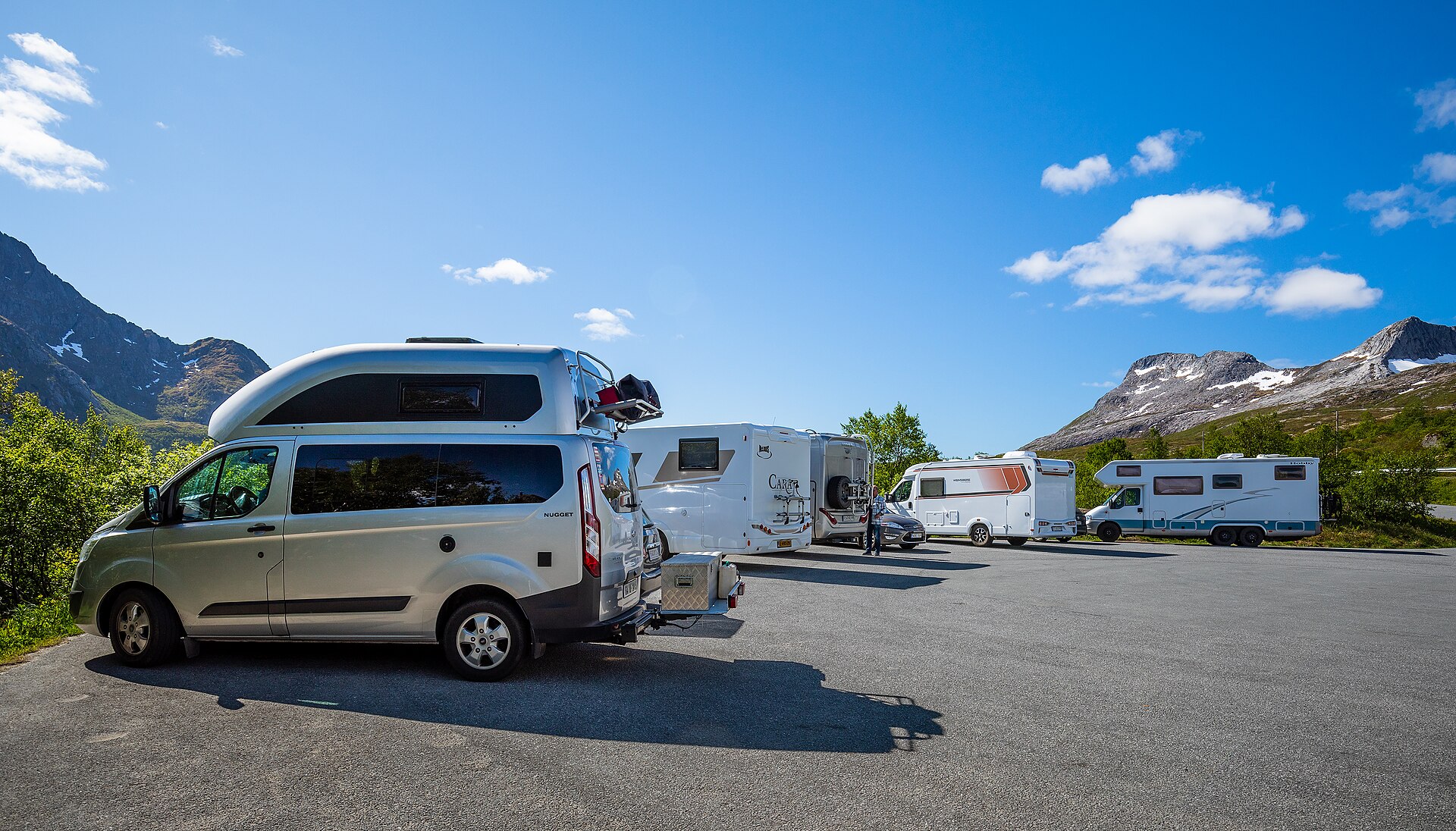
The internet has decided that allemannsretten, the Norwegian right to roam, “does not apply to motorhomes”. That claim is repeated confidently on blogs and it is too strong.
NAF, the Norwegian automobile federation, points to the preparatory works of friluftsloven, the Outdoor Recreation Act, which confirm that the law does apply to motorhomes, and that section 9 permits camping with a bobil in utmark, the uncultivated land the right covers. So the right exists for you. The real constraint is not the vehicle, it is the surface.
A tent may be carried off-road and pitched in terrain. A vehicle may not be driven into terrain, because off-road driving is illegal under separate motor-traffic legislation. Your van has to stay on a road or a parking surface, and that single distinction explains the whole argument. The accurate version is: you have the right, but only where you can legally park.
The other limits apply to you exactly as they do to hikers. Stay at least 150 metres from any inhabited house or cabin. Stay a maximum of two nights in one spot without the landowner’s permission, though that two-night cap does not apply in the high mountains or genuinely remote areas.
| Place | Overnighting allowed? | Time limit | Cost |
|---|---|---|---|
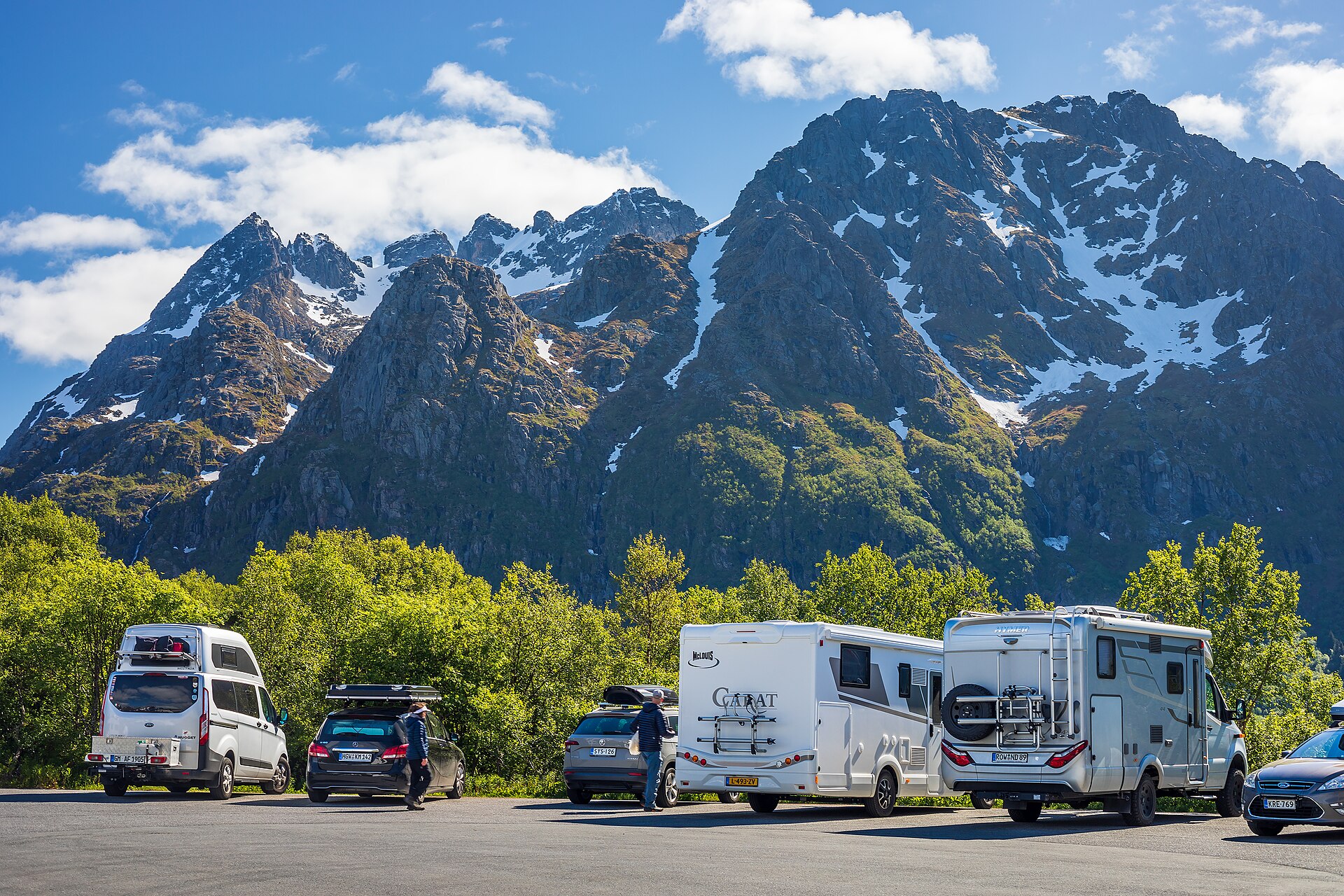
| Rest area (rasteplass) | Yes | Normally one dogn, 24 hours | Free |
| Public car park | Generally yes if parking itself is legal | Usually 48 hours, sometimes 24 | Parking fee if signed |
| Utmark, on a road or parking surface | Yes, under friluftsloven s.9 | 2 nights, 150 m from any dwelling | Free |
| Large city, outside designated bays | Often banned by the municipality | n/a | n/a |
| Bobilplass | Yes, that is the point | Site rules | NOK 130-475 ($14-51) |
Two details nobody else publishes. Rest areas allow overnighting but are normally limited to one døgn, 24 hours, so they are a single-night stop and not a base. And municipalities can ban motorhome parking outright under the planning and building act, which most large cities now do outside designated areas, so read the signs in Bergen or Tromsø rather than assuming the national rule holds. The etiquette behind how visitors are expected to behave in Norway applies doubly to a vehicle you sleep in: arrive late, leave early, leave nothing.
The 2026 visitor levy, and why it does not touch you
None of the five competitor pages mentions the new visitor levy, and what matters here is the exemption. Municipalities may charge up to 3% of the price including VAT on overnight stays, but campsites, marinas, tents, private campervans and private boats are all exempt. Collection starts on 1 January 2027 in Tromsø after a transition period.
So a campervan traveller pays nothing under the current rules, now or when collection begins. If you were weighing a van against hotels partly on cost, that is a small point in the van’s favour.
A worked two-week budget
Here is a full fortnight costed out with the 2026 numbers above, for two people in a 6-8 m coachbuilt van (AP2), in mid season, driving about 2,000 km with twelve ferry crossings. Fuel is calculated at 12 litres per 100 km and the national petrol average, so 240 litres. Food, flights and attractions are excluded, because those belong in the wider breakdown of what Norway costs rather than here.
| Line | Assumption | NOK | USD |
|---|---|---|---|
| Van hire | 14 days at NOK 2,100 mid season | 29,400 | $3,144 |
| Fuel | 240 litres at NOK 26.84 | 6,442 | $689 |
| Ferries, AP2, with prepayment | 12 crossings, 50% off | 2,191 | $234 |
| Tolls | My own allowance, tagged M1 rate | 1,150 | $123 |
| Campsites | 8 nights at NOK 400 | 3,200 | $342 |
| Bobilplasser | 3 nights at NOK 250 | 750 | $80 |
| Free overnighting | 3 nights | 0 | $0 |
| Gas bottle | One bottle | 1,200 | $128 |
| Showers and laundry | Metered, two people | 500 | $53 |
| Total | Two people, 14 nights | 44,833 | $4,795 |
That is about NOK 3,200 ($342) a day for two, or NOK 1,600 ($171) a head. Three caveats. The toll line is the only figure here I have not sourced; it is my own allowance rather than a published number, and it moves a lot if your route crosses the Oslo or Bergen ring systems.
Without the prepayment agreement the ferry line doubles to NOK 4,382 ($469). That is one form, filled in before you travel, worth more than most money-saving tips on the internet combined.
And the same trip in high season in the largest van means NOK 35,000 hire, AP3 ferry rates and peak pitch prices, which pushes the fortnight past NOK 55,000 ($5,882). The gap between a well-timed van trip and a badly-timed one is bigger than the gap between a van and a hotel.

When a campervan is the wrong choice for Norway
I like van trips in Norway. I also think plenty of people book one because the photographs are good, then spend a fortnight fighting the format. Here is where I would tell you not to.
A short, ferry-heavy fjord trip
The clearest case. If your route is a week in the western fjords with a dozen or more crossings, the AP2 penalty compounds on every one while the hire cost stays high. A car plus three or four cabins will often come in cheaper and you sleep better. Around the Geirangerfjord area, where crossings come thick and fast and good pitches sell out, I would take the car every time.
Anywhere you need to park in a city
Oslo, Bergen, Trondheim and Stavanger are hostile to motorhomes. Municipalities can ban bobil parking under the planning and building act and most large cities do so outside designated bays, which means you park on the edge and commute in, or you pay for a site out of town. If your trip has three or more city nights in it, the van is working against you for a large share of the holiday. The train and bus network handles the city legs better than any vehicle does.
Trollstigen, Lofoten in July, and other narrow-road problems
Norway’s most photographed roads are also its tightest. Trollstigen’s hairpins have length restrictions in force and a big rig is a genuine problem there rather than an inconvenience. Lofoten in July has more vans than parking, and the islands have been actively adding restrictions in response. If your heart is set on the Lofoten archipelago at the peak, a small car and booked rorbuer will produce a calmer holiday than a 7.5 m van and a nightly search for a legal spot.
Two people who want to walk all day
If the trip is really a walking trip, the van is an expensive way to store a rucksack. A fortnight of Norwegian mountain hiking works better from a fixed base or a hut-to-hut chain than from a vehicle you keep going back to.
When it is clearly the right choice
To be fair to the format: long distances, few cities, off-peak dates, three or four people. That is when a van wins outright, because the hire cost splits and the ferry penalty is fixed rather than per head. A two-week northern route in early September is exactly the shape of trip the maths rewards, and the practicalities of travelling in Norway with children are much easier with your own kitchen and beds aboard.
Frequently asked questions
How much do ferries cost for a campervan?
It depends on the length band and the zone. A 6-8 m van pays about 2.2x the car rate on every crossing and an 8-10 m van about 3x. In practice that is NOK 231 ($25) where a car pays NOK 104 ($11) on a short zone-10 hop, and NOK 734 ($79) against NOK 345 ($37) on a long zone-50 run. An AutoPASS prepayment agreement takes 50% off those figures for private customers.
Can you sleep anywhere in a campervan in Norway?
No, but you have more freedom than in most of Europe. You may overnight in rest areas, in car parks where parking is legal, and in utmark provided the van stays on a road or parking surface. You may not drive off-road into terrain, and you must keep 150 metres from any inhabited house or cabin.
Does allemannsretten apply to motorhomes?
Yes. NAF points to the preparatory works of friluftsloven confirming the law applies to motorhomes, and section 9 permits camping with a bobil in utmark. The widespread blog claim that the right to roam simply excludes motorhomes is too strong. What limits you is that a vehicle cannot legally leave the road or parking surface, whereas a tent can be carried into terrain.
How much does it cost to rent a campervan in Norway?
Roughly NOK 1,300 ($139) a day for a small van in low season up to about NOK 3,000 ($321) a day for the largest models at the peak, including 25% VAT. One Oslo operator publishes NOK 1,600 low, NOK 2,100 mid and NOK 2,500 high. Foreign booking sites quote the equivalent as EUR 150 to EUR 300 a night.
Do motorhomes pay more in tolls?
Only if you get the paperwork wrong. Tolls use weight classes, not length bands. A motorhome over 3,500 kg registered as category M1 pays the light-vehicle rate provided it has a valid AutoPASS tag and agreement; without both it falls into the heavy rate group, which is where reports of two to four times the car rate come from.
Can you park overnight in a layby?
Usually yes. Overnighting at rest areas is permitted but normally capped at one døgn, a 24-hour period, so it is a one-night stop rather than a base. Ordinary car parks generally allow it where parking itself is legal, with time limits of 48 hours or sometimes 24, and municipalities can ban bobil parking entirely, which most big cities do.
Do campervans pay the tourist tax?
No. The 2026 visitor levy lets municipalities charge up to 3% of the price including VAT, but campsites, marinas, tents, private campervans and private boats are exempt. Collection begins on 1 January 2027 in Tromsø after a transition period, and a private campervan traveller pays nothing under the current rules.
Is wild camping cheaper than campsites?
Free overnighting costs nothing and service points are usually free too, so on paper yes. In practice the saving is smaller than people expect, because the two-night limit keeps you moving, showers and laundry still cost money, and an ACSI card gives over 60% off campsites outside high season anyway. Mixing the two, as in the budget above, is the realistic approach, and it pairs well with the genuinely no-cost side of a Norwegian trip.
Photo credits
- Where you may legally sleep is a parking question, not a right-to-roam question. — Photo: Ximonic (Simo Räsänen) / CC BY-SA 4.0 via Wikimedia Commons.
- Every crossing charges a 6-8 m van roughly 2.2 times the car rate. — Photo: Wolfgang Hägele / CC BY-SA 4.0 via Wikimedia Commons.
- Rest areas allow one 24-hour stay. Car parks are usually 48 hours. — Photo: Ximonic (Simo Räsänen) / CC BY-SA 4.0 via Wikimedia Commons.
- The Atlantic Road has no tolls and no ferries, which makes it unusually cheap in a van. — Photo: Stefan V. Baumgartner / CC BY-SA 4.0 via Wikimedia Commons.
All prices checked September 2026 and quoted at 9.35 NOK to 1 USD. The AutoPASS ferry tariff took effect on 1 January 2026 and is revised annually; fuel prices moved sharply on 1 September 2026 following a duty rise, and visitor levy rules change again when collection begins in January 2027. The prepayment deposit figures are reported rather than officially verified. Check the current tariff before you travel.