Here’s the thing nobody tells you about free things to do in Norway: the free tier isn’t the consolation prize. In most countries the good stuff is ticketed and the free stuff is a park bench. In Norway it’s close to the opposite. The single most spectacular thing I’ve done here — standing on a cliff 604 metres above a fjord — cost me a parking fee. The most expensive thing I’ve done was a boat trip where I mostly looked at the same water.
That inversion has a legal basis, and understanding it is worth more than any list of twenty attractions.
I read the pages currently ranking for this search before writing. The top result quotes the Bergen funicular at “65–70 NOK” — the real 2026 price is 200. Another was last updated in 2019. Two of them confidently list free museum days that don’t exist. So: everything below was checked in July 2026, and where a “free” thing has a hidden cost, I say so.
The law that makes Norway cheap
Allemannsretten — the right to roam — was written into the Outdoor Recreation Act in 1957, and it’s the reason a country this expensive can also be one of the cheapest places in Europe to spend a week outdoors.
In plain terms: you may walk, ski, cycle, swim, forage and sleep on any uncultivated land in Norway, whoever owns it, without asking. Every beach, every mountain, every forest and every fjord shoreline in the country is legally open to you at no cost.
The rules that come with it are short and worth respecting:
- Pitch at least 150 metres from the nearest house or cabin. This is a legal boundary, not a suggestion.
- Maximum two consecutive nights in one spot on open ground.
- No open fires between 15 April and 15 September, anywhere near woodland.
- Cultivated land (innmark) is off limits in the growing season. Leave gates as you found them.
- Take everything out with you. Norwegians are quietly unforgiving about litter.
Do that and a week of hiking and wild camping in Norway costs you food and transport. Nothing else.
Free things to do in Norway at a glance
Prices are 2026, in kroner, at roughly 9.5 NOK to the dollar. “Hidden cost” is the bit other lists leave out.
| What | Where | Genuinely free? | Hidden cost |
|---|---|---|---|
| Vigeland Sculpture Park | Oslo | Yes, 24/7/365 | None |
| Opera House roof walk | Oslo | Yes, any hour | None |
| Ekeberg Sculpture Park | Oslo | Yes | None |
| Botanical Garden, Tøyen | Oslo | Yes | None |
| Akershus Fortress grounds | Oslo | Yes, 06:00–21:00 | Museums inside are ticketed |
| Bryggen wharf | Bergen | Yes | None |
| Walk up Mount Fløyen | Bergen | Yes, ~45 min | Funicular is NOK 200 return |
| Preikestolen hike | Stavanger | Trail is free | Parking NOK 275 over 2 hrs |
| Trolltunga hike | Hardanger | Trail is free | P2 NOK 500/day + NOK 220 toll |
| Nordkapp plateau | Finnmark | Yes — court ruled it public | Visitor hall NOK 350 |
| Vøringsfossen | Hardanger | Yes, parking free | Road shut in winter |
| Sverd i fjell swords | Stavanger | Yes, unstaffed | None |
| Northern lights | Arctic | Yes, if the sky cooperates | A tour buys you cloud-dodging |
| Midnight sun | Above Arctic Circle | Yes | None |
| Wild camping | Anywhere uncultivated | Yes | None |
The free ferries nobody writes about
This is the biggest omission in every competing article, and it’s worth real money.
Norway has more than 100 car ferry connections that are completely free — free for the vehicle, free for the driver, free for every passenger. It started as a subsidy for routes carrying under 100,000 passengers a year and was expanded significantly in August 2023. You’ll find them across Møre og Romsdal, Nordland, Rogaland, Troms og Finnmark, Trøndelag and Vestland.
Nobody advertises this to tourists. You simply drive on, nobody takes your card, and you drive off. On a road trip through the western fjords or the Helgeland coast, that can be several crossings a day that a comparable route elsewhere would charge for. Where a crossing isn’t free, get an AutoPASS-for-ferje account before you travel: it takes 40–50% off the fare. The transport guide covers the mechanics.
Oslo: what’s actually free
Oslo is the easiest Norwegian city to enjoy on nothing, largely because its best public spaces were designed to be public.
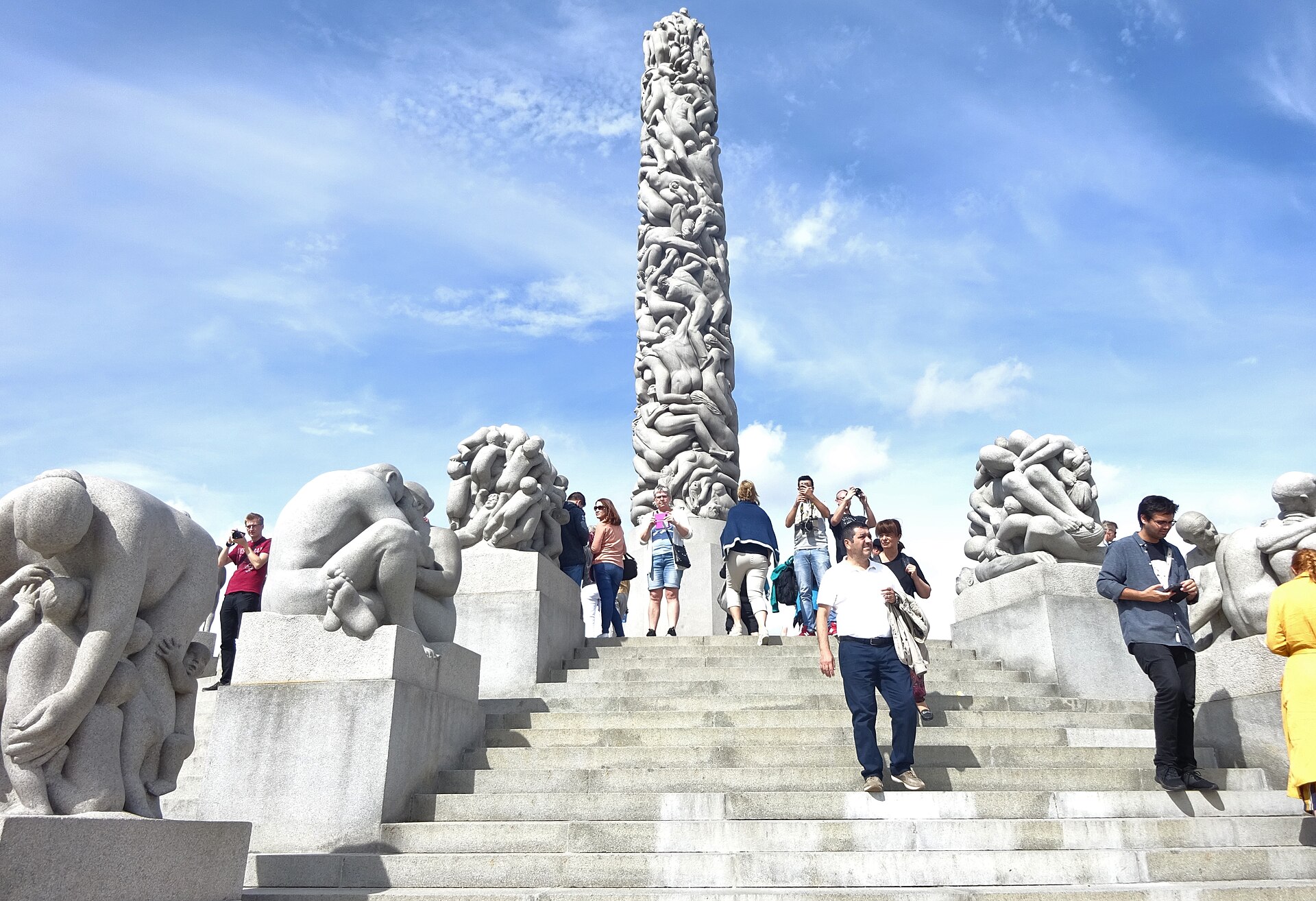
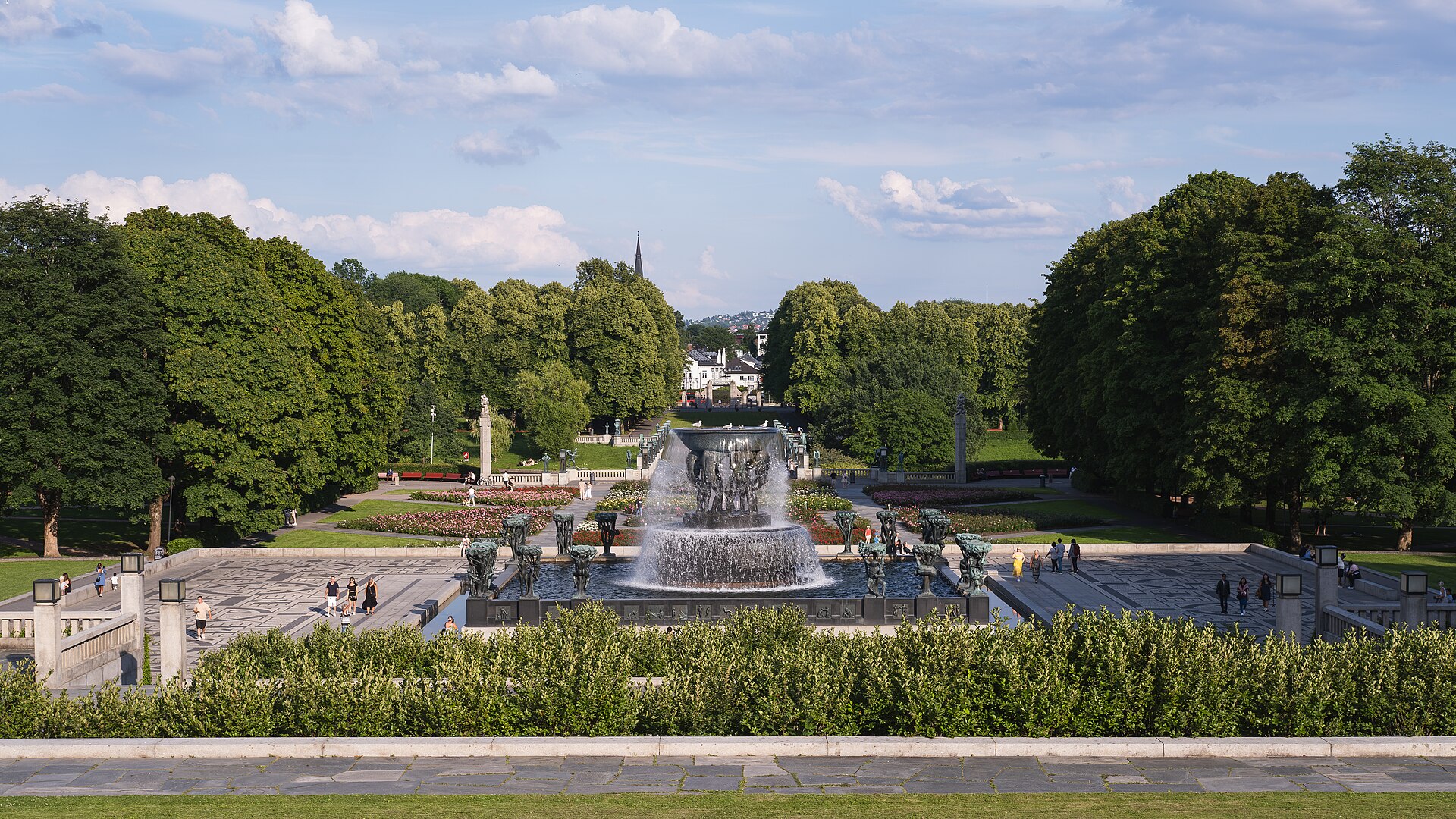
Vigeland Sculpture Park. 212 Gustav Vigeland sculptures in Frogner Park, free, unfenced, open every hour of every day of the year. The Monolith at the top is 17 metres of intertwined figures — 121 of them — carved from a single block of granite. It’s the best free attraction in Scandinavia and it isn’t close.
The Opera House roof. Snøhetta designed the building so you could walk up it. Carrara marble sloping straight out of the Bjørvika waterfront, accessible day or night, no ticket. Wear shoes with grip when it’s wet.
Ekeberg Sculpture Park. Forty-odd works by people like Louise Bourgeois and Salvador Dalí, scattered across a wooded hillside with the best view over the city and the fjord. Free, open at all hours, and far quieter than Vigeland.
The Botanical Garden at Tøyen. Around 4,500 species, free entry, and free English-language guided tours on Sundays at 13:00 from July to September.
Akershus Fortress grounds. Open daily 06:00 to 21:00, free to wander. The castle interior and the military museums are ticketed separately, but the ramparts and the harbour views cost nothing.
Deichman Bjørvika. The main public library beside the Opera House — free, warm, architecturally spectacular, with a good café and city views. In a country where sitting indoors usually costs NOK 60 for a coffee, that matters more than it sounds.
The City Hall carillon. Norway’s largest set of chimes plays free on the hour, every hour, from 07:00 to midnight. The 07:00 performance is Grieg’s Morning Mood, which is either lovely or unbearable depending on your hotel.
The islands. This one saves people money: the Oslofjord islands — Hovedøya, Gressholmen, Langøyene, Lindøya — are served by ordinary Ruter public transport ferries. There is no separate tourist fare. A standard zone-1 ticket, about NOK 42 in the app and valid 90 minutes, gets you to a swimming beach and monastery ruins. More in the Oslo guide.
The best free hikes in Norway
Norway has no entry fees for nature, no permit system, no national park gates and no charge to walk anywhere. What follows costs nothing but shoe leather — and in a couple of cases, a parking fee I’ve flagged honestly.
Reinebringen, Lofoten. Nepalese sherpas built 1,978 stone steps up this mountain, finished in 2021, which converted a genuinely dangerous mud scramble into a steep but manageable two-to-three-hour climb. At the top, Reine scattered across turquoise water between granite spires. Free, no parking fee if you’re sensible about where you leave the car, and the best effort-to-view ratio in Norway. Season runs roughly mid-May to the end of September. The Lofoten guide has the access details.
Vidden, Bergen. The 13–15 km plateau traverse between Ulriken and Fløyen, four to six hours, and the best urban-adjacent mountain walk in Europe. You can do it entirely free by walking up rather than riding either lift. Don’t attempt it in poor visibility — the plateau is exposed and the fog arrives quickly.
Nordmarka, Oslo. Take the T-bane to Sognsvann or Frognerseteren and walk straight into a forest the size of a small county. Hundreds of kilometres of marked trails, lakes you can swim in, and the metro fare is the only cost. Oslo is the only capital I know where the underground has trailheads.
Fløya and the Sherpa Steps, Tromsø. A staircase climbs from Tromsdalen to 421 metres with the city, the sound and the mountains laid out below. Free, and in late summer you can watch for the season’s first aurora from the top.
Storsteinen and the Lyngen views. If you’d rather not pay for the Fjellheisen cable car in Tromsø, the walking route up alongside it costs nothing and takes about an hour.
Besseggen, Jotunheimen. The famous ridge between two lakes at different altitudes and colours. The hike is free; the boat across Gjende that most people use to start it is around NOK 260, and you can walk the return leg instead if you’re feeling strong.
Free waterfalls, and why that’s not obvious
In much of the world the best waterfalls sit behind a ticket booth. In Norway they sit beside the road.
Vøringsfossen drops 182 metres into the Måbødalen canyon, and the stepped footbridge that puts you directly above the lip — 99 steps, opened in 2020 — is free, as is the parking. The full Scenic Routes rebuild finished in September 2024, so there’s now over a kilometre of secured path. The road over Hardangervidda is generally clear from around June.
Steinsdalsfossen near Norheimsund is 46 metres, and you walk behind the water on a maintained path. Free parking, free access. Kaiser Wilhelm II came nearly every summer between 1889 and 1914, which tells you it’s been a tourist attraction longer than most countries have had tourists.
Låtefossen on Rv13 near Odda is a twin cascade that lands beside a six-arch stone bridge and soaks your car as you drive past. No fee, no car park attendant, no queue.
The Seven Sisters in the Geirangerfjord are free from the Hellesylt–Geiranger car ferry, which is public transport, not a tour. Foot passengers pay somewhere between NOK 150 and 390 depending on the crossing and how you book.
Free experiences you can’t buy a better version of
Some of the best things in Norway aren’t attractions at all, and no amount of money improves them.
The midnight sun. Above the Arctic Circle the sun doesn’t set for weeks — roughly 28 May to 14 July in Lofoten, 20 May to 22 July in Tromsø, and 14 May to 29 July at the North Cape. There is no ticket, no viewing platform and no premium option. You just stay up. What it does to your sense of time is the actual experience, and it’s free.
Constitution Day, 17 May. Norway’s national day is not a military parade — it’s children’s parades, marching bands, everyone in bunad, and an entire country eating ice cream in the street. It is completely free to join, genuinely welcoming to visitors, and the single best day of the year to be in Norway. Trondheim and Oslo do it biggest; a small town does it more charmingly.
The blue hour. In the Arctic winter, the couple of hours either side of the sun’s non-appearance turn the snow lavender and the sky an impossible cobalt. Photographers travel for it. It costs nothing and happens daily from roughly November to February.
Public saunas and sea swimming. The swimming is free everywhere. Sauna sessions are not — reckon on NOK 350–600 — but the cold plunge in an Oslo or Tromsø harbour is free if you’re prepared to do it without the warm-up.
Free things beyond the big cities
Ålesund. Climbing the 418 steps up Aksla to the Fjellstua viewpoint is free, and the view over the Art Nouveau town scattered across its islands is the best in western Norway. Walking the town itself — rebuilt entirely in Jugendstil after the 1904 fire — costs nothing.
Røros. The UNESCO-listed copper town is an open-air museum you don’t pay to enter. Black-tarred timber, turf roofs, and a street plan essentially unchanged since the 1700s. Best under snow.
The stave churches, from outside. Twenty-eight medieval stave churches survive. Entry runs NOK 100–150 and most only open May to September — but the exteriors, with their dragon-head roof ridges, are what you actually came to see, and they’re visible year-round for nothing.
Gamle Stavanger. Around 170 white wooden houses on cobbled lanes, lived in rather than preserved, and free to wander.
Alta’s rock art. The UNESCO-listed carvings themselves sit within a ticketed museum, but northern Norway is full of free, signposted archaeology if you’re willing to read a roadside board.
If you’re building a route around this, the itinerary guide and the seasons guide will help you time it — and the main things-to-do guide puts the paid experiences alongside these for comparison.
Sleeping for free, legally
Accommodation is where a Norway trip actually gets expensive, and the right to roam is the lever.
Wild camping under allemannsretten is free, legal and normal — Norwegians do it in numbers that would surprise most visitors. Two nights per spot, 150 metres from dwellings, and pack everything out.
If a tent isn’t your thing, the DNT hut network is the middle path rather than a free one: membership is around NOK 800–860 a year and gets you member rates at roughly 570 cabins plus a key to the unstaffed self-service huts. Under-25s pay less than half, and children’s membership is about NOK 150. For a two-week hiking trip, the membership pays for itself in about three nights. The accommodation guide explains how the hut system works in practice.
How Norwegians themselves keep costs down
Worth saying plainly: Norwegians are not indifferent to these prices. They live here on Norwegian salaries and still think NOK 450 for a main course is a lot. What they do instead is a decent template for a visitor.
They eat before they go out, and they eat at home more than almost any comparable European country. They buy alcohol at Vinmonopolet rather than in bars, because anything over 4.75% ABV is only sold there and the markup in a bar is brutal. They own outdoor gear rather than experiences, and they use it constantly — friluftsliv, open-air living, is closer to a national religion than a hobby. They take the ferry rather than the sightseeing cruise. And on a Sunday they go to the forest, because most shops are shut anyway.
The visitor version: shop at Kiwi or Rema 1000, carry a water bottle, buy the transport ticket rather than the tour when the route is the same, and spend your money on the two or three things that genuinely require a guide — boats, ice, animals, Arctic winter driving. Everything else in this country is either free or barely worth the premium. The planning essentials guide has the practical layer, from Vinmonopolet opening hours to why you should always decline dynamic currency conversion at the card terminal.
Bergen, Stavanger, Tromsø and Trondheim on nothing
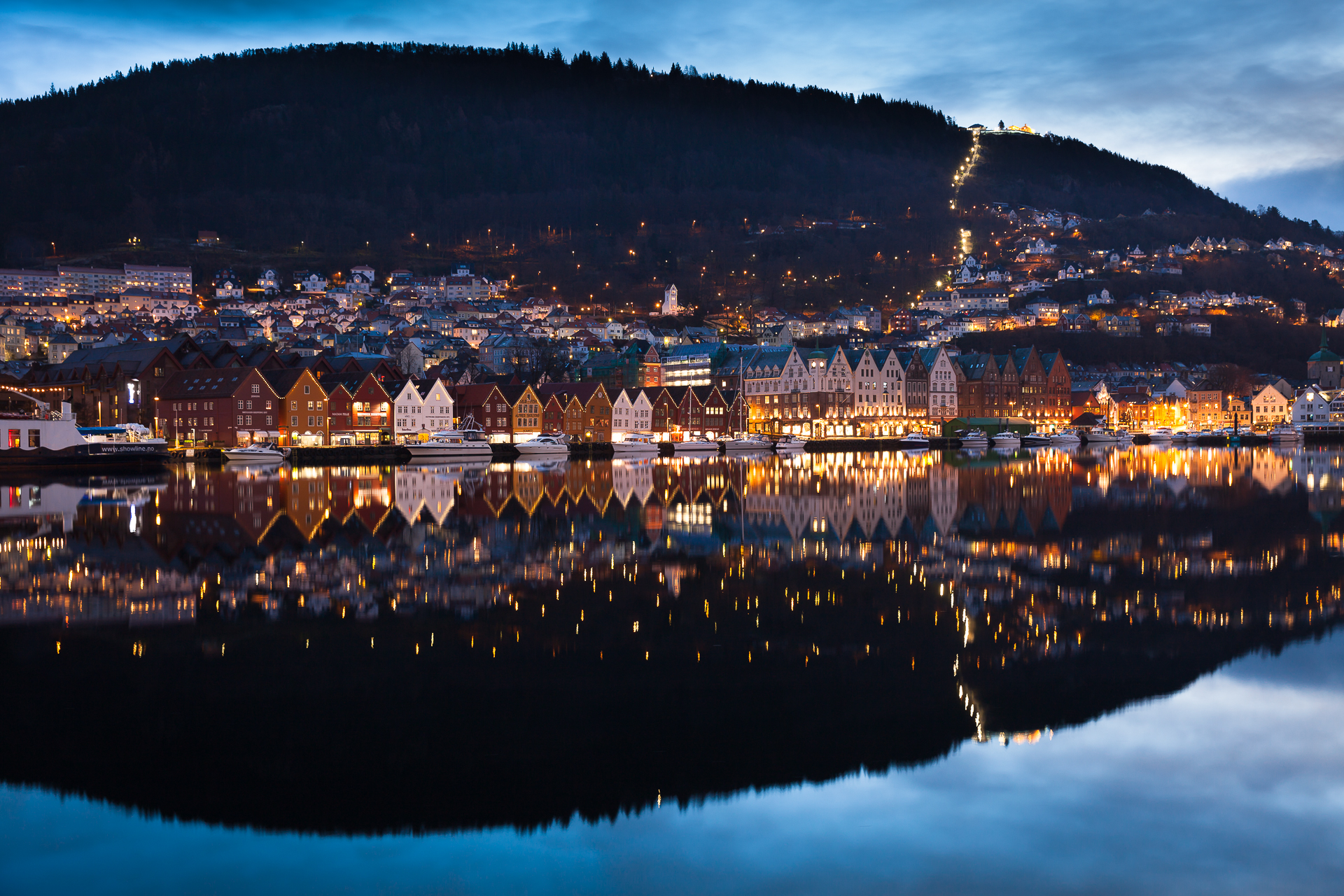
Bergen. Walking Bryggen is free, and the trick is to leave the photographed facade and go into the wooden alleys behind it, where the buildings lean at angles that look structurally optimistic. The fish market is free to browse. And you can walk up Mount Fløyen in about 45 minutes on a good path — the funicular costs NOK 200 return online in summer (NOK 220 at the counter, NOK 145 in winter), and the walk has better views anyway. Bergenhus Fortress grounds are free. See the Bergen guide for the rest.
Stavanger. Gamle Stavanger’s 170-odd white wooden houses are a free open-air museum. Sverd i fjell — three ten-metre bronze swords driven into rock, marking the battle of 872 — is unstaffed and free. Øvre Holmegate, the painted street, costs nothing to walk. And Preikestolen itself has no entry fee.
Tromsø. The aurora is free if you’re prepared to walk away from the streetlights; Telegrafbukta and the trails behind Tromsdalen work, though you’re trading a guide’s cloud-radar for luck. The Arctic Cathedral’s exterior is the shot everyone takes anyway. And in summer, the midnight sun over the Kvaløya side costs nothing at all.
Trondheim. Bakklandet’s wooden wharf houses, the Old Town Bridge, and the exterior of Nidaros Cathedral — Norway’s most impressive building, begun in 1070 — are all free to look at. Student city, so the parks are lively and the coffee is cheaper than Oslo’s.
Free museum days: what’s actually true
Several widely-copied articles list free entry days that I could not verify and in one case could not reconcile with the museum’s own site. Here’s what I could confirm for 2026, and what I couldn’t.
| Museum | Adult 2026 | Genuinely free for whom |
|---|---|---|
| MUNCH, Oslo | NOK 280 (day), NOK 200 (evening) | Everyone 0–17; under-25s pay NOK 100 |
| Nasjonalmuseet, Oslo | Around NOK 200 | Everyone under 18 |
| KODE, Bergen | NOK 200 day pass, four buildings | No free weekday found |
| Holmenkollen Ski Museum | NOK 185 | Under 6 |
| Lofotr Viking Museum | NOK 265 | Under 6 |
The genuinely useful pattern here isn’t a free day — it’s that under-18s get into Norway’s major museums free. For a family, that single policy is worth more than any city card. And the Bergen Card gives free KODE entry from October to April but only 25% off from May to September, which is the opposite of what most people assume.
If you see “free Thursdays at the National Museum” or “free Wednesdays at KODE” repeated online, treat it with suspicion. I traced both claims to articles that contradict themselves within the same page.
The “free” things that aren’t
Norway’s great hikes cost nothing to walk and quite a lot to reach. This is the single most common budgeting mistake.
- Preikestolen: trail free. Parking NOK 275 for over two hours, NOK 40 under two hours, paid on the way out. The shuttle from Stavanger is around NOK 498 return.
- Trolltunga: trail free. P2 Skjeggedal parking NOK 500 a day, plus a NOK 220 road toll. P3 is NOK 600 and has only about 30 spaces, which sell out weeks ahead in July.
- Kjeragbolten: trail free. Parking free under two hours, NOK 300 over — and since the hike takes six, that’s a NOK 300 hike.
- Nordkapp: the plateau is genuinely free, following a court ruling that it’s public land under the right to roam. Only the Nordkapphallen visitor centre charges, at NOK 350.
- Dalsnibba viewpoint: the road is a toll road — NOK 330 per car.
None of these are unreasonable. But “free hike” and “free day out” aren’t the same sentence, and the hiking guide lists the trailhead fees properly.
Is a city card worth it, or are the free things enough?
The Oslo Pass costs NOK 580 for 24 hours, NOK 845 for 48 and NOK 995 for 72 (children roughly half). It covers 30-plus museums and public transport.
The break-even maths is simple and nobody publishes it. A 24-hour pass pays for itself at roughly: one major museum (NOK 280) + a second museum (NOK 200) + two or three transport journeys (NOK 126). So if you plan two paid museums and to move around, buy it. If you plan one museum or none, don’t — because the free tier in Oslo is strong enough to fill two days on its own.
Worth knowing: the pass includes the airport train, which is otherwise NOK 268 on Flytoget. If you’re arriving and starting straight away, that shifts the maths considerably.
Free things to do in winter
Every competing article is a summer article. Norway in winter has its own free list, and in some ways a better one.
The northern lights are free. A guided chase buys you a driver who will go three hours to find a hole in the cloud, which is worth the NOK 1,300–2,500 if you have one night — but if you’re in Tromsø for four nights, walk twenty minutes from the centre and look up. Some of the best displays I’ve seen cost nothing.
Then: cross-country skiing on floodlit municipal tracks (Oslo’s Nordmarka has hundreds of kilometres, lit until 22:00 and free to use — you’ll need to hire skis), Christmas markets, the blue hour itself, which in the Arctic is a two-hour daily light show that photographs better than midday, and skating on frozen city ponds. The winter guide covers what runs when.
What this actually saves you
Here’s a real Oslo day built entirely from the free tier, against the same day done conventionally.
| Free version | Conventional version | |
|---|---|---|
| Morning | Vigeland Park, Monolith | MUNCH museum — NOK 280 |
| Midday | Supermarket picnic on the Opera roof — NOK 90 | Café lunch — NOK 250 |
| Afternoon | Ferry to Hovedøya — NOK 42 | Fjord sightseeing cruise — NOK 690 |
| Evening | Ekeberg Park at sunset, tap water | Restaurant dinner — NOK 450 |
| Total | NOK 132 (~$14) | NOK 1,670 (~$176) |
The free version is not the worse day. That’s the point I’d most like you to take from this. Drink the tap water — it’s excellent and bottled water is a con here — shop at Kiwi, Rema 1000 or Coop Extra, and put the money you save into the two or three guided things that genuinely need a guide. The costs guide has the full budget picture.
One 2026 note on the tourist tax
You may have read that Norway now charges a tourist tax. The Visitor Contribution Act did come into force on 1 July 2026, allowing municipalities to add up to 3% to paid overnight stays. But it’s opt-in, each municipality needs national approval first, and no municipality is charging it during 2026. Tromsø approved its plan in June 2026 and filed on 1 July, targeting 1 January 2027.
Tents, campervans and campsites are excluded from the levy in any case. So if you’re wild camping under the right to roam, it will never apply to you at all.
Frequently asked questions
Is anything actually free in Norway?
More than almost anywhere in Europe, because of the right to roam. Every trail, beach, mountain and fjord shore is legally open at no charge, and the best single attraction in Oslo — Vigeland Park — has no ticket, no fence and no closing time.
Can you camp for free anywhere in Norway?
On uncultivated land, yes: two nights maximum in one spot, at least 150 metres from the nearest house or cabin, no open fires between 15 April and 15 September. Not in gardens, fields or fenced grazing land.
Are the Norwegian fjords free to visit?
Seeing them is free — every roadside viewpoint, shoreline and hiking trail. Getting onto the water costs money, though the Geiranger–Hellesylt car ferry does the full fjord for a fraction of a sightseeing cruise, and some fjord crossings elsewhere are free outright.
Which Norwegian museums are free?
Few are free for adults. The reliable saving is age-based: under-18s enter MUNCH and the National Museum free, and under-25s pay heavily reduced rates. Be sceptical of “free day” claims you see repeated online — several don’t survive checking.
Can you see the northern lights for free?
Yes. You need darkness, a clear sky and to be far enough north — walking twenty minutes out of central Tromsø is often enough. What you’re buying with a tour is mobility on a cloudy night, not access.
Are Norway’s beaches free?
All of them, including the white-sand Arctic ones in Lofoten and on Sommarøy. There is no such thing as a private beach in Norway in the sense most visitors mean.
Is the Oslo Pass worth buying?
Only if you’ll visit at least two paid museums and use transport. Below that, Oslo’s free tier — Vigeland, Ekeberg, the Opera roof, the Botanical Garden, Deichman, the fortress grounds — will fill your days perfectly well.
What’s the cheapest way to eat in Norway?
Supermarkets: Kiwi, Rema 1000 and Coop Extra. A picnic costs a fifth of a café lunch, the tap water is excellent everywhere, and Norwegians eat outdoors at every opportunity, so you won’t look out of place doing it.
Photo credits
All photographs are used under their respective Creative Commons or public-domain licences.
- The Monolith, Vigeland Park. 17 metres, 121 figures, one block of granite, no ticket. — Photo: Paasikivi / CC BY-SA 4.0 via Wikimedia Commons.
- Bryggen, Bergen. Free to walk — Photo: Svein-Magne Tunli – tunliweb.no / CC BY-SA 4.0 via Wikimedia Commons.
- Vigeland’s main axis. Open every hour of every day of the year, unfenced and unstaffed. — Photo: Christian David / CC BY-SA 4.0 via Wikimedia Commons.
Prices and policies were checked in July 2026 and are given in Norwegian kroner, with dollar conversions at roughly 9.5 NOK to 1 USD. Museum admissions and parking fees change; confirm before you rely on them.