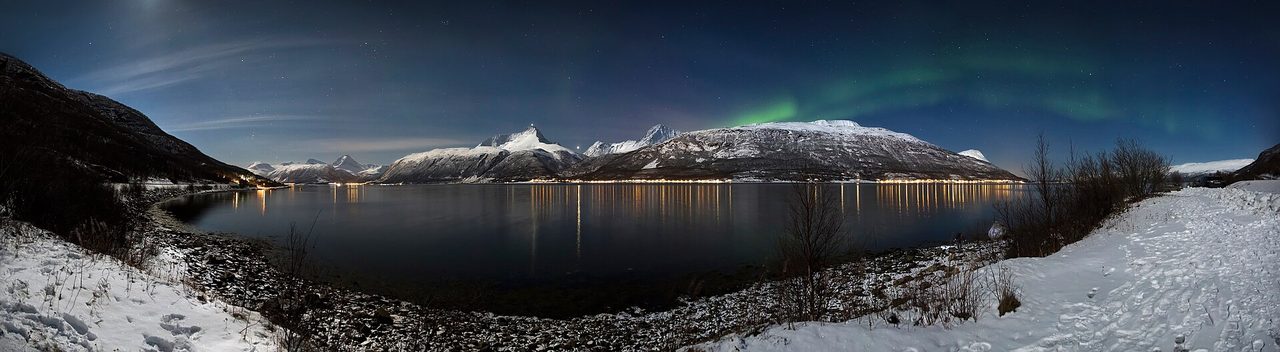
Seeing the northern lights in Norway is, for a lot of people, a genuine bucket-list moment — and the good news is that Norway is about the best place on Earth to do it. The far north of the country sits directly under the “auroral oval,” the ring where the aurora is most active, which means that on a clear, dark night you have a real shot at the lights even when solar activity is only middling. The catch is that the aurora is a wild thing: it answers to the sun and the weather, not to your itinerary.
This guide is built to stack the odds in your favour. We’ll cover when to come, where to base yourself, and — the part most guides skip — exactly how to maximise your chances once you’re here, from reading an aurora forecast to why a guided “chase” usually beats sitting still. There’s honest cost data, real itineraries, camera settings that actually work, and a frank answer to the question everyone asks: are they guaranteed? (They’re not, and anyone who says otherwise is selling something.) If you’re still deciding when to come, pair this with our guide to when to visit Norway; for the 25 experiences we’d put at the top of any Norway wish list, start there; for everything else to do while you’re here, see our things to do in Norway guide.
Northern lights in Norway: at a glance
| Question | Short answer |
|---|---|
| Best season | Late September to early April (peak November–February) |
| Best months | October, February and March — darkness plus clearer skies |
| Best time of night | Roughly 6 pm–2 am; sweet spot ~9 pm–midnight |
| Best places | Tromsø, Alta, Lofoten, Senja, Svalbard |
| How many nights | Three minimum; four to seven to be safe |
| Typical tour cost | Minibus “chase” ~NOK 1,300–2,500 (≈ $120–230) |
| Guaranteed? | No — but the Norwegian Arctic offers the best odds on the planet |
What are the northern lights?
The northern lights — the aurora borealis — are what happens when electrically charged particles streaming off the sun slam into gases high in our atmosphere. Earth’s magnetic field funnels those particles toward the poles, where they collide with oxygen and nitrogen atoms and make them glow, a bit like the gas in a neon sign. The result is that silent, shifting light that ranges from a faint grey-green smudge to curtains that ripple across the whole sky.
The southern hemisphere gets its own version, the aurora australis. But the northern show is the famous one, and Norway has a front-row seat.
What the colours and shapes mean
Most of what you’ll see is green — that’s oxygen glowing about 100–150 km up, and it’s the colour the human eye picks up most easily. Higher up, oxygen can glow a deep red, while nitrogen adds purple and pink fringes along the lower edge of a bright band. The shapes have a vocabulary too: a quiet arc low on the horizon, rippling curtains (the classic “dancing” lights), and, on a really active night, a corona — rays that seem to radiate from a single point directly overhead, like the sky is opening up. When people describe being moved to tears, it’s usually the corona.
Why northern Norway is one of the best places on Earth
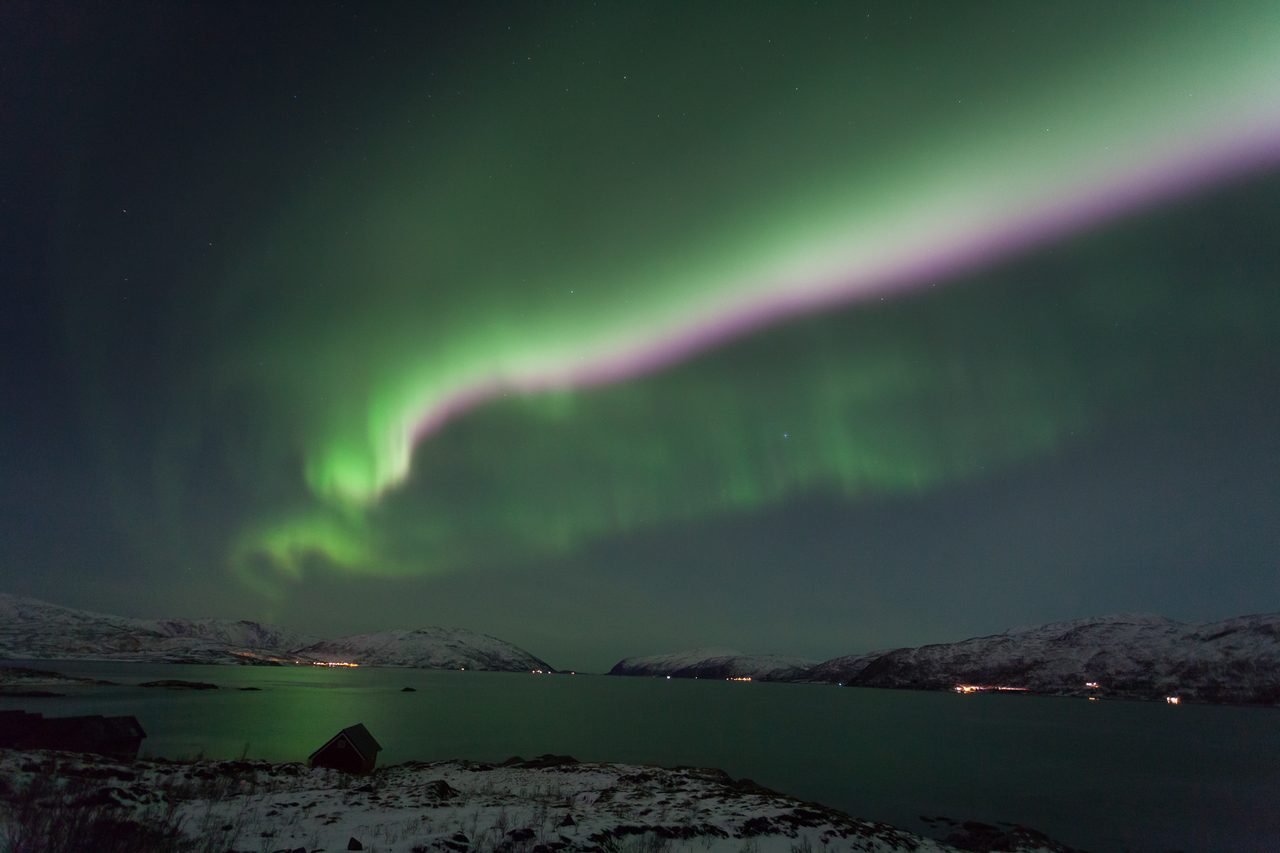
Here’s the key fact that shapes the whole trip: the aurora isn’t strongest at the North Pole. It concentrates in a ring — the auroral oval — that hovers over roughly 65–70° latitude. Tromsø sits at about 69.6°N, smack under that oval. That’s why northern Norway is so reliable: you don’t need a big solar storm to push the lights down to you, because they’re already overhead. Places further south (Oslo, the UK, the northern US) only see the aurora when activity is strong enough to stretch the oval toward them; in Tromsø, a quiet night with clear skies is often all it takes.
Solar Cycle 25: why the next few winters are special
The sun runs on an 11-year cycle of activity, and it hit its latest peak — “solar maximum” — around late 2024. That’s why recent winters have been some of the most active in over a decade. As of 2026 we’re in the gentle decline from that peak, but here’s the encouraging part: activity is still well above the long-term average, and historically some of the biggest displays arrive in the year or two after the peak. So 2026 and 2027 remain excellent years to come. By the late 2020s the show will quieten toward the next solar minimum — though, again, at Tromsø’s latitude you’re under the oval regardless of the cycle, so the far north never really has a “bad” year.
A bit of folklore
Long before anyone understood solar wind, people told stories about these lights. In parts of Sámi culture the aurora was treated with deep respect — something not to be waved at, whistled at, or mocked, lest it take notice of you. Other Nordic traditions imagined the glow as light glinting off the shields of the Valkyries, or reflections from great shoals of herring. Standing under a full corona, you understand why every culture that lived with it reached for myth.
When is the best time to see the northern lights in Norway?
The single most important rule: you need darkness. The aurora is glowing up there year-round, but you can only see it against a properly dark sky — which is why the season runs from late September to early April and why you cannot see the northern lights in Norway in summer, when the midnight sun keeps the sky bright around the clock.
The best months
People assume midwinter is best because it’s darkest, and December–February do give you the most hours of darkness. But the coast is also at its cloudiest then, and cloud is the aurora-hunter’s real enemy. My honest pick is the shoulders of the season: late September–October and March (into early April). Statistically, geomagnetic activity tends to spike around the equinoxes, the skies are often clearer and calmer, the temperatures are kinder, and there are fewer crowds. February is a great compromise — deep darkness, reliable snow, and clearer inland skies. So: come November–February for maximum darkness, or September–October and March for the best balance of darkness, clear skies and comfort.
The best time of night
Aurora activity can flare at any hour of darkness, but the statistical sweet spot is roughly 9 pm to midnight, with the broader window running from about 6 pm to 2 am. Plan to be out, away from lights, and watching from mid-evening. It often comes in waves — a quiet, cloudy-looking band can erupt into a full dancing display within minutes, so patience pays.
Month-by-month: the aurora calendar
| Month | Darkness | Conditions & verdict |
|---|---|---|
| September | Returns late month | Aurora season opens; mild, often clear; autumn colour. A lovely, underrated start. |
| October | Plenty | Dark enough, frequently clear, cheaper, fewer crowds. One of the best months. |
| November | Long nights | Peak darkness begins; coast can be cloudy/stormy. Go inland (Alta) for clearer skies. |
| December | Maximum (polar night up north) | Darkest of all and very festive, but cloudiest and coldest. Christmas markets are a bonus. |
| January | Maximum | Deep, cold dark; sun returns to Tromsø mid-month. Prime aurora, low prices post-holiday. |
| February | Long nights | Darkness + clearer skies + reliable snow + Sámi Week in Tromsø. Excellent all-rounder. |
| March | Long, shortening | Equinox activity, clearer skies, more daylight for daytime activities. Arguably the best month. |
| Early April | Closing | Last chance before the light returns for good; book the first week or two. |
For the full picture of weather, daylight and crowds across the whole year, see our companion breakdown of weather, daylight and crowds.
When the sun stops rising altogether, the viewing window widens enormously — our guide to the polar night covers what those weeks are actually like.
Where to see the northern lights in Norway
Anywhere above the Arctic Circle puts you in striking distance, but some bases are easier, clearer, or more spectacular than others. Here’s how the main contenders compare, then the detail on each.
| Destination | Latitude | Min Kp* needed | Best months | Getting there | Best for |
|---|---|---|---|---|---|
| Tromsø | 69.6°N | ~1–2 | Sep–Mar | Direct international flights | First-timers, tours, choice |
| Alta | 69.9°N | ~1–2 | Dec–Mar | Fly via Oslo/Tromsø | Clearest inland skies |
| Lofoten | 68°N | ~2–3 | Sep–Mar | Fly to Bodø/Harstad + drive | Scenery & photography |
| Senja | 69°N | ~1–2 | Sep–Mar | Drive/ferry from Tromsø | Drama without crowds |
| Svalbard | 78°N | varies | Nov–Feb | Fly Oslo/Tromsø | Daytime aurora, polar night |
| Kirkenes | 69.7°N | ~1–2 | Dec–Mar | Fly | Winter activities, dark skies |
| Bodø / Narvik | 67–68°N | ~2–3 | Oct–Mar | Train & flights | Budget gateway, ski under aurora |
*Kp is the 0–9 scale of geomagnetic activity (more on it below). The far-north spots need only a low Kp because they sit under the auroral oval; figures are rough guidance, not guarantees.
Tromsø — the Arctic capital and easiest base
If it’s your first aurora trip, start here. Tromsø has direct flights from several European hubs, a deep bench of tour operators and guides, good hotels and restaurants, and it sits right under the oval. The trade-offs: it’s genuinely busy in peak winter, and the coastal location means cloud is common — which is exactly why guided “chase” tours (that drive to clear skies) shine here. For free DIY viewing, locals head 20–40 minutes out of town to Kvaløya (spots like Ersfjord), Sommarøy, or toward the Lyngen Alps, away from streetlights with an open northern horizon. For everything to see and do once you have your aurora base sorted, see our complete guide to things to do in Tromsø.
Alta — the City of the Northern Lights
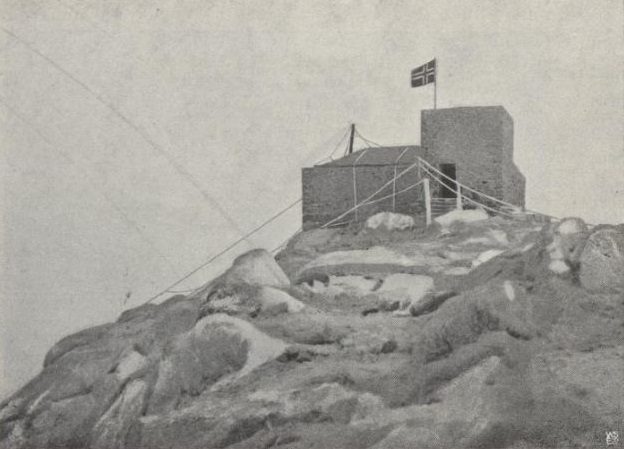
Alta wears that nickname for good reason: this is where the science began. The world’s first permanent aurora observatory opened on nearby Haldde mountain in 1899. Crucially for visitors, Alta is inland, so when the coast around Tromsø is socked in with cloud, Alta’s colder, drier air is often clear. It’s a quieter, more deliberate aurora base — and home to the Sorrisniva igloo hotel.
Lofoten — the most photogenic backdrop
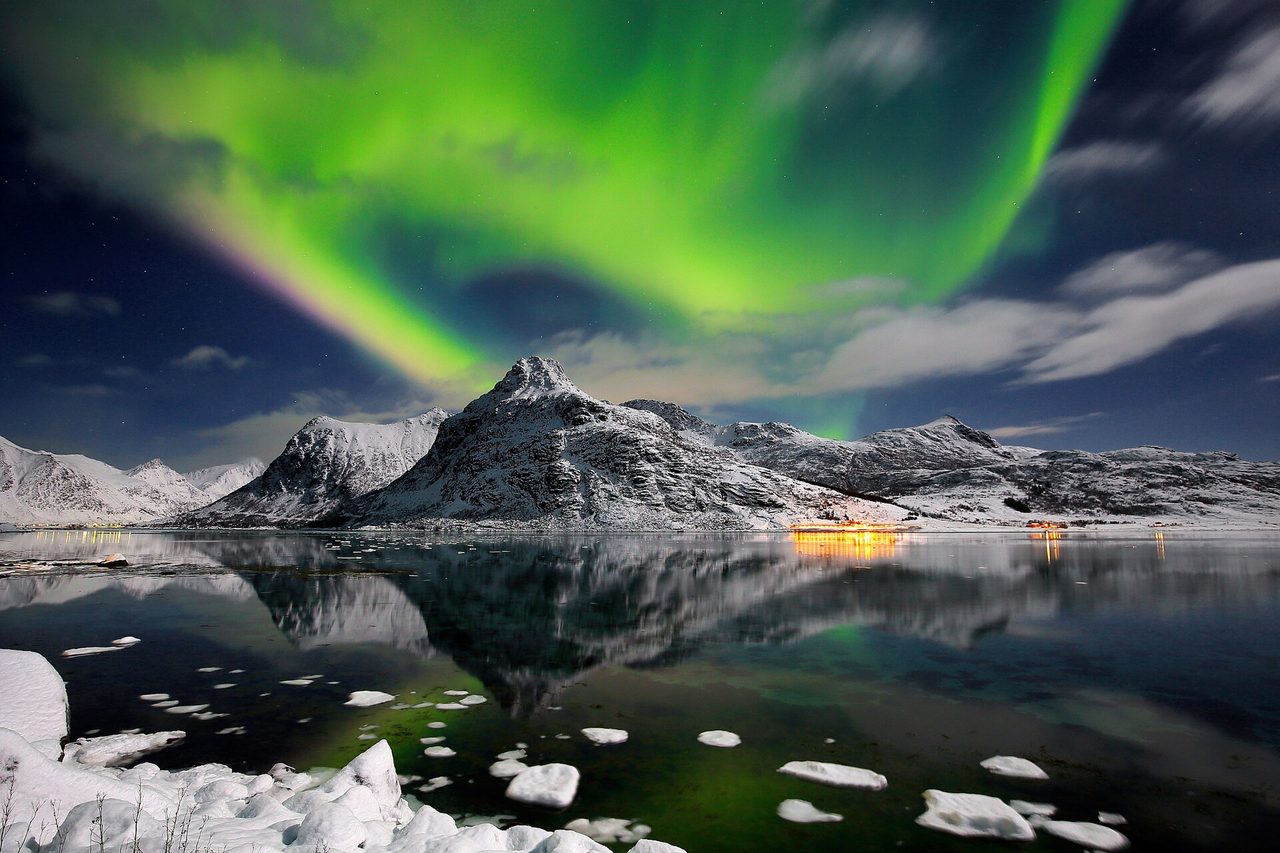
For aurora over something — jagged peaks, red fishing cabins, a mirror-still fjord — Lofoten is unbeatable, and it’s why you’ve seen a thousand Lofoten aurora photos. It sits just under the oval. The honest caveat: the islands are exposed to fast Atlantic weather, so skies change quickly and you need flexibility (and ideally a rental car to move between Reine, Hamnøy and Henningsvær chasing clear patches). Pairs beautifully with a winter Lofoten road trip — my full Lofoten Islands guide covers bases, rorbu cabins and driving logistics.
Senja — drama without the crowds
Norway’s second-largest island, between Tromsø and Lofoten, gives you Lofoten-grade scenery with a fraction of the people. Viewpoints like Ersfjordbotn, Bergsbotn and Mefjordvær frame the lights over fjords and sharp peaks. It’s a fantastic choice if you want that quiet, just-us-and-the-sky feeling.
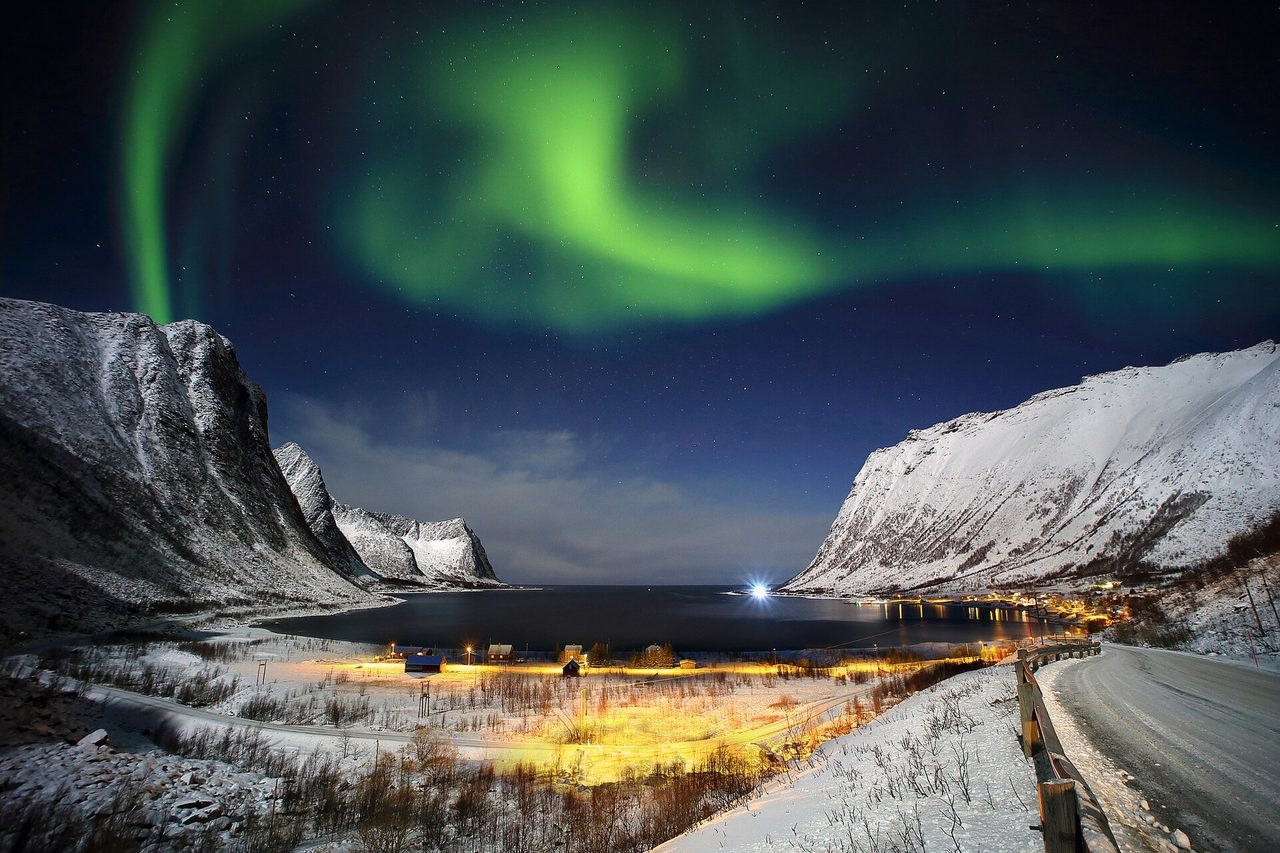
Svalbard — aurora in the middle of the “day”
Svalbard, at 78°N, has a party trick no one else can match. During the polar night (roughly mid-November to late January) the sun never rises, so it’s dark enough to see the aurora even at midday — Svalbard is essentially the only inhabited place on Earth where you can catch the lights during “daytime” hours. The archipelago also has a dry, clear Arctic climate. It’s remote and pricey (and you can’t leave Longyearbyen without an armed polar-bear guide), so treat it as a bucket-list add-on rather than a budget option.
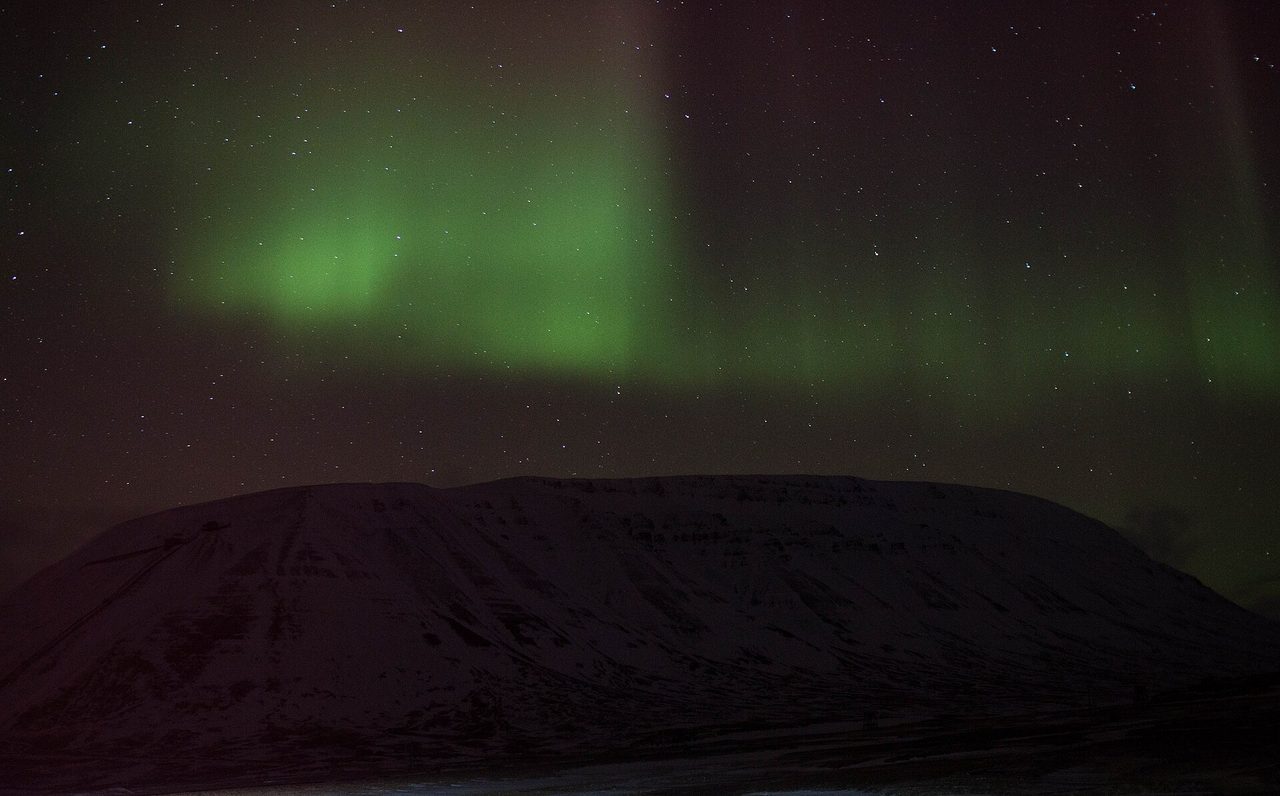
Kirkenes, Nordkapp and the far northeast
Out near the Russian border, Kirkenes delivers deep-winter atmosphere, low light pollution, and a clutch of signature experiences — king-crab safaris, the Snowhotel, dog sledding — that make a cloudy night still feel worthwhile. The North Cape (Nordkapp), mainland Europe’s northernmost point, is wild, exposed and often folded into coastal-cruise itineraries.
Vesterålen, Narvik and Bodø
Worth knowing about: Vesterålen (next to Lofoten) combines aurora with superb winter whale watching; Narvik lets you ski or ride a cable car for the lights above the clouds; and Bodø — just north of the Arctic Circle, a 2024 European Capital of Culture with a central airport — is an increasingly handy, more affordable gateway.
Can you see the northern lights in Oslo or Bergen?
Rarely, and only during strong solar storms. Both cities sit too far south and have too much light pollution for reliable viewing. During the exceptional May 2024 storm — the strongest in two decades — aurora was visible across southern Norway and much of Europe, but that’s the exception that proves the rule. For a trip you’re actually planning around the lights, go north of the Arctic Circle.
How to maximise your chances of seeing the aurora
This is the part that actually moves the needle. Get these right and you’ll dramatically improve your odds, whatever the forecast says.
Get away from city light
Light pollution washes out all but the brightest aurora. Even 20–30 minutes out of Tromsø makes a huge difference. Look for an open, north-facing horizon — a frozen lake, a fjord shore, a valley — somewhere your eyes (and camera) aren’t fighting streetlights.
Chase clear skies — why guided tours win
Here’s the thing most first-timers get wrong: cloud, not solar activity, is what defeats most aurora trips. The lights can be blazing above the clouds and you’ll see nothing. This is the single best argument for a guided minibus “chase” tour — the guides watch live cloud and aurora data all evening and will drive, sometimes hundreds of kilometres (even across into Finland), to find a hole in the sky. That mobility is worth far more than a fixed viewpoint, however scenic.
Understand the Kp index — and read a forecast
The Kp index is a 0–9 scale of global geomagnetic activity, updated every few hours by NOAA. Higher Kp means the auroral oval expands toward the equator, so the lights become visible further south. The crucial point for Norway: because Tromsø, Alta, Senja and Lofoten sit under the oval, even a low Kp of 1–2 is often enough. (By contrast, Scotland needs roughly Kp 5, central Europe Kp 7.) So in the far north, clear, dark sky usually matters more than a high Kp number.
Useful free tools: NorwayLights (the official tourism-board app), norway-lights.com, NOAA’s Space Weather Prediction Center, and the all-sky cameras and alerts run by the University of Tromsø. Pair an aurora forecast with a cloud forecast (yr.no is the Norwegian standard) — you want the night when both line up. App names change, so search your app store, but check a forecast plus the weather, not just one.
Mind the moon — and let your eyes adjust
A bright full moon won’t hide a strong aurora, but it does wash out fainter displays; a darker, new-moon sky shows more. And give your eyes 15–20 minutes away from your phone screen and any white light to fully dark-adapt — faint aurora that was invisible at first will start to appear. Use a red light if you need to see.
Stay several nights
Because the weather is a gamble on any single night, the real strategy is simply more nights. Three is the sensible minimum; four to seven dramatically raises your odds of catching at least one clear, active night. People who fly in for one night and miss out usually blame bad luck — really they didn’t give themselves enough chances.
The aurora-hunter’s checklist
- Base yourself above the Arctic Circle (Tromsø, Alta, Lofoten, Senja) — not southern Norway.
- Come in season (late Sept–early April) and give yourself 3+ nights.
- Get away from light and find an open northern horizon.
- Chase the clear skies — book a mobile guided tour, or have a rental car and stay flexible.
- Check an aurora forecast plus a cloud forecast each evening.
- Dress for standing still in the cold for hours (see packing, below).
- Be patient — be out by 9 pm and give it until the early hours.
- Manage expectations: the camera sees more colour than your eye, and nothing is guaranteed.
How to see them: tours, cruises or self-drive?
You don’t need a tour to see the northern lights — but a good one genuinely improves your odds and your comfort. Here’s an honest comparison of the three ways to do it, and what they cost.
Guided minibus “chase” tours — the sweet spot
Small groups (often 8–16 people), 6–9 hours, with a local guide who chases clear skies. The good ones include thermal suits and boots, hot drinks and a campfire snack or hot meal, tripods, and free photos taken by the guide. This is what I’d book for a first trip: you get mobility (the whole point), warmth, and someone who knows where to go. Expect roughly NOK 1,300–2,500 (≈ $120–230) per person.
Northern lights cruises
Norway’s coastal voyage (the historic Bergen–Kirkenes route, run by Hurtigruten and Havila) doubles as a brilliant aurora trip: the ship moves up the coast each night, so you’re not stuck under one cloud bank, and most northern ports are inside the aurora zone. Both lines offer a “Northern Lights Promise” on qualifying winter voyages — broadly, if the aurora doesn’t appear during your voyage, you get a complimentary short voyage another time (you usually must sign up for the onboard alert; terms and date windows vary, so confirm the current promise before booking). Cabins have an aurora alert so you’re woken when it shows. It’s transport-with-a-view, not a luxury cruise — but few aurora experiences beat watching the lights from the deck of a moving ship. For ships, cabins, costs and how the route actually works, see our full Norway fjord cruise and coastal voyage guide.
Self-drive and independent viewing
If you’re comfortable on winter roads (studded tyres, short days, snow), renting a car gives you total flexibility to chase clear skies on your own schedule and stop wherever the sky opens up — especially good in Lofoten and on Senja. Just respect Arctic driving: leave margins, check road status, and don’t park on blind bends to gawk at the sky (everyone wants to).
Are the northern lights guaranteed?
No — and be wary of any marketing that implies otherwise. The aurora is a natural phenomenon at the mercy of the sun and the weather. What some Tromsø operators offer is a “see them or go again” deal: if your tour draws a blank, you can rejoin another night free or at a steep discount, subject to availability — which only helps if you’ve got spare nights in town. The cruise “promises” work similarly, compensating with another voyage rather than guaranteeing a sighting. The only real guarantee is stacking the odds: right place, right season, enough nights, clear skies.
What northern lights tours cost
| Option | Typical price (approx) | Best for |
|---|---|---|
| Big-bus group tour | NOK 900–1,300 ($85–120) | Budget; less nimble at dodging cloud |
| Minibus “chase” tour | NOK 1,300–2,500 ($120–230) | Best all-round odds and comfort |
| Aurora boat cruise (evening) | NOK 950–1,900 ($90–175) | Comfort, sea views, dinner |
| Photography tour | NOK 2,000–3,500+ ($185–320+) | Getting great shots with coaching |
| Snowmobile / snowcat aurora | NOK 2,500+ ($230+) | Adventure + remote dark skies |
| Coastal cruise (Hurtigruten/Havila) | From ~$1,400 (6–12 days) | Combining aurora with the whole coast |
Prices are approximate, vary by season and operator, and the Norwegian krone moves — always check current rates when booking. Many trips bundle the aurora hunt with daytime activities like dog sledding, which is the smart way to fill an Arctic itinerary.

Where to stay for the northern lights
Your bed can be part of the show. A few options worth knowing:
Glass igloos and aurora cabins
Transparent-roofed “igloos,” aurora domes and glass-fronted cabins let you watch the sky from under a duvet — the dream for anyone who’d rather not stand in −15°C at 1 am. You’ll find them around Tromsø, the Lyngen Alps, Alta and beyond. They book out early in peak season and command a premium, but waking to the lights overhead is hard to top. (I compare glass igloos, snow hotels and the rest of the Arctic’s bed options — with prices — in my guide to where to stay in Norway.)
Rorbu cabins and fjord-side lodges
In Lofoten and Senja, the converted fishermen’s cabins (rorbuer) sit right on the water with mountains behind — superb aurora foregrounds, and many have hot tubs or saunas so you can soak while you wait.
Ice and snow hotels
For a one-night experience (it’s an experience, not a comfy sleep), Sorrisniva near Alta — the world’s northernmost ice hotel — and Snowhotel Kirkenes are rebuilt from snow and ice each winter, usually open roughly December to early April. Most people sleep one night on the ice and otherwise stay in warm cabins.
Aurora camps and Sámi lavvo stays
Out in the wilderness, heated lavvo (tent) camps put you under dark skies with a fire and a guide watching for activity — a more atmospheric, lower-tech way to spend the night hunting.
How to photograph the northern lights
The aurora is one of the few subjects where a camera genuinely sees more than your eyes — so even a faint display can produce a stunning photo. Here’s how.
Camera settings that work
Shoot in full Manual. Use a wide-angle lens at its fastest aperture (f/2.8 or wider). Start around ISO 1600 (push to 3200 if it’s very dark, drop toward 800 under a bright moon). Set the shutter to about 5–15 seconds — shorter if the lights are moving fast so the curtains stay crisp, longer for faint glows. Focus manually to infinity (focus on a bright star and fine-tune). Shoot RAW if you can, set white balance around 3500–4000K, and turn off the flash. A solid starting recipe: f/2.8, ISO 1600, 15 seconds — then adjust.
Gear checklist
A tripod is essential (any long exposure needs it), plus a remote or the 2-second self-timer to avoid shake. Bring spare batteries and keep them in an inner pocket — the cold drains them fast — and a head torch with a red mode.
Shooting the aurora on a phone
Modern iPhones, Pixels and Samsung flagships take genuinely good aurora shots using Night Mode, which automatically stretches the exposure to several seconds. The trick is to hold the phone dead still — prop it on a wall, rock or mini-tripod — turn off the flash, avoid zoom, and let the countdown finish. If your phone has a Pro/manual mode, mirror the camera settings above.
Composition
The best aurora photos aren’t just sky — they have a foreground: a mountain, a cabin, a person in silhouette, or a reflection in still water. Scout your spot in daylight if you can, so you’re not composing blind in the dark.
What to pack and wear for an Arctic night
You will be standing still, outdoors, for hours, often well below freezing — which feels far colder than moving around. Dressing properly is the difference between a magical night and a miserable one.
Use the three-layer system: a base layer of merino wool or synthetic (never cotton, which traps sweat and chills you); an insulating mid layer of fleece or down; and a windproof, waterproof outer — an insulated parka and snow trousers. Then protect the bits that actually get cold: insulated waterproof boots with thick wool socks, a warm hat, neck gaiter, and gloves (thin liners under mittens so you can work a camera), and hand and foot warmers, which are cheap and transformative. Add ice grips for your boots. Coastal Tromsø is often milder than people expect (around −1°C to −5°C), but inland chase routes and Finnmark can hit −15°C to −30°C. Many minibus tours lend thermal oversuits and boots — but the base layers, hat and gloves are on you.
Northern lights itineraries
How long you need depends on how much you want to do beyond the aurora hunt. Three sample shapes:
3 days: a Tromsø quick trip
Fly into Tromsø, do a guided aurora chase on each of two nights (the second is your insurance against one cloudy night), and use the daylight hours for the Fjellheisen cable car, the city, and a half-day activity. Tight but doable — and the bare minimum I’d risk for a realistic chance.
5 days: Tromsø plus activities
Same base, but three aurora nights (much safer odds) and full days for dog sledding, a whale safari (in season), a Sámi reindeer-and-lavvo experience, and a fjord day. The sweet spot for most first-timers.
7 days: a Northern Norway road trip
Rent a car and string together Tromsø → Senja → Lofoten (or fly into Tromsø and out of Bodø), chasing clear skies across three very different, very photogenic regions. More driving and more weather risk, but the scenery — aurora or not — is extraordinary.
Adding Svalbard or a cruise
For something singular, bolt on a few days in Svalbard in the polar night for daytime aurora, or swap the land trip for a Hurtigruten or Havila coastal voyage that hunts the lights up the whole coast.
Other things to do on a northern lights trip
The aurora only comes out at night, which leaves the short Arctic days free — and the daytime activities are half the fun. Dog sledding behind a team of huskies, whale watching in Vesterålen or near Tromsø, meeting reindeer and hearing joik at a Sámi camp, snowmobiling into the backcountry, king-crab safaris near Kirkenes, or just soaking in a fjord-side sauna. For the full menu, see our roundup of things to do across Norway. For winter specifically — what runs when, what it costs and where to base yourself — our complete guide to things to do in Norway in winter puts every Arctic experience in one place. Think of the lights as the spectacular bonus on top of a brilliant winter trip — that way you go home happy even on a cloudy night.
More in this series
This guide is the hub for our Northern Lights in Norway series. Each of these goes deeper on one decision, with climate data, current prices and dated openings rather than generalities:
- The best time to see them — why March wins, why November is the value pick, and what the declining phase of Solar Cycle 25 actually means.
- Month by month — daylight hours, temperatures, what activities run when, and the 2027 event calendar.
- Where to see them — every serious base ranked by latitude, cloud data and flight access.
- Tromsø, self-guided — dark-sky spots with bus numbers and fares, and when the last bus actually leaves.
- Tromsø tours — what the NOK 990 to 2,970 spread buys, what a guarantee obliges, and when a tour is a waste of money.
- Lofoten — the worst odds in Arctic Norway and the best photographs. The honest case for both.
- Alta — further north than Tromsø and half as wet, with far less to do when the sky shuts.
- Forecasts and apps — why Kp is the wrong number north of Bodø, and which free Norwegian tools beat the paid ones.
- Photographing the aurora — a settings table matched to how fast the sky is moving, and the honest 2026 verdict on phones.
- Tromsø vs Lofoten vs Alta — a straight three-way comparison, and the cloud figures that contradict what everyone repeats about Alta.
- Packages and holidays — five operators priced side by side, what the “from” figure leaves out, and whether booking it yourself is cheaper.
- Oslo and Bergen — the honest odds this far south, worked out from geomagnetic latitude and storm frequency rather than wishful thinking.
Frequently asked questions
When is the best time to see the northern lights in Norway?
Between late September and early April, when the nights are dark enough. The darkest months (November–February) give the most viewing hours, while the equinox shoulders — late September to October and March — often combine good darkness with clearer skies and milder weather.
What is the best month to see the northern lights in Norway?
There’s no single best month, but October, February and March are hard to beat — they balance plenty of darkness with statistically clearer skies and (in spring) more comfortable temperatures. December and January are darkest but cloudiest and coldest on the coast.
Where is the best place to see the northern lights in Norway?
Tromsø is the most accessible and well-equipped base. Alta has the clearest inland skies, Lofoten and Senja the most dramatic scenery, and Svalbard the unique daytime aurora during the polar night. All sit under the auroral oval, so any of them gives you strong odds.
Is Tromsø or Lofoten better for the northern lights?
Tromsø is easier (direct flights, more tours, more backup activities) and better for first-timers. Lofoten is more spectacular for photography but harder to reach and more exposed to fast-changing weather. Many travellers combine both on a road trip.
Can you see the northern lights in Oslo?
Only rarely, during strong solar storms, and city light pollution works against you. Oslo sits too far south for reliable viewing — for a trip planned around the aurora, head north of the Arctic Circle to Tromsø, Alta, Lofoten or Senja.
Can you see the northern lights in Norway in summer?
No. From roughly mid-April to mid-August the midnight sun keeps northern Norway’s sky too bright, so the aurora — though still present — is invisible. Summer is the season for the midnight sun instead; come between late September and early April for the lights.
Early autumn also overlaps the tail end of Norway’s hiking season, so a late-September trip can pair mountain days with aurora nights.
How many nights do you need to see the northern lights?
Plan at least three nights in the aurora zone, and ideally four to seven. Because clear skies on any single night are a gamble, more nights dramatically improve your odds of catching at least one clear, active display.
Are the northern lights guaranteed?
No — they’re a natural phenomenon dependent on solar activity and clear skies, so no one can guarantee a sighting. Some tours and cruises offer a “see them or go again” deal that lets you retry, but that improves your odds rather than guaranteeing anything.
Do you need a tour, or can you see them on your own?
You can absolutely see them independently if you have a car and get away from light. But a guided minibus “chase” tour improves your odds by driving to wherever the skies are clear, and includes warm gear and photos — which is why it’s the most popular choice for first-timers.
How much does a northern lights tour in Norway cost?
A small-group minibus chase typically runs about NOK 1,300–2,500 (roughly $120–230) per person, including thermal gear, hot drinks and photos. Big-bus tours are cheaper (around NOK 900–1,300) and aurora boat cruises start near NOK 950. Prices vary by season and operator.
Can you see the northern lights with the naked eye?
Yes, but they often look paler than in photos. A faint aurora can appear grey or whitish-green to the eye, while a camera reveals vivid greens, pinks and reds. A strong, active display is unmistakably colourful and clearly dances even to the naked eye.
What Kp index do you need in Tromsø?
Because Tromsø sits directly under the auroral oval, even a low Kp of 1–2 is often enough to see the lights — far less than the Kp 5+ needed in Scotland or the northern US. In the far north, clear, dark skies usually matter more than a high Kp.
What should you wear to see the northern lights?
Dress for standing still in deep cold: a merino or synthetic base layer, an insulating fleece or down mid layer, and a windproof, waterproof insulated outer. Add insulated boots, wool socks, a warm hat, gloves or mittens, and hand and foot warmers. Many tours lend thermal suits.
Will you see the northern lights on a cruise?
You have a good chance on a winter coastal voyage (Hurtigruten or Havila), because the ship moves up the coast each night and most northern ports are in the aurora zone. Both lines offer a northern-lights “promise” with compensation if the aurora doesn’t appear — confirm current terms when booking.
So, will you see the northern lights in Norway?
If you come in season, base yourself above the Arctic Circle, give yourself several nights, and chase the clear skies, your odds are about as good as they get anywhere on Earth — and in these post-solar-maximum years, especially so. Treat a sighting as the glorious bonus on top of a brilliant Arctic winter trip, and you’ll go home happy regardless. When you’re ready to plan the rest, our guides to the best time to visit Norway and the best things to do in Norway will help you build the trip around the lights.
Aurora activity and weather are inherently unpredictable, and tour terms, prices and forecasts change — always check current forecasts and operator details before you travel. Last updated: June 2026.
About this guide
Written and maintained by the NorwayTourism.org editorial team — travelers and writers focused on practical, first-hand Norway trip planning. Aurora timing and science draw on NOAA’s Space Weather Prediction Center, the University of Tromsø, and Norway’s official tourism resources; we refresh our guides regularly. Last updated: June 2026.
Sources & further reading
- Visit Norway — official northern lights guide and the NorwayLights forecast app
- NOAA Space Weather Prediction Center — Kp index, aurora forecasts and solar-cycle data
- University of Tromsø — Norwegian Centre for Space Weather and aurora all-sky cameras
- norway-lights.com — location-by-location aurora forecasts for Norway
Photo credits
All photos are used under their respective Creative Commons or public-domain licenses.
- The northern lights in Norway, arcing over a snowy fjord in the Lyngen Alps — Photo: Ximonic (Simo Räsänen) / CC BY-SA 3.0 via Wikimedia Commons. Source
- Green and purple curtains of the aurora borealis over a fjord near Tromso — Photo: Svein-Magne Tunli – tunliweb.no / CC BY-SA 4.0 via Wikimedia Commons. Source
- The historic Haldde northern-lights observatory above Alta, opened in 1899 — Photo: Kristian Birkeland (CC0/public domain) via Wikimedia Commons. Source
- The northern lights over the peaks of the Lofoten Islands — Photo: Russo Francesco / CC BY 3.0 via Wikimedia Commons. Source
- The aurora over the mountains of Senja in northern Norway — Photo: Russo Francesco / CC BY 3.0 via Wikimedia Commons. Source
- The northern lights over Svalbard during the polar night — Photo: Martyn Smith / CC BY 2.0 via Wikimedia Commons. Source
- A husky sled team at night — dog sledding is a popular add-on to a northern lights trip — Photo: PaterMcFly / CC BY-SA 3.0 via Wikimedia Commons. Source