Every article about Norway in summer currently ranking on Google sells the same premise: the cool-cation. Escape the Mediterranean heat, come somewhere mild and green.
Then July 2026 happened. Oslo hit 32–33°C. Drammen and Rjukan reached 33°C. Eight separate areas recorded five consecutive days above 27°C, which is the formal Norwegian definition of a heatwave. A meteorologist at the national institute called the southern heat “absolutely abnormal for a Norwegian summer.”
And on that same day — 15 July 2026 — it was 12°C in Narvik and Sortland. That gap, roughly 20 degrees between the south and the north of the same country on the same afternoon, is the single most useful thing to understand about a Norwegian summer, and not one competing article mentions it.
This guide gives you the actual climate numbers by city and month, when the mountain passes open, when the Norwegians themselves go on holiday, whether you can swim, and how to pick between June, July and August rather than treating them as one blur.
The numbers nobody publishes
Competing articles say things like “expect 13–18°C.” Here are the actual climate normals, with rainfall, which matters far more than temperature in Norway.
| City | June (high/low, rain) | July | August |
|---|---|---|---|
| Oslo | 20.4 / 10.8°C, 80 mm | 22.7 / 13.4°C, 87 mm | 21.3 / 12.5°C, 103 mm |
| Bergen | 17.7 / 10.1°C, 132 mm | 19.6 / 12.4°C, 158 mm | 19.4 / 12.4°C, 208 mm |
| Stavanger | 16.2 / 9.9°C, 70 mm | 18.7 / 12.5°C, 85 mm | 18.9 / 12.7°C, 130 mm |
| Lofoten (Skrova) | 13.0 / 8.6°C, 37 mm | 16.1 / 11.5°C, 50 mm | 15.4 / 11.5°C, 48 mm |
| Tromsø | 12.4 / 6.6°C, 55 mm | 15.6 / 9.3°C, 60 mm | 14.5 / 8.5°C, 75 mm |
Three things fall out of that table immediately.
Bergen’s August is the wettest month of the Norwegian summer, at 208 mm. The city gets around 2,500 mm a year across roughly 200 rain days. If your trip is fjord-focused and you have flexibility, June is meaningfully drier than August there.
Lofoten is drier than Bergen by a factor of four. That surprises people — the Arctic archipelago gets about a third of the rainfall of the western fjords in summer. It’s colder, but you’ll be wet less often.
May is the secret month. It’s Bergen’s driest (108 mm) and sunniest (252 hours), and Oslo’s sunniest too (251 hours, just ahead of July). If you can travel in late May you get the best light-to-rain ratio of the year — with the caveat that the high mountain roads may still be shut.
What actually happened in summer 2026
Worth setting out properly, because it’s the context a 2026 reader arrives with.
Southern Norway had a genuine heatwave in July. The peak was Wednesday 15 July 2026, with 32–33°C in Oslo and 33°C in Drammen and Rjukan; forecasters had flagged the possibility of up to 37°C in Dalen and Gol. Eight areas — Nesbyen, Gulsvik, Lier, Bø, Tveitsund, Valle, Byglandsfjord and Åseral — met the five-days-above-27°C threshold.
Two things to keep in perspective. First, the all-time record held: Norway’s highest recorded temperature remains 35.6°C at Nesbyen on 20 June 1970, now 56 years standing. Second, the north was entirely unaffected — 12°C in Narvik on the hottest southern day.
This wasn’t a one-off either. In July 2025, Frosta recorded 34.9°C and parts of Trøndelag exceeded 30°C on thirteen separate days, with European monitoring logging around two weeks of strong heat stress in sub-Arctic Fennoscandia alongside drought and elevated fire danger.
The practical implication for planning: Norwegian buildings are built to keep heat in. Air conditioning is rare in hotels and almost unheard of in cabins. If you’re travelling to southern Norway in July and heat bothers you, check whether your accommodation has it, and consider that the fjords and the north stay cool regardless.
Choosing between June, July and August
These are three genuinely different months, and every competing article blurs them into one.
| June | July | August | |
|---|---|---|---|
| Light | Longest days; midnight sun begins | Midnight sun ends mid-month | Real darkness returns; first aurora late Aug |
| Crowds | Building; early June is quiet | Peak, especially weeks 28–30 | Easing after mid-month |
| Waterfalls | Peak snowmelt — best of the year | Strong, glacier-fed at their best | Thinning |
| Mountain roads | Opening through the month | All open | All open |
| Rain | Least of the three in the west | Middling | Wettest in Bergen |
| Sea temperature | Cold everywhere | Oslofjord 20–22°C | Warmest, Lofoten peaks ~8 Aug |
| Mosquitoes | Starting inland | Peak inland | Peak inland |
Short version: late June if you want light and waterfalls, mid-August if you want warm water and fewer people, early July only if the school calendar forces it. And if you can go the last week of August or the first of September, you get autumn colour, thin crowds, lower prices and the season’s first aurora in the north, with almost everything still running.
The fellesferie: why Norway empties in July
This is the local knowledge that changes a trip, and no competing article covers it.
Norway takes a fellesferie — a common holiday — concentrated in weeks 28 to 30. In 2026 that ran Monday 6 July to Friday 24 July. School summer holidays run roughly 19 June to 17 August depending on the county.
During the fellesferie, cities empty out and the coast, the cabins and the fjord villages fill. Some small businesses simply close for three weeks. Accommodation in Lofoten, Flåm, Geiranger and Reine is at its most expensive and most booked. Oslo, conversely, is unusually quiet and pleasant.
If you have any flexibility, travel either side of it.
Where to go in a Norwegian summer
Summer opens the whole country, which is a nicer problem than it sounds but still a problem. These are the regions that are genuinely at their best now rather than merely accessible.
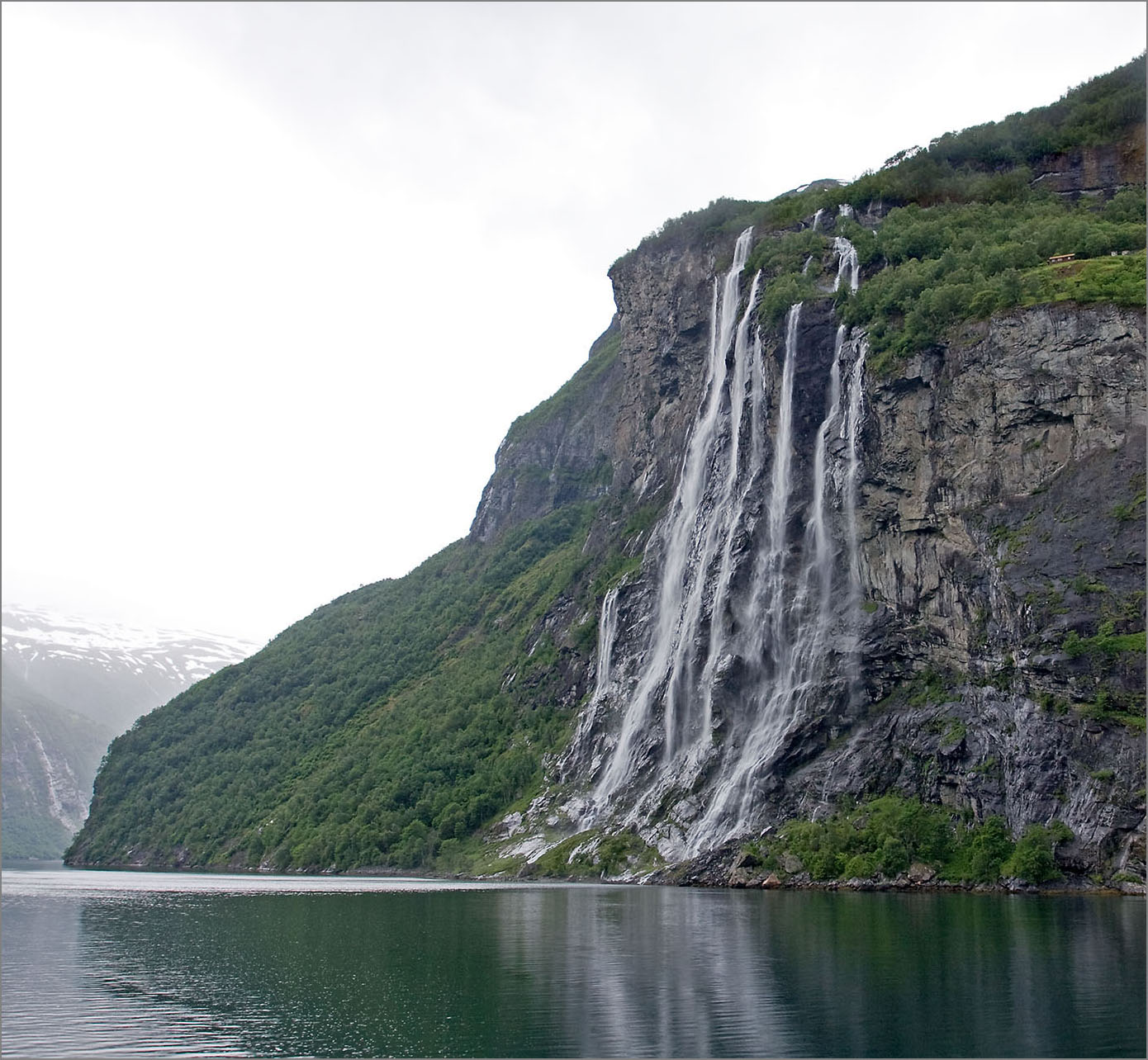
The western fjords. The obvious one, and correctly so — Nærøyfjord, Geiranger, Sognefjord, Hardanger. Everything runs, the boats are now electric in the World Heritage fjords following the zero-emission rules that took effect on 1 January 2026, and the waterfalls are at full volume in June. Expect rain and company. The fjords guide compares them.
Lofoten and Vesterålen. Arguably better in summer than the fjords, because the midnight sun is something the west simply can’t offer and the rainfall is a quarter of Bergen’s. White beaches, short dramatic hikes, and light that doesn’t stop. Four to five days. See the Lofoten guide.
Jotunheimen and the interior. Where Norwegians go. Norway’s 29 highest peaks, DNT hut-to-hut walking, and a completely different landscape from the coast — drier, sharper, emptier. The season is short, roughly late June to September.
The Helgeland coast. The Kystriksveien with its six ferries, the Svartisen glacier, and the Vega archipelago. Almost no foreign traffic and several of the ferries are free.
Sørlandet, the south coast. The one foreigners skip and Norwegians fill: white wooden towns, skerries, and the warmest, driest weather in the country. If your idea of a good holiday involves swimming rather than hiking, this is the part of Norway you actually want.
Oslo, counter-intuitively. The city is at its emptiest and most relaxed during the fellesferie, when everyone who lives there has gone to a cabin. Harbour swimming, island ferries on ordinary transport tickets, floating saunas, and the Opera roof. The Oslo guide has the detail.
A two-week summer route
Built to respect the pass openings and avoid the worst of the fellesferie crush.
| Days | Where | Why now |
|---|---|---|
| 1–2 | Oslo | Quiet in July; harbour swimming and saunas |
| 3 | Bergen Line | 492 km across Hardangervidda, snow beside the track into July |
| 4–5 | Bergen | Bryggen early, before the ships; Vidden plateau walk |
| 6–7 | Flåm & Aurland | Nærøyfjord by electric boat; Stegastein; Snow Road if open |
| 8–9 | Geiranger & Trollstigen | Both passes open; sleep in Geiranger, not day-trip it |
| 10 | Ålesund | Art Nouveau town; Fjellstua at dusk |
| 11–14 | Fly to Lofoten | Midnight sun, beaches, Reinebringen — don’t drive it |
The one structural rule: fly between the fjords and the Arctic rather than driving. Ålesund to Lofoten is well over a thousand kilometres of slow road. The itinerary guide has shorter versions.
Three things that go wrong in a Norwegian summer
Assuming warm means dry. Temperature is not the variable that matters here; rainfall is. A 19°C day in Bergen with 20 mm of rain is a worse day out than a 13°C one in Lofoten with none. Pack for water, not cold.
Booking accommodation late. The famous places are tiny. Reine, Flåm, Geiranger and Henningsvær have bed capacity measured in dozens. Three to six months ahead for July is normal, and during the fellesferie it’s essential.
Underestimating driving times. Norwegian roads in summer are slow, scenic and full of camper vans and ferry queues. Sixty kilometres an hour is a realistic average on anything worth driving. A 300 km day is a driving day, not a sightseeing one.
When the mountain roads open
This decides whether a June road trip works, and I couldn’t find it in any competing article. Norway’s great scenic roads are snowbound for most of the year and open on dates that shift with the winter.
| Road | 2026 opening | Notes |
|---|---|---|
| Trollstigen | 27 April 2026 | Earliest ever; closed 2024–25 for rockfall works |
| Sognefjellet | 2 April 2026 | Norway’s highest road pass, 1,434 m |
| Aurlandsfjellet (Snow Road) | 1 June 2026 | 47 km; Aurland–Stegastein section open year-round |
| Gamle Strynefjellsvegen | 15 June 2026 | 27 km of 1894 gravel road |
| Dalsnibba | Second half of May | Toll NOK 330 per car; closes late September |
| Lysevegen (for Kjeragbolten) | ~Mid-May | Closes October |
The pattern: if you’re coming in early June, assume the high passes may still be shut and plan a coastal route. By late June everything is open. The transport guide covers road status and the Entur app, which is the reliable source rather than Google Maps.
The midnight sun, precisely
Above the Arctic Circle the sun doesn’t set for weeks. The 2026 windows:
- North Cape: 14 May – 29 July
- Tromsø: 20 May – 22 July
- Lofoten: 28 May – 14 July
- Bodø: 2 June – 10 July
- Svalbard: 20 April – 22 August
Two practical consequences. The light is better than midday light — the sun tracks low and sideways, so you get hours of golden hour rather than forty minutes, which is why Arctic landscape photography looks the way it does. And it wrecks your sleep. Bring an eye mask; Norwegian curtains are not designed for this and hotel blackout blinds are inconsistent.
Even southern Norway gets “white nights” in June where it never truly goes dark. Aurora, obviously, is impossible during this window — the first sightings return to the far north around late August. The aurora guide has the season detail.
Can you swim?
Yes, and Norwegians do constantly. The honest numbers:
The Oslofjord reaches around 17°C in June and 20–22°C in July and August — above the 16°C threshold most people find pleasant from late June to mid-September. Oslo’s islands (Hovedøya, Langøyene, Gressholmen) are served by ordinary public transport ferries, so a swim costs a bus fare.
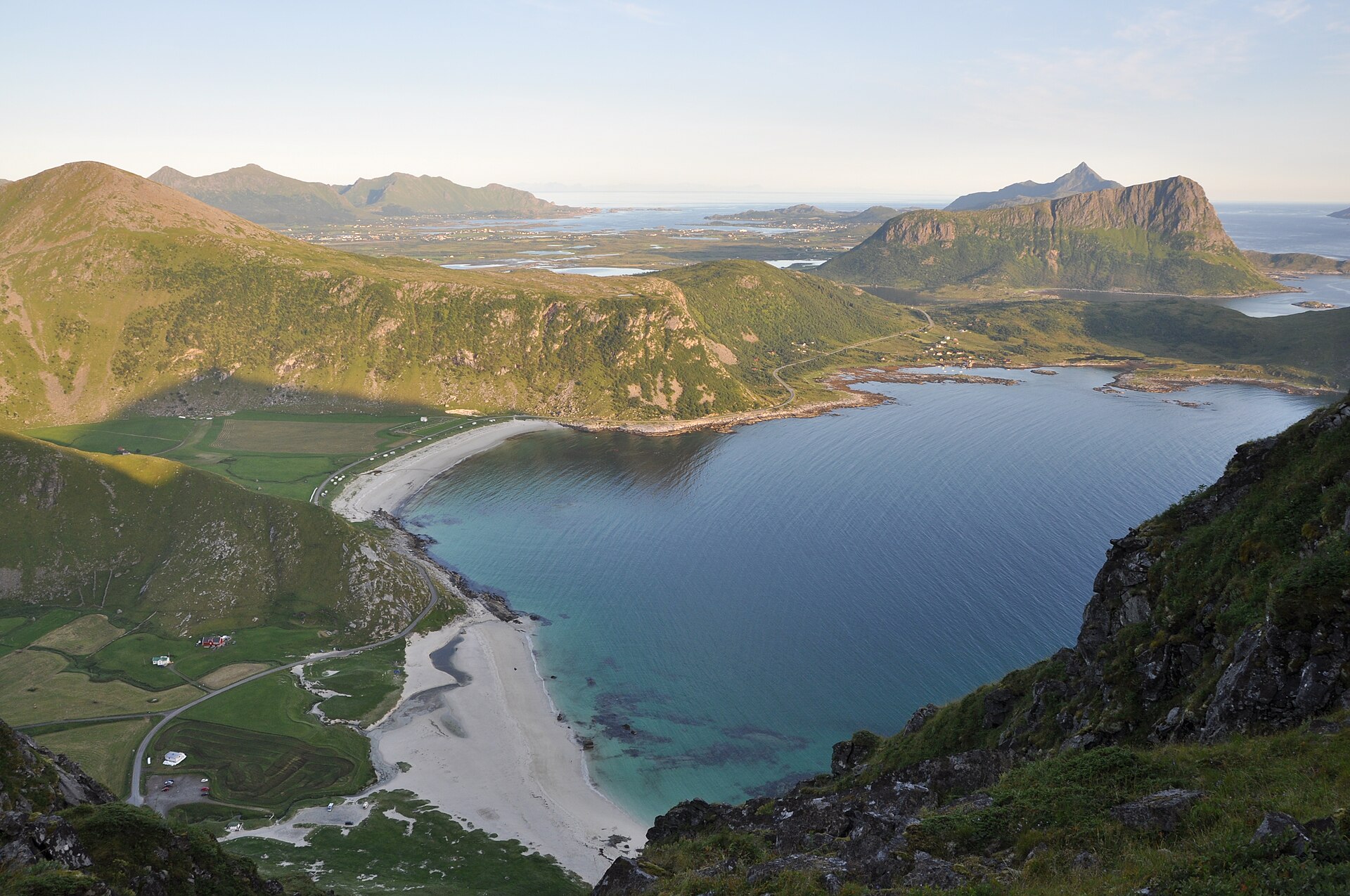
Lofoten is a different proposition: the water at Unstad peaks at just 11–15°C, around 8 August. The beaches look Caribbean and feel Arctic. People surf there in wetsuits year-round, and swimming is a shriek-and-run-out affair.
The fjords themselves sit between about 4°C and 14°C depending on depth and season, which is exactly why the sauna-and-plunge culture has exploded — NOK 350–600 for a session, and it’s the best-value experience in the country.
Mosquitoes, honestly
Nobody warns visitors about this properly. Mosquitoes peak in July and August, and they are genuinely bad inland — the Finnmarksvidda plateau, and anywhere near bogs, lakes and still water. The Norwegian midge, knott, is worse and appears on moorland.
The good news: the coast is largely fine. Wind does the work. Lofoten, Bergen, the fjord shores and the islands are rarely a problem. If you’re heading inland or into Finnmark in high summer, bring repellent and consider a head net for the worst areas — locals use them without embarrassment.
Crowds, cruise ships and how to dodge them
Norway is empty — 5.5 million people in a country the size of Germany — but its famous spots concentrate visitors severely in July.
Bergen caps cruise arrivals at four ships and 8,000 passengers a day, a limit in place since June 2022, and from 2026 every calling ship must be shore-power capable. That’s helped, but Bryggen at midday on a four-ship day is still busy.
The practical moves: check cruise schedules for Bergen, Geiranger, Flåm and Ålesund before fixing dates — they’re published, and a no-ship day in Geiranger is a completely different village. Start hikes before 8am or after 3pm. And sleep in the famous places rather than day-tripping them: Geiranger, Flåm and Reine at 8pm, once the coaches have gone, are transformed.
What summer costs, and the tax question
Summer is peak season and prices reflect it, particularly beds in the small fjord villages during the fellesferie. Reckon on NOK 900–1,200 a day camping and self-catering, NOK 1,600–2,200 with mid-range hotels and a restaurant meal.
Two 2026 specifics. Fuel is temporarily cheap at roughly NOK 20–21 a litre thanks to an excise holiday running April to September — which makes a summer road trip unusually affordable this year, and it expires in September. And Norway’s 3% visitor levy became law on 1 July 2026 but no municipality is charging it during 2026; Tromsø filed its plan on 1 July targeting January 2027. You will not pay it this summer. Tents, campervans and campsites are excluded from it in any case.
The costs guide has the full budget picture and the accommodation guide covers cabins and campsites, which are where summer Norway is genuinely affordable.
What to do with a Norwegian summer
The obvious ones are covered in the main things-to-do guide, but summer specifically unlocks things the rest of the year doesn’t:
- Every mountain trail. Preikestolen, Trolltunga (unguided season 8 June–30 September 2026), Kjeragbolten, Besseggen and Reinebringen are all only reliably walkable now. See the hiking guide.
- The National Tourist Routes. All 18 open, roughly 2,225 km of purpose-built scenic road.
- Kayaking under the midnight sun, which is exactly as strange as it sounds.
- Puffins at Runde, April to August, on cliffs you can walk along the top of.
- Wild camping under the right to roam — free, legal, two nights per spot, 150 m from the nearest house. This is the cheapest good holiday in Europe.
- Cloudberries and the berry season, late July into August, free to pick on uncultivated land.
Summer events worth timing a trip around
| Event | Where | 2026 dates |
|---|---|---|
| Sankthans (Midsummer) | Nationwide, coastal bonfires | 23 June |
| Slinningsbålet bonfire | Ålesund | Saturday nearest 23 June |
| Riddu Riđđu (Sámi festival) | Kåfjord | 8–12 July |
| Olavsfest | Trondheim | 28 July – 3 August |
| Øya Festival | Tøyenparken, Oslo | 12–15 August |
What to pack for a Norwegian summer
The rule that governs everything: you are packing for four seasons in one day, and for rain rather than cold.
- A genuinely waterproof shell — not a shower-resistant jacket. Bergen in August is 208 mm of rain.
- Waterproof trousers if you’re hiking. Norwegians wear them without comment.
- A wool or synthetic base layer even in July, especially for the north where highs are 12–16°C.
- Proper walking shoes with grip. Norwegian rock is polished and wet.
- An eye mask for the midnight sun.
- Insect repellent if you’re going inland.
- Sunglasses and high-factor sun cream — Arctic light off water and snow is stronger than it feels.
- A refillable bottle. Tap water is excellent and free everywhere.
What you don’t need: an umbrella (useless in coastal wind), formal clothes, or much cash — Norway is close to fully cashless. More in the planning essentials guide.
Frequently asked questions
Is Norway worth visiting in summer?
It’s the only season when all of Norway is open — every mountain pass, every trail, every boat. The trade-offs are peak prices and company at the famous spots. If you want the fjords rather than the aurora, summer isn’t just worth it, it’s necessary.
What is the warmest month in Norway?
July for Oslo (22.7°C average high) and for most of the country. Stavanger is the exception — its warmest month is August at 18.9°C. In the north, July too, but the numbers are much lower: Tromsø averages 15.6°C.
What is the weather like in Norway in July?
Mild and variable, with a big north–south split. Southern Norway can genuinely get hot — July 2026 saw 33°C in Oslo and Drammen — while Tromsø and Lofoten sat in the mid-teens. Expect rain in the west; Bergen averages 158 mm in July.
How crowded is Norway in July?
Crowded at the icons, empty everywhere else. The Norwegian common holiday runs weeks 28–30 (6–24 July in 2026), when the coast and fjord villages fill and cities empty. Bergen limits cruise arrivals to four ships and 8,000 passengers a day.
Can you swim in Norway in summer?
Yes. The Oslofjord reaches 20–22°C in July and August. Lofoten peaks at 11–15°C in early August — swimmable briefly, and better with a wetsuit. The fjords themselves are colder, which is why sauna-and-plunge is so popular.
Are there mosquitoes in Norway in summer?
Inland, yes, and badly — July and August on the Finnmarksvidda and around bogs and lakes. The coast is largely fine thanks to the wind. Bring repellent if you’re heading inland.
When can you see the midnight sun?
In 2026: North Cape 14 May–29 July, Tromsø 20 May–22 July, Lofoten 28 May–14 July, Bodø 2 June–10 July, Svalbard 20 April–22 August.
Is June, July or August best?
Late June for maximum light and the best waterfalls; mid-to-late August for warm water, fewer people and the first aurora returning in the north; early July only if school holidays dictate it. Late May and early September are both quietly better than any of them if the high roads aren’t essential to your plan.
Photo credits
All photographs are used under their respective Creative Commons or public-domain licences.
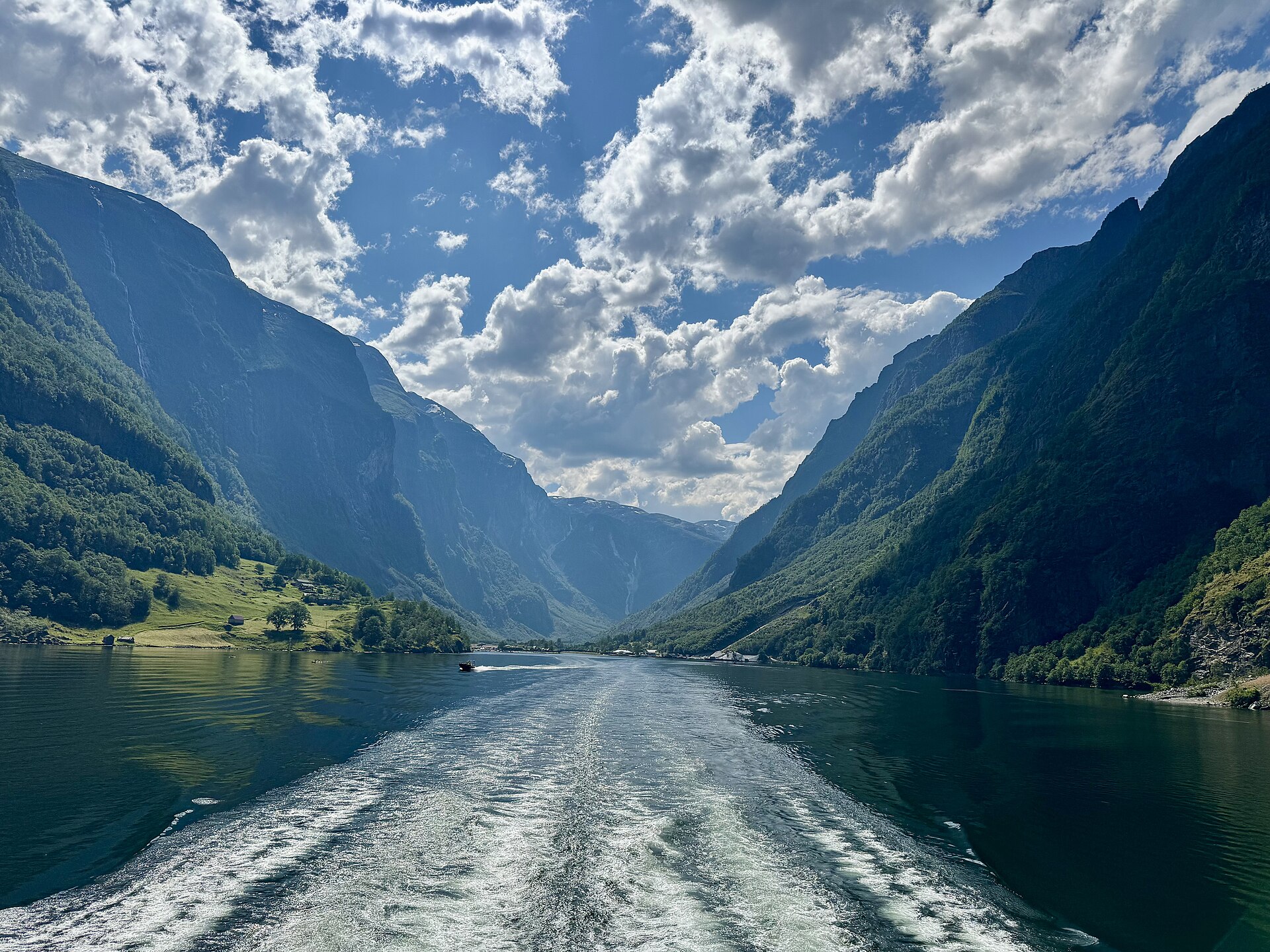
- The Nærøyfjord in summer. Since January 2026 the smaller boats here run emission — Photo: Cbliu / CC BY-SA 4.0 via Wikimedia Commons.
- Haukland, Lofoten. It looks Caribbean and peaks at 11–15°C around 8 August. — Photo: Paal Svendsen / CC BY-SA 3.0 via Wikimedia Commons.
- The Seven Sisters, Geirangerfjord. At full volume in June, thinner by late August. — Photo: Sergey Ashmarin / CC BY-SA 3.0 via Wikimedia Commons.
Climate figures are 1991–2020 normals from the Norwegian Meteorological Institute. Road openings, prices and 2026 weather records were checked in July 2026, with prices in Norwegian kroner at roughly 9.5 NOK to 1 USD. Mountain pass dates vary year to year — always check current status.