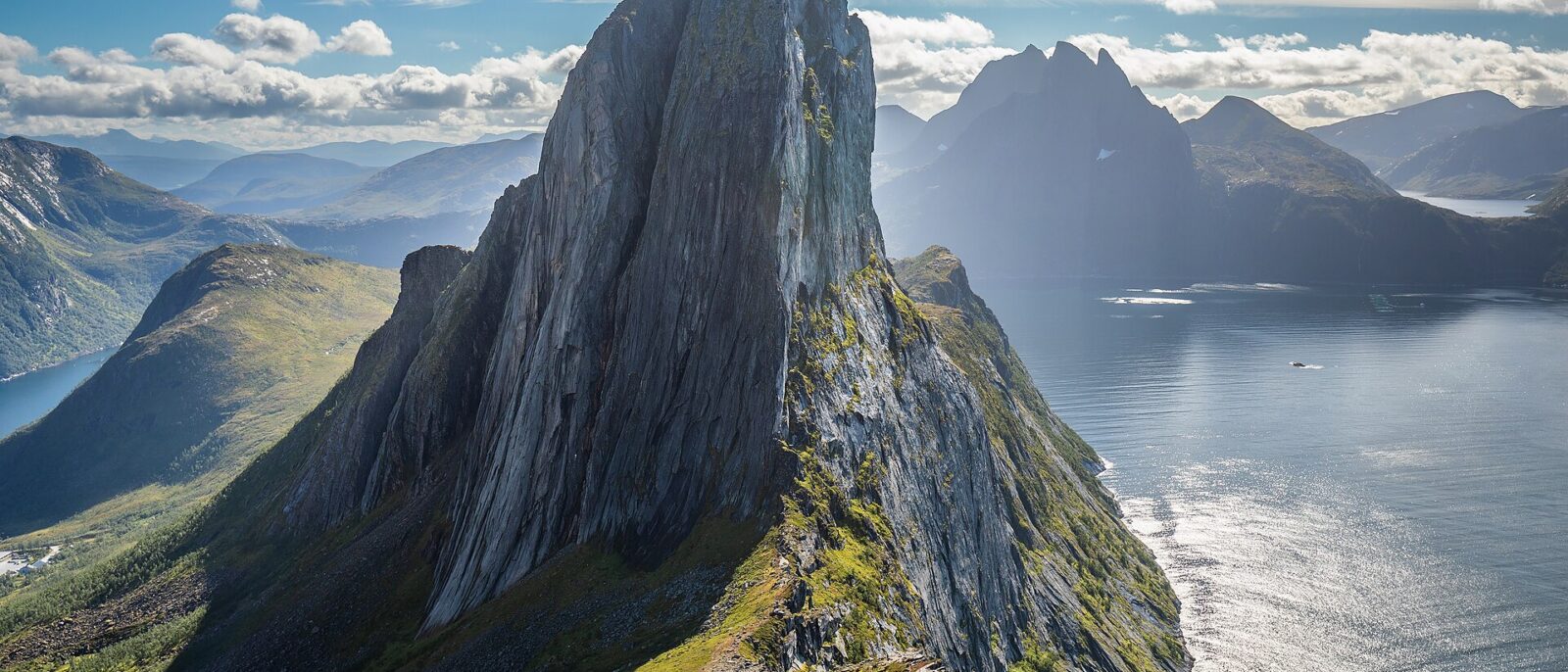
Senja is the island people mean when they say “like Lofoten, but quieter”. It’s Norway’s second-largest island outside Svalbard, 1,586 square kilometres of fjords, white beaches and saw-toothed mountains rising straight out of the sea, and it sits just south-west of Tromsø. On a clear day the outer coast is as dramatic as anything on our list of Norway’s most beautiful places.
The scenery sells Senja, but the part that actually decides your trip is getting there and around. Ferry fares and crossing times here come from the operators’ own timetables. The Senja Troll, a giant troll figure, burned down in March 2019, so any guide that still lists it is out of date. And the Tromsø ferry isn’t summer-only: it runs all year.
This guide fixes that. It compares the four ways to reach Senja from Tromsø with 2026 timetables and fares, walks the National Scenic Route stop by stop, gives the hiking numbers for Segla and Hesten, and tells you honestly what doesn’t work, starting with doing Senja without a car.
Four ways to Senja from Tromsø
Fares are 2026 prices from Svipper, the Troms public-transport authority, and drive times from Visit Tromsø. Dollars at NOK 9.41 to the US dollar.
| Route | Time | Cost | Where it puts you | Best for |
|---|---|---|---|---|
| Drive + Brensholmen–Botnhamn ferry | About 1 h 15 to Brensholmen, then a 45-minute crossing | Car up to 6 m NOK 228 ($24); NOK 247 from 20 June to 31 August; passengers free | Botnhamn, the north end of the scenic route | Most visitors with a car |
| Drive the long way via Finnsnes | About 2–4 hours, depending on where on Senja you’re going | Fuel only | Finnsnes, then over the Gisund Bridge | When the ferry times don’t fit, or on the way south |
| Express boat Tromsø–Finnsnes | 1 h 20 | NOK 295 ($31) adult, one way | Finnsnes, on the mainland just across the Gisund Bridge from Senja | Getting to a hire car or a pre-booked tour |
| Summer ferry Andenes–Gryllefjord | See Svipper timetable | Car up to 6 m NOK 925 ($98); adults 30–66 pay NOK 100 from 15 June | Gryllefjord, the south end of the scenic route | Coming from Vesterålen or Lofoten |
The obvious plan is to take the Brensholmen ferry out and drive back via Finnsnes, or vice versa. That way you see the whole island without retracing your steps.
The Brensholmen–Botnhamn ferry
This is the main link. It runs all year: Visit Senja says it operates daily throughout the year. The operator is Torghatten Nord, the ship is the M/F Rødøy, and the crossing takes 45 minutes.
On the 2026 timetable, Monday to Thursday departures from Brensholmen are at 08:45, 10:45, 12:45, 15:00, 17:00, 19:00 and 20:45. Fridays add a late trip, and weekends have fewer sailings, with the first Sunday departure from Brensholmen at 10:15. Extra trips run in summer, from 1 May to 20 September, and there’s a separate winter schedule from 21 September to 30 April. There are no sailings on 24, 25 or 31 December 2026. Check the current timetable on svipper.no before you set off, because times shift between seasons.
Fares for 2026: NOK 228 for a car up to 6 metres, rising to NOK 247 in the summer period from 20 June to 31 August. Motorbikes pay NOK 74 (NOK 79 in summer). Car passengers and foot passengers travel free. Svipper’s fare sheet says frequent users registered with AutoPASS or FerryPay drop back to the ordinary price after six summer trips.
Brensholmen is about an hour and a quarter’s drive from Tromsø, out across Kvaløya. Leave margin: you can’t reserve, so in summer it’s first come, first served.
The long way round via Finnsnes
Without the ferry, you drive south on the mainland and cross to Senja over the Gisund Bridge, which carries road 86 from Finnsnes to Silsand. Visit Tromsø puts the drive at about two to four hours, depending on which part of Senja you’re heading for. It’s not a scenic drive in the way the island is, but it’s reliable, it doesn’t depend on a timetable, and it makes sense as one leg of a round trip.
The express boat to Finnsnes
Svipper’s line 2, run by Norled, links Tromsø with Finnsnes and Harstad. Visit Tromsø says there are two to four departures a day. On weekdays in 2026, the 07:00 from Tromsø reaches Finnsnes at 08:20, and the 16:15 arrives at 17:35. Some days add more departures, and weekends run to a different timetable. The adult fare to Finnsnes is NOK 295. Since 1 February 2026 Troms express boats have had a seat guarantee, which means you buy a ticket for a specific departure, so book in the Svipper app rather than turning up.
The catch: Finnsnes is a small town on the mainland, just across the Gisund Bridge from Senja, and the coast you’ve seen in photos is on the island’s far side. The boat is a good way to reach a hire car or a tour pickup. It isn’t a way to see Senja on its own.
The summer ferry to Andenes
From mid-May to late September a summer ferry links Gryllefjord, at the southern end of Senja’s scenic route, with Andenes at the tip of Andøya in Vesterålen. In 2026 Torghatten Nord ran it with the M/F Stetind from 13 May to 27 September, leaving Gryllefjord at 11:00 and 19:00 and Andenes at 08:45 and 17:00, with an extra midday sailing each way (15:00 from Gryllefjord, 13:00 from Andenes) from 15 June to 23 August. Visit Senja says it can’t be reserved and has long waits in high season, especially at Gryllefjord. Svipper’s 2026 fares are NOK 925 for a car up to 6 metres, and from 15 June every adult aged 30 to 66 pays NOK 100; children, young adults and concessions go free.
This is the link that turns Senja into part of a bigger trip: Tromsø, Senja, then south through Vesterålen to Lofoten. Check the route 180 timetable on Svipper or Entur for the 2027 season and crossing time, and in July, be at Gryllefjord well before the departure you want.
Can you do Senja without a car?
Partly. You can reach the villages, but not the scenic route in the way the photographs promise.
Getting onto the island is easy. From 15 December to 31 March, Visit Senja lists a daily Senja Direct Winter Route bus from Tromsø, booked through Best Arctic. The summer bus Best Arctic used to run from Tromsø through Senja to Lofoten has been permanently discontinued. Otherwise, the express boat or a bus gets you to Finnsnes.
From Finnsnes, Svipper’s local buses fan out to the coast:
- Route 380 runs Finnsnes–Botnhamn–Husøy, with around ten departures from Finnsnes on weekdays in the 2026 timetable and a Sunday service.
- Route 360 runs Finnsnes–Hamn–Gryllefjord–Torsken, with a handful of weekday departures and a single Sunday bus. The 06:45 from Finnsnes reaches Hamn just under an hour later.
- Routes 362 and 370 are feeders to Mefjordvær, timed to connect with the 360 and 380.
Those buses are built around school runs and commuters, not around stopping at Tungeneset for the light. You can base yourself in one village and walk from there. What you can’t easily do is the scenic route itself, stopping where you like. Departures change by day type, so plan each leg in the Svipper app or Entur’s journey planner.
The realistic car-free options are a guided tour from Tromsø, which several operators run in summer and winter, or the express boat to Finnsnes to pick up a hire car. If you’re hiring in Finnsnes, Budget has an office at Strandveien 16, and Hertz lists a Finnsnes location; otherwise, rent in Tromsø and take the ferry. Our guide to getting around Norway covers car hire and ferries more generally.
Where to stay on Senja
Senja has no town of any size on its outer coast, so where you sleep decides how much driving you do. These four are all operating, and prices vary by date, so check rates for your dates directly with each.
| Place | Where | What it is | Good for |
|---|---|---|---|
| Hamn i Senja | Hamn, on the west coast, on bus route 360 | Rooms, the Storbrygga restaurant, and bookable kayaking, hiking, ski touring and aurora trips | A base on the outer coast without a car |
| Mefjord Brygge | Mefjordvær, under Segla and Hesten | All-year resort: apartments with 140 beds, 20 hotel rooms and the Salteriet restaurant | Hikers: Segla and Hesten rise above the village |
| Senja Fjordhotell | Frovåghamn, southern Senja | Opened in 2018: 17 rooms and 6 cottages, with an EV charger | Ånderdalen and the quieter south |
| Fjordbotn Camping | Near Botnhamn, 12 km from the ferry | Cabins and around 55 motorhome and caravan pitches, with EV charging and snowshoe rental in winter | Arriving late off the Brensholmen ferry, or a budget stay |
My pick for a first visit with a car is Mefjord Brygge, because it puts you under Segla and Hesten, with the rest of the scenic route an easy day’s driving away. Without a car, Hamn i Senja is the one place on the outer coast where the bus, the restaurant and the activities are all at the door.
Fuel and shops
Fill up before you head out to the coast. The most useful stop is Joker Skaland on the scenic route: groceries, a fuel station, a post office and a Visit Senja information point, open 24 hours six days a week all year and 24/7 from mid-May to mid-September (staffed weekdays 08:30–18:00 and Saturdays 08:30–16:00). At the southern end, Matkroken in Gryllefjord, by the ferry port, sells groceries on weekdays 09:00–18:00 and Saturdays 09:00–15:00. Smaller village shops include Joker Husøy and Nærbutikken in Fjordgård. On Sundays, outside the self-service hours at Skaland, assume most things are shut.
The National Scenic Route: stop by stop
Senja’s west coast is one of Norway’s 18 National Scenic Routes, the road authority’s programme of designated drives with architect-designed viewpoints and rest stops. The Senja route runs 102 km from Botnhamn in the north to Gryllefjord in the south, with short detours to Husøy, Bøvær and Mefjordvær. Coming off the Brensholmen ferry, you drive it north to south.
| Stop | What’s there | Facilities | Stop for |
|---|---|---|---|
| Husøy (detour) | A fishing village on its own small island | Village | 30–60 minutes |
| Mefjordvær (detour) | Fishing village under Segla and Hesten | Toilet open all year; parking for 4 cars and 4 larger vehicles | 30 minutes; longer if hiking |
| Tungeneset | Siberian larch walkway over the rocks, facing the Okshornan peaks | Toilets early May to early October | 30 minutes |
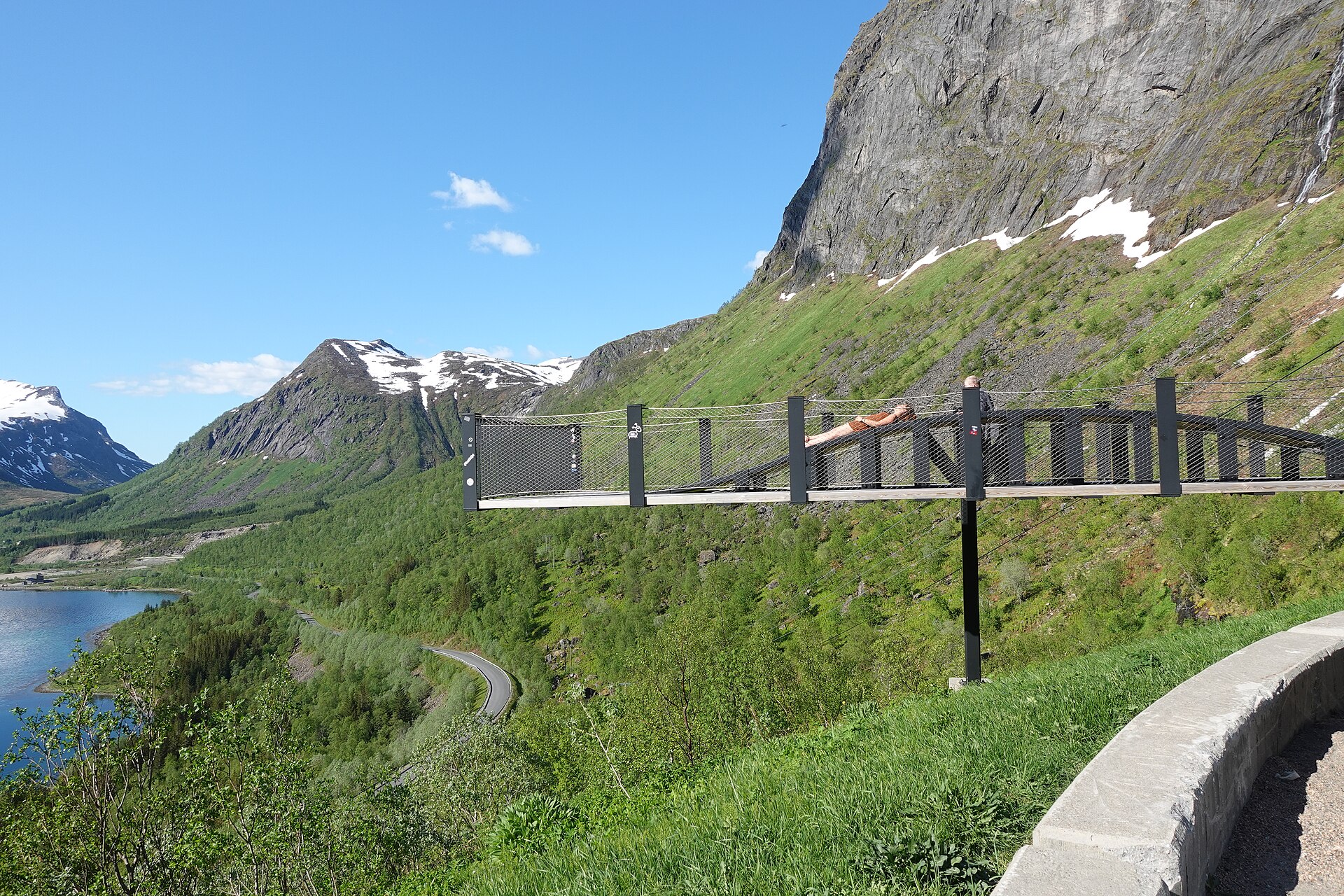
| Bergsbotn | A 44-metre viewing platform over Bergsfjorden | Wheelchair accessible | 20 minutes |
| Ersfjordstranda | White-sand beach and a gold-plated service building | Toilets early May to early October; partly wheelchair accessible | 30 minutes to an afternoon |
| Gryllefjord | End of the route; summer ferry to Andenes | Village | Depends on the ferry |
Tungeneset
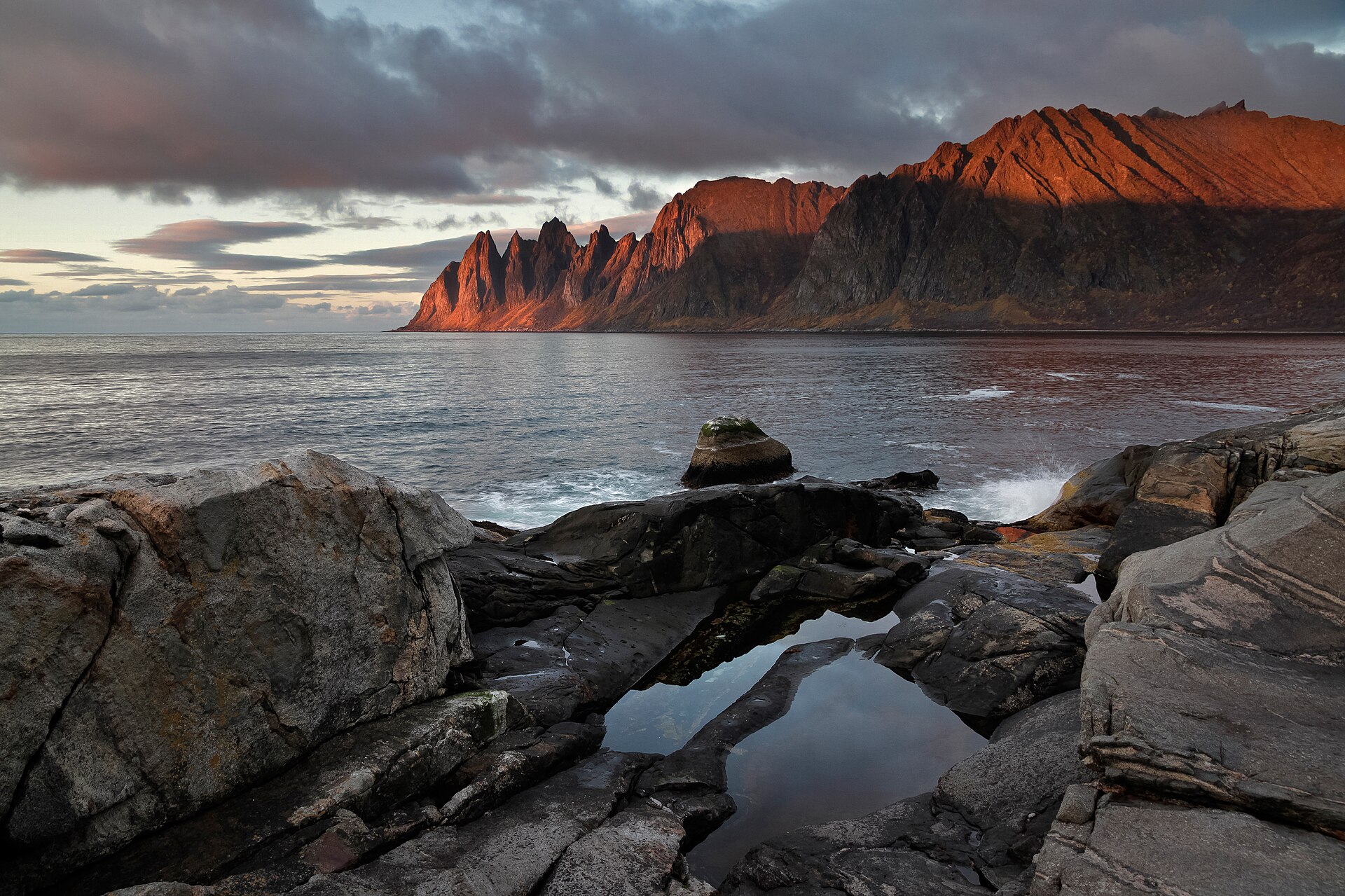
If you only stop once, stop here. A wooden walkway leads out over the rocks to the edge of the sea, and across the water the Okshornan ridge rises in a row of jagged teeth. Low sun lights those peaks well, which makes it a favourite for photographs. One of the photographs in this guide shows Okshornan from Tungeneset in October.
Bergsbotn
The platform at Bergsbotn sticks 44 metres out from the hillside above Bergsfjorden, with the fjord and its village laid out below. It’s wheelchair accessible, which makes it an easy big view for everyone to reach.
Ersfjordstranda
A white-sand beach at the head of Ersfjorden, with a gold-plated service building that looks very odd until you see it in low sun. Good for a picnic and, if you’re brave, a very cold paddle.
Husøy and Mefjordvær
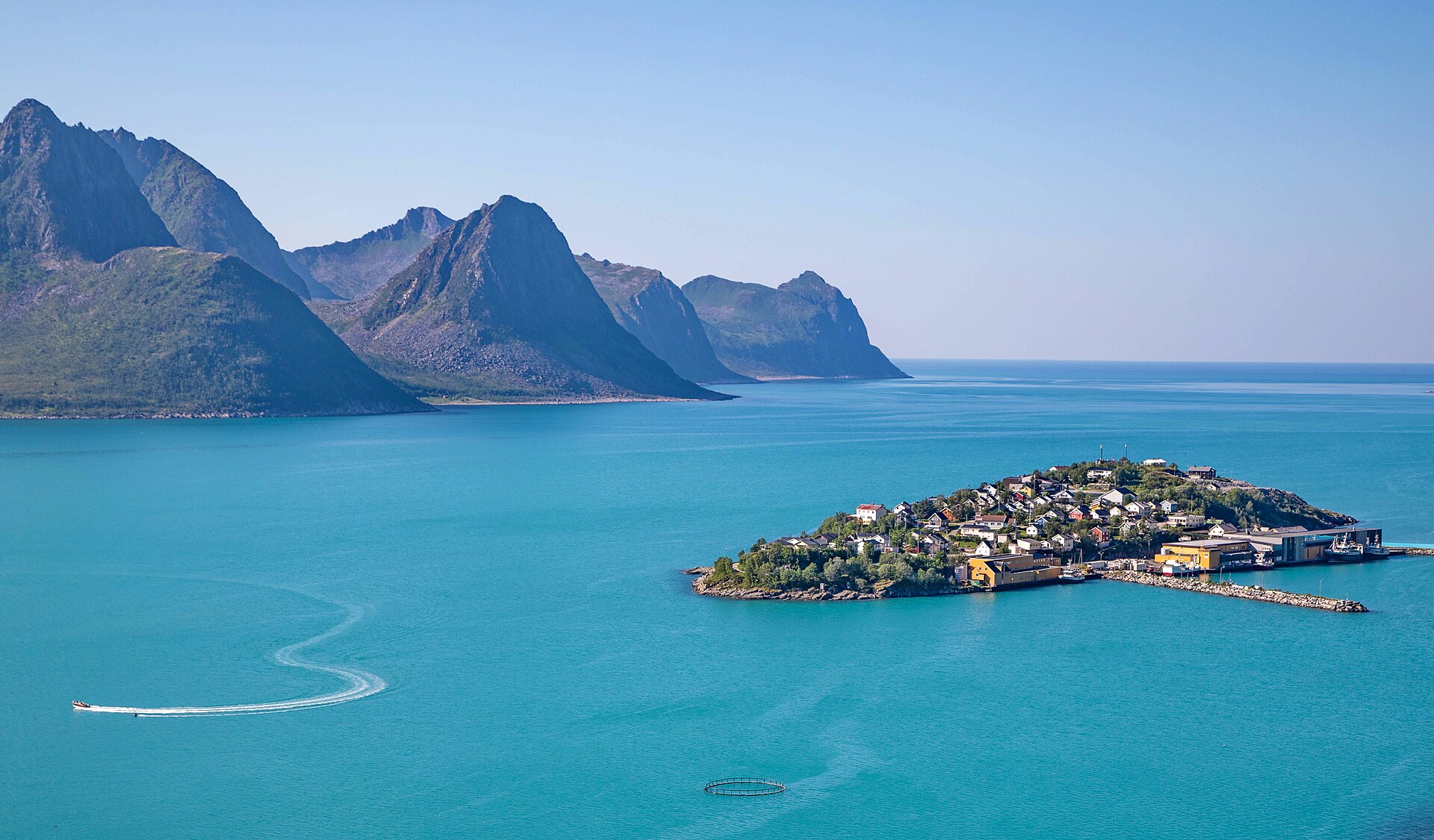
Two fishing villages, both short detours off the main route. Husøy sits on its own small island, packed edge to edge with houses and fish-processing buildings. Mefjordvær sits beneath Segla and Hesten, and it’s where you’ll be if you’re hiking either. Both are working villages, so park where you’re told and keep your drone away from people’s houses.
How long the route takes
Nobody drives the 102 km straight through, and the roads are narrow enough that you wouldn’t want to. With the detours and stops above, give it a full day. With a hike, give it two.
Hiking on Senja
Senja’s mountains are why many people come. The figures below are from UT.no, the Norwegian Trekking Association’s route database.
| Hike | Summit | Distance (return) | Ascent | Time | Season |
|---|---|---|---|---|---|
| Segla | 639 m | 4.6 km | 588 m | About 3 h 30 | May–September |
| Hesten (with Stavelitippen) | — | 4.5 km | 489 m | About 3 h | A user-submitted route; listed as all year |
Segla
The famous one: the shark-fin peak above Mefjorden that appears on every Senja poster. UT.no gives 639 metres, 4.6 km return, 588 metres of climbing and about 3½ hours. The trail starts at Fjordgård school, about 50 minutes’ drive from Finnsnes, and UT.no reminds you to pay for parking there. It’s steep and in places exposed near the top, and UT.no’s season is May to September. Outside that window, the snow makes it a mountaineering route, not a walk.
Hesten
Hesten is the neighbouring peak and the one that gives you the view of Segla, which many people prefer. A route published on UT.no by a private user covers Hesten and Stavelitippen from Fjordgård in 4.5 km and about three hours, with 489 metres of ascent. It’s rated demanding. If you only have legs for one, I’d pick Hesten for the photograph and Segla for the summit.
Ånderdalen National Park
For something gentler, Ånderdalen National Park covers 135 square kilometres of pine forest, lakes and low mountains in the south of the island. It was protected in 1970 and extended in 1975 and 2014. There’s no accommodation inside the park; the nearest unstaffed hut, Senjabu, is on road 86 about 10 km to the north. It’s the quieter, greener side of Senja, and a good choice on a day when the outer coast is under cloud.
For gear, safety and mountain weather, see our general Norway hiking guide.
Senja in summer and winter
Summer
Late May to July brings the midnight sun. Yr doesn’t list a Senja town, but the places either side of it bracket the dates: Tromsø gets the midnight sun from about 20 May to 22 July and Andenes from 22 May to 21 July. The hiking season on Segla runs May to September, the rest-area toilets are open from early May to early October, the summer ferry to Andenes runs from mid-May, and extra Brensholmen sailings run from 1 May to 20 September. It’s the easy season. Our Tromsø midnight sun guide covers the light and the weather.
Winter
Winter is the dramatic season, with snow on every peak, the aurora over a coast with almost no light pollution, and very few other visitors. It’s also harder. The Andenes ferry doesn’t run, the seasonal toilets at Tungeneset and Ersfjordstranda close, Segla is out of season, and the outer-coast roads are narrow and exposed. Mefjordvær’s toilet stays open all year, which tells you something about how few facilities there are.
If you drive in winter, you need to be confident on snow and ice. Check conditions before you go: the National Scenic Routes page lists a traffic information line, +47 815 48 991, and Statens vegvesen publishes road status online. For the aurora, Senja’s west coast is far from city light, and our guide to where to see the northern lights in Norway explains why distance from city light matters.
How many days on Senja?
One day is possible from Tromsø with a car: an early Brensholmen ferry, the scenic route south with stops at Husøy, Tungeneset and Bergsbotn, and the long drive back via Finnsnes in the evening. It’s a long day, and there’s no time for a hike. I’d only do it in summer, when the light lasts.
Two days is the right amount for most people. Day one: ferry across, Husøy, Mefjordvær and a hike up Hesten or Segla. Day two: Tungeneset, Bergsbotn and Ersfjordstranda, then out via Gryllefjord (in summer, to Andenes) or back via Finnsnes.
Three days lets you add Ånderdalen, wait out bad weather, and do both big hikes.
If you’re working out how Senja fits into the rest of a northern trip, our guide to how many days to spend in Tromsø includes a week-long winter plan with two nights on Senja.
Senja vs Lofoten
The comparison is unavoidable, so here’s what I can say plainly. They’re the same kind of landscape: jagged peaks dropping into the sea, white beaches, fishing villages, the midnight sun in summer and the aurora in winter. The differences are practical:
- Access from Tromsø. Senja is an hour and a quarter’s drive and a 45-minute ferry from Tromsø. Lofoten is much further, and most people reach it by flying, by the coastal ship or by a long drive.
- Linking the two. In summer, the Gryllefjord–Andenes ferry makes them one trip: Senja, then Vesterålen, then Lofoten.
- Infrastructure. Lofoten has far more accommodation and visitor services. Senja’s outer coast is a string of small villages, so book where you’re staying before you go.
Which is better is a matter of taste, and our comparison of Lofoten, Senja and Vesterålen puts numbers on it. If you’re based in Tromsø with limited time, Senja is the obvious choice simply because it’s close. Our Lofoten itinerary is the place to start if you’re thinking about doing both.
What I’d skip, and what people get wrong
The Senja Troll
Senjatrollet, the giant troll figure that features in older guides, was destroyed by fire on 28 March 2019. Don’t drive out of your way for it.
Assuming the Tromsø ferry is summer-only
It runs all year, with a winter schedule from late September to the end of April. Check the timetable, but don’t rule out a winter trip because of it.
Going car-free and hoping
The express boat gets you to Finnsnes. It doesn’t get you to Tungeneset. Rent a car or book a tour.
A day trip in winter
Short days, slow roads and closed facilities make a winter day trip from Tromsø mostly a drive in the dark. Stay at least one night, and you get the aurora over the outer coast as a reward.
Turning up at Gryllefjord at the last minute in July
The Andenes ferry can’t be booked and has long queues in high season. If you have a connection to make on the far side, arrive early.
Segla outside its season
UT.no gives May to September. In snow, the upper section is a different and dangerous proposition.
What a Senja trip costs
The transport costs are low. The car hire is what adds up. At 2026 fares:
| Item | Cost |
|---|---|
| Brensholmen–Botnhamn ferry, car up to 6 m (passengers free) | NOK 228 ($24); NOK 247 ($26) from 20 June to 31 August |
| Express boat Tromsø–Finnsnes, adult one way | NOK 295 ($31) |
| Gryllefjord–Andenes ferry, car up to 6 m | NOK 925 ($98), plus NOK 100 for each adult aged 30–66 from 15 June |
| Parking at the Segla trailhead | Paid; check the signs |
| Scenic route rest stops, Bergsbotn platform | Free |
A two-day round trip from Tromsø by car, ferry one way and Finnsnes the other, costs one ferry fare plus fuel and the car. For the bigger picture on Norwegian car hire and fuel, see our Norway road trip guide.
For everything else in the region, start from our main Tromsø and Arctic Norway guide.
Frequently asked questions
How do you get to Senja from Tromsø?
The quickest way with a car is to drive about 1 hour 15 minutes to Brensholmen and take the 45-minute ferry to Botnhamn, which runs all year. Without the ferry, the drive via Finnsnes and the Gisund Bridge takes about two to four hours. Without a car, the express boat reaches Finnsnes in 1 hour 20 minutes.
Is Senja worth visiting?
Yes, if you have a car and at least one night. The outer coast, with Segla, Tungeneset and Bergsbotn, is as dramatic as anywhere in Northern Norway and close to Tromsø. Without a car, it’s hard to see the best of it.
Can you visit Senja in winter?
Yes. The Brensholmen ferry runs all year and the aurora over the west coast is superb. But the Andenes ferry and several rest-area toilets close, Segla is out of season, and the roads demand winter driving experience.
How many days do you need on Senja?
Two days is right for most people: one for the northern villages and a hike, one for the scenic route south. One day is possible from Tromsø in summer, but it’s long and rushed.
Can you visit Senja without a car?
Partly. Svipper’s local buses run from Finnsnes to Botnhamn and Husøy (route 380) and to Hamn and Gryllefjord (route 360), and a direct winter bus runs from Tromsø between 15 December and 31 March. That’s enough to base yourself in one village, but stopping along the scenic route needs a car or a guided tour.
Is there a ferry from Senja to Andenes or Lofoten?
From mid-May to late September a ferry runs between Gryllefjord on Senja and Andenes on Andøya, two to three times a day. It can’t be booked. From Andenes, you drive south through Vesterålen to Lofoten.
How hard is the Segla hike?
UT.no gives 4.6 km return, 588 metres of ascent and about 3½ hours. It’s steep and exposed near the summit, and only recommended from May to September.
Is Senja better than Lofoten?
They’re similar landscapes. Senja is much closer to Tromsø and has fewer visitor services; Lofoten has more accommodation and more facilities. In summer you can do both, linked by the Gryllefjord–Andenes ferry.
Photo credits
- Segla, 639 metres, above Mefjorden. — Photo: Ximonic (Simo Räsänen) / CC BY-SA 4.0 via Wikimedia Commons.
- The Bergsbotn platform on the Senja scenic route. — Photo: Wolfmann / CC BY-SA 4.0 via Wikimedia Commons.
- Husøy, a fishing village on its own island off Senja. — Photo: Jakub Job / CC BY-SA 4.0 via Wikimedia Commons.
- Okshornan seen from Tungeneset in low autumn sun. — Photo: Ximonic (Simo Räsänen) / CC BY-SA 3.0 via Wikimedia Commons.
Ferry and express-boat fares and timetables are Svipper’s 2026 figures, checked in November 2026, and converted at NOK 9.41 to the US dollar. Hiking figures are from UT.no, and rest-area details from the National Scenic Routes. For 2027 fares and the 2027 summer ferry dates, check svipper.no or Entur before you travel.