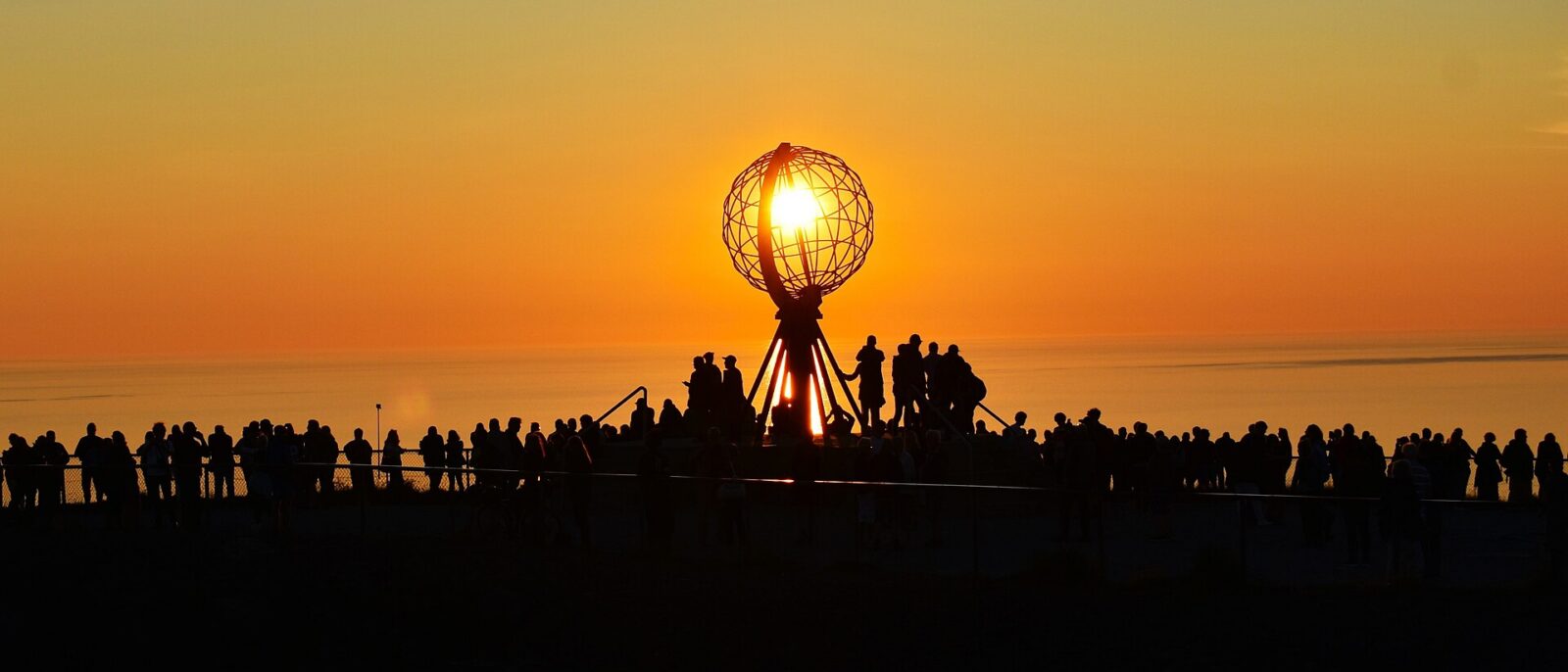
Nordkapp is the cliff everyone has heard of and almost nobody plans properly. I read the guides that rank for it. Between them you get the Globe monument, a midnight-sun photo, and a North Cape Hall ticket price that may be from a previous season. What many of them skip is the stuff that actually decides your day: that in winter the last 13 kilometres are driven in a convoy behind a snowplough at fixed times, that the local taxis won’t reliably take you up there, and that the plateau itself costs nothing at all.
So this is the practical version. Every way of getting to the North Cape, with the times and prices the operators publish, the convoy timetable, what is free and what isn’t, the hike that takes you to a point that’s genuinely farther north, and an honest answer to whether the whole trip is worth it.
One thing to know before the details, because it changes how you read everything else: Nordkapp is on an island. The 307-metre cliff sits on Magerøya, linked to the mainland by an undersea tunnel, and the northernmost point of mainland Europe is a different headland altogether, Cape Nordkinn, a long way east. I’ll come back to why that matters less than you’d think.
Every way to reach the North Cape, compared
There are really only four ways up to the plateau: drive yourself, join a tour from Honningsvåg, take an excursion off a coastal ship, or come off a cruise ship. Everything else, the bus from Alta and the flights into Honningsvåg, just gets you to the island. Here’s how they stack up.
| Way up | Starts from | Time | Cost | Season | Verdict |
|---|---|---|---|---|---|
| Your own car | Anywhere; Alta to Honningsvåg is about 3 hours | As long as you like on top (parking max 6 hours) | Fuel only; tunnel is toll-free, plateau and parking free | Free driving outside the winter convoy season; convoy on the last 13 km in winter | The most flexible way, and you choose your own hours on the plateau |
| Hurtigruten excursion | Honningsvåg quay | 3 hours | From €179 (about NOK 1,900, $197), Hall entry included | Year-round | Easiest if you’re already on board |
| Local guided tour | Honningsvåg | Timed to the convoy in winter | Set by each operator | Year-round (Arctic Guide Service); February to September (North Cape Experience) | The sensible choice if you arrive by bus or plane |
| Cruise-ship shore excursion | Honningsvåg cruise port | Fits the port call | Set by the cruise line | When cruise ships call | Fine, but expect company |
| Bus | Alta (line 110, three departures a day) | About 3 hours 20 minutes to Honningsvåg | Snelandia’s fare | Check the timetable for your date | Gets you to the island, not to the cliff |
| Fly | Tromsø, via Hammerfest (Widerøe) | About 1.5 to 2.25 hours, with stops | Widerøe’s fare | Check the timetable for your date | Only useful with a hire car or tour booked |
If you take one thing from that table: the plateau is a car-or-tour place. Honningsvåg’s tourist office says so itself, telling visitors that taxis “cannot be relied on” for trips to the North Cape because the service mainly covers local needs such as taking elderly residents to medical appointments.
What’s on the plateau, and what you actually pay for
The plateau, the Globe and the view are free. So is parking, but only for up to six hours, and overnight parking isn’t allowed, so you can’t sleep in a van at the top. What costs money is the North Cape Hall (Nordkapphallen), the visitor centre on the plateau.
The Hall was built in 1959 and expanded in 1988 and 1997. Inside, according to the July 2026 destination brochure from Visit North Cape and Hurtigruten’s excursion description, you get a panoramic film, exhibitions, a small chapel and museum, a gift shop and a coffee house, all open year-round. The restaurant opens in summer and on request outside the main season; the post office and the Panorama Bar are summer-only, though you can get a North Cape postmark all year. Outside, besides the Globe, there’s the Children of the Earth monument.
The Hall’s ticket price changes from season to season, and the figures printed in guides can be out of date, so check the current adult and child price on the Hall’s own website before you go. My honest view on whether to buy one: if the sky is clear, the view off the cliff edge is the whole point and it’s free. If it’s blowing sideways with sleet, which happens in July as well as January, you’ll be glad of a warm room, a film and a coffee, and the ticket earns its keep.
The tour price includes the Hall
Hurtigruten’s North Cape excursion, from €179 per person, includes the film, the exhibitions, the chapel, the small museum and the shop, but no food or drink. If you were going to pay for the Hall anyway, that matters when you compare it against hiring a car.
Driving to Nordkapp
The road is the E69, which leaves the E6 at Olderfjord and runs north onto Magerøya through the North Cape Tunnel. That tunnel is 6.9 kilometres long and drops to 212 metres below sea level; it opened on 15 June 1999 and has been toll-free since 29 June 2012.
Visit Alta gives about three hours by car from Alta to Honningsvåg, six from Tromsø to Alta, and two from Hammerfest to Alta. So from Tromsø you’re looking at around nine hours of driving to Honningsvåg, before the plateau road, which is why I’d treat it as a two-day drive with a night in Alta, not a heroic one-day push.
Fuel, charging and reindeer
- Fuel: Visit Nordkapp lists two fill points on Magerøya, one in Honningsvåg near the Rema 1000 supermarket and one near the airport. The nearest on the mainland side is at Olderfjord, 98 km from Honningsvåg. Fill up before the plateau.
- Charging: there are fast chargers in Honningsvåg and Storbukt and one in Skarsvåg.
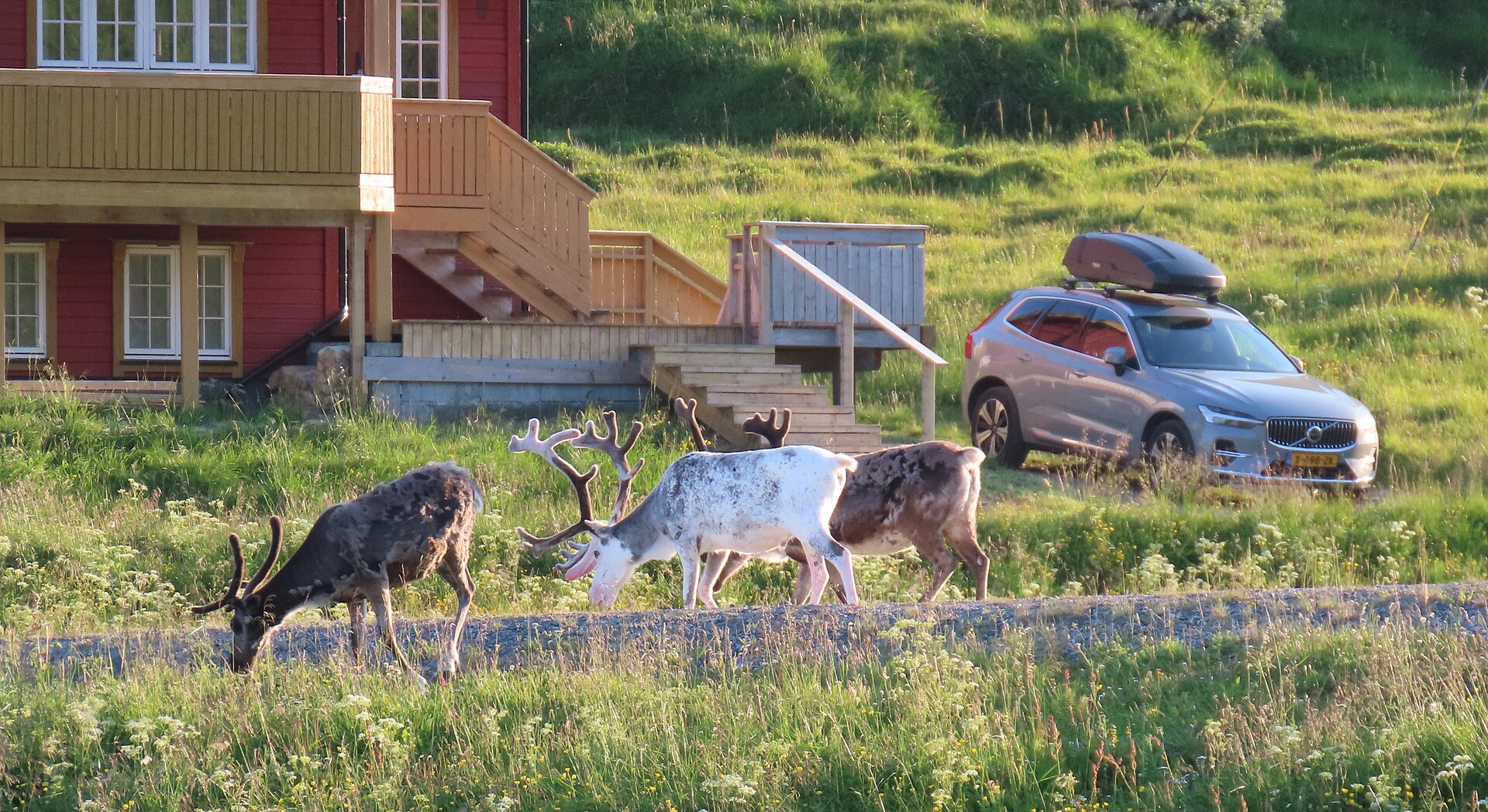
- Reindeer: from late spring to autumn Magerøya is summer pasture for semi-domesticated reindeer owned by Sámi herding families, and they stand on the E69 as if they own it. Slow down on the plateau road, and give them space.
- Snow: in early summer there can still be snow patches along the mountain, though the road itself is normally kept clear.
In Nordland, Troms and Finnmark, cars up to 3,500 kg need at least 3 mm of tread from 16 October to 30 April, and studded tyres are normally allowed in that window. If you’re driving between those dates, check your hire car’s tyres when you collect it; if you’re bringing your own car north, sort the tyres before Finnmark, not in it.
The winter convoy, explained
This is the section the guides skip, and it’s the one that decides your winter visit. In winter the E69 between the Skarsvåg junction and the plateau can only be driven in a convoy led by a snowplough. Visit Nordkapp says this usually applies from November to April. The convoy is free, you don’t book it, and guided tours schedule their departures around it.
Statens vegvesen, the roads authority, publishes fixed times. For winter 2026/27 they are:
| Up from the Skarsvåg junction | Down from Nordkapp |
|---|---|
| 08:30 | 09:30 |
| 10:00 | 11:00 |
| 12:00 | 12:30 (Fridays and Saturdays only) |
| 14:30 | 13:45 |
| 19:30 | 16:15 |
| 21:30 |
From 1 January to 15 April 2027 there’s no free passage at all: you go up and come down with a convoy, or the road is closed because of the weather. Outside that window, in late autumn and spring, whether you can drive freely depends on conditions on the day, so check the roads authority’s traffic page that morning.
The useful way to read that table is in pairs. Go up at 10:00 and you can come down at 11:00 or wait for 13:45. Go up at 14:30 and your ride down is 16:15. The evening pair, up at 19:30 and down at 21:30, is the one to aim for if you want to see the aurora over the Arctic Ocean from the cliff. Most pairs give you an hour or two between convoys, less the time the convoy takes to climb; the Friday and Saturday 12:30 run down gives you only half an hour after the 12:00 up.
The roads authority is clear that the road can still close completely in bad weather. The best advice in this whole article: don’t save the North Cape for your last day. Plan it for your first full day on the island, so a cancelled convoy costs you a day, not the trip.
Getting there without a car
You can reach Magerøya without driving, but you can’t reach the cliff without either a tour or a coastal-ship excursion. That’s the honest summary. Here’s how the pieces fit.
The bus from Alta
Snelandia’s line 110, run by Tide Buss and signed Alta–Nordkapp, links Alta with Honningsvåg. Visit Nordkapp says there are three direct departures a day, and the route continues to Alta Airport, which makes it a real option if you fly into Alta. On Entur’s journey planner the 06:54 from central Alta reaches Honningsvåg at about 10:16 on a November weekday, roughly three hours and twenty minutes for 202 kilometres. Winter weather can delay or cancel it, especially over the mountain stretch between Olderfjord and Alta, so leave slack before any flight.
On the island itself there’s Flexx, an on-demand bus that has to be booked at least four hours ahead on 75 77 18 88. Ask when you book whether it can take you where you want to go; don’t assume it covers the plateau.
Flying into Honningsvåg
Honningsvåg’s small airport is a short drive from town. Avinor lists Widerøe as its only airline, and the flights come from Tromsø with stops, typically at Hammerfest. On Entur’s planner, a late-November Sunday departure from Tromsø at 12:45 reaches Honningsvåg at 15:00 after calling at Hammerfest and Mehamn, and an evening one leaves at 21:15 and lands at 22:50. Flying makes sense if you’ve booked a tour or a hire car in Honningsvåg; on its own it leaves you a long way from the cliff.
The other option is to fly into Alta, which has nonstop flights from Oslo and Tromsø, then rent a car or take the bus. Lakselv’s Banak airport is another possibility; check which routes run in your month.
Local tours from Honningsvåg
Visit North Cape’s 2026 brochure lists several operators. Arctic Guide Service runs year-round, including trips to Gjesværstappan and a North Cape by Night tour. North Cape Experience operates from February to September. Destinasjon 71 Nord does snowshoeing, ice fishing, ATV trips, a king crab RIB safari and fish-factory visits, and the Norwegian Polar Academy runs winter hikes and ski trips to Knivskjellodden. Ask each one for a quote for your date, and ask whether Hall entry is in the price.
By coastal ship: the long stop in Honningsvåg
The coastal ships are the most comfortable way to see the North Cape, and the one with the least to organise. The coastal ships call in Honningsvåg twice a day, once northbound and once southbound. The northbound call is the one built for the cape: Havila’s published schedule has its ships arriving at 10:55 and leaving at 14:30, a stop of three and a half hours, while the southbound ships come through at 05:45. You can also start or end a coastal voyage here by choosing Honningsvåg as your port when you book on Hurtigruten’s site.
If you’re planning around Havila in late autumn or spring, note that its ships come out of service for maintenance on set dates: Havila Capella from 29 October to 30 November 2026, and Havila Castor from 27 March to 28 April 2027. Check that your sailing date has a ship on it.
Hurtigruten’s excursions from Honningsvåg are priced in euros, per person, as “from” prices:
| Excursion | From | Season |
|---|---|---|
| The North Cape (3 hours, guided bus, Hall entry) | €179 (about NOK 1,900, $197) | Year-round |
| Fishing village visit | €139 (about NOK 1,480, $153) | Year-round |
| Breakfast at the North Cape | €235 (about NOK 2,500, $258) | Spring to autumn |
| Birdwatching safari | €239 (about NOK 2,550, $263) | Spring to autumn |
| North Cape and king crab | €281 (about NOK 2,990, $309) | Summer and winter versions |
| Birdwatching safari and North Cape | €301 (about NOK 3,200, $331) | Spring and summer |
| Quad biking to the North Cape | €401 (about NOK 4,270, $441) | Year-round |
The plain North Cape excursion is the one I’d book. It does the job in three hours, includes the Hall, and leaves you back on the ship with time to spare. The quad-bike version costs more than twice as much to reach the same car park.
Midnight sun, polar night, and the fog nobody mentions
Yr, the weather service run by NRK and the Norwegian Meteorological Institute, gives the North Cape a full disc of midnight sun from 14 May to 29 July, and the sun’s upper edge staying above the horizon from 11 May to 31 July. Polar night runs from 20 November, when the sun stops rising, until it comes back on 22 January. If you’ve seen other sources quoting slightly different dates, that’s usually why: some count the full disc, some count the upper edge.
Two practical details change how you plan a midnight visit. First, the sun is at its lowest and due north at roughly 20 minutes past midnight, Norwegian summer time, not at midnight itself, so there’s no need to leave the plateau the moment the clock turns. Second, the weather. Fog and cloud sometimes hide the sun, and the way to improve your chances is to stay a few nights. One night on Magerøya is a gamble on a single sky; three nights is a plan.
Even outside the strict midnight-sun window, the nights are bright from early May to mid-August, which is lovely for driving and useless for the aurora. If northern lights are the point, you need the dark months, and Magerøya’s winter has three distinct moods, much as the rest of the Norwegian winter does: the autumn weeks when the nights darken but the days still have proper light, the polar night itself, when there’s a few hours of deep blue and pink twilight around midday, and late winter, when the sun returns and the light turns long and golden. Our guide to what polar night is really like in Norway explains why the dark months are rarely pitch black.
Dress for wind whatever the date. The plateau is open to the Arctic Ocean, so the wind makes it feel colder than the forecast. A hat and gloves are useful in July.
The North Cape isn’t the northernmost point. Does it matter?
Strictly, no. The Globe sits above a 307-metre cliff, and the point you’re standing on is famous because it looks like the end of the world, not because it’s the farthest north. Two other places have a better claim to that title.
Knivskjellodden: the farther point on the same island
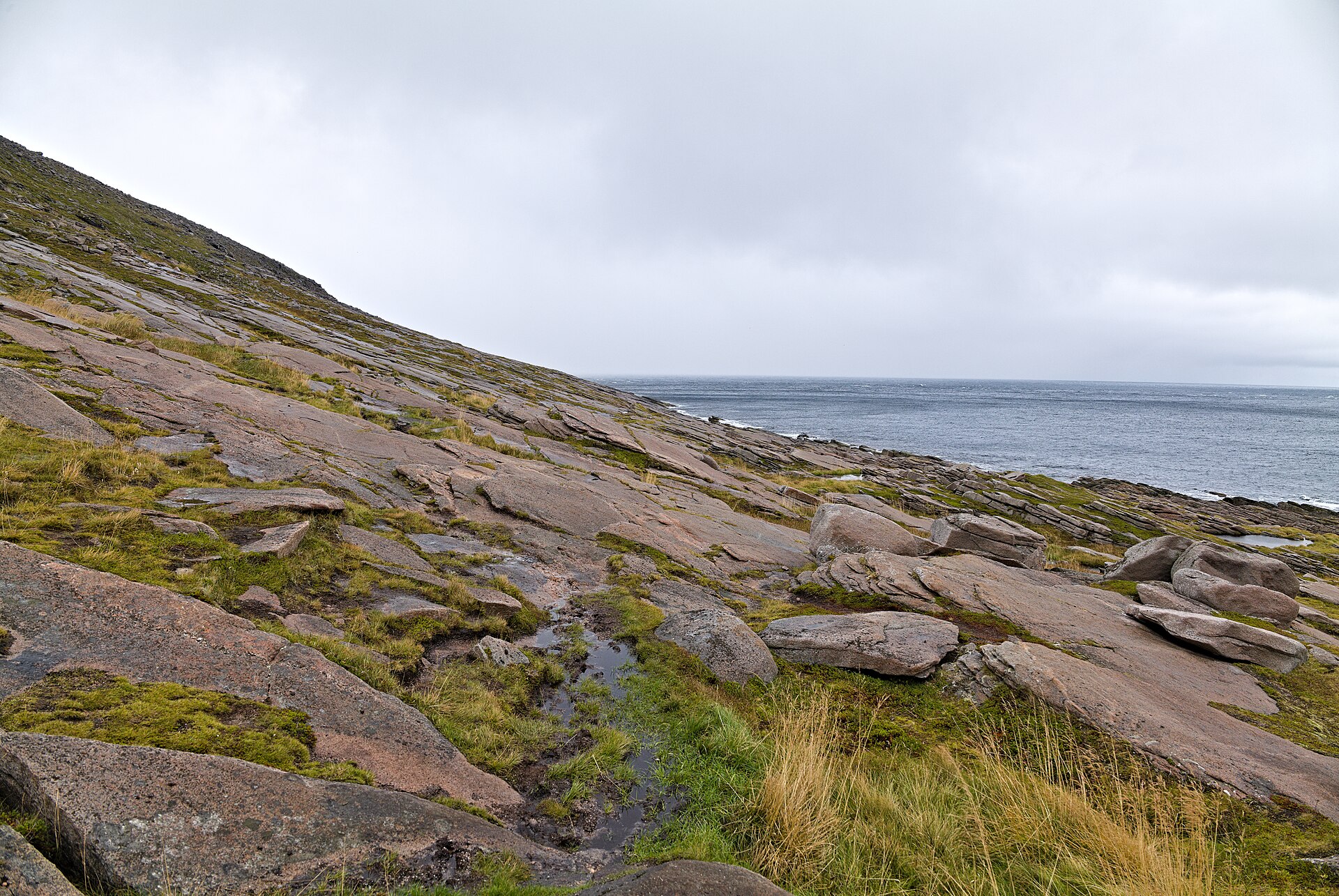
Knivskjellodden is a headland on the same island that reaches about 1.5 kilometres farther north than the Globe. You get there on foot only, on a marked trail of about 9 kilometres each way, 18 kilometres return, with around 450 metres of climbing. Visit Nordkapp allows five to six hours for the round trip and gives the season as roughly June to September. The trailhead is a parking area on the E69 six to seven kilometres before the plateau, and there are no toilets or facilities at the start or along the trail.
Verdict: this is the best thing on Magerøya for anyone who walks, better than the plateau itself on a busy summer day, and it costs nothing. Go in decent weather, carry everything you need, and don’t attempt it in winter unless you’re with a guide; the Norwegian Polar Academy runs ski trips there.
Cape Nordkinn: the mainland’s real tip
The northernmost point of mainland Europe is Cape Nordkinn, or Kinnarodden, on the Nordkinn peninsula about 14 kilometres north-west of the village of Mehamn. You reach it on foot or by boat, and it’s a serious undertaking compared with the North Cape’s car park. If the title genuinely matters to you, plan it as its own expedition from Mehamn rather than an add-on to Nordkapp.
Other things on Magerøya worth your time
The island is bigger than the cliff, and the extra day you spend waiting for a clear sky is a good excuse to see it.
- Gjesvær and the bird cliffs. Gjesvær is a fishing village 36 kilometres and about 35 to 40 minutes by car from Honningsvåg. Offshore, the Gjesværstappan islands have been a nature reserve since 1983 and hold more than 60,000 pairs of seabirds, puffins and gannets among them. Bird-safari boats usually run from May to August, and there’s no landing on the islands from 15 June to 15 August. Hurtigruten’s version starts at €239; local operators, including Arctic Guide Service, also go out there.
- King crab. Destinasjon 71 Nord runs a king crab RIB safari, and Hurtigruten’s North Cape and king crab excursions start at €281.
- Honningsvåg church. Consecrated on 22 October 1885, it’s one of the few churches in Finnmark that wasn’t destroyed or burned at the end of the Second World War, when retreating German forces burned much of the county.
- Skarsvåg. A fishing village near the start of the winter convoy, with accommodation at Cape Marina.
- Bruket fish factory. Visit North Cape lists year-round visits.
The North Cape Museum (Nordkappmuseet) is in Honningsvåg too; its hours change with the season, so check them locally before you go.
Where to stay on Magerøya
Honningsvåg is the base, with a few options out on the island. These are the places Visit Nordkapp and its 2026 brochure list:
| Where | Location | Season | Good for |
|---|---|---|---|
| Scandic Bryggen | Honningsvåg harbour | Check with the hotel | Walking to the quay and the bus |
| The View Hotel | Storfjellet, above Honningsvåg (50 rooms) | Open all year | The view, as advertised |
| Arctic Boutique Hotel | Honningsvåg | Check with the hotel | A smaller stay |
| Scandic Honningsvåg | Honningsvåg | Summer only | Peak-season availability |
| Scandic Nordkapp | Skipsfjord, out on the island | Summer only | Being closer to the plateau |
| Cape Marina | Skarsvåg | Check with the property | The shortest drive to the convoy junction |
Two pieces of advice. In summer, book early, because Magerøya fills up: Statistics Norway counted about 31,560 guest nights in Nordkapp municipality in July 2026. And in winter, stay in Honningsvåg itself, close to the shops, the bus and the tour pick-ups.
What I’d skip, and what people get wrong
- Planning the cape for your last day. In winter a cancelled convoy is normal, not bad luck. Give yourself a spare day.
- Counting on a taxi. The tourist office itself says you can’t rely on one for the North Cape. Book a tour, hire a car, or come by ship.
- A one-night midnight-sun dash. Fog and cloud are common enough that it pays to stay a few nights. A single night, especially after a nine-hour drive from Tromsø, is a lot of effort for a coin toss.
- Paying for the Hall on a clear day without thinking. The view is free. Go in if the weather is foul, if you want the film and the chapel, or if your excursion includes it anyway.
- Expensive versions of the same trip. The quad-bike and breakfast excursions are fun extras, but they deliver you to the same car park as the basic €179 tour.
- Treating it as “the top of Europe”. It’s the top of Europe you can drive to. Knivskjellodden is farther north on the same island and Cape Nordkinn is farther north on the mainland. Knowing that takes some of the pressure off the plateau, which is no bad thing.
- Driving up from Tromsø and back in a weekend. At about nine hours each way to Honningsvåg, this is a road trip in its own right. If you only have a long weekend in the north, spend it on the days you have in Tromsø instead, and save the North Cape for a trip that has room for it.
Putting a North Cape trip together
Three patterns work, depending on how you’re travelling.
By coastal ship. The simplest. Book the northbound North Cape excursion when you book the voyage, and that’s it. You get three hours, the Hall and the cliff, and the ship does the driving. If you want more than a glimpse, leave the ship in Honningsvåg, stay two or three nights, and rejoin a later sailing. Our guide to the coastal voyage and other Norway cruises covers how the two companies differ.
By car, as part of a northern road trip. Drive from Tromsø to Alta (about six hours), spend a night or two there (Alta makes a strong case for itself as an aurora base), then continue to Honningsvåg (about three hours) and give Magerøya two or three nights. That’s enough time for the plateau, Knivskjellodden in summer, Gjesvær and a spare day for weather. Our Norway road-trip guide covers tolls, ferries and the driving rules.
By air and tour. Fly to Alta and take the line 110 bus, or fly to Honningsvåg via Hammerfest, then book a local tour up to the plateau. This works year-round and avoids winter driving, but it’s the least flexible: the tour decides your time on top.
On costs, the bones of it are simple. The plateau, the parking, the tunnel and the winter convoy are all free. Your real costs are getting to Magerøya, a bed for the nights you’ll need, and either a hire car or a tour. If you’re weighing the North Cape against everything else on a northern trip, our Norway travel cost guide sets out what flights, hire cars and hotels typically run to, and getting around Norway explains how the buses, flights and ships connect.
Is it worth it? My answer: yes, if you give it the time. A clear evening on the plateau with the sea going on forever is one of the big Norwegian moments, and in winter, coming down in the convoy at 21:30 with the aurora over the water, it’s better still. As a rushed one-night tick-box at the end of a long drive, it often isn’t. If your trip is short, Tromsø and its surroundings will give you more for the same days. For the wider far north, start with our Tromsø and Arctic Norway hub, and for timing the light, see the midnight-sun dates across Norway.
Frequently asked questions
Is Nordkapp the northernmost point of Europe?
Not quite. The North Cape is on the island of Magerøya, and Knivskjellodden on the same island reaches about 1.5 kilometres farther north. The northernmost point of mainland Europe is Cape Nordkinn (Kinnarodden), north-west of Mehamn. Nordkapp is the northernmost point you can drive to, which is why it gets the visitors.
Do you have to pay to visit Nordkapp?
No. The plateau, the Globe and the view are free, and parking is free for up to six hours, though you can’t park overnight. You pay only if you go into the North Cape Hall, which has the film, exhibitions, chapel and café; check its current ticket price on the Hall’s own site.
How do you get to Nordkapp without a car?
Take a coastal-ship excursion from Honningsvåg (Hurtigruten’s starts at €179) or book a local guided tour. The line 110 bus from Alta and Widerøe’s flights get you to Honningsvåg, but not up to the plateau, and the tourist office warns that taxis can’t be relied on for the trip.
Can you visit Nordkapp in winter?
Yes. From roughly November to April the last stretch from the Skarsvåg junction is driven only in a snowplough-led convoy at fixed times, which is free and needs no booking. From 1 January to 15 April 2027 there’s no free passage at all, and bad weather can still close the road, so build in a spare day.
When can you see the midnight sun at Nordkapp?
Yr gives a full disc of midnight sun from 14 May to 29 July, and the sun’s upper edge above the horizon from 11 May to 31 July. The sun is lowest at about 00:20 summer time. Fog and cloud can hide it, so stay more than one night if you can.
How far is Nordkapp from Tromsø?
By road it’s about nine hours of driving to Honningsvåg: roughly six hours from Tromsø to Alta and three more from Alta to Honningsvåg, by Visit Alta’s figures, before the final climb to the plateau. Most people split it with a night in Alta. Flying to Honningsvåg via Hammerfest takes about two hours.
How long do you need at the North Cape?
An hour or two on the plateau is enough for the view and the Hall, and that’s what the coastal-ship excursion and the winter convoy pairs give you. For Magerøya as a whole, with Knivskjellodden, Gjesvær and a spare night for weather, allow two or three nights.
Is Nordkapp worth it?
If you give it time, yes: a clear night on the cliff is one of Norway’s great sights. If it means a nine-hour drive for a single cloudy evening, probably not. It’s at its best as part of a longer northern road trip or as the long stop on a coastal voyage.
Photo credits
- Midnight in late July at the Globe. The plateau and the monument are free to visit. — Photo: Stjepko Krehula / CC BY 4.0 via Wikimedia Commons.
- From late spring to autumn Magerøya is summer pasture for Sámi-owned reindeer, and they wander up to the houses and the road. — Photo: Ad Meskens / CC BY-SA 4.0 via Wikimedia Commons.
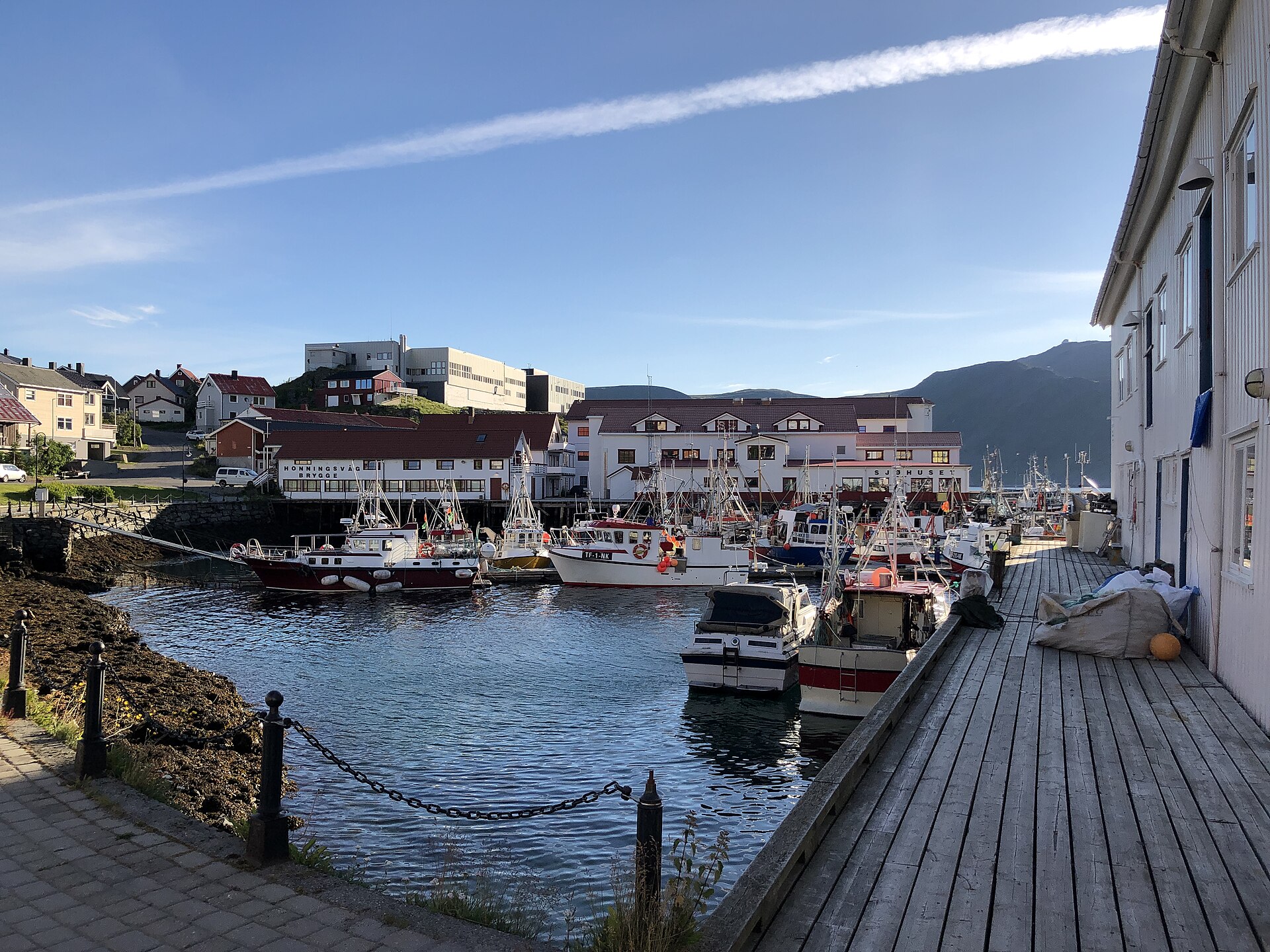
- Honningsvåg harbour, where the coastal ships, the cruise ships and the island’s tours all start. — Photo: Davide Mauro / CC BY-SA 4.0 via Wikimedia Commons.
- Knivskjellodden reaches about 1.5 km farther north than the Globe, and you can only get there on foot. — Photo: Leonhard Lenz / CC0 via Wikimedia Commons.
Prices and timetables were checked in November 2026 against the operators’ and authorities’ own pages: Visit Nordkapp, Statens vegvesen, Hurtigruten, Havila, Avinor and Entur. Euro prices are converted at NOK 10.65 and US dollars at NOK 9.69 (Norges Bank, 19 November 2026). Convoy times, ship schedules and Hall prices change every season, so check them again for your dates.