Every guide currently ranking for Fløyen in Bergen has the ticket price wrong. One says NOK 165 return and claims the Bergen Card gets you on free. Another says 190. A third says 180. The actual 2026 summer fare is NOK 200 if you buy in the app and NOK 220 at the window — a twenty-krone gap that nobody mentions, on a ticket nearly two million people a year buy.
The official site is not much better. Fløyen’s own pages give the Vidden ridge walk to Ulriken as 18 kilometres in one place and about 13 in another, and both figures are on the same website.
So here is the mountain with the numbers checked: what the funicular costs in each season, the cheap fare locals use that no guide lists, how long the walk up actually takes, whether Ulriken is the better mountain, and what the ridge traverse between them really involves.
Fløibanen 2026 fares
| Ticket | Summer (1 Apr – 30 Sep) | Winter (1 Oct – 31 Mar) |
|---|---|---|
| Adult return, app or machine | NOK 200 | NOK 145 |
| Adult return, ticket window | NOK 220 | NOK 145 |
| Adult one way | NOK 105 / 120 | NOK 80 |
| Child 4–15 return | NOK 100 / 120 | NOK 75 |
| Child one way | NOK 55 / 65 | NOK 45 |
| Senior return | No senior fare | NOK 100 |
| Family return (2+2) | NOK 500 | NOK 365 |
| Day ticket | NOK 350 | NOK 300 |
| Return to an intermediate station | NOK 90 | NOK 90 |
| With Bergen Card (return only) | NOK 100 | NOK 75 |
| Annual pass | NOK 1,095 | |
At NOK 9.35 to the dollar, the summer return is about $21. Four things worth pulling out of that table, because no other guide has them:
- Buy in the app. Twenty kroner cheaper for adults and children in summer, and you skip the window queue.
- The Bergen Card gives 50% off, not free travel. It applies to return tickets only, never one-way.
- There is no senior discount to the top between 1 April and 30 September. Seniors do get a reduced fare to the intermediate stations all year.
- The intermediate-station return is NOK 90 year-round. The line has stops on the way up. Ride to one of those, walk the last stretch, and you have halved the fare. This is what people who live here do.
The funicular itself
Fløibanen opened on 15 January 1918, delayed first by the First World War and then by the great Bergen fire of 1916. The track is 848 metres long with a height difference of 302 metres, on 1,000 mm gauge, at gradients between 15 and 26 degrees. The lowest 150 metres run in a tunnel.
The two cars are named Rødhette and Blåmann — Little Red Riding Hood and Blueman. They hold 120 at a squeeze, though normal service is about 90, and a 2022 rebuild raised the running speed to seven metres a second. The ride takes four to eight minutes depending on stops; Wikipedia says three to eight, which is the kind of disagreement that tells you nobody has timed it carefully.
It runs 07:30 to midnight on weekdays and 08:00 to midnight at weekends, every ten to fifteen minutes. There has never been a serious accident in more than a century of operation; the catch brake stops a car within two and a half metres.
Busiest between 10:00 and 14:00, when waits run fifteen to twenty minutes. Cruise passengers arrive in a block — the port has its own geography of terminals and walking times, and Bergen allows up to 8,000 of them a day. Go before nine or after six.
One thing to check before you travel: a maintenance shutdown of 2–5 November 2026 appears in search results attributed to the operator. I could not confirm it on the live opening-hours page, which is script-gated, so treat it as probable rather than certain.
Prams, dogs, bikes and wheelchairs
Prams and wheelchairs board at the terminal stations and every station is step-free. Dogs travel free but must be leashed on the trails all year, not just in the wildlife season. Bikes are allowed to the intermediate stations only, between 1 October and 31 March, and e-bikes are not allowed at all. Drones are banned at the top.
Walking up instead
About 45 minutes, roughly 3 km, free
The path from the city centre to the top station is a steady 45-minute climb of 302 metres. From Bryggen the full trail runs about 6.3 kilometres. It is well surfaced, well signed and busy with locals at all hours, and unlike most viewpoints worth the climb in Norway it starts in the middle of a city — this is Bergen’s stair machine, not a wilderness route.
The best-value version of Fløyen is to walk up and ride down for NOK 105 in summer or NOK 80 in winter. You get the exercise, the view arrives gradually rather than all at once, and you save half the fare. Going the other way — riding up and walking down — is harder on the knees and gives you the view in the wrong order.
From the cruise terminal to the lower station is fifteen to twenty minutes on foot.
What is actually at the top
The top station sits at 320 metres above sea level. The summit of Fløyen itself is a little higher, at 399 or 400 metres depending which source you believe, and is a ten-minute walk further up.
The view
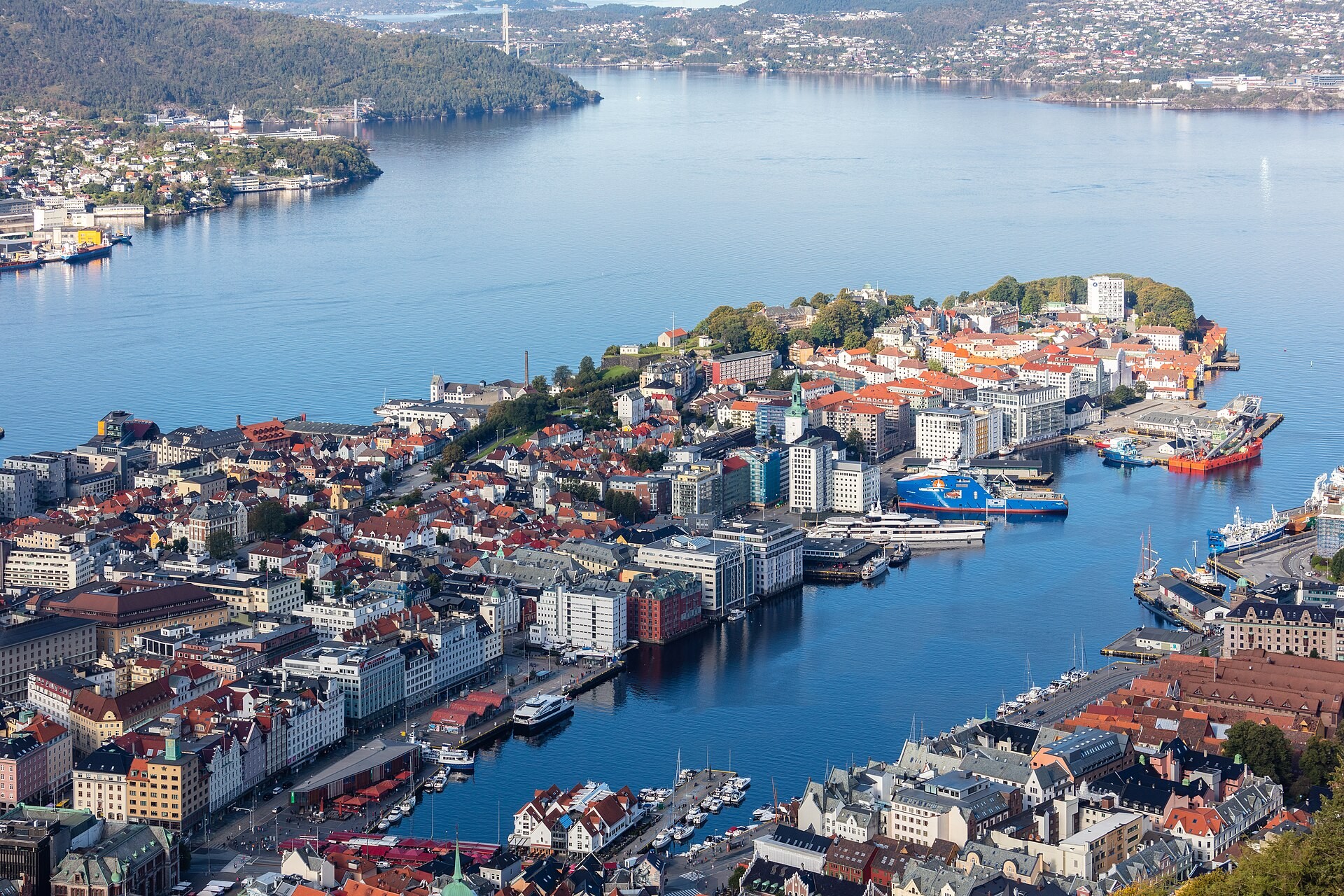
Bergen laid out below with the harbour, Bryggen’s gables from directly above, the seven mountains around, and the fjord opening westwards. It is the single best orientation you can get in Bergen, which is why it is worth doing on your first evening rather than your last.
The goats
Nine cashmere goats, born on Radøy in 2020, all castrated, kept in place by a virtual fence rather than a physical one. They live near the goat shed below the restaurant and they are entirely unbothered by people. If you are travelling with children this will be the part they remember.
Skomakerdiket and the lakes
Ten minutes behind the top station is a small lake with free canoes and stand-up paddleboards in season, a barbecue area and a swimming spot. This is where Bergen families spend Sunday. Further on, Brushytten has a cabin café and the trails open out into genuine forest.
The troll forest, the playground and the zip line
Carved wooden trolls along a marked path, a large playground beside the restaurant, and a rope course with a zip line running in summer. Mountain bike rental operates from mid-June to mid-August through Fløyen Aktiv.
Fløien Folkerestaurant
The restaurant at the top station, with the view through the windows. It is a tourist restaurant at tourist prices and it is fine. The café counter is cheaper than the dining room and the terrace is free to sit on.
Fløyen or Ulriken?
The honest answer is that Fløyen is the convenient one and Ulriken is the better mountain.
| Fløyen | Ulriken | |
|---|---|---|
| Height | 399 m (station 320 m) | 643 m |
| Adult return | NOK 200 summer / 145 winter | NOK 435 |
| Child return | NOK 100 / 75 | NOK 180 (4–16) |
| Family | NOK 500 / 365 (2+2) | NOK 1,050 (2+3) |
| Bergen Card | 50% off | 10% off |
| From the city centre | 8-minute walk to the station | Bus or NOK 150 shuttle |
| Ride | 4–8 min funicular | Cable car, every 10–15 min |
| Crowds | Heavy 10:00–14:00 | Much lighter |
| Walking up | 45 min on a good path | ~1,400 steps, 1–1.5 hrs |
Ulriken is 243 metres higher, dramatically emptier, and more than twice the price. Its Bergen Card discount is 10% — not the 20% one widely-read guide claims, which would be worth NOK 87 rather than NOK 43.
The stair route up Ulriken, called Oppstemten, is roughly 1,400 steps over 750 metres of hillside, taking an hour to ninety minutes. The operator says 1,400, a local student guide says 1,333, and nobody arrives at the top in a state to argue about it.
My verdict: if you are doing one mountain and it is your first day in Bergen, do Fløyen — it is eight minutes from Bryggen and the orientation is worth more than the extra altitude. If you are doing one mountain and the weather is genuinely clear, do Ulriken. If it is cloudy, do Fløyen, because the extra 240 metres on Ulriken buys you extra cloud and nothing else.
Vidden: the ridge walk between them
This is the serious option, and the numbers need untangling before you commit to it.
The distance is disputed by the operator’s own website. Fløibanen’s route description gives 18 kilometres and five to six hours, rated intermediate to difficult. Its FAQ on the same site says about 13 kilometres and at least five to six hours. A local guide resolves it: roughly 13 kilometres if you use both cable cars, roughly 18 if you include walking up one mountain and down the other. Elevation gain is about 776 metres going Fløyen to Ulriken, and about 700 the other way.
The route crosses open plateau — Rundemanen at 568 metres, Trappefjellet 580, Borgevardegga 637, Storhaugen 662, and the high point Hauggjelsvarden at 673. Øvre Jordalsvatnet along the way is Bergen’s drinking water, so no swimming.
Which direction
Go Fløyen to Ulriken. Two reasons nobody explains. First, Rundemanen comes early in that direction and gives you a genuine bail-out point — if the weather has turned by the time you reach it, you can drop back down to the city instead of committing to open ground. Second, the steep section at Borgaskaret is easier climbed than descended.
The safety part, said plainly
Vidden is exposed plateau with no shelter, no phone signal in places, and weather that changes fast. Bergen’s mountain rescue teams are called out to it regularly. In cloud, the cairned route is easy to lose and the plateau looks identical in every direction.
Do not start it after midday. Do not start it in poor visibility. Take a map you can read without a battery, waterproofs regardless of the forecast, and food. In winter it is a ski touring route, not a walk, and should be treated as one. This is a proper Norwegian mountain day, closer in character to the country’s serious trails than to the twenty minutes on a funicular that gets you to the start of it.
Fløyen in the rain, and Fløyen in winter
Bergen gets around 200 days of measurable rain a year, so the odds are decent that your Fløyen day is a wet one. It is still worth doing, with adjustments.
In low cloud the summit gives you nothing — you will pay NOK 200 to stand in a grey room. But the cloud base in Bergen frequently sits between 400 and 600 metres, which means the 320-metre top station is often below it while Ulriken at 643 is buried. On a marginal day, Fløyen is the mountain that still works.
Check before you buy. The webcam at the top station tells you in five seconds what an hour of forecast-reading will not, and the ticket is valid whenever you turn up rather than for a booked slot.
Winter is the season nobody sells you and it is quietly the best one. The fare drops to NOK 145, the cruise ships have gone, the queues disappear, and Bergen’s lights below the station at four in the afternoon are better than the summer view. The trails ice up — bring ice cleats, which cost NOK 50–100 at any Norwegian hardware shop — and the bike restriction lifts, so 1 October to 31 March is the window when you can take a bicycle to the intermediate stations.
Snow does settle up here more often than it does down in the city, where it usually melts within a day or two, mild by the standards of a Norwegian winter. That gap of 300 metres is enough to make the top a genuinely different place from the harbour.
Getting to the lower station
| From | On foot |
|---|---|
| Bryggen | 5 minutes |
| Fish market / Torget | 6 minutes |
| Torgallmenningen | 8 minutes |
| Bergen railway station | 12 minutes |
| Skolten cruise terminal | 15–20 minutes |
The station entrance is at the bottom of Vetrlidsallmenningen, set into the hillside, and is easy to walk past — look for the queue rather than the building.
Shorter walks from the top station
You do not have to do Vidden to get away from the crowd. Two hundred metres past the restaurant the numbers thin out sharply.
- Skomakerdiket loop — 20–30 minutes, flat, pushchair-friendly. The lake, the barbecue spot, the water.
- Fløyen summit — 10 minutes up from the station to the actual top at around 399 metres.
- Brushytten — about an hour return through forest to a cabin café.
- Rundemanen — around two hours return, 568 metres, the old radio station, and the first taste of the open plateau without committing to it.
- Fløysvingene down to the city — the switchback path, 45 minutes, the descent everyone should be doing instead of buying a return.
What to skip
Skip the ticket window. Buying in the app is NOK 20 cheaper per adult and per child in summer, and the queue at the counter between ten and two is the worst part of the whole experience.
Skip the return ticket. Walk one way. Up if you are fit, down if you are not — either saves you half the fare and the descent takes 45 minutes on a paved path.
Skip midday entirely. Between 10:00 and 14:00 you will wait fifteen to twenty minutes to board a mountain that is eight minutes’ walk from the harbour. The same view is there at eight in the morning with nobody in it.
Skip Ulriken in cloud. It is more than twice the price of Fløyen and 240 metres closer to the weather.
Do not go up expecting the northern lights. This comes up constantly and the answer is no. Bergen sits at about 60°N, well south of the auroral oval at roughly 66.5°N, under Europe’s cloudiest skies. It happens during strong geomagnetic storms, in the October-to-March window, and that is the whole story. If the aurora is why you are coming to Norway, you want somewhere several hundred kilometres north of here.
Fitting it into a day
Fløyen is a two-hour commitment if you ride both ways and look at the view, three if you walk one leg, and a full day if you take the ridge to Ulriken.
The sequence that works: Bryggen and the museum in the morning, lunch off the harbour front, funicular up in the late afternoon, walk down at golden hour. That covers most of what makes Bergen worth a stop and leaves the next day free for something further out.
If you only have a single day, do Fløyen first thing — before nine, before the ships — and use the view to work out what you want to do with the rest of it.
Frequently asked questions
How much is the Fløibanen funicular in 2026?
NOK 200 adult return between 1 April and 30 September if you buy in the app or at a machine, or NOK 220 at the ticket window. From 1 October to 31 March it is NOK 145. Children 4–15 pay NOK 100 or 120 in summer and NOK 75 in winter. A family return is NOK 500 summer, NOK 365 winter.
Is the Fløibanen free with the Bergen Card?
No — it is 50% off, and only on return tickets. That makes it NOK 100 in summer and NOK 75 in winter for an adult. One popular guide states that the card covers it outright; it does not.
Can you walk up Mount Fløyen, and how long does it take?
Yes, and it is the best way to do it. The path from the city centre climbs 302 metres over about three kilometres, taking around 45 minutes on a good surface. Walk up and ride down for NOK 105 in summer or NOK 80 in winter and you have halved the fare.
How long does the Fløibanen ride take?
Four to eight minutes depending on how many intermediate stops it makes. The track is 848 metres long with a 302-metre height difference, and departures run every ten to fifteen minutes from 07:30 to midnight on weekdays.
Fløyen or Ulriken — which is better?
Ulriken has the better view at 643 metres against Fløyen’s 399, and far fewer people, but costs NOK 435 return against NOK 200 and needs a bus or shuttle to reach. Fløyen is eight minutes’ walk from Bryggen. In clear weather take Ulriken; in cloud or on a tight schedule take Fløyen.
How long is the Vidden hike from Fløyen to Ulriken?
About 13 kilometres using both cable cars, or roughly 18 including the climb up and the descent down, with around 776 metres of ascent going Fløyen to Ulriken. Allow five to six hours. Fløibanen’s own website quotes both the 13 and the 18 figure in different places, which is where the confusion comes from.
Can you take a pram, a dog or a bike on the Fløibanen?
Prams and wheelchairs yes, boarding at the terminal stations, and every station is step-free. Dogs travel free but must be leashed on the trails year-round. Bikes only to the intermediate stations, only between 1 October and 31 March, and no e-bikes at any time.
What is there to do at the top of Mount Fløyen?
The viewpoint, a restaurant and café, nine cashmere goats, a large playground, a troll-carving trail, a rope course with a zip line in summer, and Skomakerdiket lake ten minutes behind the station with free canoes and paddleboards in season. Beyond that the trails run out onto open mountain.
Photo credits
- The view from the top station, 320 metres above the harbour. — Photo: Diego Delso / CC BY-SA 4.0 via Wikimedia Commons.
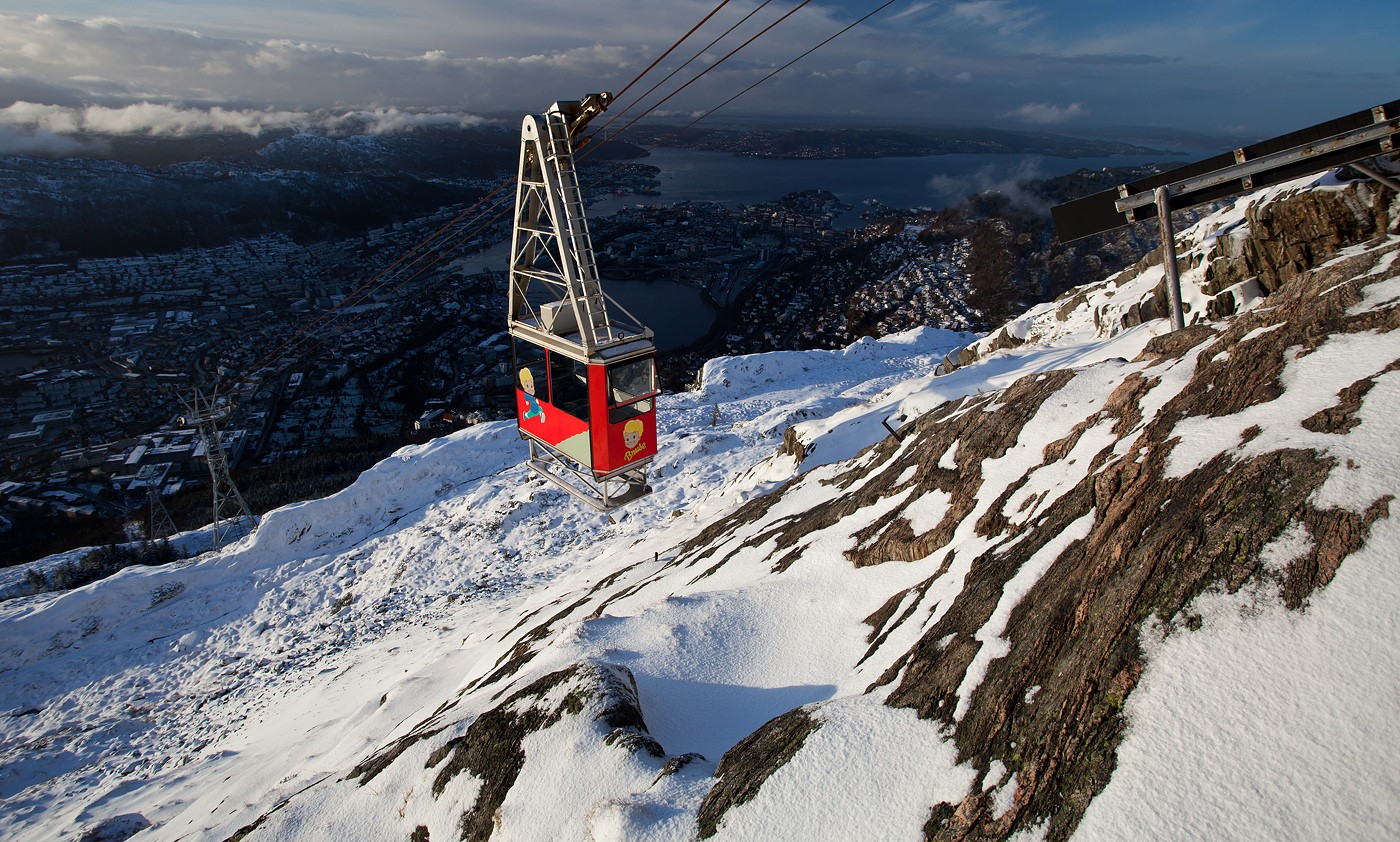
- The Ulriken cable car: NOK 435 return, and 10% off with a Bergen Card. — Photo: Smtunli / CC BY-SA 3.0 via Wikimedia Commons.
Fares checked August 2026 against the operator’s own tariff, at NOK 9.35 to the US dollar. The summer rate applies 1 April to 30 September and the winter rate the rest of the year, so a trip that straddles the changeover will see the price move. The reported 2–5 November 2026 maintenance closure could not be confirmed on the live opening-hours page — check before travelling that week.