Two of the five guides currently ranking for one day in Bergen send you to the Hanseatic Museum. It has been shut since October 2018 and it is not reopening until the beginning of 2027. That is eight years of closure and it is still on itineraries, which tells you roughly how much checking goes into this search.
None of the five gives a price in kroner for the Fløibanen funicular, the Bergen Card, or the light rail from the airport. All of them tell you Bergen is rainy without saying how rainy, which matters, because a wet-weather plan is the difference between a good day here and a miserable one.
So: a timed day, with prices, built around the fact that you will probably get wet. Most people reading this arrived on a cruise ship or the morning train from Oslo, so those are the two starting points I have used.
The short version
Bryggen, the funicular up Fløyen, and one museum. That is a day in Bergen. Everything else on the standard lists is either half an hour of walking past something, or it belongs to a second day — which we cover separately in two days in Bergen.
| Stop | Price | Time | Verdict |
|---|---|---|---|
| Bryggen wharf | Free | 45–60 min | Keep. This is why you came. |
| Fløibanen funicular | ~200–220 NOK return (see below) | 7–8 min up, 1 hr on top | Keep. |
| Walking up Fløyen instead | Free | 45–60 min up | Keep, if it is dry and you are fit. |
| Fisketorget fish market | Free to look | 20 min | Look, don’t eat. See below. |
| Bergenhus Fortress grounds | Free, 06:00–23:00 | 30 min | Keep. |
| Rosenkrantz Tower | ~80 NOK | 30 min | Optional. |
| KODE art museums | ~160–200 NOK | 2 hr | The rainy-day answer. |
| Bryggens Museum | Paid | 1 hr | Better than the closed Hanseatic one. |
| Hanseatic Museum | — | — | Closed until 2027. |
| Ulriken643 cable car | 435 NOK return | 2–3 hr | Skip on one day. |
| Norway in a Nutshell | ~1,595 NOK | 10–12 hr | Skip. That is your whole day. |
About the rain, with numbers
Bergen’s average annual rainfall is 2,495 mm on the 1991–2020 meteorological normal. For comparison, London gets around 600. The number of wet days per year is disputed across sources — I found 231, 253 and 284 in different places, which is a wide enough spread that I would not quote any of them as fact — but the volume figure is solid and the practical implication is the same either way.
Plan for rain, and be pleased when it does not come. That means: waterproof outer layer rather than an umbrella, because the wind off the harbour destroys umbrellas; the funicular rather than the walk if the forecast is bad, because the Fløysvingene path is slick; and a museum held in reserve so a wet afternoon has somewhere to go.
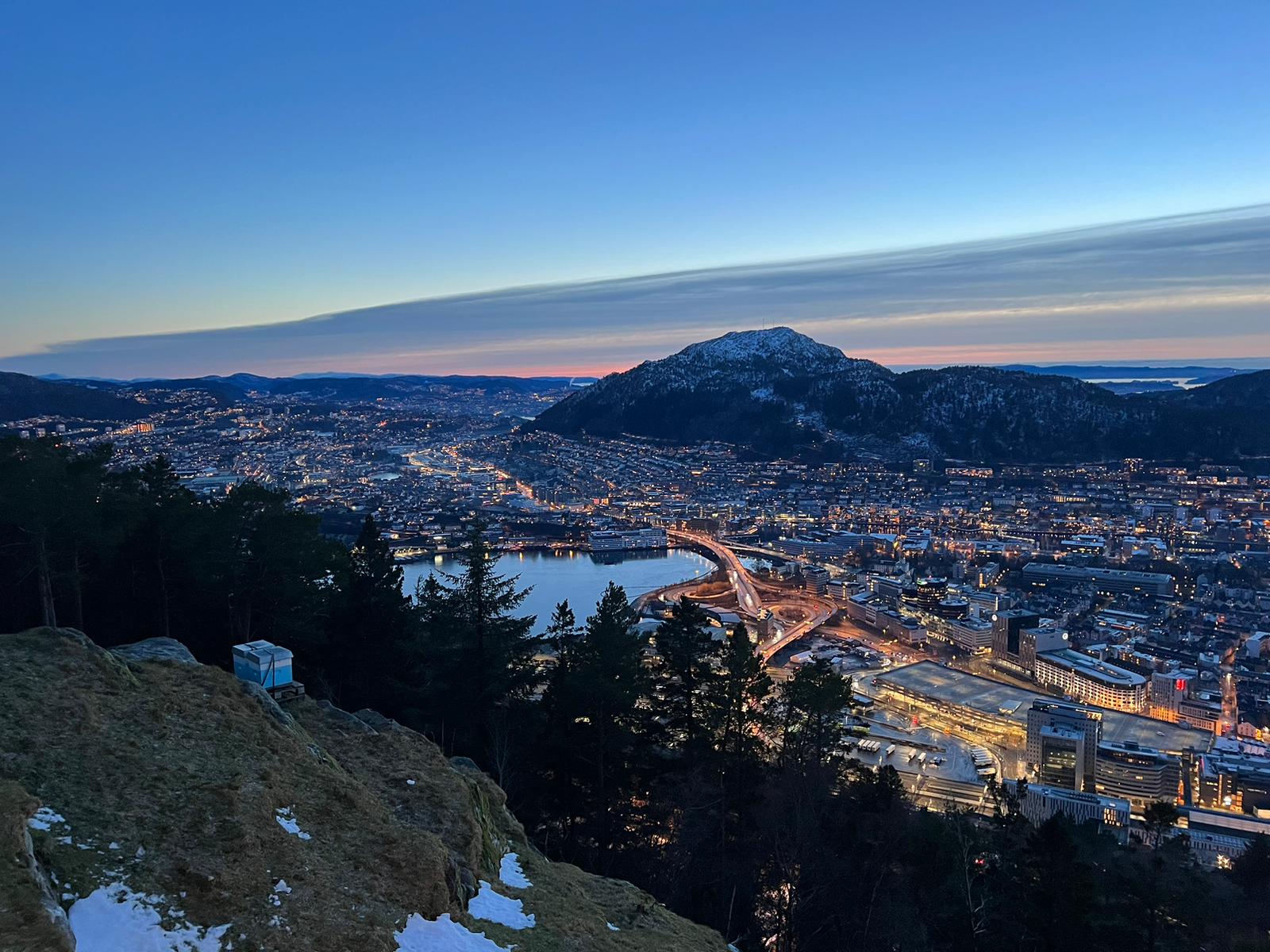
It also means not building the day around the view from Fløyen. On a clear day it is one of the great city views in Europe. On a wet one you will pay 200 kroner to stand in a cloud.
Getting into town
| Arriving by | Route | Time | Cost |
|---|---|---|---|
| Air, Flesland | Bybanen light rail, line 1 | ~45 min | ~51 NOK adult, 26 child (single source) |
| Train from Oslo | Walk from Bergen station | 10 min to Bryggen | Free |
| Cruise ship | Walk from the terminal | 10–20 min depending on berth | Free |
The Bybanen fare above comes from one source and I could not confirm it against Skyss, the operator. It is the right order of magnitude — this is a normal city transit fare, not an airport-express premium — but check the machine.
Bergen’s centre is genuinely small. Bryggen, the fish market, the funicular base station, the fortress and KODE are all within about ten minutes’ walk of each other. Unlike a day in Oslo, you will not spend your time in transit here.
The day, timed
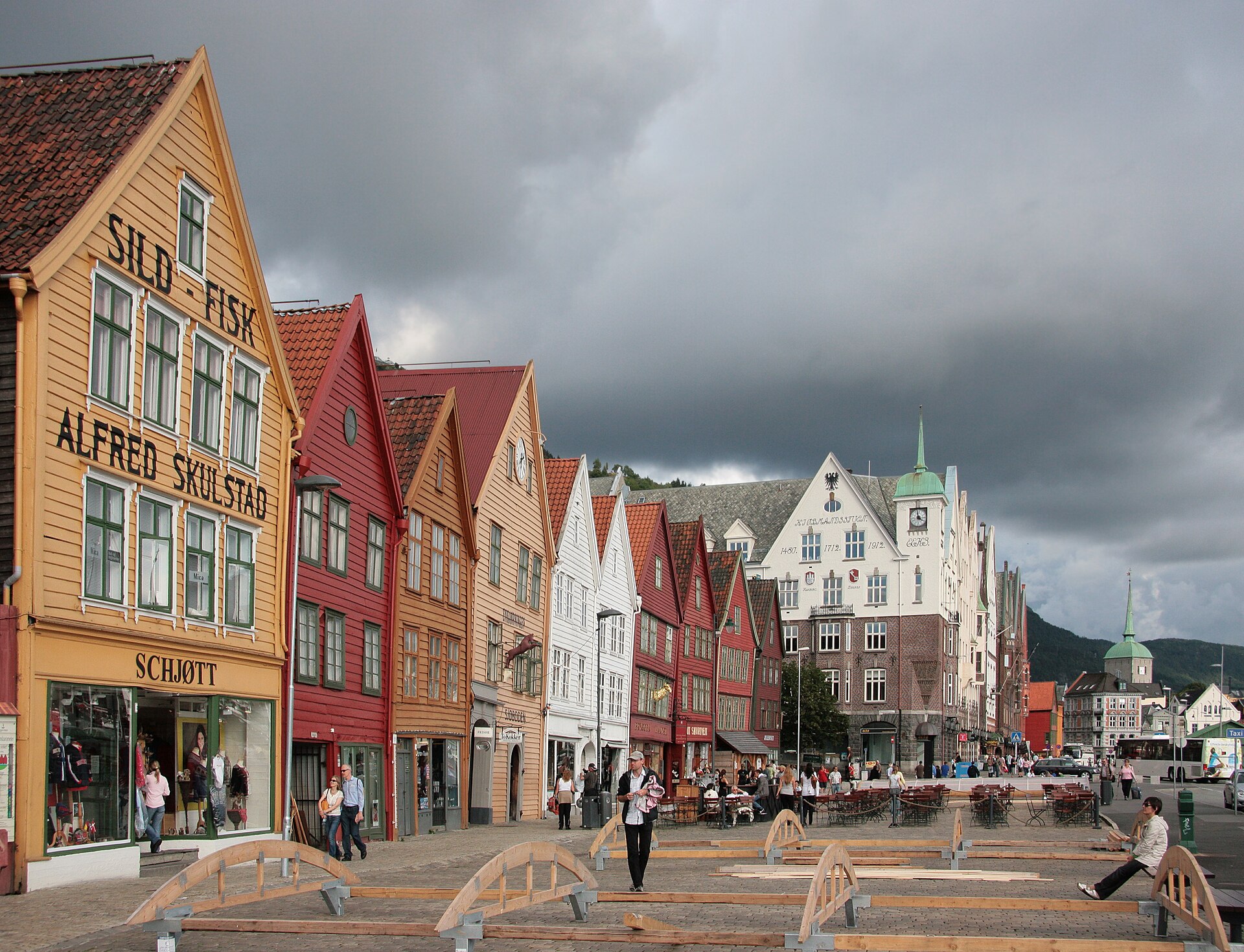
08:30 — Bryggen, before the ships
The row of leaning wooden trading houses on the north side of the harbour, a UNESCO World Heritage Site and the reason Bergen is on anyone’s list. Free, always open, and it is a working street of shops and workshops rather than a museum.
Go early. Genuinely early. Bergen takes cruise ships — roughly 600,000 passengers in 2024, with a record number of calls forecast for 2026 — and the port caps traffic at around four ships and 8,000 passengers a day. Both figures come from single sources, but the effect is not in doubt: between about 10:00 and 16:00 in summer, the alleys behind Bryggen are full. At 08:30 they are empty and the light is better.
Walk into the passages behind the front row. That is where the buildings are properly medieval in feel — crooked, dark, timber-framed, smelling of tar.
09:45 — Bryggens Museum
Built over the excavated foundations of the twelfth-century wharf, which are the actual archaeological remains rather than a reconstruction. This is the substitute for the closed Hanseatic Museum and it is arguably the better building.
11:00 — Fløibanen up Fløyen
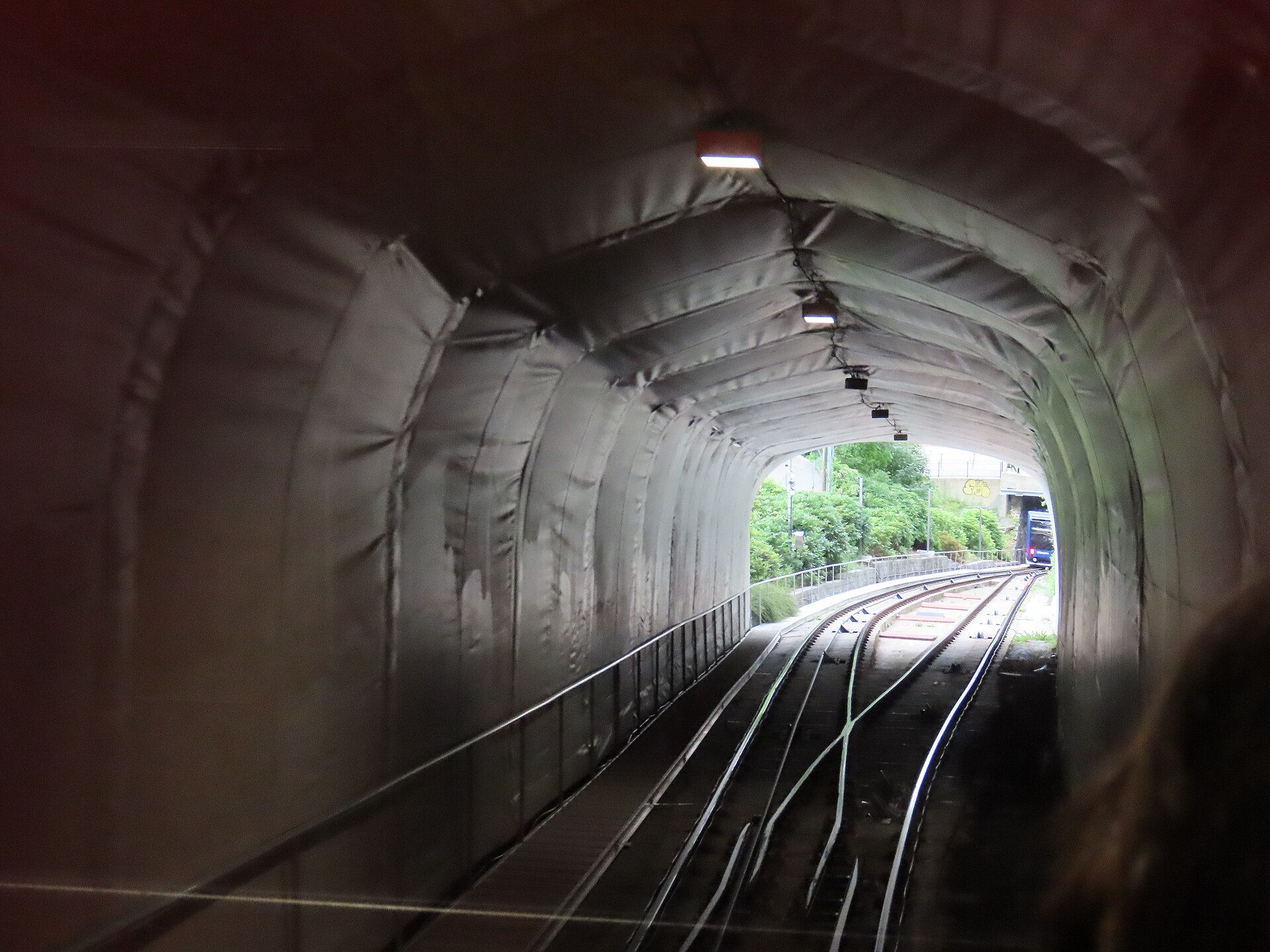
The funicular climbs 320 metres in seven to eight minutes from a station a few minutes’ walk from Bryggen. Return fares are quoted at around 200–220 NOK in the April–September high season and around 145 NOK from October to March, though the figures I found were inconsistent even within a single source, so treat the summer number as approximate and expect the winter one to be lower.
The alternative: walk. The Fløysvingene path is about 3 kilometres and takes 45 to 60 minutes uphill. It is free, well made, and busy with locals. A good compromise is to walk up and ride down, which halves the fare and gives you the view without the climb in reverse.
At the top: viewpoint, café, a troll forest for children, and marked trails into the mountains behind. An hour is enough unless you are hiking on.
The season changes what a day is worth
Bergen is more seasonal than most cities its size, and the guides treat it as a single place all year.
| Season | What works | What does not |
|---|---|---|
| May–Sep | Outdoor fish market stalls, Fløyen trails, fjord cruises, Fantoft open | Bryggen after 10:00 — cruise season |
| Oct–Apr | Cheaper funicular fares, empty Bryggen, KODE without queues | Outdoor market closed, short days, more rain |
| Dec | Christmas market, lit wooden fronts | Around 6 hours of daylight |
| Jun–Jul | Long light — 20+ hours of usable day | Peak prices, peak ships |
The genuinely counterintuitive advice: a wet October Tuesday in Bergen can be a better day than a sunny July one, because Bryggen without eight thousand cruise passengers is a different street. If your dates are flexible and you do not need the fjord boats, come in the shoulder.
What Bergen has that Oslo does not
Worth naming, since most people reading this are choosing between them or fitting both into a week.
The mountains start at the edge of the shops. Seven or eight minutes on the funicular and you are on marked trails at 320 metres with the city below you. Oslo’s forest is twenty minutes on the metro, which is remarkable; Bergen’s is seven, which is absurd.
Medieval fabric that survived. Oslo burned and was rebuilt. Bryggen did not, quite — it has burned repeatedly and been rebuilt in the same form on the same foundations, which is why the alleys still run the way they did in the fourteenth century.
The fjords, an hour away rather than seven. This is the whole argument. Bergen is a base; Oslo is a destination. If your Norway trip is about landscape, everything in our guides to the best fjords and fjord sightseeing cruises starts closer to here.
Cheaper to move around. Bergen’s 24-hour transit pass is quoted at about 105 NOK against Oslo’s 121, and the seven-day at 235 against 335. Small differences, from a single comparison source, but they run the right way.
What Oslo has that Bergen does not is museums — considerably more of them and better funded — and a third less rain. Our Bergen city guide is the parent page for everything here, and if you are arriving by train, the Oslo to Bergen route covers the journey itself.
Where to base yourself for one night
If your single day in Bergen has a night either side of it, stay inside the small central rectangle bounded by Bryggen, the station and Lille Lungegårdsvann. Everything on this page is then a ten-minute walk and you will not touch public transport all day.
The area behind Bryggen is atmospheric and noisy in summer. Nordnes, the peninsula west of the harbour, is quieter, ten minutes further out and often cheaper. Near the station is the practical choice if you are arriving on the Oslo train late or leaving early — and Bergen station to Bryggen is a ten-minute walk, so “near the station” costs you nothing in convenience here, unlike in most cities. The national picture is in our guide to where to stay in Norway.
One thing to factor in for 2027 onwards: Norway’s visitor levy law came into force on 1 July 2026, allowing municipalities to charge up to 3 per cent on overnight stays and on cruise calls. Adoption is up to each council and nothing is being collected yet anywhere in Norway. Bergen, with its cruise volume, is among the places most likely to adopt it.
12:45 — the fish market, and an honest word about it
Fisketorget sits at the head of the harbour. The outdoor stalls run May to September only; the indoor Mathallen section is open year-round.
Here is the thing nobody says: it is a tourist market with tourist prices. A modest plate of seafood here costs what a full meal costs elsewhere in Bergen, and the produce is not better for it. Walk through it, look at the king crab, take the photograph, and eat somewhere else.
Where to eat instead: the streets behind Bryggen, or the area around Nordnes. Bergen restaurant prices sit at roughly Norwegian city level — budget around 200 NOK for a modest meal and 110 NOK for a beer.
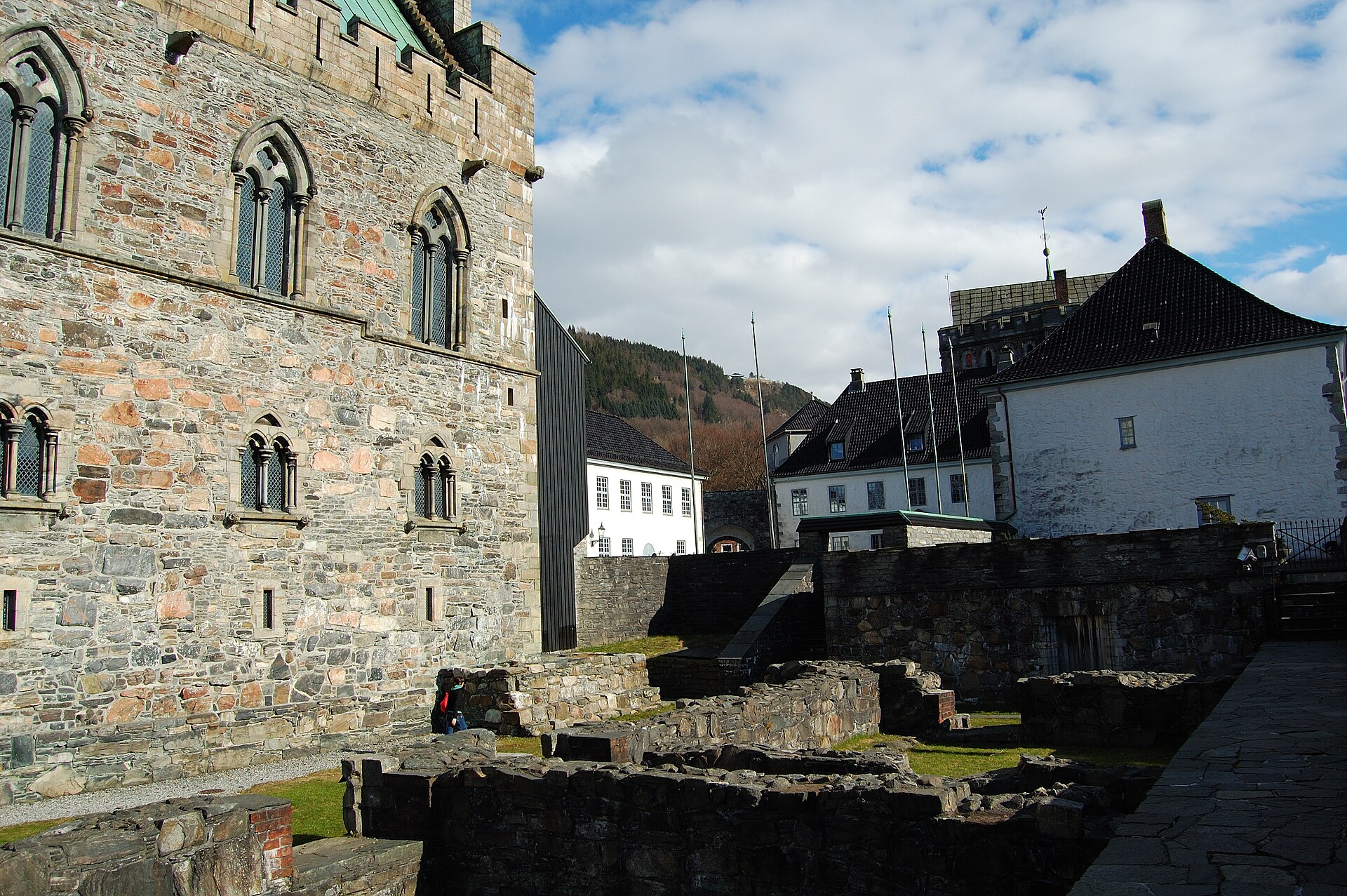
13:45 — Bergenhus Fortress
At the far end of Bryggen. The grounds are free and open from about 06:00 to 23:00; Håkon’s Hall, the thirteenth-century royal ceremonial building, and the Rosenkrantz Tower are ticketed at around 80 NOK, often on a combined ticket. Both were badly damaged in 1944 when a Dutch munitions ship exploded in the harbour and both were rebuilt.
Verdict: the grounds are worth thirty free minutes. Go inside only if you have time spare or the weather has turned.
14:45 — KODE, or the harbour walk
If it is raining, this is where the day is saved. KODE spans four buildings around Lille Lungegårdsvann, the octagonal lake in the centre of town, plus three composer homes outside it. A day pass covering all four buildings is quoted at either 160 or 200 NOK depending on the source — another figure I could not pin down.
KODE 3 holds a substantial Munch collection, which surprises people who assume all of it is in Oslo. KODE 4 has the modern and contemporary work.
If it is dry, walk instead: round the lake, out to Nordnes point past the aquarium, and back along the other side of the harbour. About an hour, free, and it is where Bergen stops being a UNESCO site and starts being a town people live in.
16:30 — finish
Back towards Bryggen for the evening light on the wooden fronts, which is when they photograph best.
If you are on a cruise ship
The compressed version, assuming a berth around 08:00 and an all-aboard around 17:00. Note that from 2026 all ships in Bergen must use shore power under new port emission rules — which is good news for the air quality at the terminal and makes no difference to your day.
- 08:15 Walk from the terminal. Ten to twenty minutes depending on berth.
- 08:45 Bryggen, ahead of the other ships. One hour.
- 10:00 Fløibanen up. Ninety minutes including the top.
- 11:45 Bryggens Museum or Bergenhus, depending on weather. One hour.
- 13:00 Lunch away from the fish market.
- 14:15 KODE if wet, harbour walk if dry.
- 16:00 Back to the ship with an hour in hand.
Do not book a fjord excursion on a nine-hour call unless the cruise line is running it and takes responsibility for the timing. The Mostraumen cruise alone is three and a half hours before transfers.
You are free to use this picture for any purpose as long as y / CC BY-SA 4.0 via Wikimedia Commons
Is the Bergen Card worth it for one day?
The 2026 Bergen Card is quoted at 400 NOK for 24 hours, 500 for 48, 600 for 72 and 700 for 96, with children at 100 NOK for 24 hours. That comes from a single aggregator rather than Visit Bergen directly, so confirm before buying.
It includes free travel on the Bybanen light rail and Skyss buses across Vestland county, plus free or discounted museum entry and a 20 per cent discount on the Rødne fjord cruises.
The arithmetic for a single day: funicular return at around 200 NOK plus KODE at around 200 NOK plus a couple of Bybanen rides is roughly 480 NOK against a 400 NOK card. So it works, narrowly — but only if you do both the funicular and a museum. A day of Bryggen, the fortress grounds and a walk up Fløyen costs nothing and the card is a straight 400 NOK loss.
The card makes considerably more sense if you arrive at Flesland, since the airport light rail is included both ways.
What to skip
The Hanseatic Museum. Closed since 1 October 2018, reopening at the beginning of 2027 after a restoration budgeted at 337.9 million kroner. Parts of the collection have moved to Schøtstuene nearby. Two currently ranking guides still route you to the closed building.
Ulriken643. The cable car to Bergen’s highest peak costs 435 NOK return for an adult, 180 for a child aged 4–16, or 255 one way. It reopened in October 2021 with 50-person cars, the largest in Norway. It is excellent and it is a second-day activity — you cannot do both mountains properly in one day, and Fløyen is closer, cheaper and has the better city view.
Norway in a Nutshell. Ten to twelve hours round trip from Bergen, at a quoted figure of around 1,595 NOK per adult — a number that conflicts badly with other sources, so verify it. Whatever it costs, it is not a component of a Bergen day, it is a replacement for one. If the fjords are the point, give them their own day; our guide to Flåm covers what that trip involves.
Eating at the fish market. Covered above.
Fantoft stave church, on one day. It is out on the Bybanen line, open May to September only, and it is a 1990s reconstruction after the 1992 arson. Worth an hour on a second day, not on your only one.
Renting a car. Bergen’s centre is walkable end to end in twenty minutes and parking is expensive. A car here is a liability until the day you leave for the fjords — see our road trip guide for when it starts making sense.
Frequently asked questions
Is one day enough for Bergen?
For the city itself, yes. Bryggen, the funicular and one museum fill a day comfortably and the centre is small enough that you lose no time in transit. What one day does not allow is a fjord trip, Ulriken, or Troldhaugen — those need a second day.
Is the Bergen Card worth it for a single day?
Marginally, and only if you do both the funicular and a paid museum. At a reported 400 NOK for 24 hours it beats paying separately by about 80 NOK in that case, and loses you the whole 400 if you spend the day on the free sights.
Should I walk up Fløyen or take the funicular?
Walk up and ride down if it is dry and you are reasonably fit — the path is about 3 km and takes 45 to 60 minutes, and you halve the fare. Take the funicular both ways in rain, when the path is slick and the view at the top may not be there anyway.
Is the Hanseatic Museum in Bergen open?
No. It has been closed for restoration since October 2018 and is due to reopen at the beginning of 2027. Some of the collection is displayed at Schøtstuene, and Bryggens Museum covers similar ground.
How do I get from Bergen Airport to the city centre?
The Bybanen light rail, line 1, runs from Flesland to the centre in about 45 minutes for an ordinary transit fare — reported at around 51 NOK for an adult. It is included in the Bergen Card.
How rainy is Bergen really?
Average annual rainfall is 2,495 mm on the 1991–2020 normal, roughly four times London’s. The number of wet days is disputed between sources, ranging from 231 to 284. Bring a waterproof jacket rather than an umbrella; the harbour wind ruins umbrellas.
How much does a day in Bergen cost?
Free sights plus a walk up Fløyen and a supermarket lunch comes to almost nothing. Add the funicular, a museum and a restaurant meal and you are at roughly 600–700 NOK (~$65–75) per person.
Is Bergen better than Oslo?
For a short Norway trip built around scenery, yes — Bergen is the gateway to the western fjords and Oslo is seven hours from them. Oslo has far more museums. The comparison is set out properly in is Oslo worth visiting.
Photo credits
- Bryggen at 08:30, before the cruise ships. By ten the alleys behind it are full. — Photo: Anna Anichkova / CC BY-SA 3.0 via Wikimedia Commons.
- Floyen is 320 metres up and seven or eight minutes by funicular. On a wet day you pay to stand in a cloud. — Photo: Barrowbob / CC BY-SA 4.0 via Wikimedia Commons.
- The Floibanen climbs 320 metres, part of it through tunnel. Walking up takes 45 to 60 minutes. — Photo: [[User:Ad Meskens|Ad Meskens
You are free to use this picture for any purpose as long as y / CC BY-SA 4.0 via Wikimedia Commons. - Bergenhus grounds are free and open from six in the morning until eleven at night. — Photo: User:Sveter (Please credit as “Petr Šmerkl, Wikipedia” in case you use this outside WMF pr / CC BY-SA 3.0 via Wikimedia Commons.
Prices checked August 2026 and converted at 9.35 NOK to 1 USD. The Fløibanen, Bergen Card, KODE and Bybanen figures each rest on a single source or conflict between sources, and I have said so at each point rather than printing a confident number — confirm with floyen.no, visitbergen.com and Skyss before you rely on them. The Ulriken643 fares and the Hanseatic Museum closure come from those operators directly.