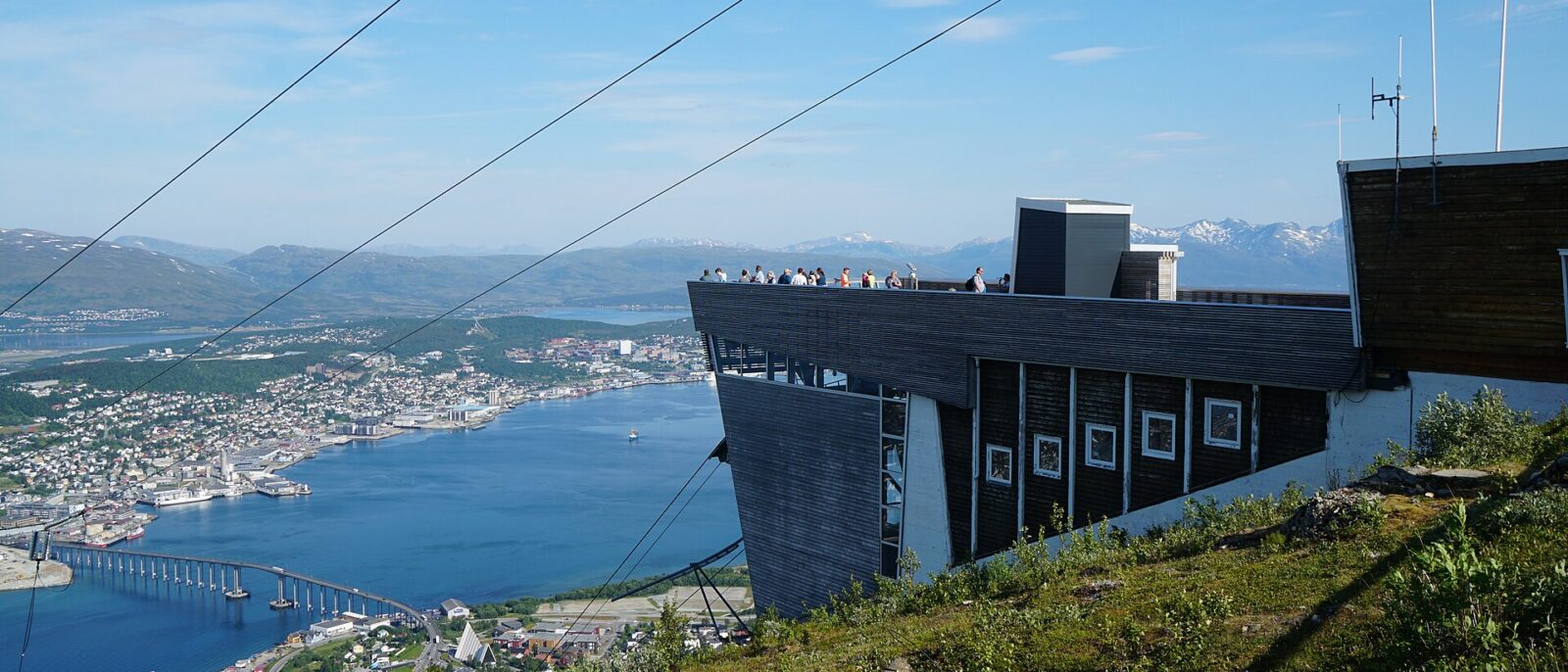
Tromsø’s cable car, Fjellheisen, is the easiest big view in Arctic Norway: four minutes from the mainland suburb of Tromsdalen up to the Storsteinen ledge at 421 metres, with the whole island city spread out below. It’s also the attraction where the internet is most out of date. The guides ranking for it quote return fares of NOK 345 or 495. The operator’s actual 2026 adult return is NOK 645. Even the official tourism board’s own Fjellheisen page still carries the old figure.
The other thing nobody does is treat this side of the bridge as what it is: one half-day. The cable car, the Sherpa stairs that climb the same slope on foot, and the Arctic Cathedral, Tromsø’s best-known landmark, all sit within a short distance of each other in Tromsdalen. Done in the right order, they make the best three or four hours you can spend in the city without booking a tour.
This guide covers all three, with current prices, what the ongoing rebuild means for your visit, when the view is worth the money and when it isn’t, and a route that ties them together.
Tromsdalen at a glance
Prices are adult rates from the operators’ own pages, checked in November 2026, with dollars at NOK 9.41 to the US dollar.
| What | Cost | Time needed | When | Verdict |
|---|---|---|---|---|
| Fjellheisen cable car, return | NOK 645 ($69) | 1–2 hours with the café | Daily 09:00–00:00 | Worth it on a clear day or night; skip in thick cloud |
| Fjellheisen one-way (walk down) | NOK 415 ($44) | 2–2½ hours | Summer and autumn, when the path is clear of snow | The best value way to do it |
| Sherpa stairs, up and down on foot | Free | 40–60 minutes up | Late spring to autumn | Excellent, but not in snow or ice |
| Arctic Cathedral | NOK 90 ($10) | 30–45 minutes | Hours vary by season | Go for the east window and the light |
| Aurora Tunes organ concert | NOK 250 ($27) | 30 minutes | Fridays 17:30, autumn 2026 | A good half-hour if your dates line up |
Fjellheisen: what it costs and how it runs
The cable car climbs from a lower station at Solliveien 12 in Tromsdalen to Storsteinen. The operator gives the cable length as 752 metres and the ride as about four minutes. Cars carry up to 28 people and leave on the hour and the half hour. The gondola runs daily from 09:00 to midnight, and the café at the top from 09:00 to 23:30.
| Ticket | Adult | Child (3–15) | Family (2+2) |
|---|---|---|---|
| Return | NOK 645 ($69) | NOK 310 ($33) | NOK 1,360 ($145) |
| One-way | NOK 415 ($44) | NOK 195 ($21) | NOK 850 ($90) |
A family of four pays NOK 1,360 for a ride of eight minutes in total. That’s the reality of Norwegian prices, and it’s why the walking options below matter.
Those figures are from fjellheisen.no. If you find a lower price on a blog or a tourism listing, it’s from before the current tariff. The operator’s page is the one you’ll be charged against.
The rebuild, and what it changes for you
Fjellheisen is in the middle of a rebuild, which the operator calls “Nye Fjellheisen”. The cable car stays open throughout, but several things work differently from what older guides describe:
- No parking at the lower station. The car park has gone for the works. The operator points drivers to free temporary parking at Solstrandvegen 30 in Tromsdalen, about five minutes away on foot.
- No wheelchair access. The operator says wheelchair users can’t be accommodated during the works, and the tourism board says that applies until the end of 2027.
- A free shuttle. From 30 November the ticket includes a shuttle bus between Scandic Ishavshotel in the city centre and the lower station. The first city departure is at 09:00 and the last at 22:00; from the lower station, 09:15 to 22:15. There’s no separate ticket and no booking, but the operator suggests leaving at least 25 minutes before a booked gondola time. The last shuttle back to the centre leaves the lower station at 22:15, although the gondola runs until midnight, so you’d need your own transport after that.
Check fjellheisen.no for the current state and timetable of the works before you go, especially if you’re relying on step-free access.
Getting to the lower station
You have four options:
- The shuttle, from 30 November, free with your cable car ticket, from Scandic Ishavshotel.
- Bus 26 from the city centre, which the tourism board recommends. Tromsø’s buses don’t take cash; use the Svipper app or a ticket machine, and check Svipper’s site before relying on a card on board. An adult single in one zone is NOK 50.
- Walk: the tourism board puts it at about 45 minutes from the centre, across the Tromsø Bridge and up through Tromsdalen.
- Drive, and park at Solstrandvegen 30.
The bridge itself is part of the experience. It’s 1,036 metres long and opened in July 1960, and the walk across gives you the cathedral’s white triangle ahead of you the whole way.
It’s a high bridge, built so ships can pass underneath, which means the walkway climbs steadily to the middle and then drops to Tromsdalen. In summer it’s a pleasant stroll. In winter, wear boots with grip, because the pavement can be icy, and expect the wind to be noticeably stronger at the crown than it was on the harbour. Walking back across in the dark, with the lit-up city on its island ahead of you, is one of the nicer free things to do in Tromsø.
At the top: Storsteinen and Fjellstua
Storsteinen is a broad ledge on the slope of Fløya, not a summit. That’s actually what makes the view work: you’re high enough to see the whole layout of Tromsøya, the bridge, the airport, the sound and the mountains of Kvaløya and Ringvassøya beyond, but close enough to pick out individual streets.
The café and restaurant at the top, Fjellstua, is open daily 09:00 to 23:30 and serves coffee, cakes, waffles and warm dishes. The operator’s homepage has a table-booking link, which is worth using on clear evenings in aurora season, when the place fills.
Beyond the café, a network of paths leads further up the mountain. In summer you can keep walking to Fløya proper. In winter, unless you’re equipped for snow, the ledge around the station is as far as you go.
Walking on from the top
The walking route to Fløya on UT.no, the Norwegian Trekking Association’s route database, is 8.4 km with 663 metres of climbing, about two hours, and the cable car saves you around 350 metres of that climb. It’s a steady, well-trodden path in summer and gives you a view in both directions, back over the city and east into the mountains.
Tromsdalstinden, at 1,238 metres the big peak you see from everywhere in Tromsø, is a different proposition: UT.no gives 17.1 km and about 1,240 metres of ascent from the Tromsdalen valley, around six hours return. It’s a serious day hike and doesn’t start from the cable car. If you’re tempted, our Norway hiking guide covers what you need to know about mountain weather before a route like that.
The Sherpa stairs: the free way up
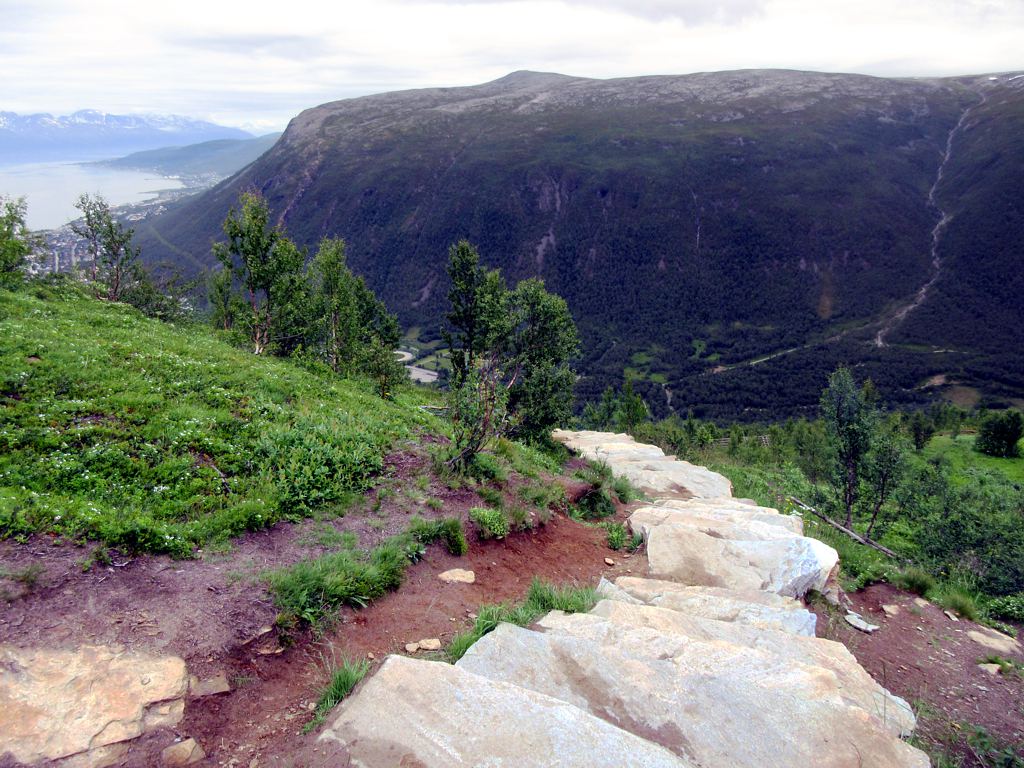
Running up the same hillside as the cable car is Sherpatrappa, a stone staircase built by Sherpas from the Khumbu region of Nepal, mostly from local stone. The tourism board says it has more than 1,200 steps; Visit Norway’s listing gives 1,203. You’ll see “almost 1,000” and “1,300” elsewhere. Count them yourself if you like, but 1,200-odd is the figure from the official sources.
Allow 40 to 60 minutes to climb it at a steady pace. It’s steep, relentless and genuinely beautiful work: the steps are big, irregular slabs set into the slope, and the view opens up behind you the whole way.
The important part is the season. The stairs are a summer and autumn route, roughly late spring until the snow comes. The tourism board advises against using them in snow and ice and suggests taking the cable car instead, and says you’ll need a head torch in the dark. In practice, from November to April or May, assume the stairs are off the menu unless you’re carrying traction devices and know how to use them.
The smart combination
In summer and early autumn, the best way to do Storsteinen is to climb the stairs and ride down for NOK 415, or ride up and walk down. Walking down a thousand-plus stone steps is harder on the knees than walking up, so most people prefer stairs up, cable car down. Either way you save NOK 230 per adult on the return fare and get the best of both.
For fit walkers on a budget, stairs up and stairs down costs nothing at all, and you can still sit in Fjellstua at the top.
When to go up
The view from Storsteinen is the whole point of the cable car, so the weather decides whether NOK 645 is a bargain or a waste.
In the polar night
From roughly 27 November to 15 January the sun doesn’t rise over Tromsø, the stretch Norwegians call the polar night. Around the middle of the day there’s a few hours of deep blue twilight, and from Storsteinen that light over the snow and the city lights is spectacular. Go up between about 11:00 and 13:00 for the blue, or stay for the city after dark. Our guide to Tromsø in winter has a month-by-month daylight table if you’re timing a visit.
For the northern lights
Because the gondola runs until midnight, Storsteinen is a reasonable place to wait for an aurora. You’re above the worst of the street lighting, you have a view to the north, and there’s a warm café behind you. It’s not dark-sky country, though. The city is directly below, glowing. If the aurora is strong you’ll see it overhead; if it’s faint, you’d do far better on a tour that drives out of town. Our Tromsø aurora guide explains the difference.
Under the midnight sun
From about 20 May to 22 July the sun doesn’t set over Tromsø. The tourism board’s advice is that from Storsteinen you see the midnight sun above the mountains of Ringvassøya to the north. Since the gondola runs until midnight, a late ride up on a clear June evening is one of the great Tromsø experiences, and far quieter than the winter evenings. Our wider midnight sun guide covers the phenomenon across Norway.
When not to bother
If the cloud base is sitting on the mountains and you can’t see the top of Fløya from town, you won’t see anything from Storsteinen either. Have a look up from the harbour before you cross the bridge. If it’s blowing hard, check the operator’s site before you set off.
Storsteinen month by month
Put the light, the aurora season and the state of the stairs together and the year sorts itself out like this. Polar-night and midnight-sun dates are from the Tromsø tourism board and the Norwegian Meteorological Institute’s Yr service; the aurora season, late August to early April, is the tourism board’s.
| Month | Light from the top | Aurora possible? | Sherpa stairs | My take |
|---|---|---|---|---|
| December | Polar night; a few hours of blue twilight around midday | Yes | Snow and ice: no | Go up late morning for the blue, or after dark |
| January | Polar night until about 15 January, then short days | Yes | No | As December; the sun’s return is a local event |
| February–March | Days lengthening fast; low sun on snow | Yes | No | The best all-round months for the cable car |
| April | Long, bright days | Early April only | Usually still snowbound | Good daytime views, little darkness left |
| May–July | Midnight sun from about 20 May to 22 July | No (too light) | From late spring, as snow clears | Ride up late on a clear evening |
| August–September | Nights return; long golden evenings | From late August | Yes | Stairs up, cable car down, aurora after dark |
| October–November | Days shortening fast | Yes | Until the first snow | Quiet, cheap-ish, unpredictable weather |
If I had to pick one window, it would be late February to mid-March: real daylight on deep snow, the aurora still in season, and the city below looking its most Arctic. September is the other sweet spot, because it’s one of the few months when you can realistically climb the stairs in daylight and wait for the northern lights after dark on the same visit.
What to bring up in winter
Storsteinen is 421 metres above sea level and fully exposed to the wind off the sound, so it will feel several degrees colder than town, and you’ll be standing still. If you’re going up to wait for an aurora, dress as if for an aurora tour: wool base layers, a proper insulated jacket, a hat that covers your ears, and boots with grip, because the ledge around the station gets icy.
Bring a head torch for the paths beyond the station, and keep your phone in an inside pocket, because batteries drain fast in the cold. The café is open until 23:30 and the last gondola down is at midnight, so you have a warm place to retreat to, but check the time before you wander off the ledge.
Photographing the view
The classic shot from Storsteinen looks south-west over the bridge, the cathedral and the island. A few things help:
- Twilight beats darkness. The best city shots come in the half-hour when the sky is still deep blue and the street lights are on. In the polar night that blue lasts for hours around midday; in autumn and spring it’s a short window after sunset.
- Bring something to steady the camera. The station’s railings work if you don’t have a tripod, but in a strong wind even a tripod shakes.
- Shoot the cathedral from the bridge, not from the top. From Storsteinen it’s a small white shape among the houses. From the middle of the bridge, with the mountain behind it, it fills the frame.
- Watch your breath and your lens. Moving from the warm café to the cold terrace fogs glass instantly. Leave the camera in its bag for a few minutes when you go back outside.
The Arctic Cathedral
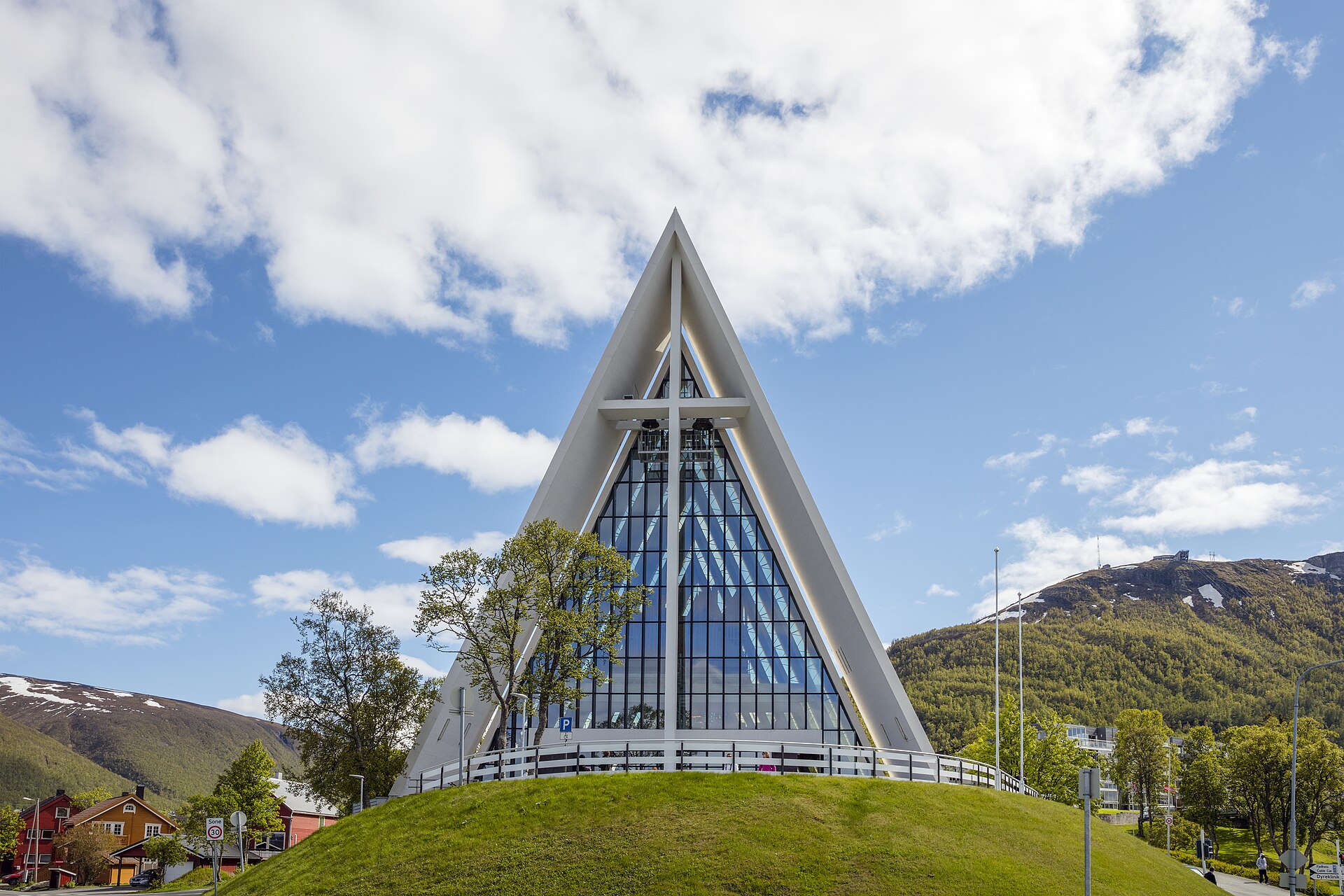
The Arctic Cathedral, Ishavskatedralen, is the white triangular church at the Tromsdalen end of the bridge. The first thing to know is that it isn’t a cathedral. It’s the parish church of Tromsdalen, Tromsdalen kirke, and the nickname stuck. Tromsø’s actual cathedral is the wooden church in the city centre.
It was designed by the architect Jan Inge Hovig and dedicated on 19 November 1965. The shape is made of aluminium-coated concrete panels, eleven on each side of the roof according to the tourism board, stepping down in a series of overlapping triangles that people compare to icebergs, a Sámi tent or a pile of ice floes depending on who’s talking.
Inside, the reason to go is the east wall. The huge glass mosaic there, The Return of Christ by Victor Sparre, was installed in 1972 and fills the end of the church with colour, especially in low sun. The organ, by Grönlund, dates from 2005 and has 2,940 pipes.
Entry and hours
Adult entry is NOK 90; groups of 15 or more pay NOK 85 each, children under 12 are free, and services are free to attend. You pay at the door.
| Period (2026) | Visiting hours |
|---|---|
| 1 January – 30 May | 10:00–17:00 (Wednesdays closed 13:00–14:00; Sundays 13:00–17:00) |
| 1 June – 15 August | 09:00–18:00 (Sundays 13:00–18:00) |
| 16 August – 31 December | 10:00–17:00 (Wednesdays closed 13:00–14:00; Sundays 13:00–17:00) |
| 24 December | Closed to visitors; services at 12:00, 14:00 and 16:00 |
| 31 December | 11:00–16:00, New Year’s concert at 21:00 |
The cathedral says hours can change around services and events, so check its website on the day, especially for 2027, when the schedule above will be updated.
Visiting well
The church is small enough that a coach party changes the atmosphere completely, so it pays to think about timing. The east window faces the morning, so outside the polar night the mosaic is at its most vivid earlier in the day. On Sundays the visiting hours start at 13:00, after the morning service.
If you’d rather experience the building as a church than as an attraction, go to a service: they’re free, and you’ll hear the organ in the room it was built for. Remember it’s a working parish church. Weddings, funerals and rehearsals take priority, which is why the cathedral warns that visiting hours can change at short notice.
Concerts
The cathedral runs two seasonal concert series, and they’re the best way to hear the building.
- Aurora Tunes is a 30-minute organ concert at 17:30 on Fridays through the autumn of the northern-lights season. In 2026 the last dates are 20 and 27 November. Tickets are NOK 250 for adults and NOK 150 for children aged 8 to 15; under-8s go free.
- Cathedral of Light is the summer series in the midnight-sun season. In 2026 it included an organ concert on 4 June at 21:00 (NOK 200) and a lying-down performance of the Goldberg Variations in July. Check the cathedral’s events calendar for the 2027 programme.
One confusion to avoid: the much-advertised “Midnight Concert” runs at Tromsø Cathedral in the city centre, not at the Arctic Cathedral. The tourism board lists it from 1 November to 31 March at NOK 295. If you buy a ticket and turn up in Tromsdalen, you’re on the wrong side of the bridge.
What the half-day costs
The difference between the walking options and the full return fare adds up quickly for a group. Here’s what Storsteinen and the cathedral cost at the 2026 prices above, before coffee.
| Group | Cable car both ways + cathedral | Stairs up, cable car down + cathedral | Stairs both ways + cathedral |
|---|---|---|---|
| One adult | NOK 735 ($78) | NOK 505 ($54) | NOK 90 ($10) |
| Two adults | NOK 1,470 ($156) | NOK 1,010 ($107) | NOK 180 ($19) |
| Two adults, two children under 12 | NOK 1,540 ($164) with the family ticket | NOK 1,030 ($109) with the family one-way | NOK 180 ($19) |
The family rows assume both children are 3 to 11: the cathedral is free for under-12s and the family tickets cover two adults and two children aged 3 to 15. The walking columns only apply when the stairs are clear of snow, roughly late spring to autumn.
A half-day route that ties it together
Here’s how I’d do it, with the summer and winter versions.
Summer and early autumn (no snow on the stairs)
- Walk across the bridge from the city centre. The cathedral gives about 20 minutes to reach it on foot.
- The Arctic Cathedral, 30 to 45 minutes. Mornings are best for the east window.
- Walk up to the bottom of the Sherpa stairs and climb them, 40 to 60 minutes.
- Coffee and waffles at Fjellstua, and as long as you like on the ledge.
- Cable car down, NOK 415, then bus 26 or walk back over the bridge.
Cost per adult: NOK 90 cathedral plus NOK 415 one-way, plus whatever you eat. About NOK 505 ($54) before coffee.
Winter (snow, short days)
- Shuttle or bus 26 to the lower station, timed to reach Storsteinen in the late-morning twilight.
- Cable car up and down, NOK 645, with lunch at Fjellstua.
- The Arctic Cathedral on the way back, before it closes at 17:00. If it’s a Friday in November, stay for Aurora Tunes at 17:30.
- Return to the centre by bus, or walk the bridge in the dark with the city lights ahead of you.
Cost per adult: NOK 645 plus NOK 90, or NOK 985 with the concert. That’s NOK 735 to 985 ($78–$105). The shuttle leaves from Scandic Ishavshotel on the harbour, so if you’re choosing a base, our guide to where to stay in Tromsø explains why the streets around it work well.
If you have a clear evening in aurora season, flip it: cathedral in the afternoon, cable car after dark, and stay up top until the lights come or the cold wins.
What I’d skip, and what people get wrong
Paying the full return fare on a cloudy day
The view is the product. Without it, NOK 645 buys you an expensive waffle. Look up before you go.
The Sherpa stairs in winter
The tourism board says not to, and it’s right. Icy stone steps on a steep slope in the dark are how people get hurt. Take the cable car up and come back for the stairs in summer.
Driving and expecting to park
The lower-station car park has gone for the works. Use the temporary lot at Solstrandvegen 30, or better, take the shuttle or the bus.
Trusting old prices
Anything quoting NOK 345, 445 or 495 for a return is out of date. Budget NOK 645.
Expecting a big cathedral interior
The Arctic Cathedral is a parish church, and its interior is simple and fairly small. The glass wall is magnificent; the rest is quiet. Thirty minutes is enough for most people, which is exactly why it pairs so well with the cable car.
Expecting dark skies at Storsteinen
It’s a fine place to watch a strong aurora with a hot drink. It’s not a substitute for getting out of town on a weak night.
How it compares
If you’ve been to Bergen, the comparison people make is with Fløyen and its funicular. Bergen’s ride is easier to reach on foot from the centre; Tromsø’s goes higher, and you get the bonus of the cathedral and the bridge walk on the way. For more views like this around the country, our list of Norway’s landmarks puts both in context, and if you’d rather keep the budget for the sledding and whale trips, our roundup of free things to do in Norway includes the Sherpa stairs.
For everything else in town, start from our main Tromsø guide.
Frequently asked questions
How much does the Fjellheisen cable car cost?
An adult return is NOK 645 ($69) and one-way is NOK 415 ($44). Children aged 3 to 15 pay NOK 310 return, and a family ticket for two adults and two children is NOK 1,360. Older prices you may see online are out of date.
How long is the Tromsø cable car ride?
About four minutes each way, with departures on the hour and half hour. Allow one to two hours for the visit with time at the top.
Is Fjellheisen worth it?
On a clear day or night, yes: it’s a superb view of Tromsø. In thick cloud, no. In summer, walking up the Sherpa stairs and riding down for NOK 415 is the best value.
How many steps are the Sherpa stairs?
The tourism board says more than 1,200, and Visit Norway’s listing says 1,203. Allow 40 to 60 minutes to climb them. They’re not recommended in snow or ice.
Can you see the northern lights from Fjellheisen?
Yes, when the aurora is strong and the sky is clear, and the gondola runs until midnight. But the city lights below wash out weaker displays, so a tour that drives away from town gives you much better odds.
Is Fjellheisen open in winter?
Yes. The cable car runs year-round, including through the polar night, and stays open during the rebuild. It’s the Sherpa stairs that close in practice, because the tourism board advises against using them in snow and ice.
What are Fjellheisen’s opening hours?
The gondola runs daily from 09:00 to midnight and the Fjellstua café from 09:00 to 23:30. The operator lists one set of hours, but check its site before a late visit.
Is the Arctic Cathedral free to enter?
No. Adult entry is NOK 90; children under 12 are free, and so are services. Concerts are ticketed separately.
How do you get to the Arctic Cathedral from the city centre?
Walk across the Tromsø Bridge, about 20 minutes, or take a bus to the Tromsdalen Church stop. The buses don’t take cash, so use the Svipper app or a ticket machine.
Photo credits
- Storsteinen in summer, with the Tromsø Bridge and the island city below. — Photo: Olivier Bruchez / CC BY-SA 2.0 via Wikimedia Commons.
- The Arctic Cathedral is the parish church of Tromsdalen. — Photo: Godot13 / CC BY-SA 4.0 via Wikimedia Commons.
- The Sherpa stairs: hand-laid stone steps up to Storsteinen. — Photo: David Stanley from Nanaimo, Canada / CC BY 2.0 via Wikimedia Commons.
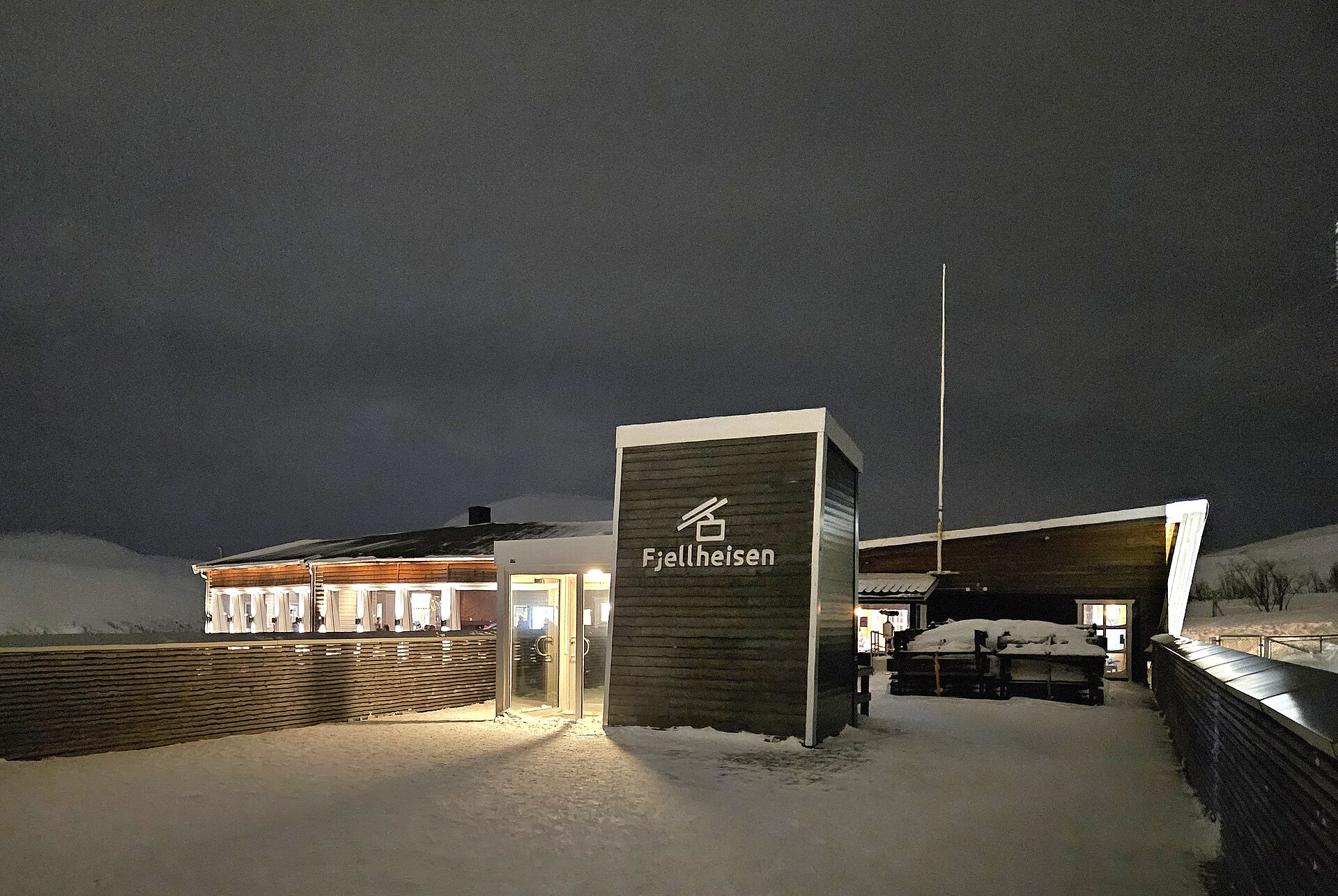
- The top station after dark in winter. — Photo: Peter Fiskerstrand / CC BY-SA 4.0 via Wikimedia Commons.
Prices, hours and concert dates were checked in November 2026 against fjellheisen.no, ishavskatedralen.no and the official Tromsø tourism pages, and converted at NOK 9.41 to the US dollar. The cable car’s rebuild means access arrangements change, and the cathedral publishes its 2027 hours and concerts later, so check both sites before you go.