Most articles about Sámi culture in Norway are written to a template: ancient indigenous people, reindeer, colourful clothing, joik, book a lavvu experience. They’re not wrong, exactly. They’re just twenty years out of date, and they leave out the things a visitor most needs to know — including how to tell whether the experience you’re booking is Sámi-owned, and what happened at Fosen.
The Sámi are not a historical people. They have a parliament that opened in 1989, an electoral roll that has grown fivefold since, a national theatre in a new Snøhetta building, and a Supreme Court judgment against the Norwegian state that took three years to settle. That’s the culture you’d actually be visiting.
This guide covers who the Sámi are, where to experience the culture properly, which operators to choose and why it matters, the terminology to use, and the dated 2026–27 events calendar that every competing article omits.
Who the Sámi are
The Sámi are the indigenous people of Sápmi — the homeland spanning northern Norway, Sweden, Finland and Russia’s Kola Peninsula. Note the distinction: Sámi is the people, Sápmi is the territory.
Estimates put the total population at around 80,000, with roughly half in Norway — somewhere between 50,000 and 65,000. All figures are estimates, because Norway keeps no ethnic register, and that itself is a deliberate response to history.
A few facts that cut against the standard picture:
- Most Sámi do not herd reindeer. Around 3,000 people in Norway work in Sámi reindeer husbandry out of a population many times that. Most Sámi are teachers, nurses, engineers and civil servants, and many live in cities.
- Reindeer herding is legally reserved for people of Sámi descent with family ties to a herding unit. It isn’t a job you can take up.
- Herding covers roughly 40% of Norway’s land area across some 140 municipalities, with about 538 registered herding units in 2025 and a winter herd somewhere in the region of 210,000–250,000 animals depending on the season.
The language question
There are nine or ten Sámi languages; six were historically spoken in Norway and three remain in active use here.
| Language | Speakers | Where |
|---|---|---|
| Northern Sámi | ~25,000 total, ~15,000 in Norway | Finnmark, Troms |
| Lule Sámi | ~650 | Nordland |
| Southern Sámi | ~500–600 | Trøndelag, Hedmark |
UNESCO classifies every Sámi language as endangered. That context matters when you see bilingual road signs in Finnmark or hear Northern Sámi spoken in a shop — those are the products of a hard-won revival, not decoration.
Two words worth learning: bures (hello) and giitu (thank you), in Northern Sámi.
Terminology: what to say and what to avoid
This trips up well-meaning visitors constantly, so plainly:
- Use “Sámi” (or Sami). Use Sápmi for the homeland.
- Do not say “Lapp” or “Laplander.” These are derogatory, tied to a root meaning a patch of cloth — that is, ragged or poor. You’ll still see them in old books and occasionally on souvenirs. Don’t repeat them.
- “Lapland” is not a synonym for Sápmi. It’s a Finnish and Swedish administrative region, and Norwegian Sámi generally don’t use it of themselves.
- The gákti is not a costume. The traditional dress — gákti in Northern Sámi, kofte in Norwegian — is living clothing whose colours, cut and details encode home region and marital status. Calling it a costume, a national dress or regalia misses what it is. Visitors don’t wear one; if you want the aesthetic, the luhkka, a poncho-like garment, is the acceptable option.
- “Finn” survives in place names like Finnmark as an old word for Sámi, but is not a current term.
What joik actually is
Joik (or luohti) is one of Europe’s oldest continuous vocal traditions, and the crucial thing about it is grammatical: you do not joik about someone, you joik them. A joik is closer to a portrait or an evocation than a song with a subject — of a person, an animal, a place.
It was suppressed for generations. Under Norwegianisation and the influence of Læstadian Christianity, joik was condemned as sinful and banned in schools. That it survived at all is remarkable; that it now turns up in film scores and at the Sámi Grand Prix is a genuine cultural recovery.
If someone joiks for you, listen rather than record. It’s often personal.
The history that shaped all of this
Fornorsking — Norwegianisation — was official state policy from roughly the 1850s to the 1960s: Sámi children were educated in Norwegian in boarding schools, Sámi language use was punished, and land rights were tied to Norwegian-speaking status.
Two recent developments are essential context, and almost no travel article covers them.
The Truth and Reconciliation Commission delivered its report to the Storting on 1 June 2023 — around 700 pages, drawing on more than 760 personal testimonies from Sámi, Kven and Forest Finn communities. Its conclusion was blunt: Norwegianisation “did not stop.” In November 2024 the Storting adopted 17 follow-up resolutions and issued a formal apology.
Fosen. On 11 October 2021 Norway’s Supreme Court ruled unanimously that wind farm licences at Storheia and Roan breached Article 27 of the International Covenant on Civil and Political Rights by damaging Sámi reindeer herders’ cultural rights. The turbines kept running. After protests that blockaded government ministries, settlements followed: Sør-Fosen sijte in December 2023, Nord-Fosen siida on 6 March 2024. The turbines stay, each siida receives around NOK 7 million a year in compensation plus replacement winter pasture, and — the significant part — a veto over any licence extension beyond 2045.
If you visit Sápmi and someone raises green energy, this is what they’re talking about.
Duodji: the craft, and how to buy it properly
Duodji is Sámi handicraft, and the word covers both the objects and the knowledge behind them. Traditionally everything a herding household needed was made by hand from what the land provided: reindeer antler and bone, birch burl, leather, root and sinew, and pewter thread embroidered onto wool.
The things worth buying, and what to look for:
- A birch burl cup (guksi). Carved from a single knot of birch, and the classic Sámi object. A real one takes days to make and is priced accordingly — expect several thousand kroner. If it’s NOK 300, it isn’t one.
- Pewter-thread embroidery. Fine silver-coloured thread worked onto reindeer leather, usually as bracelets. Genuinely distinctive and portable.
- A knife (niibi). Antler and birch handle, hand-forged blade, tooled sheath. Check the airline rules before you fly home with it.
- A luhkka. The poncho-like overgarment, and the one piece of Sámi clothing a visitor can appropriately wear.
The Sámi Duodji trademark is the thing to look for: it certifies that the maker is a trained Sámi duojár working in traditional materials and technique. The alternative is to buy directly from the maker, which you can do at the Easter Festival market in Kautokeino, at museum shops in Karasjok, and at workshops across Finnmark.
What to avoid: souvenir-shop drums, plastic “Sámi” figurines, and anything using Sámi motifs made in bulk elsewhere. The drum in particular was a sacred object — used by the noaidi and burned in large numbers during the witch trials and Christianisation — so a mass-produced one as a fridge magnet lands badly.
Sámi food
The cuisine follows the herd and the season, and it’s genuinely good rather than merely interesting.
Bidos is the dish to try — a reindeer stew with potato and carrot, traditionally served at weddings and celebrations, and the closest thing to a Sámi national dish. Suovas is smoked reindeer meat, often served in a flatbread. Gáhkku is a soft griddle bread cooked over a fire in the lavvu. And cloudberries — luomi, the amber bog berry that grows across Finnmark — turn up with cream or on cheese, and are expensive everywhere because they resist cultivation.
Reindeer meat itself is lean, dark and mild, and it’s on menus across northern Norway. Eating it isn’t culturally insensitive — it’s the product of the herding economy, and buying it supports the herders directly.
Museums and institutions worth the detour
- Sámiid Vuorká-Dávvirat, Karasjok. Founded 1972, around 5,000 objects, and the largest Sámi cultural-history collection in Norway. Part of the RiddoDuottarMuseat group, which runs four sites across West Finnmark.
- The Sámi Parliament, Karasjok. Free guided tours; a working legislature rather than a museum.
- Čoarvemátta, Kautokeino. Snøhetta with 70°N arkitektur and the artist Joar Nango, housing the Beaivváš Sámi National Theatre and the Sámi High School. In use since 2024 — genuinely striking contemporary Sámi architecture, which is not a phrase most travel guides ever get to write.
- The Alta Museum. The UNESCO-listed rock carvings, some of them 7,000 years old, on boardwalks over the rock. Pre-Sámi in origin but essential context for the region.
- Várdobáiki, Evenes. A Sámi centre in the Ofoten region, useful if you’re travelling between Narvik and Lofoten.
- Saemien Sijte, Snåsa. The Southern Sámi museum, in a 2022 building — and a corrective to the assumption that Sámi culture is only a far-north phenomenon.
A four-day Sápmi route
If you want to do this properly rather than as an add-on to an aurora trip, this is the shape that works. Fly into Alta.
| Day | Where | What |
|---|---|---|
| 1 | Alta | Alta Museum rock art; overnight Alta |
| 2 | Alta → Kautokeino | Drive the Finnmarksvidda; Čoarvemátta; a Sámi-run reindeer experience |
| 3 | Kautokeino → Karasjok | Sámi Parliament tour; Sámiid Vuorká-Dávvirat |
| 4 | Karasjok → Alta or Lakselv | Duodji workshop; fly out |
Two practical warnings. The Finnmarksvidda in winter is a genuine Arctic plateau — check road status, carry warm gear, and don’t set off at dusk in a storm. And distances are deceptive: Alta to Karasjok is a little over 200 km, but it’s a mountain road across open tundra, so budget three hours and more in snow. The itinerary guide has routes for combining this with the rest of a northern trip, and the accommodation guide covers the limited options inland.
The Sámi flag, and the symbols you’ll see
The Sámi flag was adopted in August 1986, designed by the artist Astrid Båhl. The circle is the sun and moon — the red arc the sun, the blue the moon — and the four colours are those of the gákti. The anthem, Sámi soga lávlla, sets an 1906 poem by Isak Saba to a melody by Arne Sørlie, and was adopted at the same time.
You’ll see the flag flown on public buildings on 6 February, and increasingly on Norwegian municipal buildings year-round in Sámi-majority areas. It isn’t a tourist logo; treat it as you’d treat any national flag.
Where to experience Sámi culture in Norway
Karasjok (Kárášjohka)
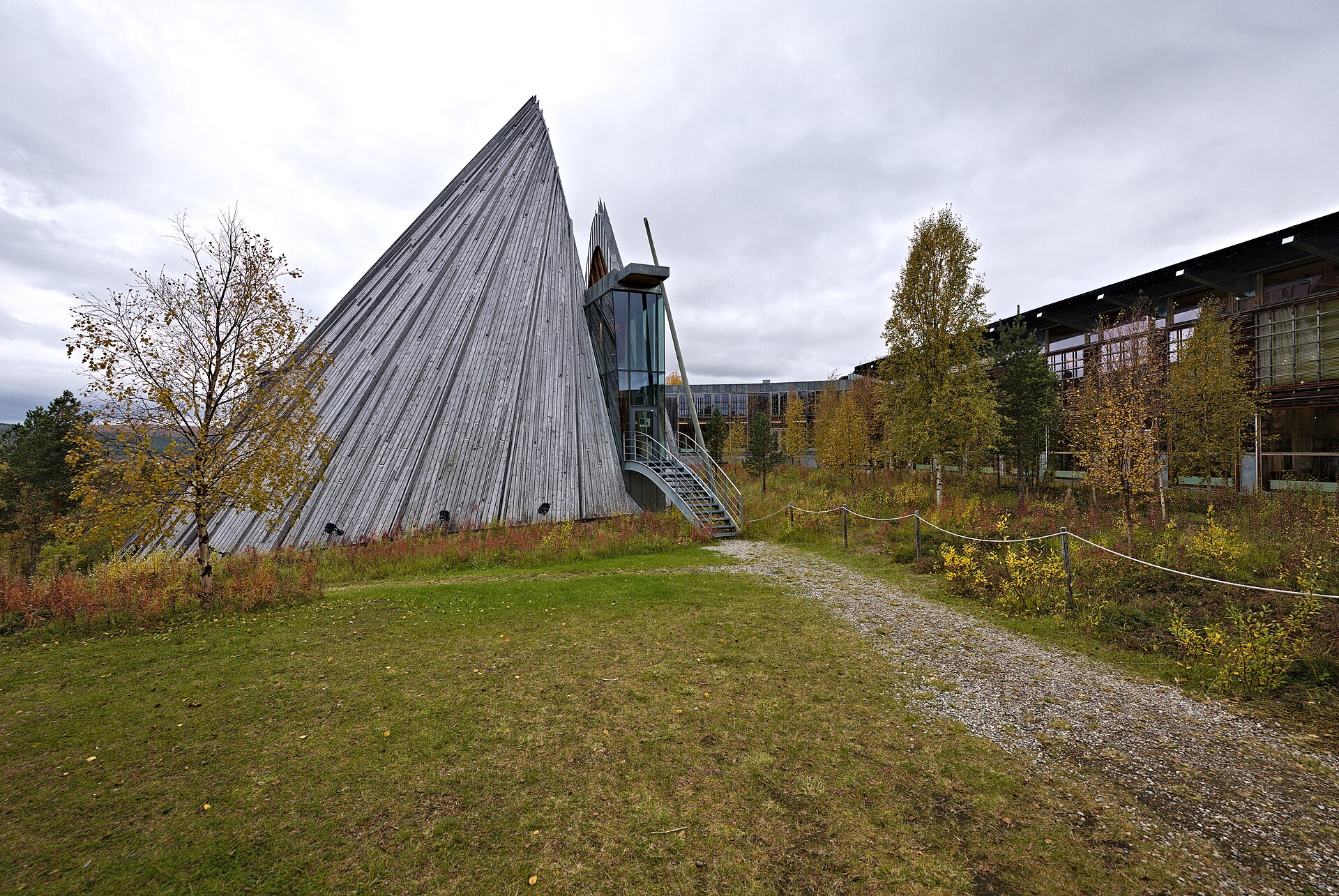
The administrative heart. The Sámediggi — the Sámi Parliament — sits here: it opened on 9 October 1989, and the current lavvu-shaped building by Stein Halvorsen and Christian Sundby opened on 2 November 2000. It runs free guided tours in Sámi, Norwegian and English, and this is the single most underused visitor experience in northern Norway. Competing articles treat it as architecture; it’s a working legislature you can walk into.
Also here: Sámiid Vuorká-Dávvirat, founded in 1972 as Norway’s first Sámi cultural institution, holding around 5,000 objects — the largest Sámi cultural-history collection in the country.
Kautokeino (Guovdageaidnu)
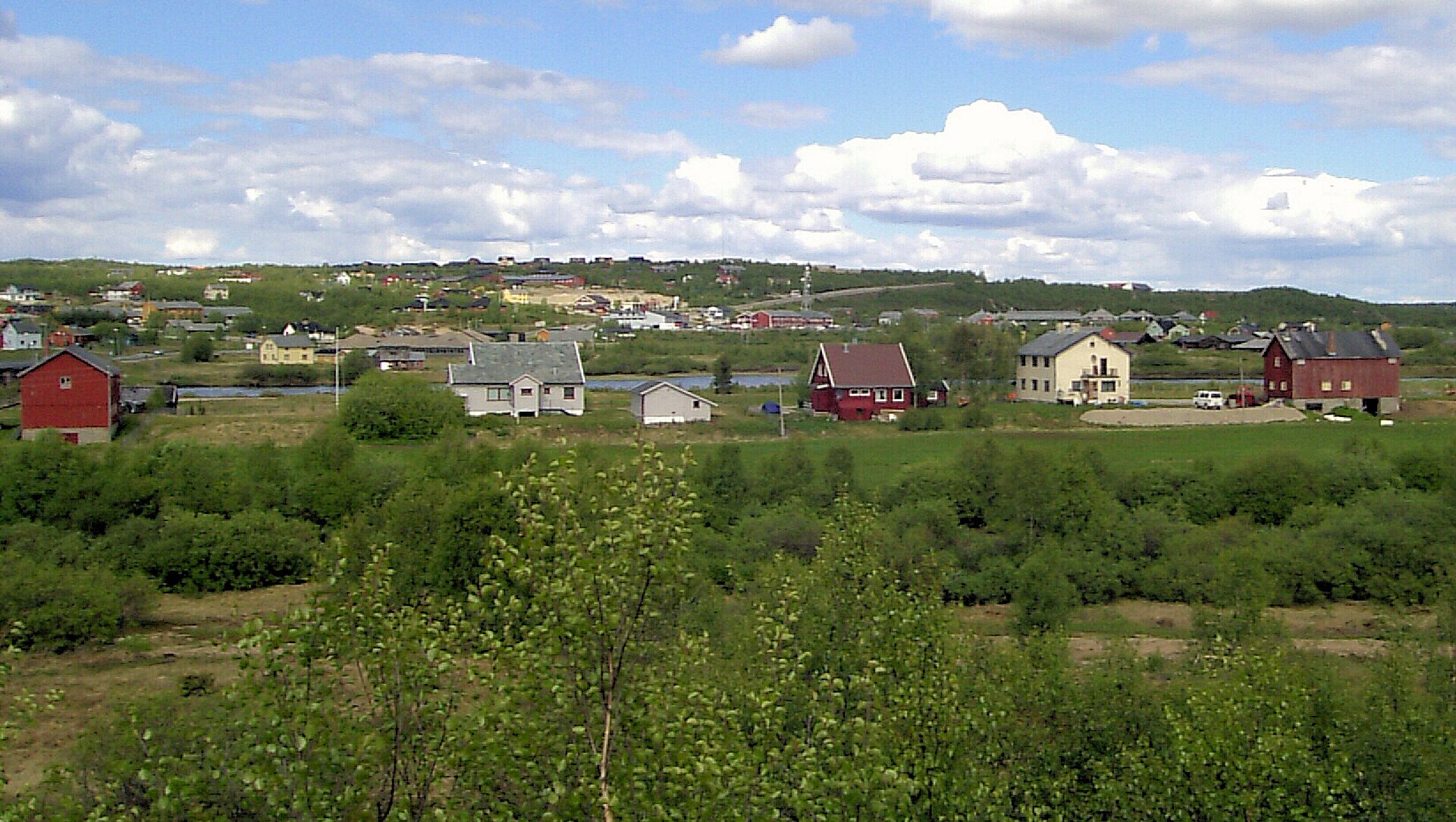
The reindeer-herding centre, and where the language is strongest in daily use. Čoarvemátta, the new Snøhetta building housing the Beaivváš Sámi National Theatre alongside the Sámi High School and Reindeer Herding School, has been in use since 2024. It’s also the home of the Easter Festival.
Tromsø
The easiest introduction if you’re not driving into Finnmark, and where most visitors will actually encounter Sámi culture. Several Sámi-owned operators run reindeer experiences within half an hour of the city. Sámi Week takes over the town every February. See the Tromsø guide for bases and logistics.
Alta, Varanger and the south
Alta has the UNESCO-listed rock art and good reindeer operators. The Varanger coast has the Sámi coastal tradition, which is a distinct culture from the inland herding one — a point almost always missed. And Sámi presence extends far further south than most visitors realise: the Southern Sámi communities of Trøndelag and Hedmark, around Røros, have their own language and history.
How to choose an operator, and why it matters
Every guide says “choose Sámi-owned.” Almost none says how. Here’s the practical version.
Ask directly. Is the business Sámi-owned? Do the guides herd reindeer year-round, or only during the season? Where does the income go? A genuine operator answers these easily and often volunteers the answers. Evasiveness tells you what you need to know.
Look for the family name and the siida. Sámi-run businesses are usually named for the family running them and will tell you which herding district they belong to.
For crafts, look for the Sámi Duodji trademark. Duodji is Sámi handicraft, and the Sámi Duodji mark guarantees the maker is a trained Sámi duojár using traditional materials and technique. Mass-produced “Sámi-style” souvenirs — plastic drums, machine-made “lucky” trolls in gákti colours — are a documented appropriation problem, and the money leaves the community entirely. Buying direct from the maker is the other reliable route.
Be wary of staged mysticism. If an operator is selling “shamans,” spirit ceremonies or a mystical experience, that’s a marketing construct rather than a living practice. Real Sámi spiritual tradition — the noaidi, the sieidi sacred sites — is not performed for visitors, and pressing for access to it is intrusive.
Things visitors get wrong
- Photographing people without asking. Visit Norway’s own guidance leads with this, which tells you how common it is. Ask first, every time.
- Approaching or feeding reindeer in the wild. They’re not wild — every reindeer in Norway is owned and marked. Approaching a herd stresses the animals and interferes with someone’s livelihood.
- Treating a working herd as a petting zoo. A herding operation that welcomes visitors is doing so alongside a year-round job.
- Assuming everyone herds. Most Sámi don’t, and the assumption gets tiring.
- Buying or wearing a gákti. Don’t. The luhkka is the visitor-appropriate garment.
- Driving fast on the Finnmarksvidda. Reindeer cross those roads constantly, and collisions are a real and expensive problem. Slow down.
The 2026–27 events calendar
Every competing article describes these festivals without a single date. Here are the ones I could verify, with the honest caveats.
| Event | Where | Dates |
|---|---|---|
| Sámi National Day | Everywhere | 6 February, annually |
| Sámi Week | Tromsø | 1–8 February 2026 (passed) |
| Sámi Easter Festival | Kautokeino | 28 March – 6 April 2026 (passed) |
| Riddu Riđđu | Manndalen, Kåfjord | 8–12 July 2026 (passed) |
For 2027: Sámi National Day is fixed at 6 February. Easter Sunday 2027 falls on 28 March, so the Kautokeino festival should land roughly 20–29 March, though that isn’t yet confirmed. Riddu Riđđu has not announced 2027 dates. Sámi Week in Tromsø runs around National Day and closes with the Norwegian Reindeer Racing Championship down the main street, which is exactly as good as it sounds.
Sámi National Day, 6 February, marks the first cross-border Sámi congress in Trondheim in 1917. It has been observed since 1993 and an official Norwegian flag day since 2004 — so on that date you’ll see the Sámi flag flying from public buildings across the country.
The Sámi Parliament, and why 2025 mattered
The Sámediggi’s electoral roll reached 25,676 before the 2025 election, up from around 5,500 in 1989 — a fivefold increase that says a great deal about how identity has changed in a generation.
The election on 8 September 2025 filled all 39 seats. The Norwegian Sámi Association took 37.9% and 18 seats, its best result since 1993, and Silje Karine Muotka continues as President.
You can watch proceedings during sitting weeks, and the free guided tours run year-round.
When to go
February is the strongest month: National Day on the 6th, Sámi Week in Tromsø, snow, reindeer racing and aurora. It’s cold — genuinely cold inland, where Kautokeino and Karasjok regularly sit below -30°C — but it’s when the culture is most visible.
Easter in Kautokeino is the other peak: the Easter Festival is the biggest gathering in the Sámi year, and beds in a village that size book out six months ahead.
Summer is the quiet season inland and the busy one on the coast — Riddu Riđđu in July, the midnight sun, and reindeer up on the summer pastures. It’s also mosquito season on the Finnmarksvidda, which is not a minor point in July and August.
The seasons guide has the wider month-by-month picture, and the winter guide covers what runs in the cold months.
What it costs
Sámi experiences sit in the same bracket as other guided Arctic activities. A reindeer sledding and lavvu session near Tromsø starts around NOK 1,655; longer or more remote experiences in Finnmark run higher. Museum entry is modest — typically NOK 100–150. The Sámi Parliament tour is free.
Getting to Karasjok or Kautokeino realistically means flying to Alta or Lakselv and driving; there’s no train, and bus connections are sparse. Budget a full day each way from Tromsø. The transport guide covers northern connections, and the costs guide has daily budgets.
Frequently asked questions
Who are the Sámi people?
The indigenous people of Sápmi, spanning northern Norway, Sweden, Finland and north-west Russia. Around 80,000 in total, roughly half of them in Norway. They have their own languages, parliament, flag, national day and legally protected rights.
Is it offensive to say “Lapp” or “Lapland”?
“Lapp” and “Laplander” are offensive and shouldn’t be used. “Lapland” is a Finnish and Swedish administrative region rather than a synonym for Sápmi, and Norwegian Sámi generally don’t use it of themselves.
Do all Sámi herd reindeer?
No — and it’s the most common misconception. Around 3,000 people work in Sámi reindeer husbandry in Norway, a small fraction of the population. Herding is also legally restricted to those of Sámi descent with family ties to a herding unit.
What is joik?
One of Europe’s oldest vocal traditions. Crucially you joik a person, animal or place rather than singing about them — it’s an evocation rather than a song with a subject. It was suppressed for generations under Norwegianisation and has been substantially revived.
Where is the best place to experience Sámi culture in Norway?
Karasjok for the Parliament and the main museum; Kautokeino for the language, the theatre and the Easter Festival; Tromsø for accessibility and Sámi Week in February. Choose Sámi-owned operators wherever you book.
How do I know if a Sámi experience is authentic?
Ask whether the business is Sámi-owned, whether the guides herd year-round and where the income goes. For crafts, look for the Sámi Duodji trademark or buy direct from the maker. Be sceptical of anything marketing “shamans” or staged spirituality.
What happened at Fosen?
Norway’s Supreme Court ruled in October 2021 that two wind farms breached Sámi herders’ cultural rights under international law. After protests, settlements were reached in December 2023 and March 2024: the turbines remain, each affected siida receives around NOK 7 million a year plus replacement pasture, and holds a veto over licence extension beyond 2045.
Can you visit the Sámi Parliament?
Yes. The Sámediggi in Karasjok runs free guided tours in Sámi, Norwegian and English, and you can observe proceedings during sitting weeks.
Photo credits
All photographs are used under their respective Creative Commons or public-domain licences.
- The Sámediggi in Karasjok. Free guided tours, and a working legislature rather than a museum. — Photo: Leonhard Lenz / CC0 via Wikimedia Commons.
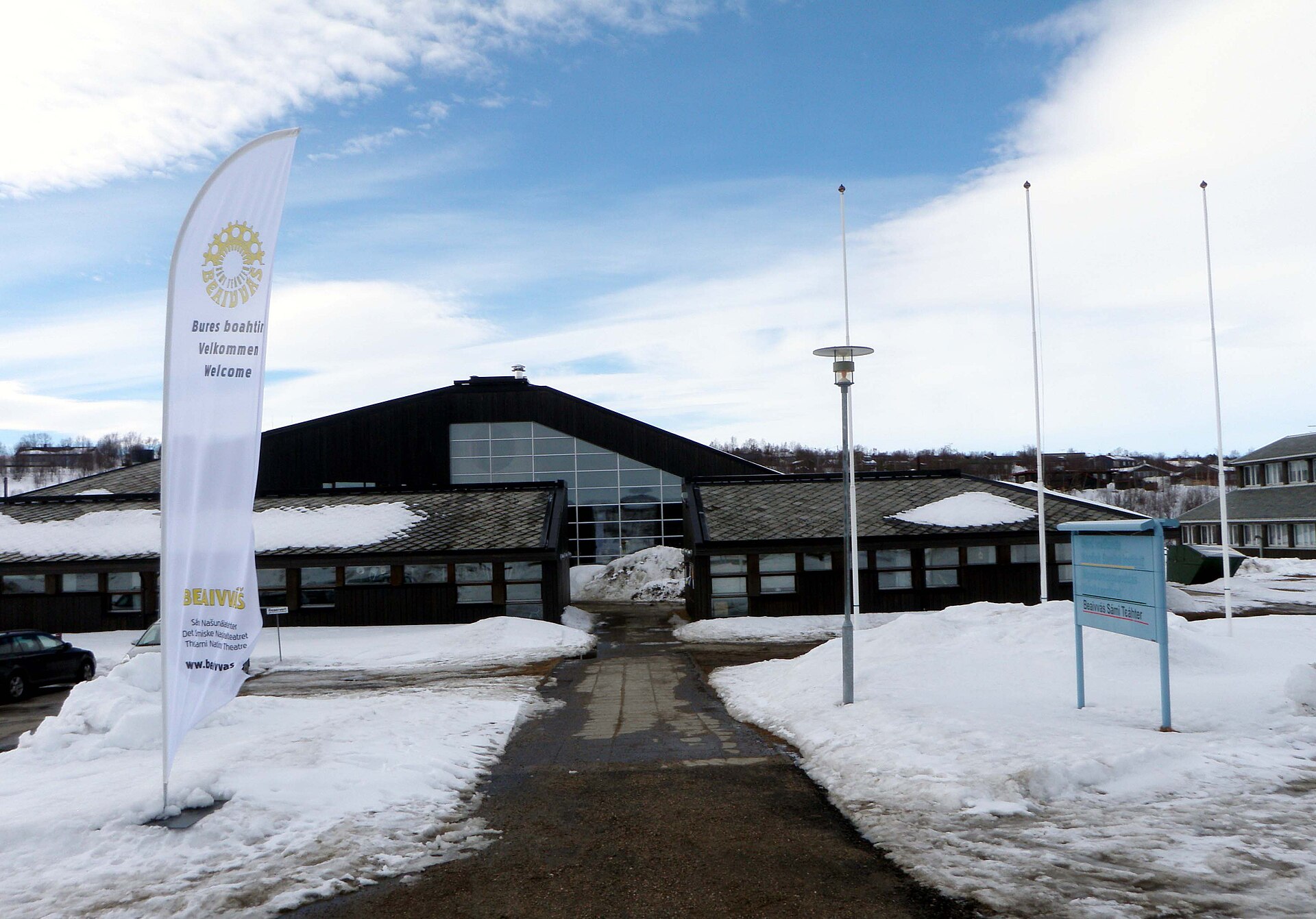
- The Beaivváš Sámi National Theatre at Kautokeino, before its move into the new Čoarvemátta building. — Photo: Manxruler / CC BY-SA 4.0 via Wikimedia Commons.
- Kautokeino on the Finnmarksvidda. Where the Sámi language is strongest in everyday use. — Photo: Rauenstein / CC BY-SA 3.0 via Wikimedia Commons.
Figures, dates and policies were checked in July 2026. Population and reindeer numbers are estimates and vary by source and season; festival dates for 2027 were unannounced at the time of writing. Written with care, but for authoritative information on Sámi rights and institutions, the Sámediggi’s own site is the place to go.