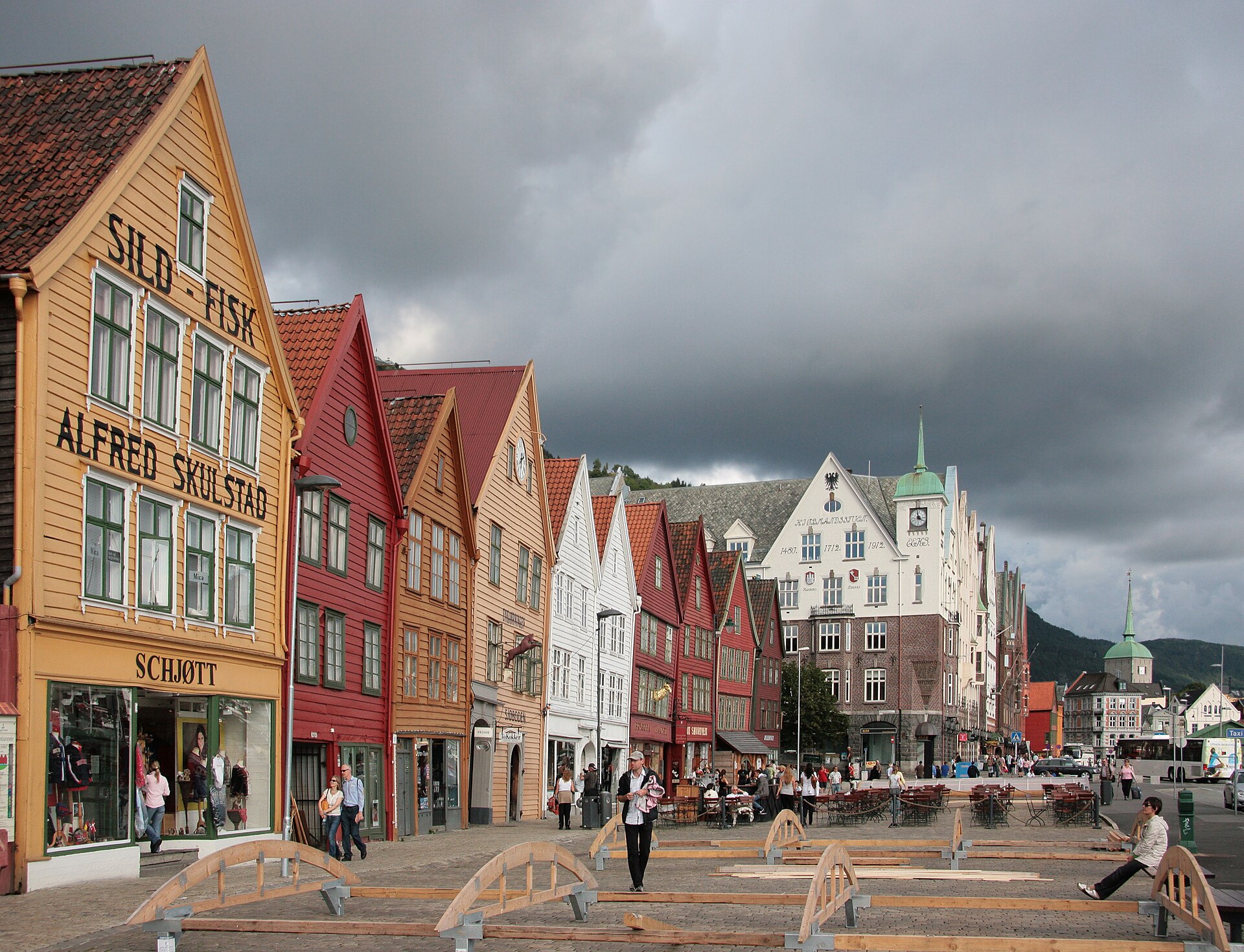
Here is a thing almost nobody writing about Bryggen in Bergen will tell you: the buildings are not medieval. The wharf has been on the UNESCO World Heritage List since 1979, the Hanseatic merchants’ office was founded here in 1350, and the wooden facades you photograph mostly date from after the fire of 1702. UNESCO’s own description says so in the first paragraph.
That does not make it less remarkable. It makes it a different and better story than the one on the postcards — a 300-year-old wooden trading quarter, rebuilt on medieval foundations to a medieval plan, currently sinking into ground that is drying out beneath it. But you would not learn any of that from the guides ranking for this search, one of which is still quoting a museum ticket price that is wrong by seventy kroner, and none of which mention that the Hanseatic Museum’s main building has been shut since 2018.
So: what is actually here, what it costs in 2026, what is open, and how long you genuinely need.
Bryggen at a glance
| Detail | |
|---|---|
| Cost to walk it | Free, always, day or night |
| Time needed | 45 min for the alleys · 3 hrs with one museum · a full day with all of them |
| UNESCO listing | 1979, cultural criterion (iii), property area 1.268 ha |
| Buildings standing | Around 62, from a quarter that survived |
| Best time of day | Before 09:00 or after 18:00 in summer |
| Shut in 2026 | Hanseatic Museum (Finnegården), Svensgården alley |
What you are actually looking at
Bergen was one of four overseas Kontore of the Hanseatic League — the German merchant network that ran northern European trade for four centuries. Lübeck, London, Bruges and Novgorod had the others. Bryggen is the only one still standing anywhere.
The trade was stockfish: cod, dried on racks in Lofoten and the far north, shipped south, sold across Europe. German merchants lived in these buildings, unmarried by rule, in a closed quarter with its own law. The gårder — the long double rows of wooden buildings running back from the harbour with an alley between them — are the physical shape of that business. Goods on the ground floor, offices above, sleeping rooms at the back.
The authenticity question, answered properly
Bergen burned repeatedly. The fire of 1702 destroyed the quarter and it was rebuilt to the same plan with the same techniques, which is why UNESCO describes the present appearance as stemming from after that fire. Demolitions around 1900 took more. A fire in 1955 took a large section of the northern end.
The numbers, and I am giving you the disagreement rather than picking one: UNESCO and the Norwegian heritage directorate both say “some 62 buildings remain.” Other sources say 61, and one says 63. UNESCO also states that only around a quarter of the original buildings survived the demolitions and the 1950s fires. A local guide puts it at 61 buildings representing about 30% of the site, of which roughly a quarter date to the 1702 rebuild.
The honest summary: about a quarter of what was here is here, it is 300 years old rather than 700, and the plan beneath it is genuinely medieval. The 1955 fire triggered a thirteen-year archaeological excavation that pulled hundreds of thousands of objects out of the ground — which is where the museum came from.
Why it leans
Walk into any alley and the buildings tilt. This is not charm, it is a live conservation emergency. The wooden foundations sit in waterlogged organic layers metres deep. As groundwater levels dropped, oxygen reached those layers, and both the archaeology and the timber began to rot. The buildings settle unevenly into the gap.
Monitoring since interventions in 2011 shows groundwater rising again and subsidence rates falling, which is good news. I could not find a published millimetres-per-year figure, and I am not going to invent one. The Bryggen Project, formalised in 2000, exists to manage exactly this. Bryggen is privately owned — most of it by the Bryggen Foundation, established 1962.
Walking the alleys
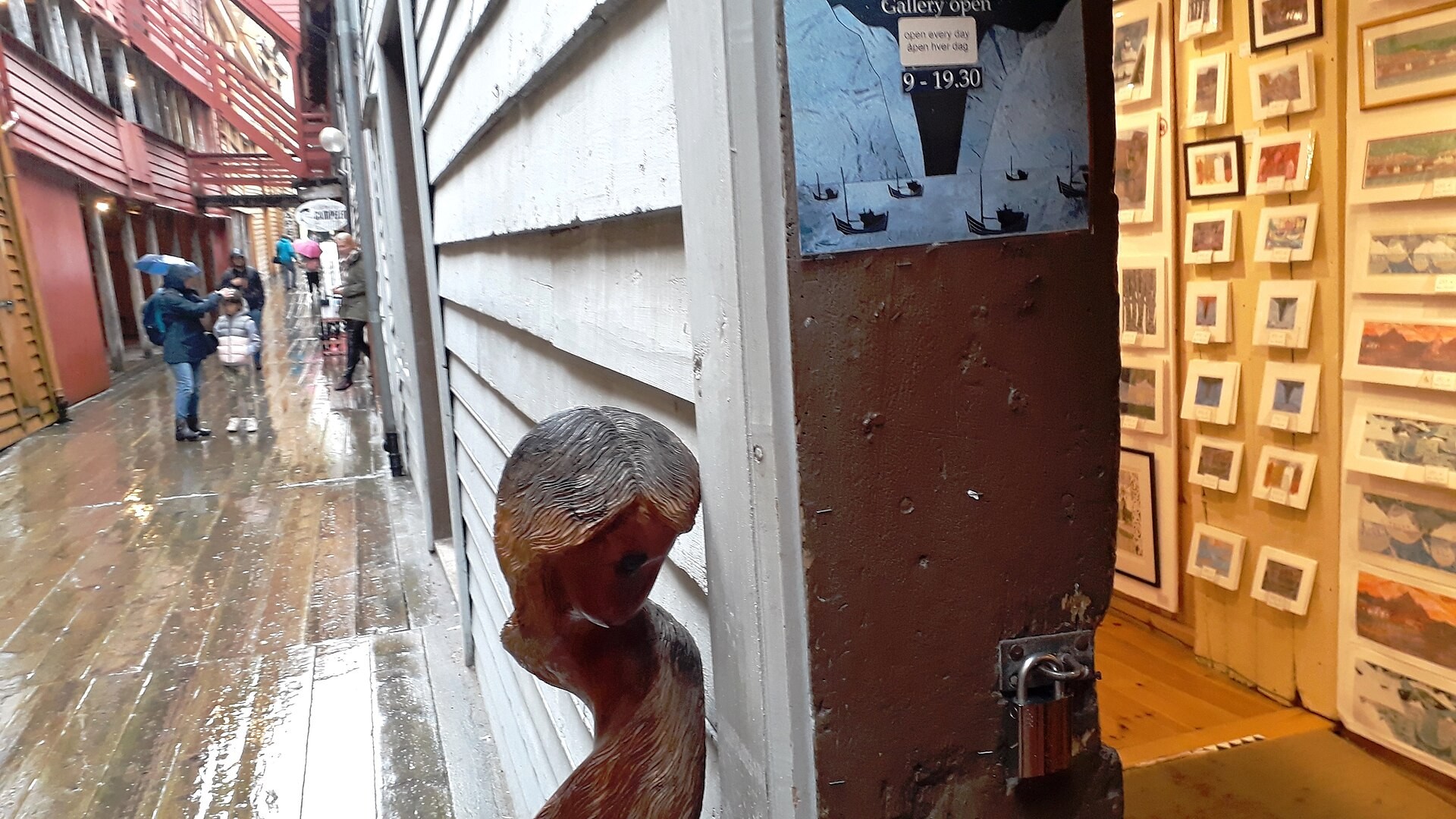
This is the free part, and it is the best part. From the harbour front the buildings look like a row of painted gables. The actual experience is behind them: narrow wooden passages, worn plank walkways, staircases going nowhere, the smell of tar and old timber.
Names worth knowing as you walk:
- Bredsgården — first recorded in 1310 and the most original-feeling of the lot. Start here.
- Bellgården — also 1310, German-owned from 1370.
- Jacobsfjorden — recorded 1309, formerly Åfjorden.
- Enhjørningsgården — “the Unicorn”, named for the carved figurehead on its facade. These carvings were merchant logos for fishermen who could not read; a unicorn here, a three-faced king’s head at Svendsgården.
- Svensgården — closed to the public for over a decade because of rot. Do not plan around it.
- Holmedalsgården, Bugården, Engelgården, Bryggestredet — the rest, all walkable.
Forty-five minutes covers it properly. There are craft workshops, small galleries and a few decent shops tucked into the ground floors, and a handful of restaurants along the front that are the most expensive in Bergen and not the best.
The museums: what is open, what it costs, what is shut
| Site | Adult | Bergen Card | 2026 season | Time needed |
|---|---|---|---|---|
| Bryggens Museum | NOK 170 | 50% off | 12 Jan – 30 Dec, daily 10:00–17:00 | 60–90 min |
| Håkon’s Hall | NOK 120 | Free | 2 Jan – 20 Dec, daily 10:00–16:00 | 20–40 min |
| Rosenkrantz Tower | NOK 170 | Not included | 2 Jan – 20 Dec, hours vary | 45–50 min |
| Schøtstuene | ~NOK 160 | Check on arrival | Open — the Hanseatic collection moved here | 45 min |
| St Mary’s Church | NOK 100 | — | 18 May – 31 Aug 10:00–16:00; otherwise Tue/Thu/Fri 12:00–14:00 | 20–30 min |
| Hanseatic Museum (Finnegården) | CLOSED until early 2027 | |||
Students pay half at all the Bymuseet sites and under-18s go free. Prices checked August 2026.
Bryggens Museum — start here
NOK 170, student NOK 85, under-18 free · daily 10:00–17:00
Built directly over the excavated foundations of Bergen’s oldest buildings, from the first half of the 1100s, and open right through 2026 — closed only on 17 May, 23–26 December and 31 December. The main exhibition, “Below Ground”, is the thirteen years of digging that followed the 1955 fire, including a garment roughly a thousand years old.
This is the one that makes the rest of Bryggen legible. Do it before you walk the alleys, not after. The Bergen Card halves the ticket.
The Hanseatic Museum is closed, and everyone still lists it
Finnegården, built in 1704 and a museum since 1872, closed on 1 October 2018 and is scheduled to reopen at “the beginning of 2027”. The wooden foundations are being replaced and the whole building raised. The budget is NOK 337.9 million — roughly $36 million to fix one wooden house, which tells you something about the scale of the subsidence problem.
The collection has moved to Schøtstuene at Øvregaten 50, a few minutes’ walk uphill. These are the merchants’ assembly rooms and cook houses — the only buildings in the quarter where fire was permitted, which is why they stand apart. Part of the museum since 1938, with a medieval ruin visible through a glass floor. Adult entry is around NOK 160, though I could not confirm the 2026 figure on the operator’s own price page, so treat it as approximate.
Bergenhus: Håkon’s Hall and the Rosenkrantz Tower
Five minutes north along the harbour, the fortress at the mouth of the Vågen, and the anchor of everything else worth doing in the city. Håkon’s Hall is a 13th-century royal banqueting hall, NOK 120, and free with the Bergen Card — the single best-value thing the card unlocks. Twenty minutes will do it.
One warning nobody publishes: the hall closes for events on around fifteen scattered dates in the second half of 2026 — 12, 17, 19, 24 and 26 September; 16 and 31 October; 13 and 22 November; and 7–13 and 21–31 December. If it is on your list, check the day.
The Rosenkrantz Tower next door has a core dating from the 1270s and costs NOK 170. It is not included in the Bergen Card, which surprises people at the door. Allow 45 to 50 minutes; the stairs are the point.
St Mary’s Church
Bergen’s oldest surviving building, built somewhere around 1130 to 1170, and the German-speaking congregation’s church until 1874 — the Hanseatic merchants’ own parish. Entry is NOK 100 according to the parish, though some guides claim it is free; the sources genuinely conflict here. Open daily 10:00–16:00 from 18 May to 31 August, and Tuesday, Thursday and Friday 12:00–14:00 the rest of the year.
The fish market, honestly
Fisketorget sits at the head of the harbour, a hundred metres from Bryggen, and it is the most complained-about attraction in Bergen.
The outdoor market runs roughly 10:00 to 18:00 from 1 May to 30 September and closes for winter. The indoor Mathallen is open Monday to Saturday, 09:00 to 21:30, all year. Outdoor prices are widely reported at two to three times the indoor ones — I could find no actual price survey behind that ratio, only a lot of agreeing bloggers, so take it as direction rather than fact.
What I would do: walk through the outdoor stalls, look at the king crab, and eat inside. The Mathallen has the same seafood, a roof, and prices that will not spoil your afternoon.
When to go, and the cruise ship problem
Bergen caps cruise arrivals at four ships and 8,000 passengers per day, a limit in force since June 2022, and from 2026 every calling ship must be able to use shore power. The port handled around 745,000 cruise passengers across 335 calls in 2025.
Those 8,000 people arrive between roughly 08:00 and 10:00 and are largely gone by 17:00. Which gives you the answer:
- Before 09:00. The alleys are empty and the light comes across the harbour onto the facades. This is the photograph everyone wants.
- After 18:00. Quiet again, warmer light in summer, everything shut but the walking is free.
- 10:00 to 16:00 in July. Fine, but you will be sharing a two-metre-wide alley.
Winter is genuinely good here — the wooden facades against low grey light, almost nobody about, and the museums all open — one of the few arguments for a Norwegian city break in the cold months. It is also when it rains most, which the month-by-month rainfall data makes uncomfortably clear.
A self-guided walk, in the order that makes sense
Bryggen rewards being walked in a particular sequence, because the site only becomes legible once you have seen what came out of the ground.
1. Bryggens Museum (60–90 min). Start underground, literally. The museum sits on the excavated 12th-century foundations and explains what you are about to walk over. NOK 170.
2. The first alley, Bredsgården (10 min). Immediately north of the museum. The oldest-feeling passage of the lot, first recorded in 1310. Look up at the way the upper storeys overhang, and at how far out of true the whole row has settled.
3. Bellgården and Jacobsfjorden (15 min). Both recorded around 1309–1310. Bellgården was in German hands from 1370. This is where the plank walkways and the tar smell are at their strongest.
4. Enhjørningsgården (5 min). Find the unicorn on the facade. These carvings identified each gård to fishermen who could not read a sign — a merchant’s trademark, three hundred years before the word existed.
5. Uphill to Schøtstuene, Øvregaten 50 (45 min). The assembly rooms and cook houses, and since 2018 the home of the Hanseatic collection while Finnegården is rebuilt. The only buildings in the quarter where open fire was allowed, which is why they sit set back from the wooden rows.
6. St Mary’s Church (20 min). Directly opposite. Bergen’s oldest building, c.1130–1170, and the German congregation’s own church for five hundred years.
7. Bergenhus, Håkon’s Hall and the tower (40–90 min). Five minutes north along the water. Free with the Bergen Card for the hall; NOK 170 extra for the tower, which the card does not cover.
That is a four-hour route with two museums, and it ends a ten-minute walk from the Fløibanen. Cut the tower and Schøtstuene and it compresses to two and a half hours without feeling rushed.
What to skip
Skip the Bryggen-front restaurants. The row facing the harbour has the highest prices and the least interesting food in central Bergen. You are paying for the window. Walk two streets back.
Skip the guided walking tours unless you want the history spoken aloud. The alleys are a hundred metres end to end and free. Do Bryggens Museum first and you will have the context a tour would give you, for the price of the ticket.
Skip Rosenkrantz Tower if you are short on time and have a Bergen Card. It is excluded from the card, costs NOK 170, and Håkon’s Hall next door is free with it. If you are doing one, do the one you have already paid for.
Do not plan a day around the Hanseatic Museum. It is shut until early 2027 and a surprising number of current guides do not say so. Go to Schøtstuene instead.
Do not eat at the outdoor fish market stalls unless the theatre of it is what you came for.
How long you actually need
| Plan | Time | Cost |
|---|---|---|
| Walk the alleys, look at the front | 45 min | Free |
| Alleys + Bryggens Museum | 2.5 hrs | NOK 170 |
| Alleys + museum + Bergenhus | 4 hrs | NOK 290–460 |
| Everything open, including Schøtstuene and St Mary’s | Full day | ~NOK 600 |
Most people over-plan this. Bryggen is a small site — the whole World Heritage property is 1.268 hectares. Two and a half hours with one museum is the sweet spot, which leaves the rest of your day for the funicular up Fløyen or a boat out. If you only have one day in Bergen, that combination is the day.
Combining it with the rest of the city
Everything here is inside a ten-minute walk of everything else, which is unusual and worth exploiting. A natural sequence: Bryggens Museum, then the alleys, then five minutes north to Bergenhus for Håkon’s Hall, then back along the front to the Fløibanen station and up the mountain for the view that puts it all in place.
That is about five hours and covers most of what makes Bergen worth the trip. The day trips and the fjord boats both leave from quays within a few hundred metres of Bryggen, so you can bolt a morning cruise onto the front of it without moving your luggage.
If you are arriving by ship, Skolten terminal is 600 to 900 metres away — five to ten minutes on foot, and by some distance the best-placed cruise berth in Norway. Where the other terminals leave you, and what that means for booking a bed, is in the Bergen accommodation guide.
Frequently asked questions
Is Bryggen free to visit?
Yes. Walking the wharf front and the alleys behind it costs nothing, at any hour, all year. Only the museums charge — Bryggens Museum NOK 170, Håkon’s Hall NOK 120, Rosenkrantz Tower NOK 170, all free for under-18s.
How long do you need at Bryggen?
Forty-five minutes for the alleys alone, two and a half hours if you add Bryggens Museum, four with Bergenhus as well. The World Heritage site is only 1.268 hectares — it is much smaller than the photographs suggest.
Are the Bryggen buildings original or rebuilt?
Rebuilt, on medieval foundations. UNESCO’s own description says the present appearance stems from after the fire of 1702. Around 62 buildings remain — sources vary between 61 and 63 — representing roughly a quarter of what stood before the demolitions around 1900 and the fires of the 1950s. The street plan and building techniques are medieval; the timber mostly is not.
Why is Bryggen a UNESCO World Heritage Site?
It is one of eight World Heritage sites in the country and one of the most visited of Norway’s landmarks. It was inscribed in 1979 under cultural criterion (iii) alone, as the surviving physical evidence of the Hanseatic League’s overseas trading system. Bergen was one of four Hanseatic Kontore — with Novgorod, Bruges and London — and it is the only one that still stands.
Can you go inside the Bryggen buildings?
Some of them. The ground floors hold workshops, galleries and shops that are open to walk into, and Bryggens Museum and Schøtstuene are proper museums. Svensgården has been closed to the public for over a decade because of rot, and the Hanseatic Museum’s Finnegården is shut until early 2027.
Is the Hanseatic Museum in Bergen open?
No. Finnegården closed on 1 October 2018 for a NOK 337.9 million restoration — new wooden foundations, and the building physically raised — and is due to reopen at the beginning of 2027. The collection has moved to Schøtstuene at Øvregaten 50, which is open.
What is the best time of day to visit Bryggen?
Before 09:00 or after 18:00. Bergen allows up to four cruise ships and 8,000 passengers a day, and they are ashore roughly between ten and five. Early morning also gives you the light on the facades, which face the water.
Is Bergen’s fish market worth it?
Worth walking through, not worth eating at. The outdoor stalls (1 May to 30 September, roughly 10:00–18:00) are reported at two to three times the prices of the indoor Mathallen, which sells the same seafood, is open all year Monday to Saturday until 21:30, and has a roof.
Photo credits
- The wharf front at Bryggen. Most of what you see postdates the fire of 1702. — Photo: Anna Anichkova / CC BY-SA 3.0 via Wikimedia Commons.
- Behind the facades: the gårder, the alleys, and the lean. — Photo: Palickap / CC BY-SA 4.0 via Wikimedia Commons.
Prices and opening hours checked August 2026, at NOK 9.35 to the US dollar. Bymuseet publishes its closure dates a season ahead, so check Håkon’s Hall before travelling in autumn. The Schøtstuene entry price and St Mary’s Church admission are the two figures I could not confirm from a primary source — both are given here with that caveat rather than stated flatly.