Every guide to where to stay in Oslo tells you Sentrum is central, Grünerløkka is hip, and Frogner is elegant. All true, all useless, because none of them tells you what a room actually costs in each one, how many minutes you will walk to the station, or whether the price difference is worth the walk.
I read five of the biggest — about 17,000 words between them. Exactly one published prices, in euros, pulled from a booking widget with no date on it. Not one mentioned that Norway passed a visitor levy law that took effect on 1 July 2026, which is the single newest thing affecting what an Oslo hotel night costs.
So: eight districts, what each one costs, how far it is on foot, who it suits, and — the part everyone leaves out — who should not stay there.
The short answer
Stay in Sentrum if it is your first visit and you have two nights or fewer. Stay in Grünerløkka if you have three or more nights and want to eat well. Stay in Majorstuen or St. Hanshaugen if you want the same city for less money and do not mind a fifteen-minute walk. Everything else is a preference, not an upgrade. For what to do once you have checked in, start with our guide to seeing Oslo.
| District | Walk to Oslo S | Typical double, per night | Best for |
|---|---|---|---|
| Sentrum | 0–10 min | High end of the city’s range | Short stays, early trains, first visits |
| Bjørvika / Sørenga | 5–10 min | High | Opera House, MUNCH, waterfront |
| Aker Brygge / Tjuvholmen | 10–15 min | Highest in Oslo | Harbour views, expense accounts |
| Grünerløkka | ~20 min | Mid | Food, bars, repeat visitors |
| Frogner | 25–30 min (tram 10 min) | Mid to high | Vigeland Park, quiet residential |
| Majorstuen | 30 min (metro 8 min) | Mid | Value, Holmenkollen access |
| St. Hanshaugen | ~20 min | Mid to low | Value, park, walkable to everything |
| Grønland / Tøyen | 5–15 min | Lowest central rates | Budget, hostels, cheap food |
What an Oslo hotel night actually costs in 2026
Let me be straight about the quality of the numbers here, because everyone else presents estimates as facts. Hotel pricing is dynamic and there is no authoritative published rate table. What exists:
- A mid-range Oslo hotel commonly quoted at 2,000–3,000 NOK (~$215–320) a night, though that is one source’s generalisation.
- An aggregate putting January cheapest at around $168 a night and August priciest at around $237 — again a single source, and it does not distinguish district.
- Hostel dorm beds averaging roughly $20, with the cheapest around $10 and the top of the range near $35.
- Booking-widget starting rates by district: Sentrum and Frogner from about €150, Grünerløkka from about €140, Gamle Oslo from about €130, Nordstrand from about €100. Undated, so treat as relative ordering rather than absolute prices.
What that adds up to: the spread between the cheapest central district and the most expensive is real but smaller than the guides imply — on the order of 20–30 per cent, not double. The bigger lever is when you come. A January booking in Aker Brygge can undercut an August booking in Grønland. If your dates are flexible, our guide to the cheapest time to visit Norway saves more money than any district choice will.
The tourist tax question
Norway’s national visitor levy became law on 1 July 2026, allowing municipalities to charge up to 3 per cent on overnight stays. It is opt-in, and each council has to adopt it separately. Oslo has not adopted it. As of this writing no Norwegian municipality is actually collecting it — Tromsø is targeting 1 January 2027 and Lofoten’s pilots are aimed at the first half of 2027, both pending.
So there is no tourist tax on an Oslo hotel room right now. On a 2,500 NOK night, a 3 per cent levy would add about 75 NOK (~$8) if and when Oslo adopts it. Worth knowing, not worth planning around.
Breakfast is a real line item
Nobody else mentions this and it changes hotel comparisons. An Oslo hotel breakfast buffet typically runs around 200 NOK, rising to 300–400 NOK at the top end. Two people for three nights is 1,200 NOK (~$128) — enough that a “room only” rate 300 NOK cheaper than a “breakfast included” rate is usually the worse deal. Compare the two rates including breakfast, always.
The districts
Sentrum — the default, and usually right
The grid around Karl Johans gate, between Oslo S and the Royal Palace. You are within a ten-minute walk of the station, the harbour promenade, the Opera House and the tram network. Everything in our one-day Oslo plan starts from here on foot.
Costs: at the upper end of the city’s range, though the chains — Thon, Scandic, Comfort — cluster here and discount hard midweek and in winter.
Who should not stay here: anyone staying four nights or more. Sentrum empties out in the evening. It is a transport hub and a shopping street, and after the shops close it is quieter than the residential districts, which is the opposite of what people expect.
Verdict: the correct default for one or two nights. Stop thinking about it and book.
Bjørvika and Sørenga — new Oslo
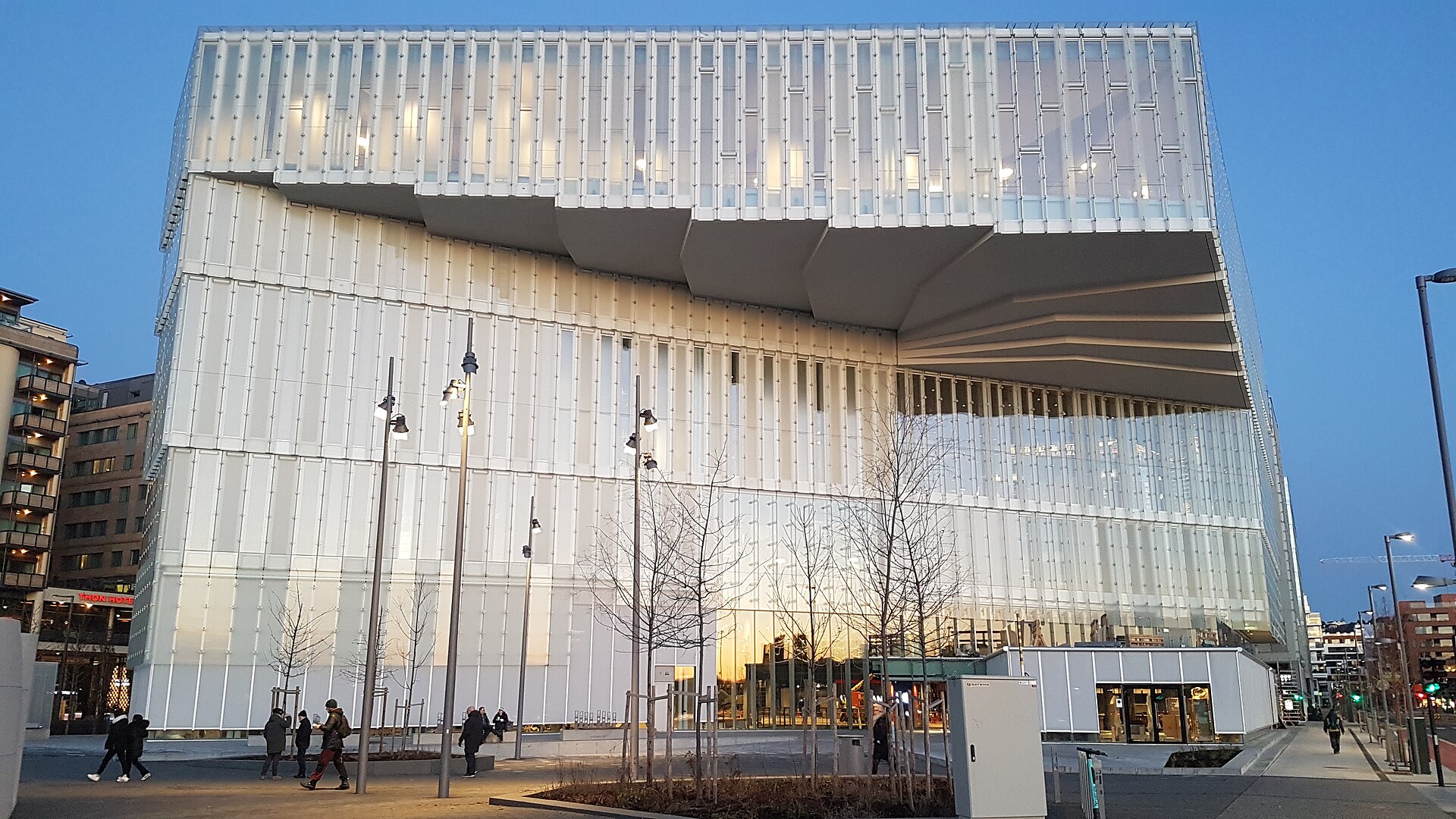
The redeveloped waterfront east of the station: the Opera House, MUNCH, the Deichman library, the Barcode towers. Five to ten minutes from Oslo S along the water.
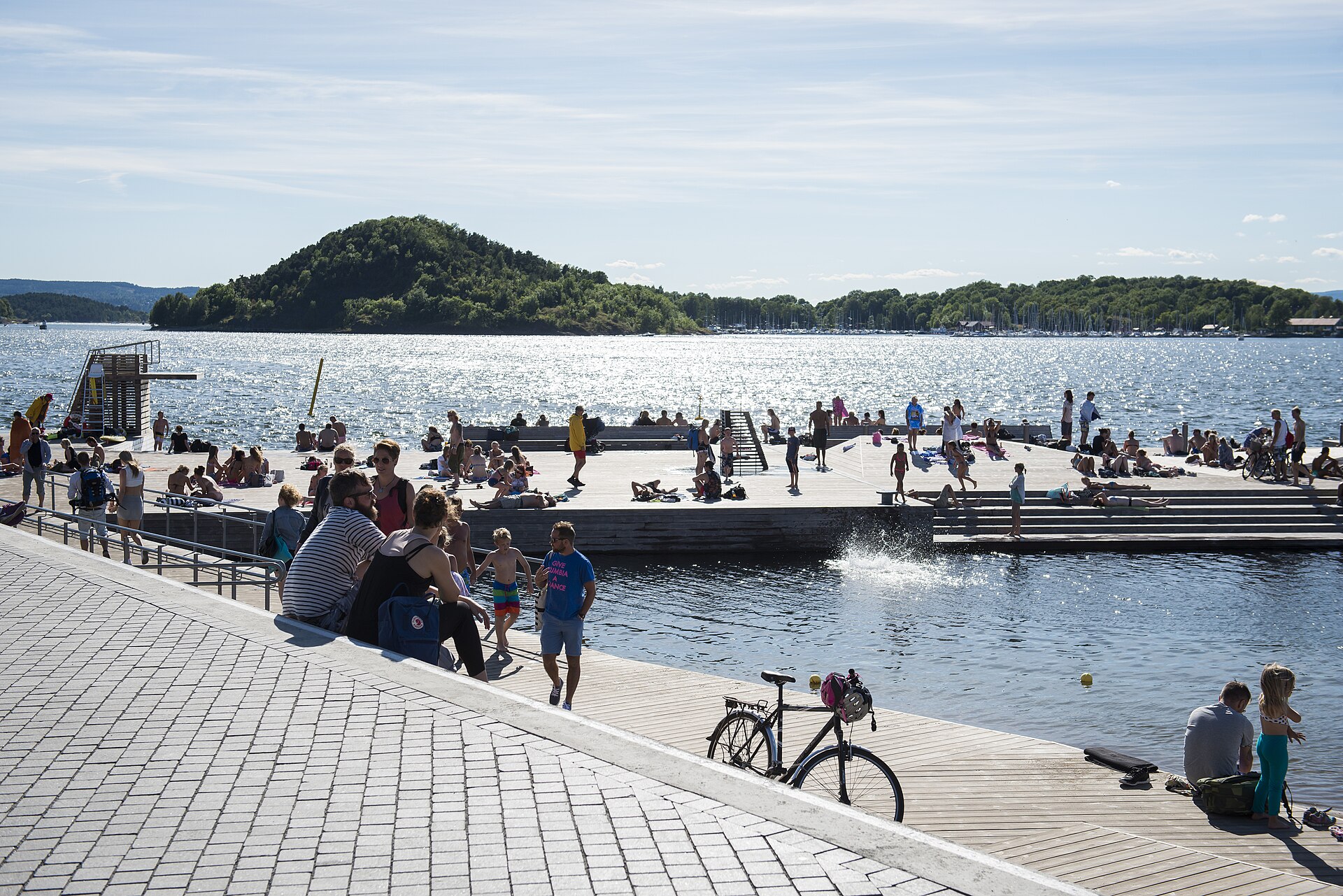
What you get: the best morning walk in the city, straight out of your door onto the Opera roof. Sørenga has a free seawater pool and swimming decks open year-round, genuinely swimmable from mid-June to August at 19–22°C.
Costs: high, and rising as the district fills in.
Who should not stay here: anyone who wants a bar with a history. This area was a container port fifteen years ago and it shows — the restaurants are good and expensive, and the streets are wide and windy.
Aker Brygge and Tjuvholmen — the priciest water in Norway
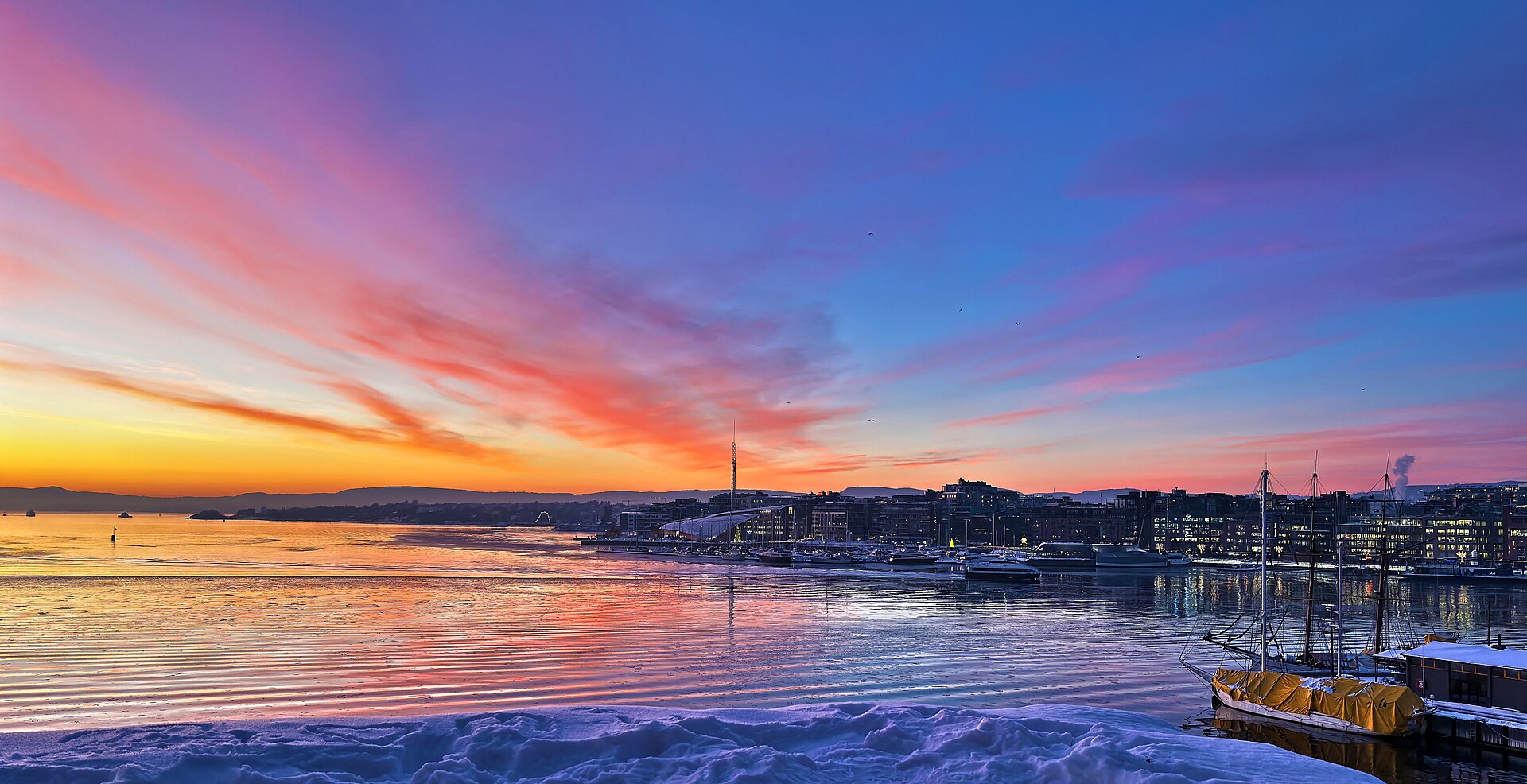
Converted shipyard on the west side of the harbour, with the Astrup Fearnley Museum on the spit at the end. Ten to fifteen minutes’ walk to Oslo S, three minutes to the Rådhusbrygge ferry piers for the fjord islands.
Costs: the highest hotel rates in the city, and the restaurant prices to match. A pint on the Aker Brygge boardwalk sits at the top of the 110 NOK city average.
Verdict: beautiful, and you are paying a substantial premium for a view you can walk to for free from anywhere else in central Oslo. Stay here on somebody else’s money.
Distance, properly measured
Guides describe districts as “close to the centre” without saying close to what. Oslo has two centres that matter: Oslo S, where every train and the airport express arrive, and Karl Johans gate, where you will actually spend your evenings. They are twenty minutes apart, and a district can be near one and awkward for the other.
| District | Walk to Oslo S | Walk to Karl Johans gate (mid) | Transport if you’d rather not walk |
|---|---|---|---|
| Sentrum | 0–10 min | 0–5 min | None needed |
| Bjørvika / Sørenga | 5–10 min | 10–15 min | None needed |
| Grønland | 5–15 min | 15–20 min | Metro, 1 stop |
| Aker Brygge | 10–15 min | 8 min | Tram 12 |
| Grünerløkka | ~20 min | 15 min | Tram 11, 12, 13 |
| St. Hanshaugen | ~20 min | 15 min | Tram 11, 12, 13 |
| Frogner | 25–30 min | 20 min | Tram 12, ~10 min |
| Majorstuen | ~30 min | ~22 min | Metro, ~8 min |
Note what this shows: Aker Brygge is further from the station than Grønland but closer to the nightlife spine. Grünerløkka and St. Hanshaugen are functionally the same distance from both. And nothing on this list is more than half an hour on foot, which is the real headline — Oslo is a small city pretending to be a capital.
What transport costs if you use it
A single Ruter ticket in zone 1 covers all of central Oslo including everything in the table above. Reported fares range from 42 to 46 NOK for a single and from 105 to 137 NOK for a 24-hour ticket, depending on which guide you read; Ruter’s own fare pages are JavaScript-driven and would not return a figure I could quote. Buy in the Ruter app, where the price is shown before you pay.
Either way the sum is small. Staying in Majorstuen rather than Sentrum and taking the metro twice a day for three nights costs somewhere around 250–280 NOK in fares — considerably less than the nightly difference in room rate. Distance is not the expensive variable here. If you want the full picture on fares and passes, our guide to getting around Norway covers the national network too.
Hostels and the budget end
Oslo has a proper hostel scene, concentrated in Grønland and around the station, with dorm beds averaging roughly $20 and a range from about $10 to $35. That is the cheapest way to sleep in one of Europe’s more expensive cities, and it is what makes an Oslo stop viable on a backpacking route.
Two things worth knowing. First, hostel prices in Oslo compress in winter far less than hotel prices do, so the saving over a discounted January hotel room can be smaller than you expect. Second, many hostels charge separately for bed linen and for breakfast — at Oslo prices, a 200 NOK breakfast on a $20 bed doubles the cost of your night. Read the extras line.
For the wider picture on keeping a Norway trip affordable, see our breakdown of what Norway costs and the list of free things to do across the country.
Where to stay for what you came to do
Districts are not interchangeable once you know your plan. A few specific cases:
- Museums. Bjørvika puts MUNCH five minutes away; Aker Brygge puts you three minutes from the Bygdøy ferry pier. If your trip is built around the collections in our Oslo museums guide, one of those two saves you real time.
- The fjord and the islands. Anywhere on the harbour front. The island ferries leave from Rådhusbrygge, by the City Hall — see the Oslofjord guide for which line goes where.
- Day trips out of the city. Sentrum or Grønland, both minutes from Oslo S. Trains to Fredrikstad, Lillehammer and Tønsberg all leave from there, and our day trips from Oslo guide assumes that start point.
- Winter. Majorstuen, for metro line 1 up to Frognerseteren and the Korketrekkeren toboggan run. More on the season in Oslo in winter.
- Hiking. Majorstuen or St. Hanshaugen, for line 1 and line 3 into the Nordmarka forest. The national picture is in our hiking guide.
Grünerløkka — where I would stay for three nights or more
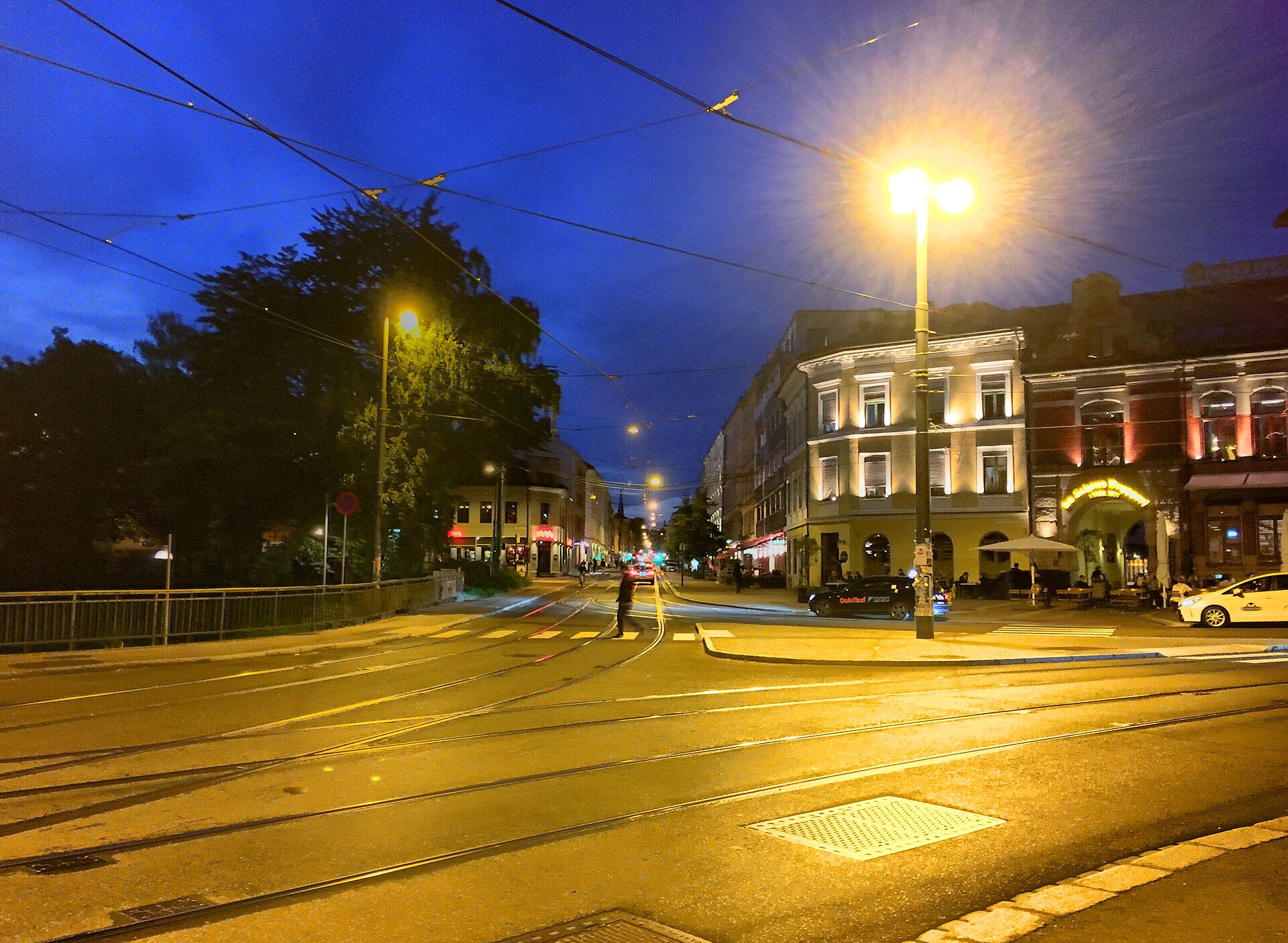
North-east of the centre along the Akerselva river. Nineteenth-century workers’ housing turned into the city’s best eating and drinking district. About a twenty-minute walk to Oslo S via Torggata, or a short tram ride.
What you get: the Mathallen food hall, independent coffee, actual nightlife, and the Akerselva walk — a river path with waterfalls that runs from Grünerløkka right down to the harbour, free and largely empty of tourists.
Costs: mid-range, and reliably cheaper than Sentrum for equivalent quality.
Who should not stay here: anyone with an early flight or a 06:00 train, and anyone who wants to be in bed by ten on a Saturday. The trade-off is noise and a walk.
Frogner — quiet, green, and further than it looks
West of the palace, wrapped around Frogner Park and the Vigeland sculptures. Embassies, nineteenth-century apartment blocks, expensive delicatessens.
Getting in: 25–30 minutes on foot to Oslo S, or about ten minutes on tram 12. That tram is the reason Frogner works — without it the distance would rule it out.
What you get: Vigeland Sculpture Park on your doorstep, free and open around the clock, which means you can walk the 212 sculptures at seven in the morning with nobody else there. That is a genuinely different experience from the coach-party version at midday.
Who should not stay here: anyone on a short trip. The commute eats the time you saved.
Majorstuen — the value pick nobody writes about
Just north of Frogner where the metro lines converge. About eight minutes to the centre by metro, thirty on foot.
Why it works: it is a real neighbourhood with normal shops and normal prices, it sits on the metro line 1 that runs up to Holmenkollen and Frognerseteren, and it is a short walk from both Frogner Park and the St. Hanshaugen bars. Rates run below Sentrum for comparable rooms.
Verdict: the best price-to-convenience ratio in Oslo, and the district I would recommend to anyone on a second visit.
St. Hanshaugen — central without the centre’s prices
The hill district between Grünerløkka and Majorstuen, built around a park with a view over the whole city. Twenty minutes on foot to the station, ten to Grünerløkka.
What you get: genuinely walkable to almost everything, quieter than Grünerløkka, cheaper than Sentrum, with the free hilltop park as a bonus. It has the fewest hotels of any district here, which is why nobody writes about it.
Grønland and Tøyen — cheap, and the honest version of the safety question
Immediately east of the station. Oslo’s most diverse district, its best cheap food, and the one every guide warns you about in identical words.
Here is the calibrated version. Grønland and Tøyen see somewhat more property crime than the rest of Oslo — pickpocketing, bike theft, some visible drug use around the station and Vaterland. Violent crime against visitors is rare. It is entirely unremarkable by day and it is the sort of area where, after dark, you would keep your phone in your pocket and not much else.
What you get for that: the lowest central hotel and hostel rates in the city, Tøyen’s Botanical Garden (free), the Munch collection’s old neighbourhood, and grocery shops where a meal costs a fifth of what it does in Aker Brygge.
Who should not stay here: anyone who will be uncomfortable walking past a rough patch outside a station at midnight. That is a fair preference and not worth arguing with. Everyone else is fine.
Apartments and Airbnb: the rules nobody explains
Short-letting in Oslo is regulated and it affects what you will find listed. Owner-occupied apartments can generally be let out whole for up to 90 days a year; units inside a housing cooperative, a borettslag, are capped at 30 days a year. Rental income up to 10,000 NOK is tax-free where each let is under 30 days, with VAT registration required above 50,000 NOK in a twelve-month period.
These figures come from a single source and I have not been able to confirm them against a Norwegian government page, so treat them as the shape of the rules rather than the letter of them. The practical consequence is real either way: the Oslo apartment market is thinner than in comparable European capitals, and a listing that looks like a bargain in high season is worth a second look.
What to skip
Holmenkollen and Nordstrand. Both appear on district lists as “quiet alternatives”. Both are 25–40 minutes out on public transport. You will save less on the room than you spend on time and fares, and you will not go back into the city in the evening. Do not stay outside the metro’s inner reach on a short trip.
Airport hotels at Gardermoen. Only worth it for a genuine pre-dawn flight. The airport is 47 km from the city and the train back in is 19–23 minutes each way — you are not “based near Oslo”, you are staying at an airport.
Paying for a fjord-view room. The Oslofjord is public. The Opera roof, the Akershus ramparts, Sørenga and the entire harbour promenade are free and open, and the ferry across to Nesoddtangen costs the price of a normal transit ticket. A room with a view is a nice thing to buy; it is not a thing you need to buy in Oslo.
Booking Sentrum for a week. Covered above. It is the wrong district for a long stay and the most expensive way to get it wrong.
Matching the district to the trip
| Your trip | Stay in | Why |
|---|---|---|
| One night, early train out | Sentrum | Walk to Oslo S in under ten minutes |
| Two nights, first visit | Sentrum or Bjørvika | Everything on foot, no transport decisions |
| Three or more nights | Grünerløkka | Somewhere that is still alive at 21:00 |
| Second visit, watching the budget | Majorstuen or St. Hanshaugen | Same city, lower rate, short metro ride |
| Backpacking | Grønland | Cheapest beds and food, five minutes from the station |
| Travelling with children | Frogner or Sørenga | Park or swimming decks within a few minutes’ walk |
| Cruise call, no hotel | Not applicable | You are docked 10 minutes from Akershus — walk |
If Oslo is one stop in a longer route, our national accommodation guide covers how the capital compares with Bergen, Tromsø and the fjord towns, and the seven-day Norway itinerary shows how many nights Oslo is normally worth.
Frequently asked questions
What is the best area to stay in Oslo for first-time visitors?
Sentrum, the grid between Oslo S and the Royal Palace. Everything on a standard first-visit list is within a twenty-minute walk, which removes transport from your planning entirely. On a longer stay the answer changes to Grünerløkka.
Is it safe to stay in Grønland?
Yes, with normal city sense. Grønland and Tøyen have more property crime than the rest of Oslo and visible drug use near the station, but violent crime against visitors is rare. By day it is unremarkable; at night it is the sort of area where you would keep your valuables out of sight.
What is the cheapest area to stay in Oslo?
Grønland for hotels and hostels within walking distance of the centre. Further out, Nordstrand has the lowest advertised starting rates in the city, but the commute cancels the saving on a short trip.
Is there a tourist tax on Oslo hotels?
Not currently. Norway’s national visitor levy law came into force on 1 July 2026 allowing up to 3 per cent on overnight stays, but adoption is up to each municipality and Oslo has not adopted it. No Norwegian municipality is collecting it yet.
When are Oslo hotels cheapest?
January, by a wide margin, with August the most expensive. One aggregate puts the gap at roughly $168 against $237 a night. Midweek in the shoulder months of April, May, September and October is the sweet spot for price against daylight.
Do I need to stay near the metro?
Only if you are staying west of the Royal Palace. Central Oslo, Bjørvika, Grünerløkka, St. Hanshaugen and Grønland are all comfortably walkable to the centre. Frogner, Majorstuen and anywhere further out need the tram or metro, which is fine — just check the line before you book.
Is Aker Brygge worth the extra money?
Rarely. You are paying Oslo’s highest rates for a waterfront that is free to walk on and ten minutes from every other central district. The exception is if you specifically want the ferry piers on your doorstep.
Should I book breakfast with the room?
Usually yes. Hotel breakfast in Oslo costs around 200 NOK a head bought separately, up to 300–400 NOK at premium hotels, so a rate including breakfast that is under about 350 NOK more for two people is the better deal.
Photo credits
- Grunerlokka: where I would stay for three nights or more, about twenty minutes’ walk from Oslo S. — Photo: Toreau / CC BY-SA 4.0 via Wikimedia Commons.
- Aker Brygge and Tjuvholmen carry the highest hotel rates in Oslo, for a waterfront that is free to walk on. — Photo: Geir Hval (www.MacWhale.eu) / CC BY-SA 4.0 via Wikimedia Commons.
- Sorenga’s free seawater pool, at the end of the Bjorvika waterfront. — Photo: Katrine Lunke / CC BY-SA 4.0 via Wikimedia Commons.
- Deichman Bjorvika: free, warm, and the most underrated indoor space in the city. — Photo: Bernt Rostad / CC BY 2.0 via Wikimedia Commons.
Prices checked August 2026 and converted at 9.35 NOK to 1 USD. Hotel rates in Oslo are dynamic and there is no published rate table, so the figures above are ranges from named sources rather than quotes — I have flagged where a number rests on a single source. The visitor levy position is current as of September 2026 and is the thing most likely to change during 2027.