I read the five guides ranking for the best time to visit Bergen. Between them, around 8,000 words about a city that gets 2,495 millimetres of rain a year, and not one of them publishes a table of how much falls in each month.
One gives temperature but no rainfall. One gives rainfall as a range so wide it is useless. The official tourist board page is 700 words of reassurance with a single graph. None of them mention that Bergen once recorded 85 consecutive days of rain, and none compare the city with anywhere you have been, which is the only way the number means anything.
Bergen is, by most measures, the rainiest city in Europe. That is not a reason to stay away — it is the reason the place looks the way it does. But you should be able to see the actual figures before you choose your week. Here they are.
The table nobody publishes
These are the official 1991–2020 normals from the Norwegian Meteorological Institute, measured at the Bergen–Florida station in the city. Rain days count any day with at least one millimetre.
| Month | Rain (mm) | Rain days | Avg high (°C) | Avg low (°C) |
|---|---|---|---|---|
| January | 256 | 19.2 | 4.7 | 0.6 |
| February | 210 | 17.4 | 4.9 | 0.1 |
| March | 202 | 17.6 | 6.9 | 1.3 |
| April | 141 | 14.1 | 11.1 | 3.9 |
| May | 109 | 13.0 | 15.0 | 6.9 |
| June | 132 | 13.3 | 17.7 | 10.1 |
| July | 158 | 15.2 | 19.6 | 12.4 |
| August | 208 | 16.6 | 19.4 | 12.4 |
| September | 248 | 18.1 | 16.1 | 9.9 |
| October | 268 | 18.5 | 11.7 | 6.1 |
| November | 275 | 18.5 | 7.6 | 3.1 |
| December | 290 | 19.3 | 5.3 | 1.0 |
| Year | 2,495 | 200.8 | 11.7 | 5.6 |
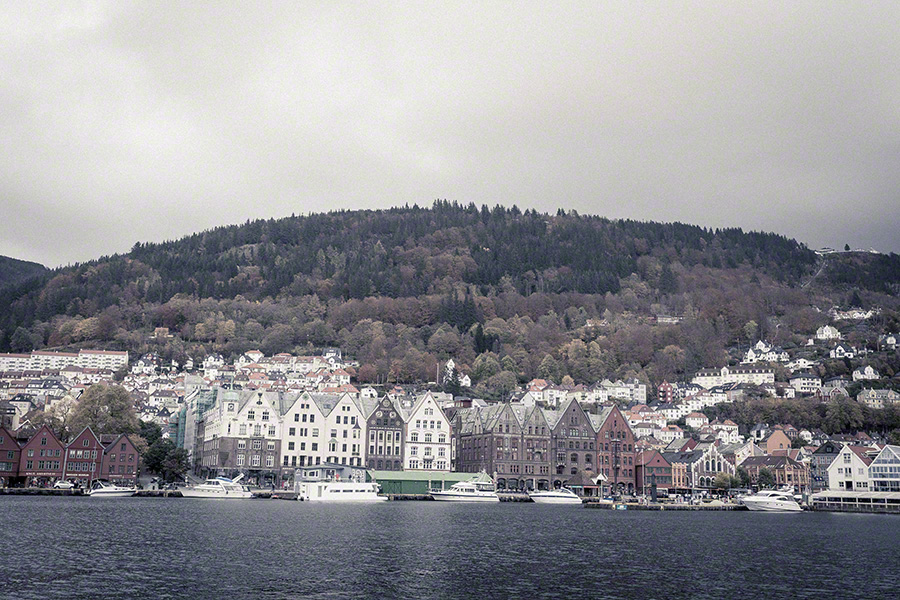
Two hundred rain days a year. Not two hundred washouts — most of Bergen’s rain is light and intermittent, and a one-millimetre day can mean twenty minutes of drizzle at seven in the morning. But it does mean that on any given day, the odds are better than even.
Why every website gives a different annual total
Because they are quoting different weather stations and not saying so. Bergen–Florida, in the city, records 2,495 mm. Bergen Airport at Flesland records 2,029 mm over the same period. Same city, twenty kilometres apart, a 466 mm difference — the mountains around the city wring the rain out before it reaches the coast.
The city figure is the one that matters to you, because that is where you will be standing.
How that compares to somewhere you know
| City | Annual rainfall | Relative to Bergen |
|---|---|---|
| Bergen | 2,495 mm | — |
| Seattle | ~1,000 mm | 2.5× less |
| Oslo | 763 mm | 3.3× less |
| London (Heathrow) | ~615 mm | 4× less |
Bergen gets four times London’s rain. Seattle, the byword for grey drizzle in the English-speaking world, gets less than half of it. The cause is orographic lift: wet Atlantic air hits the seven mountains ringing the city, rises, cools and dumps.
The 85-day record
Between late October 2006 and late January 2007, Bergen recorded measurable precipitation on 85 consecutive days. Nearly three months without a dry day.
The sources disagree by a day at each end — one gives 28 October 2006 to 20 January 2007, Norwegian press reports of the same streak give 29 October to 21 January — but the 85-day length is consistent across all of them. The runners-up are 51 days, achieved twice, in 1988–89 and 2014–15, and 48 days across January and February 2022.
Bergen’s own weather station has the receipts and the city is entirely unembarrassed about it.
So what is the best month? Not July.
Everybody says July. July is the warmest month at 19.6°C, it has the longest opening hours and the most sailings, and it is what the tourist board photographs.
The data says May, and it is not close.
| May | July | |
|---|---|---|
| Rainfall | 109 mm | 158 mm (45% more) |
| Rain days | 13.0 | 15.2 |
| Sunshine hours | 252 | Fewer |
| Average high | 15.0°C | 19.6°C |
| Daylight | 17+ hours | ~18 hours |
| Crowds and prices | Moderate | Peak |
May is the driest month, has the fewest rain days, and gets the most sunshine of any month in the year — 252 hours. It is four and a half degrees cooler than July, and if you are building a wider trip the national picture broadly agrees, and that is the entire trade-off. Fifteen degrees and dry beats twenty degrees and wet in a city you will be walking around.
May also catches the Hardanger blossom, roughly mid-May to mid-June, and gets you in before the peak cruise season and the summer hotel rates.
The one caveat: some mountain roads and seasonal services are not open yet. The Norled express boat to Flåm starts 1 April, so that is fine. The Aurlandsfjellet Snow Road opened on 1 June in 2026, and historically anywhere between 7 May and 3 June. If a specific mountain drive matters to you, check its opening date before booking May.
Month by month, honestly
January and February — cheapest, wettest, emptiest
256 mm and 210 mm, around 18 rain days each, highs under 5°C. December through February is when hotel rates hit the floor, which makes this the cheapest window in the country — the citywide average roughly halves against July.
Snow falls and usually melts within a day or two. Bergen’s centre is too mild for it to lie, though it occasionally does for weeks; the surrounding mountains hold it much longer. Daylight bottoms out at 5 hours 51 minutes on 21 December.
Go if: you want a cheap city break with all the museums open and no queue for the funicular. Avoid if: you need to see a fjord from a boat that runs once a day.
March and April — the improvement
March is still wet at 202 mm, but April drops sharply to 141 mm and 14 rain days, with highs climbing past 11°C. April is the first month that feels like a reasonable proposition, and prices have not moved yet.
Go if: you want most of May’s weather at February’s prices.
May — the best month
109 mm, 13 rain days, 252 hours of sun, highs of 15°C, and seventeen-plus hours of daylight by the end of it. Everything seasonal has opened or is about to. The Bergen International Festival takes over the city at the end of the month — the 75th edition runs 26 May to 12 June 2027, three days longer than usual, and the whole city sells out for it.
June — nearly as good, busier
132 mm and 13.3 rain days, highs of 17.7°C, and the longest days of the year: 19 hours 8 minutes on 21 June 2026, with the sun setting at 23:15 in late June. Bergen does not get the true midnight sun at 60°N, but the June nights barely get properly dark. Bergenfest runs 10–13 June 2026 at the fortress.
July and August — peak everything
The warmest months at 19.6 and 19.4°C, and the wettest of the summer — August jumps to 208 mm and 16.6 rain days, nearly double May. This is when the cruise ships are thickest, the hotels are at NOK 2,000–3,000 a night, and every boat runs at capacity.
Fjordsteam, the gathering of around seventy historic vessels, runs 5–9 August 2026 and is worth planning around if your dates are flexible.
Go if: you need the warmth, the full timetable and the long days, and you have accepted the price. Do not go assuming July is drier than spring. It is not.
September and October — the collapse
The autumn rain arrives fast. September 248 mm, October 268 mm, both around 18 rain days. Temperatures are still decent in September at 16.1°C and the light is good, but statistically you are into the wet half of the year.
The Bergen Food Festival and Norwegian Cider Festival run 3–5 September 2026 at Festplassen, though one listing gives 2–4 September, so check.
November and December — the extreme
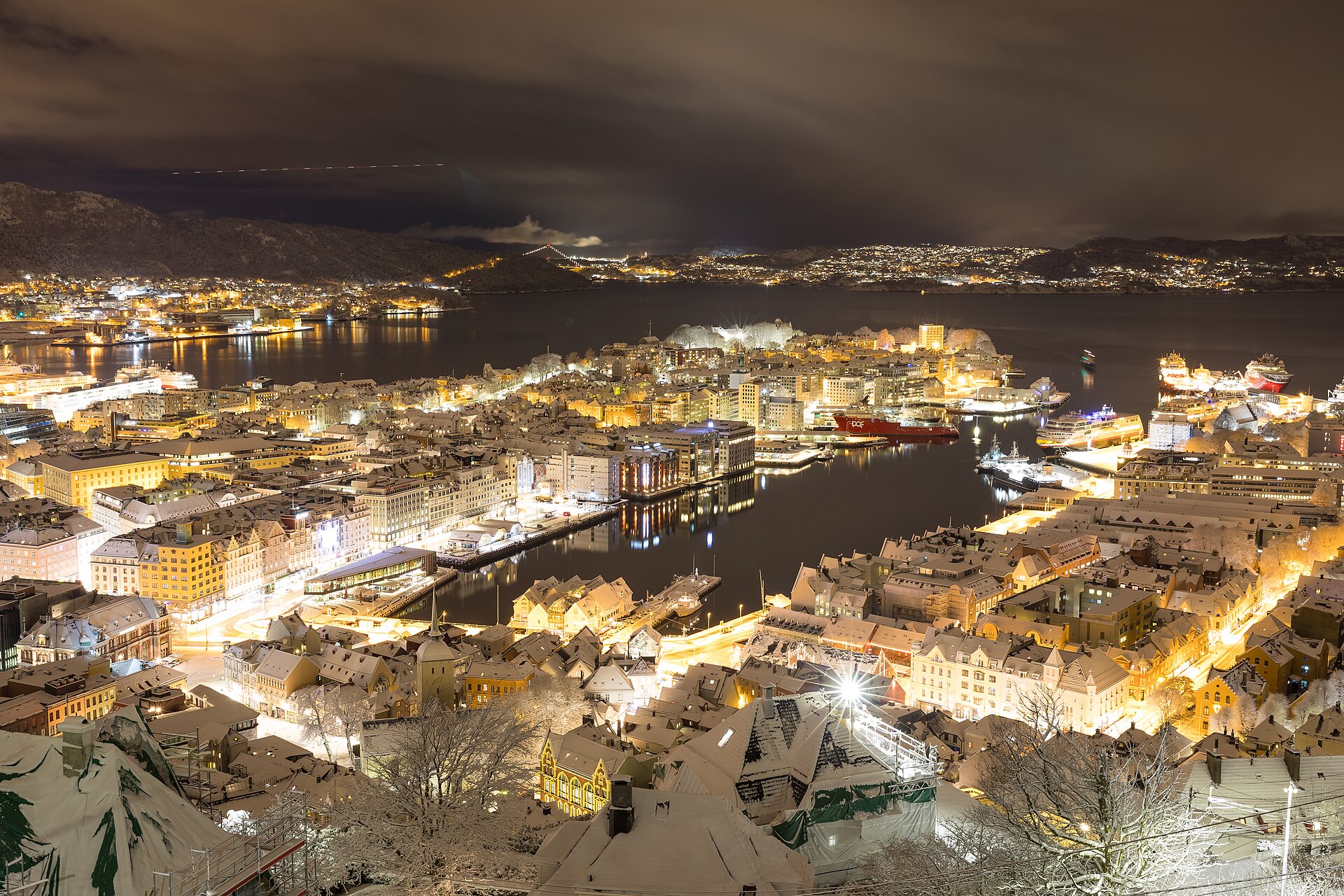
275 mm and 290 mm, the two wettest months. December gets 13.4 hours of sunshine in the entire month — about seven per cent of what is theoretically possible — against 252 hours in May. That is the statistic that tells you most about Bergen in winter.
Pepperkakebyen, the world’s largest gingerbread town, runs 14 November 2026 to 10 January 2027, and the Christmas market is genuinely good. December in Norway is a different proposition here than in the Arctic — dark and wet rather than dark and frozen.
The normals lie to you, a bit
Thirty-year averages smooth out a lot. Bergen’s actual recent years:
| Year | Total rain | Rain days | Wettest month |
|---|---|---|---|
| 2023 | 2,305 mm | 184 | — |
| 2024 | 2,806 mm | 213 | August, 473 mm |
| 2025 | 2,415 mm | 201 | November, 322 mm |
| 2020 | — | 234 | — |
So the spread across recent years runs from 184 to 234 rain days. August 2024 delivered 473 mm — more than double the August normal — in what should be the back end of summer. The wettest single day of 2025 was 14 January with 63.5 mm; of 2024, 1 November with 65.7 mm.
What this means: the table above tells you the odds, not your week. A dry fortnight in November is entirely possible and a soaking one in May is too.
Daylight and temperature extremes
Bergen sits at about 60.4°N, far enough north for the day length to swing hard:
- Longest day, 21 June 2026: 19 hours 8 minutes. Latest sunset of the year is 23:15 on 23 June.
- Shortest day, 21 December 2026: 5 hours 51 minutes. Latest sunrise is 09:42 on 27 December.
- Effective white nights: roughly 10 May to 2 August, when it never gets fully dark.
The temperature record is milder than the latitude suggests, thanks to the Atlantic: the all-time high is 33.4°C in July 2019 and the all-time low −16.3°C in January 1987. In 2025 the range was 31°C on 2 July down to −8.8°C on 5 January. Sea temperature runs from 5.5°C in March to 15°C in August.
The cruise ship calendar
Bergen caps arrivals at four ships and 8,000 cruise passengers per day, a limit in force since 24 June 2022, and from 2026 every calling ship must be able to use shore power — Europe’s largest such plant here serves three at once. An older figure of 9,000 passengers still circulates; it has been superseded.
The cap is why summer in Bergen is busy rather than unbearable. But 8,000 people ashore between roughly nine and five, in a centre you can cross in twenty minutes, is noticeable. If your dates are fixed, plan Bryggen and the funicular for early morning or evening.
Does the rain actually ruin the trip?
No, and it is worth saying why, because the numbers above make it sound worse than it is.
Bergen’s rain is mostly light, frequent and short. A “rain day” in the record is any day with a millimetre — which can be a twenty-minute shower at six in the morning while you are asleep. The city gets sustained all-day downpours, but they are the minority of those 200 days.
More usefully: the city is built for it. Almost everything a visitor wants is within a twenty-minute walk, so a shower means ducking into a museum rather than rearranging your day. Bryggen looks better wet than dry — the tarred timber goes almost black and the colours saturate. The fjord boats have heated indoor cabins with panoramic windows, which is precisely why they run in January. And the cloud base often sits between 400 and 600 metres, which means the funicular’s 320-metre top station is frequently below it while Ulriken at 643 is buried.
What to actually bring
- A proper hardshell with a hood. Not a fashion raincoat. Wind comes off the Atlantic and drives rain sideways.
- Waterproof shoes, and a second pair. The single most common mistake. Wet boots do not dry overnight in a hotel room.
- No umbrella. There is a reason you will not see locals with them.
- Layers rather than one warm coat. July highs of 19.6°C and lows of 12.4°C mean a fifteen-degree day that feels like ten in the wind.
- Ice cleats in winter, NOK 50–100 in any hardware shop, if you plan to walk up any of the hills.
The one genuine casualty of bad weather is the view. If the mountains are in cloud, the funicular, Ulriken and the fjord walls all deliver considerably less. Keep those flexible and book them on the clear morning rather than the day you had planned.
What I would skip
Skip July if you have any flexibility. It is 45% wetter than May, meaningfully more expensive, and the four and a half degrees of extra warmth do not compensate. This is the single most useful thing on this page and it contradicts every guide on the first page of results.
Skip planning around “avoiding the rain”. You cannot. Two hundred rain days means you plan around having rain — proper waterproofs, indoor options held in reserve, and an attitude adjustment. Bergensers do not own umbrellas because the wind takes them — see the packing notes for what actually works.
Skip the northern lights as a reason to come. Bergen is at 60°N, several hundred kilometres south of the auroral oval, under Europe’s cloudiest skies. It happens in strong storms between October and March and that is the whole story. If that is the trip, go much further north.
Skip late September through November for a first visit. Those three months average 264 mm each with 18-plus rain days, and the daylight is going fast. There is nothing wrong with Bergen then, but there is nothing that month specifically offers either.
Do not book anything in Bergen for 26 May to 12 June 2027 without checking the festival. The 75th Bergen International Festival will fill every bed in the city.
The short answer, by what you want
| You want | Go in | Why |
|---|---|---|
| The best weather odds | May | 109 mm, 13 rain days, 252 sun hours |
| Long days and full timetables | June | 19 hrs of light, everything open, drier than July |
| Warmth | July | 19.6°C, and 45% more rain than May |
| Cheap | January–February | Rates roughly halve; museums all open |
| No crowds | October–March | Cruise season over |
| Christmas | Mid-Nov to early Jan | Pepperkakebyen, 14 Nov – 10 Jan |
| Fjord boats running | April–October | Norled’s Flåm service, 1 Apr – 31 Oct |
Whatever you choose, the practical consequence is the same: bring real waterproofs, book somewhere central so a wet afternoon is not a logistical problem, and have a fallback plan for the day the mountain is in cloud. Where to base yourself is covered in the accommodation guide.
Frequently asked questions
What is the rainiest month in Bergen?
December, at 290 mm across 19.3 rain days. November is close behind at 275 mm and October at 268. The three-month stretch from October to December delivers roughly a third of Bergen’s annual rainfall.
Does it really rain every day in Bergen?
Not quite, but the record is 85 consecutive days of measurable precipitation, from late October 2006 to late January 2007. On average Bergen has 200.8 days a year with at least a millimetre of rain — so on any given day, slightly better than even odds. Most of it is light and intermittent rather than sustained downpour.
What is the driest month in Bergen?
May, at 109 mm and 13.0 rain days. It also gets the most sunshine of any month at 252 hours. April is second at 141 mm.
How many days a year does it rain in Bergen?
200.8 on the official 1991–2020 normal, counting any day with at least one millimetre. Actual years vary considerably — 184 days in 2023, 213 in 2024, 234 in 2020.
Is Bergen the rainiest city in Europe?
By most measures yes. At 2,495 mm a year it gets roughly four times London’s rainfall, three and a bit times Oslo’s, and two and a half times Seattle’s. The cause is orographic — Atlantic air forced up over the seven mountains surrounding the city.
What is the best month to visit Bergen?
May, on the data: the least rain, the fewest rain days, the most sunshine hours and seventeen-plus hours of daylight, at 15°C. Most guides say July, which is 4.5°C warmer and 45% wetter. If warmth matters more to you than dryness, June is the compromise.
How cold does Bergen get in winter, and does it snow?
Mild for the latitude — average highs of 4.7°C in January and lows around freezing, with an all-time record of −16.3°C. Snow falls regularly but usually melts within a day or two in the centre, though it can lie for weeks. The surrounding mountains hold it far longer.
How many hours of daylight does Bergen get?
From 19 hours 8 minutes at the summer solstice down to 5 hours 51 minutes at the winter one. It never gets fully dark between roughly 10 May and 2 August. December is the extreme in every sense: 13.4 hours of sunshine across the whole month.
Photo credits
- Two hundred rain days a year, and the city is built around that fact. — Photo: Tore Sætre / CC BY-SA 4.0 via Wikimedia Commons.
- December records 13.4 hours of sunshine across the entire month. — Photo: Svein Magne Tunli / CC BY-SA 4.0 via Wikimedia Commons.
Climate figures are the Norwegian Meteorological Institute 1991–2020 normals for the Bergen–Florida station, retrieved August 2026; the airport station at Flesland records a substantially lower 2,029 mm and is not used here. Annual and daily figures for 2023–2025 come from Bergen municipality’s own published records. Where a second source gave a different sunshine total or a different date for the 85-day rain streak, both are noted in the text rather than reconciled silently.